Pendant Lighting Sourcing Guide for Importers: Styles, Specs, and What to Verify Before You Order
Most pendant lighting sourcing problems don't start at the factory. They start at the spec stage — when a buyer places an order based on a sample and a catalog photo without confirming the housing material, the finish process, the driver spec, or whether the certification on the datasheet actually covers the destination market. By the time the container arrives, the problems are already baked in.
This guide covers what actually matters when sourcing pendant lighting at wholesale volume: which style categories are commercially relevant for different market segments, which specifications determine real-world quality and installation reliability, what certifications are required by market and what documentation to request, and what to verify about a factory's production process before you commit to an order.
We've been manufacturing pendant lighting for export since 2008 — to North America, Europe, the Middle East, and Australia. The verification steps in this guide are the same ones our own buyers use when they're evaluating us.
Style Categories That Map to Commercial Market Segments
Style selection isn't an aesthetic decision at the sourcing level — it's a market positioning decision. The pendant styles that move volume in hospitality procurement are different from what sells through electrical distributors into residential new construction, and both are different from what project contractors specify for commercial office fit-outs.
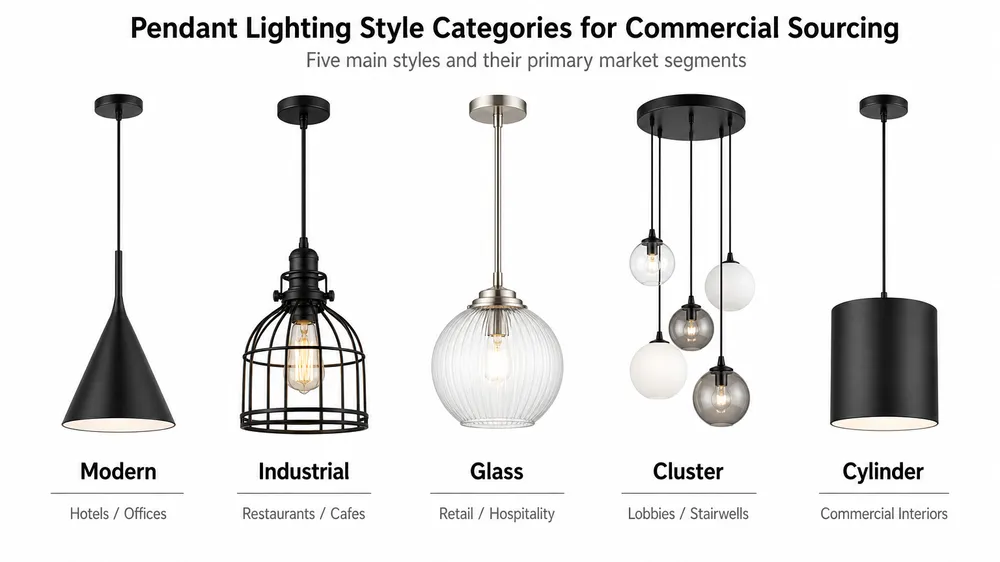
Here's how the main pendant categories map to commercial demand:
Modern and minimalist pendants — clean geometry, matte or brushed metal finishes, integrated LED — are the dominant volume category for residential developers, hotel chains, and commercial office projects. The buyer profile is typically a distributor supplying fit-out contractors or a hospitality procurement team running a multi-property rollout. Batch consistency matters more here than design complexity: 200 identical fixtures across a hotel floor need to match in finish tone, drop length, and light output. Our Modern Pendant Lighting range is built around this requirement.
Industrial pendants — exposed hardware, cage guards, Edison-style or tubular lamp formats, raw metal or aged finishes — sell well through specialty lighting retailers and into restaurant and bar fit-outs. The commercial opportunity is in the hospitality renovation segment, where designers specify by look and contractors need reliable supply. Industrial Pendant Lighting in this category typically runs in smaller batch sizes but at higher per-unit margins.
Glass pendants — blown glass, ribbed glass, opal diffusers — are the most technically demanding to source correctly. Glass quality varies enormously between suppliers, and the difference between a clean opal diffuser and a cloudy one with visible seams is the difference between a product your retail buyers can sell and one that generates returns. We run dimensional checks on every glass shade before assembly — it's one of the few components we don't produce in-house, so incoming inspection is where we catch supplier variation.
Cluster and multi-arm pendants — multiple drop points from a single canopy, often with mixed glass or metal shades — are popular in hospitality lobbies and high-ceiling residential applications. The sourcing complexity here is canopy load rating and drop length flexibility. A cluster pendant with 12 arms and glass shades can weigh 8–12 kg; the canopy and ceiling mount need to be rated accordingly, and that rating needs to be documented, not assumed.
Cylinder and drum pendants — fabric or metal shade over a central LED module — are the workhorse of the commercial lighting category. High volume, moderate price point, broad application. The spec that matters most here is the diffuser material and its effect on light output uniformity. A fabric shade that looks warm and even in a showroom can look patchy and dim in a 4-meter ceiling installation.
Specifications That Determine Real-World Quality
A pendant lighting datasheet lists wattage, lumen output, color temperature, and dimensions. Those numbers are necessary but not sufficient. The specs that actually determine whether a batch holds up across a full order — and whether your downstream customers have installation problems — are the ones that rarely appear on a catalog page.
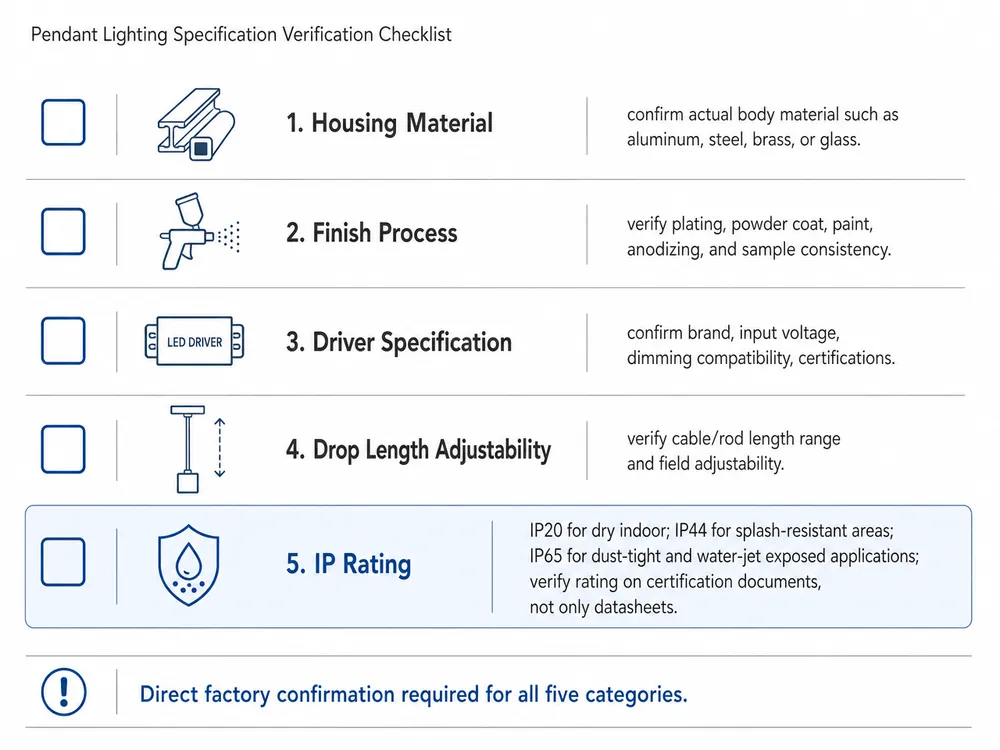
Housing material and casting method
Most pendant housings are aluminum alloy, zinc alloy, or iron. The material choice affects weight, corrosion resistance, and the precision of the finished casting.
Aluminum alloy (typically ADC12 or equivalent) is the standard for quality commercial pendants — lighter than iron, better corrosion resistance than zinc alloy, and capable of holding tight dimensional tolerances when die-cast properly. Zinc alloy is common in lower-cost decorative pendants where the casting geometry is complex and the weight penalty is acceptable. Iron is used in industrial-style pendants where the heavier feel is part of the product positioning.
The casting method matters as much as the material. Die-casting produces consistent wall thickness and dimensional accuracy across a production run. Sand casting and gravity casting are cheaper but introduce more variation — you'll see it in surface finish quality and in mounting dimension consistency. We run die-casting in-house with CNC machining to ±0.1mm on critical dimensions, which means the canopy-to-ceiling mount fit is consistent across every unit in a batch, not just the sample.
(The dimensional consistency point matters more than it sounds. On a 500-unit hotel installation, even a 0.5mm variation in the canopy mounting hole position means your installation team is adjusting every fixture individually. That's a real labor cost your buyer absorbs.)
Finish process and durability
The finish is the first thing your buyer's customer sees and the first thing that fails if it's done wrong. The three main finish processes for pendant lighting are powder coating, electroplating, and PVD (physical vapor deposition).
| Finish Process | Typical Thickness | Salt Spray Rating | Best For |
|---|---|---|---|
| Powder coating | 60–80μm | 500–1,000 hrs | Matte black, white, textured finishes |
| Electroplating | 10–25μm | 200–500 hrs | Chrome, nickel, gold tones |
| PVD | 2–5μm | 500–800 hrs | Brushed gold, rose gold, titanium tones |
Salt spray rating is the number to ask for — it tells you how the finish performs in humid or coastal environments, which is directly relevant if you're supplying hospitality projects near coastlines or buyers in tropical markets. A finish that passes 500 hours of salt spray testing will hold up in a beachfront hotel; one rated at 200 hours won't.
Batch consistency in finishing is where most decorative lighting factories have problems. Electroplating and PVD are process-sensitive — bath chemistry, temperature, and plating time all affect the final color tone. If a factory is outsourcing finishing to a third-party plating shop, color consistency across a 300-unit batch is genuinely difficult to control. We run finishing in-house specifically because we've seen what happens when it's outsourced: the first 100 units match the approved sample, and the last 100 are visibly different.
Driver specification and dimming compatibility
The LED driver is the component most likely to cause field failures, and it's the one buyers most often under-specify. Three things to confirm before ordering:
Input voltage range: Confirm the driver covers your destination market's voltage standard. North America runs 120V/60Hz; Europe and Australia run 220–240V/50Hz. A driver specified for 220–240V will not work reliably on a 120V circuit, and vice versa. Some drivers are rated for 100–240V universal input — confirm this explicitly rather than assuming.
Dimming protocol compatibility: If your buyer's project uses a specific dimming system — TRIAC, 0–10V, DALI — the driver needs to be compatible. TRIAC dimming is the most common in residential and hospitality; DALI is standard in commercial building management systems. A pendant specified as "dimmable" without a protocol designation is not a useful spec. We specify driver dimming protocol per SKU because a mismatch between driver and dimmer causes flickering, buzzing, and early driver failure — all of which become warranty claims.
Driver brand and origin: This is worth asking about directly. There's a significant quality range in LED drivers from Chinese manufacturers. Meanwell, Inventronics, and Osram are the reference-tier brands; there are dozens of lower-cost alternatives with shorter rated lifespans and less consistent performance. A factory that can't tell you the driver brand is probably using whatever is cheapest at the time of production.
Cord, canopy, and drop length adjustability
For pendant lighting, the installation variables are as commercially important as the electrical specs. Drop length — the distance from the ceiling canopy to the fixture — needs to be adjustable for different ceiling heights, and the adjustment range needs to be documented.
Standard cord adjustment typically runs 1–3 meters total drop, adjustable at the canopy. For high-ceiling applications — hotel lobbies, staircase voids, commercial atriums — you may need 3–5 meters or custom drop lengths. Confirm the maximum drop length and whether the cord is field-adjustable or factory-set.
Canopy diameter and mounting hole pattern need to match the ceiling box standard in your destination market. North American ceiling boxes use a different mounting pattern than European ones. This is a detail that gets missed on first orders and causes installation delays.
IP rating for relevant environments
Most pendant lighting is IP20 — suitable for dry indoor environments. If you're sourcing for bathroom, outdoor covered, or commercial kitchen applications, you need IP44 (splash-resistant) or IP65 (dust-tight and jet-resistant) rated fixtures. The IP rating needs to be on the certification documentation, not just the datasheet — a factory can print any IP rating on a spec sheet without testing.
Certification Requirements by Destination Market
Certifications are not interchangeable. A CE-marked pendant is compliant for European markets; it is not automatically compliant for North America or Australia. Importing a CE-only fixture into the US without UL listing creates liability exposure for your buyer's customers and potential customs issues for you.
Here's what each certification covers and what documentation to request:
| Certification | Market | Scope | Documentation to Request |
|---|---|---|---|
| CE | European Union | Electrical safety, EMC, RoHS compliance | Declaration of Conformity, test report from notified body |
| UL | North America (US) | Electrical safety, listing for specific application | UL listing certificate, file number for verification |
| SAA | Australia / New Zealand | Electrical safety to AS/NZS standards | SAA certificate, test report |
| ISO 9001:2015 | Global | Quality management system | Certificate with scope and audit date |
| SGS | General export | Third-party factory and product audit | SGS audit report |
A few things worth knowing about how these certifications work in practice:
CE is self-declared, UL is third-party listed. CE marking requires the manufacturer to declare conformity to EU directives, supported by test reports. UL listing requires testing by UL's own labs and ongoing factory audits. This means UL is harder to fake and easier to verify — you can look up a UL file number on UL's public database. If a factory claims UL listing, ask for the file number and check it.
Certification scope matters. A UL listing for a pendant fixture covers that specific fixture design. If a factory modifies the driver, changes the housing material, or alters the wiring configuration, the original listing may no longer apply. Ask whether the certification covers the exact configuration you're ordering, not just the product family.
RoHS compliance is separate from CE. CE marking includes a declaration of RoHS compliance, but some buyers in regulated markets need a standalone RoHS test report for customs or procurement documentation. Confirm whether you need this separately.
We hold CE, UL, SAA, and SGS across our pendant lighting range — not as a blanket claim, but per product family with documentation available per SKU. When you're evaluating a supplier, ask them to send the actual certificate for the specific product you're ordering, not a general company certification page.
For buyers who need compliance documentation as part of their import process, we maintain Declaration of Conformity, test reports, and material safety data per SKU and include them in the order documentation package. See our certifications page for the current scope.
What to Verify About a Factory Before You Order
The catalog and the sample tell you what a factory can produce. The factory's production process tells you whether they can produce it consistently across your full order. These are different questions, and the second one is the one that matters for repeat business.
In-house production vs. assembly-only
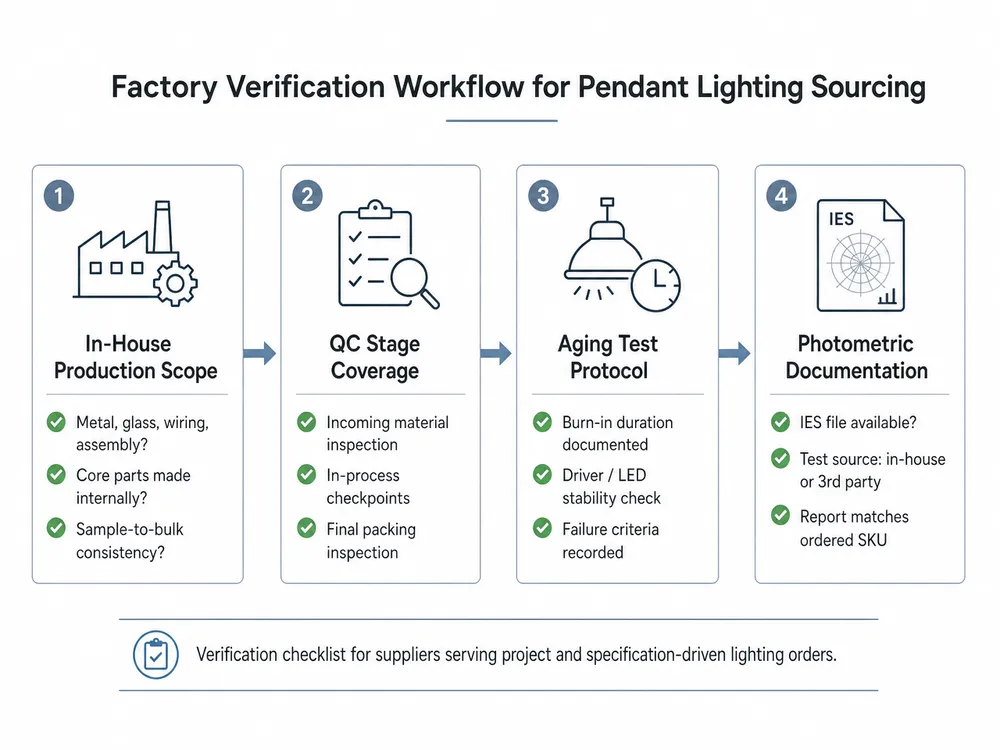
Most decorative lighting factories in Guzhen are assembly operations. They buy die-cast housings from one supplier, drivers from another, glass shades from a third, and assemble them. There's nothing inherently wrong with this model, but it means the factory's quality control depends on their suppliers' consistency — which they may or may not be actively managing.
A factory with in-house die-casting, machining, and surface finishing controls the three variables that cause the most quality problems: dimensional consistency on metal components, finish uniformity across batches, and driver-to-fixture compatibility. Ask directly: what do you manufacture in-house, and what do you purchase? The answer tells you where the quality risk sits.
QC stages and what they cover
A credible QC process runs at multiple stages, not just at final inspection. The stages that matter:
- Incoming inspection: Are raw materials and purchased components (drivers, glass, hardware) inspected before entering production? What's the rejection rate?
- In-process inspection: Are there checkpoints after die-casting, after finishing, and after assembly? Or is everything inspected at the end?
- Outgoing inspection: What does final inspection cover? Dimensional checks, electrical safety, visual inspection?
The finishing checkpoint is where most defects in decorative lighting are caught — adhesion failures, color inconsistency, and surface contamination are visible at this stage and fixable before assembly. A factory that only inspects finished, assembled fixtures is catching problems too late to fix them efficiently.
The aging test — and why most factories skip it
The aging test (burn-in test) runs each assembled luminaire powered for a minimum period before packing. It catches LED driver failures, wiring faults, and early-life component failures before they reach your customer's installation.
Most decorative lighting factories don't run a 100% aging test. It requires floor space, time, and power infrastructure, and it adds cost. The factories that skip it are betting that their driver quality is consistent enough that field failures will be rare. Sometimes that bet pays off. When it doesn't, the failures show up in your customer's installation — and the warranty claim comes back to you.
We run 100% aging test on every luminaire before packing. We added this protocol after a batch of LED drivers failed in the field for a Gulf distributor early in our export history. That was an expensive lesson for everyone involved, and it's why the protocol is non-negotiable now. When you're evaluating a factory, ask specifically: do you run a 100% aging test, or a sample-based test? The answer is a meaningful quality signal.
Photometric verification and IES files
For project contractors submitting lighting designs for approval — commercial office, hospitality, retail — photometric data is often required as part of the submission package. IES files (Illuminating Engineering Society format) contain the fixture's measured light distribution data and are used in lighting design software like AGi32, DIALux, and Revit.
Most decorative lighting factories don't have an in-house optical lab and don't generate IES files. If your buyers include project contractors or specification-driven distributors, ask whether the factory can provide IES files for the fixtures you're ordering. A factory with an in-house optical lab generates these from actual measurements; a factory without one either can't provide them or provides generic files that don't reflect the actual fixture performance.
Our optical lab generates IES files from measured photometric data for our LED Pendant Lighting range and for OEM designs. For buyers supplying commercial project contractors, this is worth confirming before you commit to a supplier.
MOQ, Lead Time, and Batch Consistency
These three variables determine whether a supplier fits your business model, not just whether they can make the product.
MOQ sets the minimum order size per SKU. For pendant lighting, typical factory MOQs run 50–200 units per style per finish. If you're building a product line with 20 SKUs, a 100-unit MOQ means a 2,000-unit minimum opening order — which may or may not fit your inventory model. Confirm MOQ per SKU, not per order, and ask whether mixed-finish orders count toward the MOQ (they often don't).
Lead time on standard catalog items typically runs 25–35 days from order confirmation for established suppliers with the product in their active range. Custom and OEM orders add tooling time — 15–20 days for new tooling before production starts. The number to confirm is not the headline lead time but the lead time from your order confirmation date, after any tooling or material procurement delays. Ask for the last three orders' actual ship dates versus confirmed ship dates. That's a more useful data point than a quoted lead time.
Batch consistency is the hardest to verify from a distance and the most important for repeat business. The sample you approved may have been produced under different conditions than your production run — different operator, different finishing bath chemistry, different driver lot. The questions to ask: Do you run the same tooling across a full production batch without mid-run changes? How do you control finish color consistency across a 500-unit run? What's your process if a production batch drifts outside the approved sample tolerance?
A factory that can answer these questions specifically — with process details, not reassurances — is a factory that has thought about batch consistency. A factory that says "don't worry, our quality is very good" has not.
(We've had buyers come to us after a bad experience with a previous supplier where the first order was fine and the second order had visible finish variation. The root cause was usually outsourced finishing with no color-matching protocol between batches. It's a solvable problem, but only if the factory is actually managing it.)
Documentation to Request Before Placing an Order
Before committing to a supplier, request the following documentation. A factory that can't provide these documents for the specific product you're ordering is a factory that hasn't done the compliance work — or is hoping you won't ask.
For compliance verification:
- CE Declaration of Conformity (for EU-bound orders) — specific to the product, not a generic company document
- UL listing certificate with file number (for North American orders) — verify the file number on UL's public database
- SAA certificate (for Australian orders)
- RoHS test report if required by your import documentation
For quality verification:
- ISO 9001:2015 certificate with current audit date
- Salt spray test report for the finish process on your specific product
- Aging test protocol documentation — what percentage of units are tested, for how long, at what load
For project specification support:
- IES file for the fixture (if your buyers need photometric data for project submissions)
- Photometric test report showing lumen output, beam angle, and color rendering index
For production planning:
- Confirmed MOQ per SKU per finish
- Lead time from order confirmation, including any tooling requirements
- Packaging specification and carton dimensions for container loading calculation
This documentation request is standard practice in B2B lighting sourcing. A supplier who pushes back on providing it is telling you something about how they operate.
Sourcing Pendant Lighting from China: What the Location Tells You
Not all Chinese lighting factories have the same supply chain access. Guzhen, in Zhongshan, Guangdong, is China's lighting manufacturing hub — the concentration of component suppliers, specialist subcontractors, and tooling shops in this area is what makes rapid prototyping and short lead times possible. A factory in Guzhen has access to glass shade suppliers, driver manufacturers, hardware specialists, and finishing shops within a short radius. A factory in a different region may be sourcing the same components from Guzhen anyway, adding transit time and a layer of supply chain complexity.
This matters for OEM and custom development work. When we prototype a new pendant design, the tooling shop, the glass supplier, and the finishing line are all local. Our 7–10 working day prototype turnaround is only possible because of that supply chain density. A factory in a different location quoting the same turnaround is either overpromising or has a different definition of "prototype."
For standard catalog sourcing, location matters less than production capability and QC process. But for custom programs, OEM development, or any order where you need rapid iteration between sample approval and production, the supply chain proximity of a Guzhen-based factory is a real operational advantage.
Frequently Asked Questions
What's the difference between CE and UL certification for pendant lighting?
CE covers the European market and is a self-declaration of conformity to EU directives, supported by third-party test reports. UL covers the North American market and requires testing by UL's own labs plus ongoing factory audits. They are not interchangeable — a CE-marked fixture is not automatically compliant for US import, and a UL-listed fixture doesn't satisfy EU requirements. If you're supplying both markets, you need both certifications. Confirm that the factory holds both for the specific product family you're ordering, not just one or the other.
How do I verify that a factory's UL listing is current and covers my product?
Ask for the UL file number and look it up on UL's Product iQ database (ul.com/productiQ). The listing will show the scope, the listed products, and the current status. If the file number doesn't appear or the scope doesn't cover the fixture configuration you're ordering, the listing doesn't apply to your order.
What causes finish color variation between batches, and how do I prevent it?
Finish color variation between batches is almost always a process control issue — inconsistent bath chemistry in electroplating, temperature variation in PVD, or different powder lots in powder coating. The prevention is a factory that runs finishing in-house with documented process parameters and color-matching protocols between batches. Ask whether the factory outsources finishing. If they do, ask how they control color consistency between production runs. If they can't give you a specific answer, batch variation is a real risk.
Do I need IES files for pendant lighting, and how do I get them?
IES files are required when your buyers are project contractors submitting lighting designs for approval — commercial office, hospitality, retail, and institutional projects typically require photometric data as part of the design submission. Not all pendant lighting factories can provide IES files; generating them requires an in-house optical lab with calibrated photometric measurement equipment. Ask the factory directly whether they can provide IES files for the specific fixture, and whether those files are generated from actual measurements or from generic manufacturer data.
What's a realistic MOQ for wholesale pendant lighting from a Chinese manufacturer?
For standard catalog items, 50–200 units per SKU per finish is typical. For OEM or custom designs requiring new tooling, MOQs are often higher — 200–500 units — to amortize the tooling cost. Mixed-finish orders usually don't count toward the MOQ for individual finishes. Confirm MOQ per SKU, per finish, and ask whether trial orders at lower quantities are available for new buyers evaluating a product before committing to a full program.
How do I evaluate batch consistency before placing a large order?
Request a production sample from a recent batch — not a pre-production sample made specifically for you, but a unit pulled from an actual production run. Compare it against the approved sample for finish tone, dimensional fit, and light output. Ask for the factory's process documentation for finish color control and dimensional inspection. If the factory can't provide a production sample or won't share process documentation, that's a meaningful signal about how they manage consistency.
Putting It Together: A Sourcing Decision Framework
The pendant lighting market has no shortage of suppliers. The differentiation is in the details that don't appear on a catalog page: whether the factory controls its own production or assembles purchased components, whether certifications cover your specific destination market and product configuration, whether the QC process catches problems before they reach your customer, and whether the factory can support your buyers' documentation requirements.
The verification steps in this guide are not bureaucratic overhead — they're the questions that separate a supplier you can build a program around from one that works fine on the first order and creates problems on the second.
If you're building a pendant lighting line for a specific market — hospitality, residential development, commercial fit-out — the style and spec decisions are straightforward once you know what your buyers actually need. The sourcing risk is in the execution: finish consistency, driver reliability, certification coverage, and delivery reliability across multiple orders.
We supply importers and distributors across North America, Europe, the Middle East, and Australia from our facility in Guzhen. If you have a pendant lighting requirement — a specific style, a target market, a volume, and certification requirements — send us your specs and we'll come back with a configuration recommendation and a detailed quote based on what's working for our existing buyers in your region.
For the full range of pendant styles available for wholesale sourcing, see our Pendant Lighting Manufacturer category page.