ASCLighting Preview

DNOOO blank theme is active for local preview.

How to Specify Bedroom Lighting for Hotel Rooms: Guest Comfort Standards, Fixture Selection, and Long-Term Maintenance

The most common mistake in hotel bedroom lighting specs isn't choosing the wrong fixture style. It's treating the bedroom as a single zone and specifying one ambient light level for the whole room. The result: guests complain the bedside reading light is too dim, the desk is unusable after dark, and the bathroom transition feels like stepping into a different building. Maintenance teams end up fielding complaints that look like fixture failures but are actually specification failures.

Getting the spec right before production starts saves you from two expensive problems: guest satisfaction issues that show up in reviews, and fixture replacement cycles that weren't budgeted. This guide covers both — the technical parameters that define a workable hotel bedroom lighting standard, and the sourcing decisions that determine whether those parameters hold up across a 200-room rollout and the refurbishment cycle that follows.
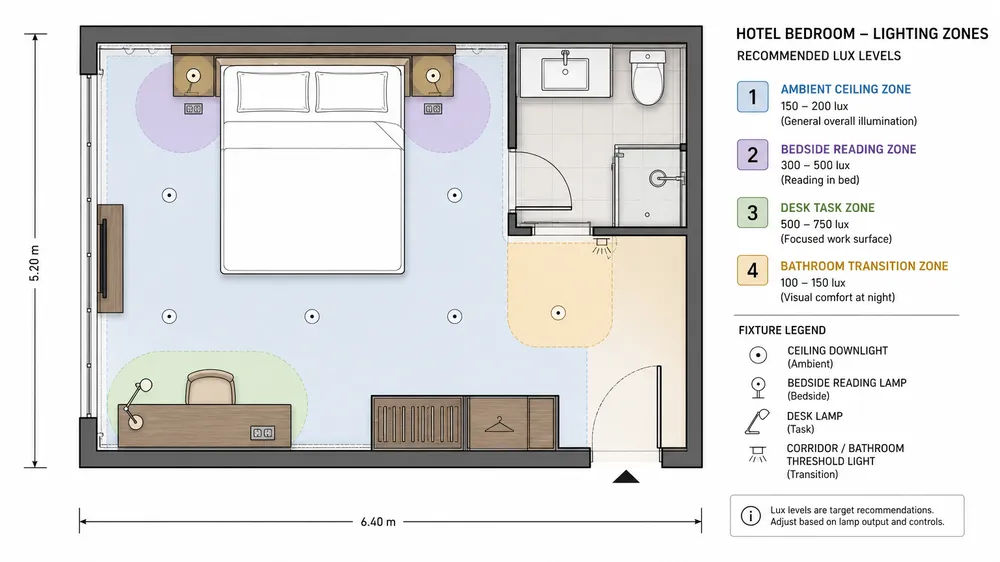
Diagram showing hotel bedroom lighting zones including ambient ceiling, bedside reading, desk task, and bathroom transition areas

Why residential bedroom specs fail in hotel environments

A residential bedroom fixture is designed for one household's usage pattern. A hotel bedroom fixture runs under a fundamentally different load: 300+ occupancy cycles per year, housekeeping teams who handle fixtures daily, and guests who use every switch and dimmer without any familiarity with the system.

Three failure modes show up repeatedly when residential-grade fixtures are specified into hotel rooms:

Driver lifespan under continuous cycling. Residential LED drivers are rated for typical home use — maybe 2–4 on/off cycles per day. In a hotel room, that number is closer to 10–15 cycles daily when you account for housekeeping, turndown service, and multiple guest interactions. Drivers that aren't rated for high-cycle operation fail within 18 months. The fixture looks fine; the driver is dead. Replacement cost per room is manageable — replacement cost across 200 rooms in year two of operation is a budget problem.

Finish durability under housekeeping contact. Housekeeping teams wipe down every surface in a room, including fixture bases, shades, and wall sconces. Powder coat finishes below 60μm thickness show wear at contact points within a year. Electroplated finishes without proper sealing oxidize in humid bathroom-adjacent environments. The fixture that looked right in the sample photo looks tired by the second year of operation.

Dimming compatibility with hotel control systems. Most hotel rooms use centralized lighting control or at minimum trailing-edge dimmers. Residential fixtures are often specified with drivers that work with leading-edge (TRIAC) dimmers only. The result is flicker, buzzing, or incomplete dimming range — all of which generate maintenance calls that aren't actually maintenance problems.

These aren't edge cases. We see them consistently in projects where the spec was built around aesthetics first and operational requirements second.

Zone-by-zone lux and CCT targets

Hotel bedroom lighting works as a system of zones, not a single ambient level. Each zone has a different task requirement, and the spec needs to address them separately. The table below reflects working targets used across mid-scale to upper-upscale hotel programs — not regulatory minimums, but the levels that consistently produce acceptable guest comfort scores.

Zone Lux Target (maintained) CCT Range CRI Minimum Dimming Required
General ambient (ceiling) 100–150 lux 2700–3000K CRI 80+ Yes
Bedside reading 200–300 lux at task surface 2700–3000K CRI 80+ Yes
Desk / work surface 300–500 lux at desk height 3000–3500K CRI 80+ Optional
Wardrobe / dressing 150–200 lux 2700–3000K CRI 80+ No
Bathroom transition / vanity 300–500 lux 3000–4000K CRI 90+ Optional

A few notes on these numbers. The ambient target of 100–150 lux is intentionally lower than office or retail standards — hotel bedrooms are rest environments, and overlighting the ambient layer is a common mistake in budget properties trying to compensate for poor zone design. The desk zone is where you can push toward 3500K without disrupting the room's overall warmth, because guests using the desk are in task mode. The bathroom transition zone warrants CRI 90+ because guests are making grooming decisions there — lower CRI makes skin tones look off, which generates complaints that are hard to trace back to the spec.

(We've had buyers push back on the CRI 90+ requirement for bathroom fixtures, citing cost. The delta between CRI 80 and CRI 90 at the fixture level is smaller than the delta in guest satisfaction scores. It's worth the spec.)
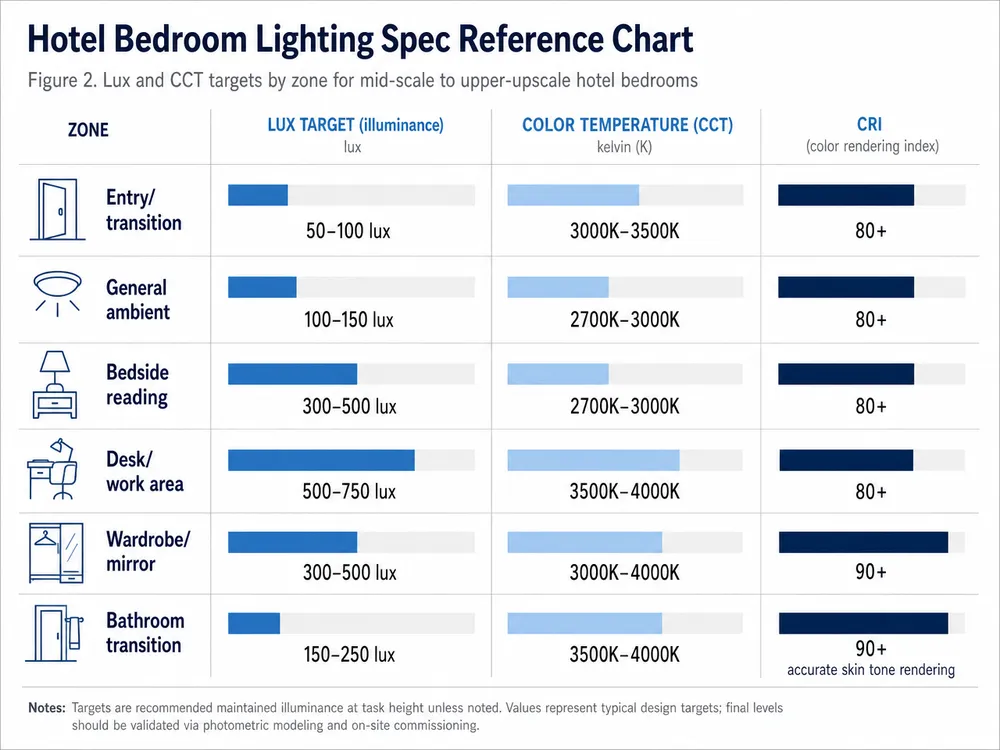
Reference chart showing lux levels and color temperature targets for each hotel bedroom lighting zone

Fixture type selection by zone

The zone targets above define what the light needs to do. Fixture type selection determines whether it can actually do it within the physical and aesthetic constraints of the room.

Ambient ceiling layer. Recessed downlights or flush ceiling fixtures are the standard choice for hotel ambient lighting — they're unobtrusive, easy to maintain, and compatible with most ceiling heights. For rooms with higher ceilings (3m+), a pendant or semi-flush fixture can carry the ambient layer while contributing to the room's design identity. The key spec parameter here is beam angle: a 60° flood beam distributes ambient light more evenly than a 36° spot, reducing the hot-spot effect that makes a room feel like a retail display rather than a rest environment.

Bedside reading. Wall-mounted reading sconces are the most reliable solution for bedside task lighting in hotel rooms — they put the light source at the right height, keep the bedside table clear, and eliminate the cord management problem that comes with table lamps in high-turnover environments. Specify adjustable-arm sconces where the room design allows; fixed-position sconces work but require careful placement during installation to ensure the beam hits the pillow zone rather than the headboard. Table lamps remain common in full-service hotels where the aesthetic warrants them, but they require cord management solutions and are more vulnerable to housekeeping damage.

Desk task lighting. A dedicated desk lamp or a ceiling-mounted directional spotlight over the desk zone is the practical choice. Integrated desk lamps (built into the desk furniture) are common in branded hotel programs but create a sourcing dependency between the lighting spec and the furniture spec — worth flagging to the FF&E team early. Standalone desk lamps give more flexibility for replacement and are easier to source consistently across a multi-property program.

Wardrobe and dressing. LED strip lighting inside wardrobe cavities or a small recessed downlight above the wardrobe opening handles this zone efficiently. This is not a zone that warrants decorative fixture investment — function and durability matter more than aesthetics here.

Bathroom transition. Vanity wall sconces flanking the mirror are the standard approach for CRI 90+ bathroom lighting. Overhead downlights alone create unflattering shadows on the face — the flanking sconce arrangement eliminates this. For budget programs where flanking sconces aren't feasible, a high-CRI LED strip above the mirror is an acceptable compromise, but the CRI minimum should not be relaxed.

For a broader view of how these fixture types fit into full hotel lighting programs, see our Hotel Lighting application guide.

Dimming system compatibility: the spec decision that causes the most field problems

Dimming compatibility is where hotel bedroom lighting specs most often create problems that don't surface until installation — or worse, until the first guest complaint cycle.

Hotel rooms use one of three dimming approaches:

  1. Standalone wall dimmers (budget and limited-service properties): typically trailing-edge (ELV) or leading-edge (TRIAC) dimmers, depending on the property's electrical contractor preference.
  2. Centralized lighting control systems (full-service and luxury properties): DALI, 0–10V, or proprietary protocols depending on the BMS vendor.
  3. Bedside panel control (common in branded programs): a bedside panel that controls multiple circuits, often with scene presets.

The fixture spec needs to match the dimming infrastructure — and the dimming infrastructure decision is often made by the electrical engineer, not the FF&E team. This creates a coordination gap that causes real problems. We've seen projects where 500 fixtures were specified with TRIAC-compatible drivers, and the electrical contractor installed trailing-edge dimmers. The result is flicker across every room.

The practical fix: specify fixtures with dual-mode or universal dimming drivers (compatible with both leading-edge and trailing-edge dimmers) for any project where the dimming infrastructure isn't confirmed in writing before the fixture order is placed. The cost premium over single-mode drivers is modest — typically 8–12% at the driver level — and it eliminates the compatibility risk entirely.

For DALI or 0–10V systems, the driver spec must explicitly call out the protocol. Don't assume a "dimmable" driver is DALI-compatible — it usually isn't unless the spec says so.

(We've started including dimming protocol confirmation as a standard item in our pre-production checklist for hotel projects. It catches the gap before production, not after delivery.)

Finish durability and batch consistency across multi-room programs

For a single residential installation, finish variation between two fixtures is a minor aesthetic issue. For a 200-room hotel program, it's a visible quality problem that affects the property's brand perception — and a sourcing problem that's expensive to fix after installation.

Two finish-related issues come up consistently in hotel programs:

Batch-to-batch color drift. Powder coat and electroplated finishes can drift in color temperature and sheen level between production batches if the process isn't tightly controlled. A brushed gold sconce from batch one and a brushed gold sconce from batch three should be indistinguishable when installed side by side. Achieving this requires consistent powder material sourcing, controlled application thickness (we run 60–80μm on our powder line with automated application), and color verification against a master sample before each batch ships.

Finish wear at contact points. Housekeeping contact, guest handling, and cleaning chemicals all attack finish surfaces. The areas that fail first are typically the base of wall sconces (where housekeeping grips them to clean around them), the switch or dimmer interface on bedside fixtures, and any exposed metal edge on ceiling fixtures. Specifying a minimum 60μm powder coat thickness and requesting salt spray test results (500-hour minimum for standard hotel environments, 1000-hour for coastal properties) gives you a defensible durability baseline.

Our in-house die-casting and surface finishing means we control both variables under one roof — the same tooling runs the full batch, and the finishing line doesn't change process parameters mid-run. For hotel programs ordering 100+ units of a given fixture, we maintain a master finish sample and verify each production batch against it before shipment. That's not a standard practice at assembly-only factories, and it's the difference between a consistent installation and a visible mismatch problem.

For large multi-property programs, batch consistency becomes a supply chain planning issue as well. If your hotel brand is rolling out 10 properties over 18 months, the fixtures installed in property one and property ten need to match. That requires either holding inventory from a single production run (which has carrying cost implications) or working with a factory that can reliably reproduce the finish specification across multiple runs. We document finish parameters per SKU and maintain them across reorders — it's part of how we support multi-property programs.
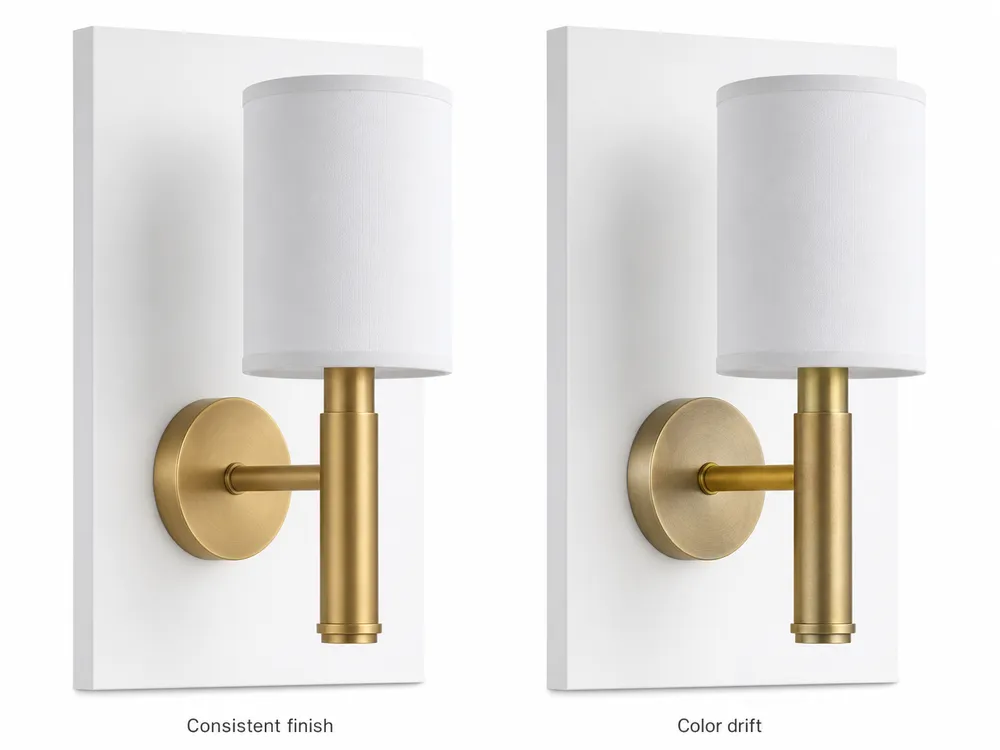
Side-by-side comparison of consistent versus inconsistent fixture finish across a hotel room installation

Certifications and documentation for hotel compliance sign-off

Hotel projects in regulated markets require fixture certifications as part of the building compliance process. The specific requirements depend on the destination market, but the pattern is consistent: the electrical inspector or building authority needs to see certification documentation before sign-off, and missing documentation delays the opening.

CE (European markets): Required for all electrical fixtures sold or installed in EU member states. Covers electromagnetic compatibility and low-voltage directive compliance. For hotel projects, the Declaration of Conformity and test reports should be available per fixture SKU.

UL (North American markets): UL listing is the standard requirement for hotel installations in the US and Canada. Some jurisdictions accept ETL listing as an equivalent. Specify UL-listed fixtures for any North American hotel project — unlisted fixtures will fail inspection.

SAA (Australian market): Required for electrical fixtures installed in Australia. Similar documentation requirements to CE.

Beyond market certifications, hotel projects often require additional documentation for the FF&E procurement package: photometric data (IES files) for the lighting designer's calculations, material safety data for finishes, and in some cases energy compliance documentation for green building certifications (LEED, BREEAM, Green Star).

Our in-house optical lab generates IES files from our own photometric measurements — not from manufacturer data sheets. For hotel lighting designers who need to run AGi32 or DIALux calculations to verify zone lux levels before installation, having accurate IES files from the actual production fixture (not a generic approximation) is the difference between a calculation that matches reality and one that doesn't.

MOQ, lead time, and procurement planning for hotel rollouts

Hotel FF&E procurement operates on project timelines that don't flex easily. A 300-room hotel opening in Q3 needs fixtures on-site by a specific date, and a 6-week production delay doesn't have a good solution once the construction schedule is locked.

A few planning parameters that affect how we structure hotel orders:

MOQ by fixture type. Our standard MOQ for hotel bedroom fixtures runs 50–100 units per SKU depending on the fixture type and whether custom tooling is involved. For a 300-room hotel with 4–5 fixture SKUs per room, the per-SKU quantities are typically well above MOQ — the constraint is usually lead time, not minimum order size.

Lead time structure. Standard catalog fixtures: 25–35 days from order confirmation. Custom or OEM fixtures with new tooling: add 15–20 days for the tooling cycle. For hotel projects, we recommend building a 2-week buffer into the procurement schedule to absorb any production or logistics variance. Ordering to the last possible date on a hotel opening schedule is a risk that's hard to recover from.

Replacement fixture planning. Hotels refurbish rooms on a 5–7 year cycle, and individual fixture replacements happen continuously due to damage and wear. Specifying fixtures from a factory that can reproduce the same SKU 3 years later — same finish, same driver spec, same photometric output — is a real operational advantage. We maintain production documentation per SKU and can rerun a fixture to the original spec on a reorder, which matters when you're replacing 20 damaged sconces in year three and need them to match the 280 that are still on the walls.

(The Guzhen supply chain is part of why we can do this reliably. Component sourcing, tooling, and specialist subcontractors are all local — we're not dependent on a single overseas supplier for a critical component that may have been discontinued.)

For projects with confirmed room counts and fixture schedules, we can provide a detailed quote with lead time milestones and batch delivery options. See our Bedroom Lighting product range for standard hotel-compatible SKUs, or review our broader Lighting Applications for Premium Projects for the full fixture portfolio.

Common specification mistakes and how to avoid them

These are the errors we see most often when reviewing hotel bedroom lighting specs before production:

Specifying a single CCT across all zones. A 3000K ambient fixture and a 3000K bathroom vanity fixture are both technically correct, but the bathroom zone needs CRI 90+ — a spec that says "3000K throughout" without calling out CRI by zone will get you CRI 80 in the bathroom unless you specify otherwise.

No dimming protocol confirmation. As covered above: "dimmable" is not a protocol. Specify the dimming protocol explicitly, or specify universal-compatible drivers.

Ordering replacement fixtures without referencing the original batch spec. Three years after installation, a hotel maintenance team orders replacement sconces and gets a slightly different finish because the reorder didn't reference the original production documentation. Always include the original order number and finish specification in reorder requests.

Underspecifying the desk zone. The desk is where business travelers spend significant time, and 150 lux at desk height (common in budget specs) is genuinely inadequate for extended work. The 300–500 lux target in the zone table above is the working minimum for a desk that functions as a workspace.

Skipping IES file verification. A lighting designer's lux calculation is only as accurate as the photometric data it's based on. Generic IES files from a fixture category (rather than the specific production fixture) can produce calculations that are off by 20–30% — enough to miss the zone targets after installation.

Sourcing checklist for hotel bedroom lighting procurement

Before placing a production order for a hotel bedroom lighting program, confirm the following:

  • [ ] Zone-by-zone lux targets defined and verified against IES file calculations
  • [ ] CCT and CRI specified per zone (not a single value for the whole room)
  • [ ] Dimming protocol confirmed in writing with the electrical engineer
  • [ ] Driver spec matches dimming infrastructure (leading-edge, trailing-edge, DALI, 0–10V)
  • [ ] Finish specification documented with salt spray test requirement (500hr minimum)
  • [ ] Batch consistency protocol confirmed with factory (master sample, per-batch verification)
  • [ ] Certifications confirmed for destination market (CE, UL, SAA as applicable)
  • [ ] IES files requested and verified against zone lux targets
  • [ ] Lead time confirmed against project opening schedule with buffer
  • [ ] Replacement fixture reorder process documented (SKU reference, finish spec, driver spec)
  • [ ] MOQ confirmed per SKU against room count

This checklist won't catch every project-specific issue, but it covers the gaps that generate the most expensive problems in hotel bedroom lighting programs.

Frequently asked questions

What lux level is required for hotel bedroom ambient lighting?

The working target for hotel bedroom ambient lighting is 100–150 maintained lux at floor level. This is lower than office or retail standards by design — hotel bedrooms are rest environments, and higher ambient levels work against the comfort function of the space. The bedside reading zone is where you need 200–300 lux at the task surface, which is why zone-specific specification matters more than a single room-wide lux target.

Do hotel bedroom fixtures need to be dimmable?

Ambient and bedside reading circuits should be dimmable in any mid-scale or above hotel program. Dimming is a standard guest expectation and a meaningful factor in comfort scores. The desk zone can be non-dimmable in budget programs without significant impact. The critical spec decision isn't whether to dim, but which dimming protocol to specify — confirm this with the electrical engineer before the fixture order is placed.

What CRI is required for hotel bathroom vanity lighting?

CRI 90+ is the working minimum for hotel bathroom vanity lighting. Lower CRI (80–85) produces skin tone rendering that guests notice as unflattering, even if they can't articulate why. The cost difference between CRI 80 and CRI 90 at the fixture level is small relative to the guest satisfaction impact.

How do I ensure finish consistency across a 200-room hotel order?

Specify powder coat thickness (60–80μm minimum), request salt spray test results, and confirm with the factory that a master finish sample will be maintained and used for per-batch verification before shipment. For multi-property programs, document the finish specification per SKU and reference it on all reorders. Assembly-only factories that source finished components from multiple suppliers cannot guarantee batch consistency the way a factory with in-house surface finishing can.

What certifications are required for hotel bedroom fixtures in the US?

UL listing is the standard requirement for hotel installations in the US. Some jurisdictions accept ETL listing as an equivalent. Confirm the specific requirement with the project's electrical engineer or building authority — requirements can vary by state and municipality. For the documentation package, you'll typically need the UL listing certificate, a Declaration of Conformity, and photometric data (IES files) for the lighting designer's calculations.

If your hotel bedroom lighting spec is ready for a factory review, send the fixture schedule, room count, target market, and certification requirements to Request Quote and we'll return a detailed quote with configuration recommendations based on current hotel program experience. For related application guidance, see How to Specify Hotel Lighting for Guest Rooms.
How to Specify Hotel Lighting for Guest Rooms and Public Areas Without Creating Maintenance Headaches After Handover

Most hotel lighting specification guides stop at installation day. They give you lux targets, color temperature recommendations, and a fixture schedule — and then the project closes out. What they don't cover is what happens six months after handover when the maintenance team starts logging complaints: a corridor pendant that won't dim properly, a bathroom downlight with a failed driver that requires ceiling access to replace, a lobby chandelier where half the units have drifted to a noticeably different finish tone.

Those problems don't start at handover. They start at specification. The fixture selection decisions you make before the order is placed determine whether the maintenance team inherits a manageable system or a recurring problem. This guide covers both sides: the technical specification criteria for each space type, and the manufacturer-side requirements that most spec documents never mention.

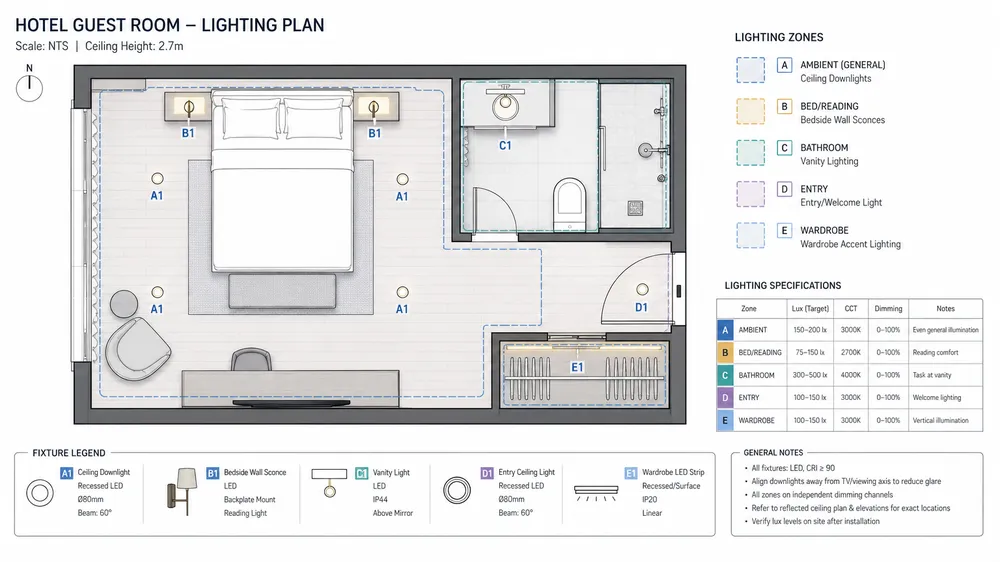
Hotel guest room lighting layout showing ambient, task, and accent zones with labeled fixture positions

Why Post-Handover Failures Trace Back to Specification Decisions

The failure pattern we see most often in hospitality projects isn't a manufacturing defect. It's a specification mismatch that was invisible at installation and becomes a problem at the 6–18 month mark.

Driver failures are the most common. An LED driver specified without a burn-in test will pass installation inspection — the fixture lights up, the dimming works, everything looks fine. The early-life failure rate on LED drivers follows a bathtub curve: failures cluster in the first few hundred hours of operation. If those hours happen in the hotel room rather than at the factory, the maintenance team is the one dealing with it. We run 100% aging test on every luminaire before it ships, so driver failures surface on our floor, not in the guest room. That's not a quality claim — it's a process decision that shifts where the failure cost lands.

Finish drift is the second pattern. A hotel orders 300 units of the same pendant for a corridor run. The first 150 ship from one production batch, the second 150 from a batch three months later. If the manufacturer doesn't control powder coat thickness and color consistency across batches, the corridor looks fine at handover and starts showing visible tone variation within a year as the finishes age at different rates. (We've seen this on projects where the original supplier was replaced mid-order — the color match looked acceptable on a single sample but diverged under the corridor's consistent lighting conditions.)

Dimensional tolerance is the third. A 500-room hotel project means 500 ceiling cutouts, 500 canopy fits, 500 bracket alignments. If the fixture housing tolerances drift ±0.5mm or more across a production run, installation teams start shimming and forcing fits. That's rework cost on-site, and it's avoidable if the manufacturer holds CNC tolerances to ±0.1mm on critical mounting dimensions.

None of these failures are dramatic. They accumulate quietly and show up as maintenance tickets, warranty disputes, and replacement orders that eat into the project margin.

Guest Room Lighting Specification: Zones, Targets, and Dimming

A hotel guest room has four distinct lighting zones, each with different requirements. Specifying them as a single fixture schedule is where most problems start.

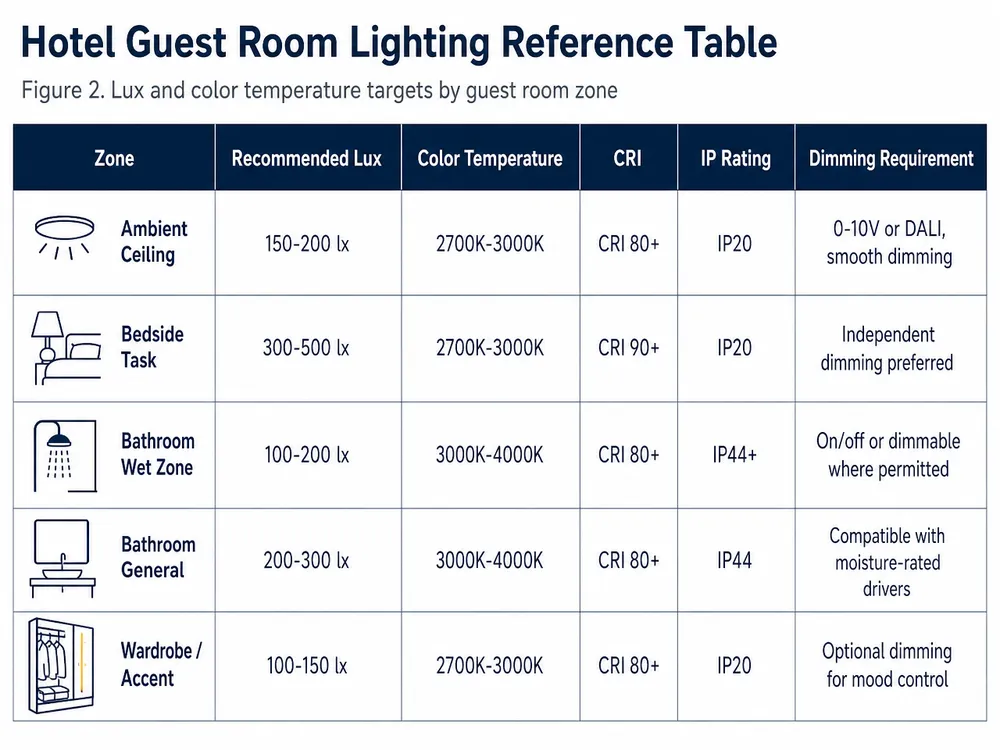
Ambient ceiling is the general illumination layer. For a standard guest room, 150–200 lux at floor level is the working target for a comfortable ambient level — bright enough for general use, low enough to feel residential rather than clinical. Color temperature in the 2700K–3000K range is standard for hospitality; 2700K reads warmer and works better in rooms with warm-toned finishes, 3000K is slightly crisper and suits contemporary interiors. CRI 90+ is worth specifying for any hotel above the mid-market tier — the difference in how fabrics, skin tones, and room finishes render under CRI 80 vs CRI 90 is visible to guests even if they can't name it.

Bedside task lighting needs to be independently switchable and dimmable. The common failure here is specifying a wall sconce with a driver that isn't compatible with the hotel's dimmer infrastructure. Before finalizing the fixture spec, confirm the dimmer protocol in use — TRIAC, 0-10V, DALI, or Casambi — and specify drivers accordingly. A fixture that dims smoothly on a TRIAC dimmer may buzz or flicker on a 0-10V system. This is a driver selection issue, not a fixture quality issue, but it shows up as a fixture complaint.

Bathroom lighting has two non-negotiable requirements: IP rating and driver access. The wet zone directly above a shower or bath requires IP65 minimum; the wider bathroom zone (outside the wet zone but still subject to steam and humidity) requires IP44 minimum. These aren't conservative recommendations — they're the minimum thresholds for compliance in most markets. A downlight specified at IP20 in a bathroom zone will pass installation inspection and fail within 18 months as moisture ingress degrades the driver.

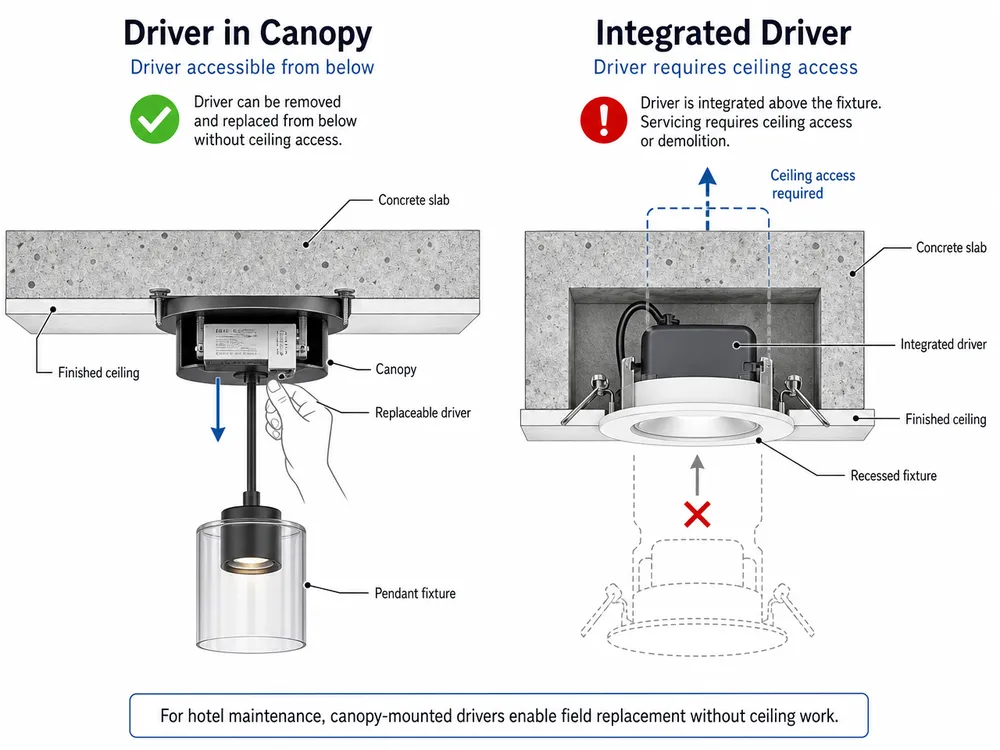
Driver access in bathrooms is the maintenance problem nobody specifies for. If the driver is integrated into the fixture housing and the fixture is recessed into a concrete ceiling with no access panel, replacing a failed driver means cutting into the ceiling. Specify fixtures with either externally accessible drivers or driver-in-canopy designs where the driver can be reached without ceiling access. (This sounds obvious, but we regularly see project specs that don't address it — and the maintenance team finds out the hard way.)

Wardrobe and accent lighting is typically lower-priority but worth noting: LED strip or small spotlights in wardrobe zones should be specified at 3000K or warmer to avoid the cold-white effect that makes clothing look washed out. Lumen output here is secondary to color quality.

Reference table showing recommended lux levels and color temperatures for hotel guest room lighting zones

Public Area Specification: Lobby, Corridor, F&B, and Exterior

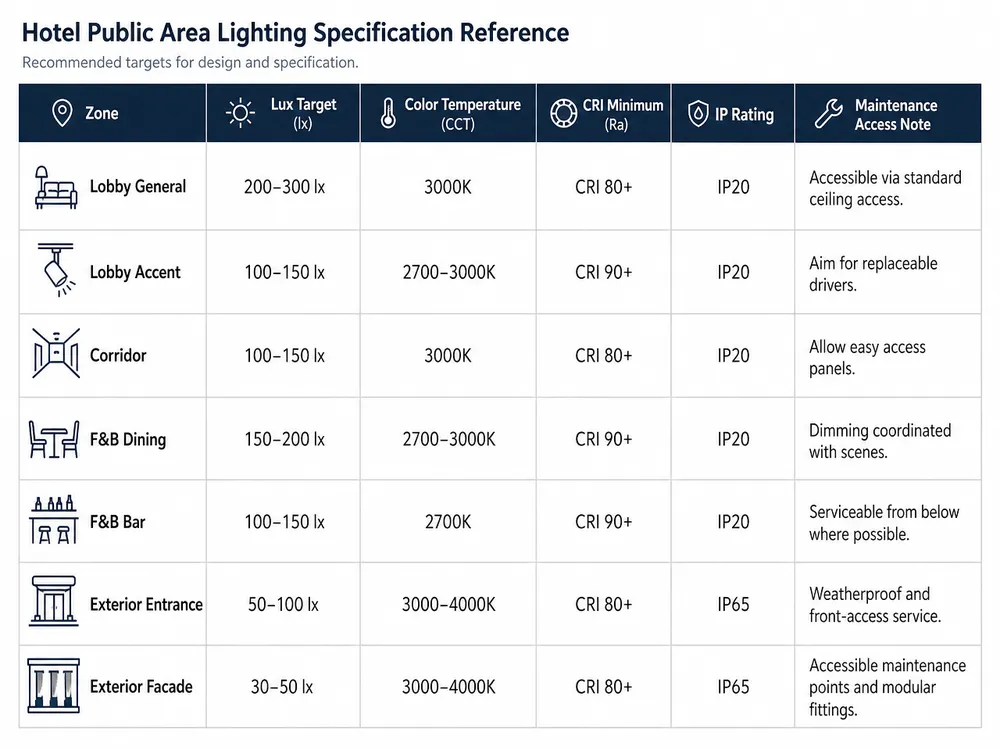
Public areas have different failure modes than guest rooms, mostly because the operating hours are longer and the maintenance access is harder.

Lobby is the highest-visibility space and typically the most complex to specify. Lux targets for hotel lobbies range from 200–300 lux for general circulation, with accent lighting at 500–750 lux on feature walls, artwork, or reception desks. The fixture selection challenge in lobbies is scale: a chandelier or pendant cluster that looks proportionate in a render may be difficult to re-lamp or service in a 6-meter ceiling without scaffolding. Specify fixtures with accessible lamp or driver replacement — either a lowering system for large pendants or a design where the driver is in the canopy rather than the fixture body.

Color temperature consistency across a lobby installation matters more than in any other space. If you're specifying 20 pendants for a lobby atrium, all 20 need to come from the same production batch with verified color temperature tolerance. A ±150K drift across a batch is invisible on a single fixture and obvious when 20 are lit simultaneously. Require batch consistency documentation from your manufacturer — not just a spec sheet, but confirmation that the order will ship from a single production run.

Corridors are a maintenance frequency problem. Corridor lighting runs 24 hours a day in most hotels, which means a fixture rated for 50,000 hours at 8 hours/day is actually running through its rated life in 17 years at continuous operation — but in practice, driver quality variation means failures cluster much earlier. Specify L70 lumen maintenance data (the point at which output drops to 70% of initial) and require it from measured data, not manufacturer claims. For corridor pendants or wall sconces, driver replaceability without ceiling access is the same requirement as bathrooms.

Lux targets for hotel corridors: 100–150 lux at floor level is the standard working range. Below 100 lux starts to feel dim and raises safety concerns; above 200 lux in a corridor reads as institutional rather than hospitality.

F&B spaces (restaurants, bars, breakfast rooms) have the most demanding color rendering requirements of any hotel space. CRI 95+ is worth specifying for fine dining; CRI 90 is the minimum for any F&B space where food presentation matters. Color temperature in F&B typically runs 2700K–3000K for dining, with the lower end (2700K) preferred for evening dining environments. Dimming is non-negotiable in F&B — the space needs to transition from breakfast service at 300 lux to dinner service at 80–100 lux. Confirm dimming range: some LED drivers dim to 10% minimum, others to 1%. For a dinner service environment, 10% minimum may still be too bright.

Exterior and entrance lighting requires IP65 minimum for all fixtures in exposed positions. For coastal hotel projects — beach resorts, waterfront properties — finish durability becomes a specification criterion, not just an aesthetic one. Salt air accelerates corrosion on powder-coated and plated finishes. Specify powder coat thickness (60–80μm is the working standard for coastal applications) and require salt spray test results from the manufacturer. A finish that passes 500-hour salt spray testing will hold in a coastal environment; a standard decorative finish rated for 200 hours will show corrosion within two seasons.

Specification reference table for hotel public area lighting including lobby, corridor, F&B, and exterior zones

Batch Consistency: The Specification Criterion Most Guides Skip

A 200-room hotel project typically means 200–500 units of the same fixture across guest rooms, corridors, or public areas. At that scale, batch consistency stops being a quality preference and becomes a project risk.

The two variables that drift most in large decorative lighting orders are finish tone and lumen output. Finish tone drift happens when a manufacturer runs your order across multiple production batches — different powder coat batches, different plating chemistry cycles, or different surface preparation runs. Each batch may be within the manufacturer's internal tolerance, but the cumulative drift across 500 units can be visible when the fixtures are installed side by side under consistent lighting.

Lumen output drift is less visible at installation but shows up over time. If the LED modules in your order come from two different component batches with slightly different binning, the fixtures will age at different rates. A corridor that looks uniform at handover may show visible brightness variation at the 2-year mark.

What to require from your manufacturer:

  • Single-batch production confirmation: For orders over 100 units of the same SKU, require written confirmation that the order will be produced in a single run, not split across multiple batches.
  • Color consistency documentation: Require finish samples from the production batch, not just the approved sample. For powder coat finishes, require thickness measurement records (60–80μm is the standard range; variation outside this range indicates process inconsistency).
  • LED binning documentation: Require confirmation that all LED modules in the order come from the same binning batch. MacAdam ellipse Step 3 or tighter is the standard for hospitality applications — Step 5 is acceptable for utility spaces but visible in high-quality environments.

We run our die-casting and CNC machining in-house with tolerances held to ±0.1mm on critical mounting dimensions, so dimensional consistency across a 500-unit batch isn't dependent on a third-party supplier's process control. The finish line runs automated powder application at 60–80μm — consistent across the batch, not just the first units off the line. For large hotel orders, we can provide batch production records as part of the shipment documentation.

Driver Replaceability and IP Ratings: What to Require Before the Container Ships

Driver replaceability is the single most overlooked specification criterion in hospitality lighting. It determines whether a failed fixture is a 10-minute maintenance task or a ceiling demolition job.

The specification question is simple: can the driver be replaced without removing the fixture from the ceiling? For recessed downlights, this means a driver that's accessible through the fixture aperture or mounted in an accessible junction box. For surface-mounted or pendant fixtures, this means a driver in the canopy or a driver compartment with a removable cover. For any fixture going into a concrete ceiling without an accessible ceiling void, driver-in-canopy is the only practical design.

IP rating requirements by zone:

Zone Minimum IP Rating Notes
Guest room bathroom — wet zone (above shower/bath) IP65 Mandatory in most markets
Guest room bathroom — general IP44 Steam and humidity exposure
Guest room general IP20 Standard interior
Corridor IP20 Standard interior
Lobby IP20 Standard interior
Exterior — covered entrance IP44 Indirect weather exposure
Exterior — exposed IP65 Direct weather exposure
Pool area IP65 Humidity and splash

For coastal and tropical hotel projects, treat the IP44 zones as IP54 minimum. The additional ingress protection is worth the marginal cost difference when the alternative is premature driver failure from humidity.

Certification requirements vary by destination market. For North American hotel projects, UL listing is required for fixtures in occupied spaces — CE marking is not a substitute. For European projects, CE marking with the relevant EN standards is required. For Australian projects, SAA certification. For hotel groups operating across multiple markets, confirm that your manufacturer holds the relevant certifications in-house rather than relying on third-party certification retrofits — the documentation trail matters when your import team is reviewing compliance.

We hold CE, UL, and SAA certifications in-house, built into the product development process rather than added after the fact. For project submissions that require Declaration of Conformity, test reports, or IES files, we maintain these per SKU and include them in the order documentation package.

Diagram comparing driver-in-canopy versus integrated driver designs for hotel ceiling fixture maintenance access

Common Specification Mistakes and How to Avoid Them

Finish selection without climate consideration. A brushed gold finish specified for a beach resort in a humid coastal environment will corrode within 18 months if the manufacturer hasn't run salt spray testing on that finish. Before finalizing finish selection for any coastal or tropical project, ask for salt spray test results. 500-hour salt spray is the minimum threshold for coastal applications; 1000-hour is worth specifying for exposed exterior fixtures.

Driver mismatch with dimmer infrastructure. This is the most common cause of post-handover dimming complaints. The fixture dims, but it buzzes, flickers at low levels, or has a limited dimming range. The fix at specification stage is straightforward: confirm the dimmer protocol (TRIAC, 0-10V, DALI, Casambi, or other) and specify drivers that are tested and confirmed compatible. The fix after installation is expensive — either replace the drivers or replace the dimmers.

Missing IES files for project submissions. Many hotel projects require photometric data for lighting design software submissions — the architect or lighting designer needs IES files to model the actual fixture performance, not generic approximations. If your manufacturer can't provide IES files generated from measured data, you're either submitting with approximations (which creates compliance risk) or paying a third party to measure the fixtures after they arrive. Our optical lab generates IES files from measured photometric data on production samples — usable directly in AGi32, DIALux, or Relux submissions.

Specifying by catalog without confirming certification. A fixture that looks right in a catalog may not hold the certification required for your destination market. CE marking doesn't satisfy UL requirements. A fixture certified for the European market needs separate UL testing for North American projects. Confirm certification coverage before the order is placed, not when the container arrives at customs.

Over-specifying lumen output in guest rooms. A 1000-lumen downlight in a 30m² guest room will hit 300+ lux at floor level — bright enough to feel like an office. Guest rooms need layered lighting at lower lumen outputs per fixture, not a single high-output source. The specification error here is treating lumen output as a quality proxy; higher lumens in a guest room context is often a worse outcome.

What to Require from a Hospitality Lighting Manufacturer

The fixture spec covers what you're buying. The manufacturer evaluation covers whether you'll actually receive it — consistently, across the full order quantity, with the documentation your project needs.

A practical checklist for evaluating a hospitality lighting manufacturer for a hotel project:

Production capability

  • [ ] In-house die-casting and CNC machining, or assembly-only operation? (Assembly-only means dimensional consistency depends on third-party suppliers.)
  • [ ] Powder coat line with automated application and thickness measurement? (Manual application produces thickness variation across a batch.)
  • [ ] Can they confirm single-batch production for orders over 100 units of the same SKU?

Quality control

  • [ ] 100% aging test before shipment? (Spot-check aging is not equivalent — early-life driver failures require 100% testing to catch.)
  • [ ] Photometric verification on production samples, not just prototypes?
  • [ ] LED binning documentation available per order?

Documentation

  • [ ] IES files generated from measured data, not manufacturer approximations?
  • [ ] Declaration of Conformity and test reports available per SKU?
  • [ ] Batch production records available for large orders?

Certification

  • [ ] CE, UL, and SAA held in-house, not retrofitted?
  • [ ] Certification coverage confirmed for your destination market before order placement?

Finish durability

  • [ ] Salt spray test results available for finishes specified for coastal or humid-climate projects?
  • [ ] Powder coat thickness specification (60–80μm) confirmed and documented?

The manufacturers who can answer yes to all of these are a smaller group than the catalog suggests. Most decorative lighting factories in Guzhen are assembly operations — they buy components, assemble, and ship. The documentation and process control requirements above require in-house production capability and a QC infrastructure that most assembly operations don't have.

Documentation Requirements for Project Submissions

Hotel projects — particularly those involving international hotel brands, government-funded hospitality developments, or projects in regulated markets — typically require a documentation package that goes beyond a product spec sheet.

The standard documentation set for a hospitality lighting project submission:

Technical documentation

  • IES photometric files (generated from measured data, not approximations)
  • Lumen output and color temperature test reports
  • CRI measurement data
  • Beam angle verification

Compliance documentation

  • Declaration of Conformity (CE for European projects, or equivalent)
  • UL listing documentation (North American projects)
  • SAA certification (Australian projects)
  • IP rating test reports for bathroom and exterior fixtures

Production documentation

  • Batch production records for large orders
  • LED binning documentation
  • Finish specification records (powder coat thickness, salt spray test results)

If your manufacturer can't provide this package, you're either assembling it yourself from third-party testing (expensive and slow) or submitting without it (a compliance risk). For hotel lighting specification projects where brand standards or local regulations require full documentation, confirm the manufacturer's documentation capability before the order is placed.

We maintain this documentation per SKU and include it in the shipment package as standard for project orders. For buyers who need specific test reports or certifications not already on file, we can arrange third-party testing through SGS — the lead time adds to the project schedule, so it's worth flagging early.

Putting the Specification Together

The practical sequence for a hotel lighting specification that holds up after handover:

1. Zone the spaces first. Guest room ambient, task, bathroom, and accent are separate specifications. Lobby, corridor, F&B, and exterior each have different lux targets, color temperature requirements, IP ratings, and maintenance access considerations. A single fixture schedule that doesn't distinguish between zones will produce a specification that's wrong for at least some of them.

2. Confirm dimmer infrastructure before finalizing drivers. The dimmer protocol in the hotel's electrical specification determines which driver types are compatible. Get this confirmed before the fixture order is placed, not after.

3. Specify IP ratings by zone, not by fixture type. A downlight that's IP20-rated is fine for a guest room ceiling and wrong for a bathroom. The fixture type doesn't determine the IP requirement — the zone does.

4. Require batch consistency documentation for orders over 100 units. Single-batch production confirmation, LED binning documentation, and finish thickness records are the three documents that protect you from the finish drift and lumen variation problems described above.

5. Confirm certification coverage for your destination market. CE, UL, and SAA are not interchangeable. Confirm which certification applies to your project market and verify the manufacturer holds it in-house before the order is placed.

6. Require IES files before the project submission deadline. IES files generated from measured data take time — the manufacturer needs to run photometric testing on a production sample. Build this into the project schedule, not as an afterthought.

7. Specify driver replaceability for bathroom and high-ceiling fixtures. For any fixture going into a location where ceiling access is difficult or impossible, driver-in-canopy or accessible driver compartment is a specification requirement, not a preference.

For lighting applications across premium hospitality and commercial projects, the specification decisions above are the difference between a project that closes cleanly and one that generates maintenance calls for the next three years.

If you're working on a hotel project and need confirmation of certification coverage, batch consistency capability, or IES file availability for specific fixture types, send your fixture list to Request Quote — room types, quantities, target market, and any certification requirements — and we'll come back with a detailed quote and documentation confirmation.

Hotel Lighting vs Residential Lighting: Spec Differences That Drive Durability, Compliance, and Total Project Cost

The fixture that works perfectly in a private villa will fail a hotel compliance review. Not because it looks wrong — it might look identical — but because the spec underneath is built for a different operating reality. Hotel projects get caught on this distinction more often than any other sourcing mistake we see, and the cost of discovering it after production starts is significant.

Here's the short version: hotel-grade fixtures carry higher IP ratings, commercial-grade drivers, DALI or 0-10V dimming compatibility, harder surface finishes, and market-specific certifications that residential-grade products don't require. The upfront price difference is real. The downstream cost of getting it wrong is larger.

This comparison covers the spec dimensions that actually drive procurement decisions — not a surface-level overview, but the parameters that determine whether your fixtures pass compliance review, survive a five-year maintenance cycle, and arrive in consistent finish across a 500-room order.

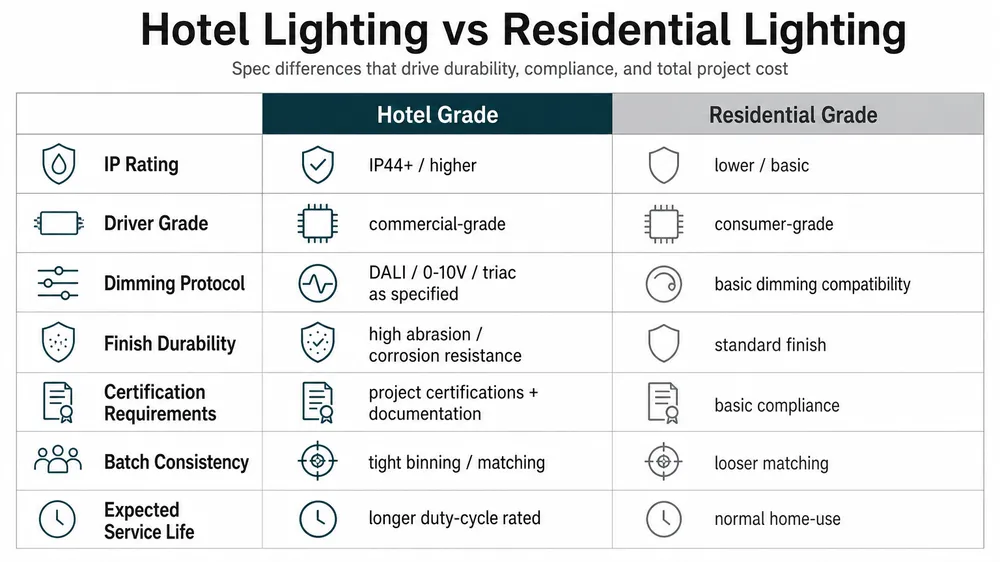
Side-by-side comparison matrix of hotel-grade vs residential-grade lighting fixture specifications across IP rating, driver grade, dimming protocol, finish durability, and certifications

The Spec Table: Where Hotel and Residential Diverge

The differences aren't subtle. Across every parameter that matters to a project contractor or FF&E procurement team, hotel-grade fixtures carry specifications that residential products don't need to meet — because the operating environment, maintenance model, and compliance framework are fundamentally different.

Parameter Hotel Grade Residential Grade
IP Rating IP44 minimum (bathrooms IP65) IP20 standard; IP44 optional
Driver Grade Commercial-grade, 50,000+ hr rated Consumer-grade, 25,000–35,000 hr rated
Dimming Protocol DALI, 0-10V, or Casambi compatible Trailing-edge TRIAC only
Finish Durability 500+ hr salt spray; PVD or hard anodize 200–300 hr salt spray; standard powder coat
Certifications UL (NA), CE (EU), SAA (AU) — market-specific CE or UL; rarely both; SAA uncommon
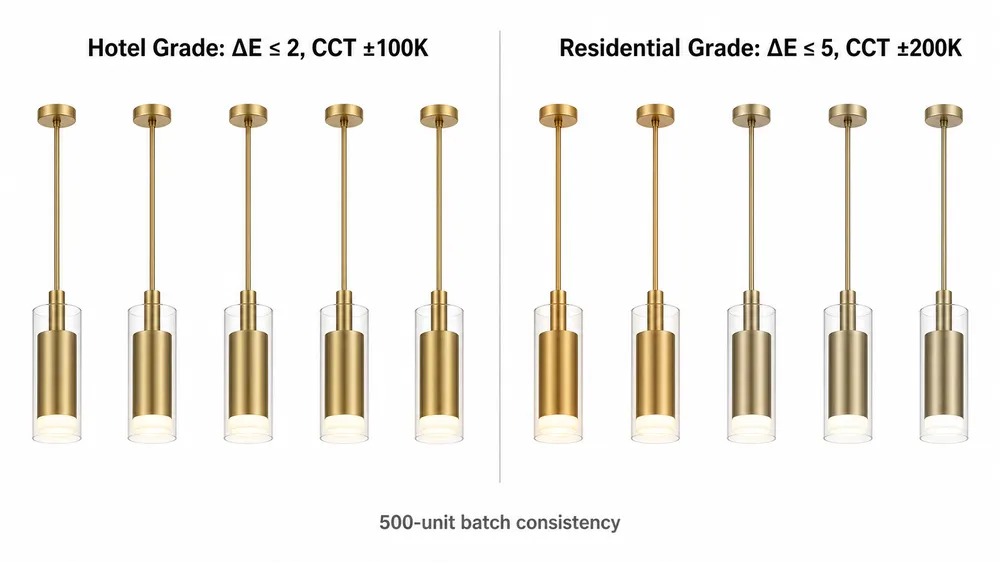
Batch Consistency ΔE ≤ 2 color tolerance across full order ΔE ≤ 4–5 acceptable
CRI 90+ standard; 95+ for F&B and spa zones 80–85 typical
CCT Tolerance ±100K across batch ±200K acceptable
Expected Service Life 5–7 years before maintenance cycle 3–5 years typical
IES File Availability Required for project submission Rarely provided

The driver spec and dimming protocol rows are where most sourcing mistakes happen. A residential-grade driver rated at 30,000 hours in a hotel room running 12–16 hours daily reaches end-of-life in under seven years — and hotel maintenance teams don't replace individual drivers, they replace fixtures. That's a full FF&E replacement cost, not a component swap.

Why Residential-Grade Fixtures Fail Hotel Compliance Review

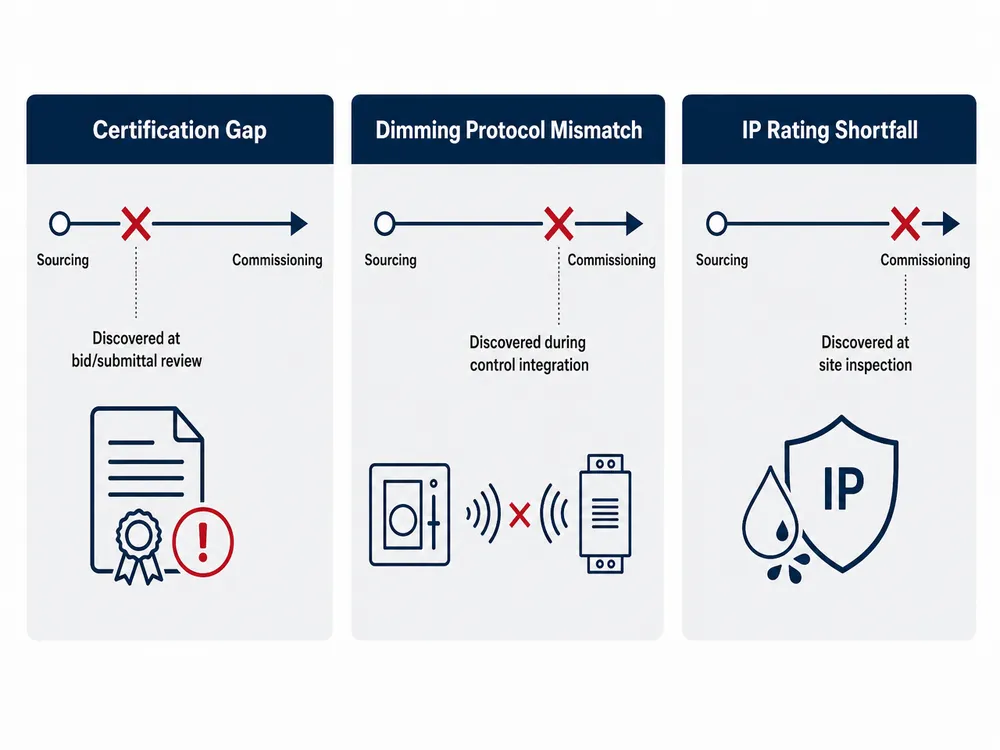
The compliance failure isn't always obvious at the sample stage. A residential pendant can look identical to a hotel-grade version, pass a visual inspection, and still fail the project's electrical review for three reasons: certification scope, dimming compatibility, and IP rating for wet zones.

Certification scope is the most common failure point. Hotel projects in North America require UL-listed fixtures. Projects in Europe require CE with the full technical file — not just the mark. Australian hotel projects require SAA. A residential-grade fixture sourced for cost might carry CE but not UL, or UL but not SAA. When the project spans multiple markets — a hotel group rolling out properties across the US, UK, and Australia — a single-certification fixture fails two of the three markets. The rework cost isn't just the fixture replacement; it's the delay to the project handover, the re-inspection fees, and the contractor's time.

Dimming compatibility is the second failure mode. Hotel room management systems — from Lutron to KNX to Crestron — use DALI or 0-10V protocols. Residential dimmers use TRIAC. A residential-grade driver with TRIAC-only dimming will flicker, buzz, or fail to dim at all when connected to a hotel BMS. We've seen this discovered during commissioning, which means the fixtures are already installed. Pulling and replacing at that stage costs three to five times what the spec upgrade would have cost at the sourcing stage.

IP rating in wet zones is the third. Hotel bathrooms, pool surrounds, and spa areas require IP44 minimum — IP65 for direct water exposure zones. Residential-grade fixtures in these zones fail the building inspection. (In some markets, the insurance liability for a non-compliant wet-zone fixture is the contractor's, not the hotel's — worth knowing before you spec it.)

Diagram showing three common compliance failure modes when residential-grade fixtures are specified for hotel projects — certification gaps, dimming protocol mismatch, and IP rating shortfall

The Hidden Cost: Driver Grade and Maintenance Frequency Over Five Years

The upfront price difference between a commercial-grade and residential-grade driver is typically 15–25% of the driver cost — a meaningful but manageable delta at the fixture level. The five-year maintenance cost difference is not manageable.

A hotel room runs its lighting 12–16 hours per day. At 14 hours average, that's roughly 5,100 hours per year. A residential-grade driver rated at 30,000 hours reaches its L70 point (the industry threshold for driver replacement) in under six years. A commercial-grade driver rated at 50,000 hours reaches the same point in under ten years. In a 300-room hotel, the difference between a six-year and ten-year replacement cycle is approximately 300 fixture replacements — at full fixture cost, not driver cost, because hotel maintenance teams don't carry driver inventory.

The math on a mid-range decorative pendant: if the fixture costs $85 landed and the hotel has 300 rooms with two pendants each, a six-year replacement cycle costs $51,000 in fixtures alone, plus labor. Push that cycle to ten years and the cost drops to zero within the typical FF&E depreciation window. The driver upgrade that enables the longer cycle costs roughly $8–12 per fixture at the sourcing stage.

We run 100% aging tests on every luminaire before shipment — every driver in every fixture burns in before the container loads. That catches early-life failures before they reach the installation. But the aging test doesn't change the driver's rated lifespan; it just ensures you're not shipping a defective unit. The rated lifespan is determined by the driver grade you specify at the sourcing stage.

Batch Consistency: The Hotel-Specific Requirement Residential Sourcing Ignores

A residential buyer ordering 20 pendants can tolerate a ΔE of 4–5 between units — the fixtures are in different rooms, different lighting conditions, and the variation isn't visible. A hotel buyer ordering 500 pendants for 250 identical guest rooms cannot. When two pendants hang in the same room and one reads warm gold while the other reads cool champagne, the guest notices. The hotel notices. The contractor gets the call.

Batch consistency in hotel lighting has two dimensions: finish color and CCT (correlated color temperature). Both require tighter tolerances than residential sourcing typically demands.

Finish consistency across a 500-unit batch requires in-house surface finishing with automated application and batch-controlled process parameters. Factories that outsource finishing — or run manual spray lines — can't hold ΔE ≤ 2 across a full hotel order. We run our own electroplating, powder coating, and PVD lines in-house, with automated powder application at 60–80μm consistent thickness. For hotel orders, we run finish samples from the beginning, middle, and end of the production batch and compare them before the batch ships. (This sounds obvious, but a lot of factories only check the first-off sample and assume the rest of the batch matches.)

CCT consistency requires driver and LED source matching within the same production batch. We specify LED sources from the same bin code across a hotel order — not just the same model, the same bin. A ±100K CCT tolerance across a 500-room order is achievable when you control the LED sourcing. It's not achievable when you're buying LED modules from spot market suppliers who ship whatever bin is available.

For buyers sourcing hotel projects, the question to ask your factory isn't "what's your CCT tolerance?" — it's "how do you control bin consistency across a 500-unit order?" The answer tells you whether they've actually done hotel work before.

Visual comparison showing finish color and CCT variation in a hotel lighting batch with tight vs loose tolerance control across 500 units

Certification Coverage by Market: What Hotel Projects Actually Require

The certification landscape for hotel projects is more demanding than residential, and it varies by destination market. Getting this wrong at the sourcing stage means either re-certifying fixtures (expensive and slow) or replacing them (more expensive and slower).

North America: UL listing is required for hotel fixtures in the US and Canada. This isn't a preference — it's a code requirement in most jurisdictions, and hotel projects go through electrical inspection. A CE-only fixture fails the inspection. UL certification requires testing to UL 1598 (luminaires) or the relevant product standard, plus ongoing factory surveillance audits. We hold UL and maintain it through annual audits — the certificate is current, not a legacy mark from a previous product generation.

Europe: CE marking is required, but the mark alone isn't sufficient for a hotel project submission. The technical file behind the CE mark — test reports, Declaration of Conformity, Bill of Materials — is what the project's M&E consultant reviews. A CE mark without a complete technical file is a compliance risk. We maintain the full technical file per SKU and provide it as part of the order documentation package.

Australia: SAA (Standards Australia) certification is required for hotel projects. This is the certification that most Chinese factories don't hold — it's a smaller market than North America or Europe, and the certification cost isn't justified for factories that don't actively supply Australian projects. We hold SAA because we supply hotel and hospitality projects in Australia regularly. For buyers sourcing a hotel group with Australian properties, this matters: you're not waiting on certification work before you can import.

The practical implication: a factory that holds UL, CE, and SAA can supply a hotel group's global rollout from a single source. A factory that holds only CE cannot supply the North American or Australian properties without either re-certifying or sourcing from a second factory. The supply chain complexity of managing two factories for the same fixture spec — different lead times, different QC standards, different documentation — is a real project risk.

Application Scenarios: Which Spec Wins in Each Context

Scenario 1: 300-room branded hotel, North American market, full FF&E package

Hotel grade wins, no contest. UL listing is non-negotiable. DALI dimming is required for the BMS integration. The 5-year maintenance window the hotel's facilities team is planning around requires commercial-grade drivers. Batch consistency across 300 identical rooms requires in-house finishing with tight tolerance control. Specifying residential grade here doesn't save money — it creates a compliance failure at inspection and a maintenance cost problem at year four.

Scenario 2: Boutique hotel, 40 rooms, European market, design-led FF&E

Hotel grade still wins on certification and driver spec, but the batch consistency requirement is more manageable at 40 rooms. CE with full technical file is required. DALI compatibility depends on whether the property is using a BMS — smaller boutique properties sometimes use standard dimming, which opens the door to trailing-edge compatible drivers. The finish tolerance requirement is still tighter than residential because the rooms are identical, but a 40-unit batch is easier to control than a 500-unit batch. (We'd still run the same bin-code LED sourcing protocol — the cost difference is negligible and the risk of a visible CCT mismatch in a boutique property is higher, not lower, because guests are paying for the design experience.)

Scenario 3: Serviced apartment complex, 120 units, mixed residential and hospitality use

This is the grey zone. Serviced apartments often use residential-grade fixtures because the procurement team is thinking "residential" — but the operating model is hospitality. Units run 12+ hours daily, maintenance is centralized, and the building goes through commercial electrical inspection. The right call depends on the inspection jurisdiction and the operator's maintenance model. If the building is inspected to commercial code, hotel-grade certification is required. If the operator is planning a 5-year FF&E refresh cycle, commercial-grade drivers are the right spec. We've supplied both configurations for this segment — the decision usually comes down to what the M&E consultant specifies on the drawings.

What to Include in Your RFQ for Hotel-Grade Fixtures

The difference between a useful RFQ and one that generates a generic quote is the spec data you include upfront. For hotel-grade fixtures, the minimum information that drives an accurate quote:

Fixture type and room category: Pendant, wall sconce, ceiling fixture, or spotlight — and which room type (guest room, lobby, F&B, spa, bathroom). Room type determines IP rating requirement and CRI specification.

Target market and certification requirement: North America (UL), Europe (CE with technical file), Australia (SAA), or multi-market. If the project spans markets, specify all of them — a single-certification quote won't cover your full project.

Dimming protocol: DALI, 0-10V, Casambi, or TRIAC. If you don't know the BMS specification yet, say so — we can quote with DALI as the default and adjust when the BMS spec is confirmed.

Order volume and batch structure: Total units and how they're distributed across room types. This determines whether we need to run a single production batch or multiple batches, which affects the batch consistency protocol.

Finish specification: Color, texture, and any durability requirement (coastal environment, high-humidity zone). If you have a finish reference — a RAL code, a physical sample, or a reference fixture — include it. Finish matching across a hotel order is easier when we have a physical reference rather than a color name.

For Hotel Lighting projects specifically, IES files for photometric documentation are available from our in-house optical lab — include that requirement in your RFQ if your project submission requires it.

Total Project Cost: The Five-Year View

The fixture price is the number that appears on the purchase order. The total project cost is the number that appears on the facilities manager's budget five years later.

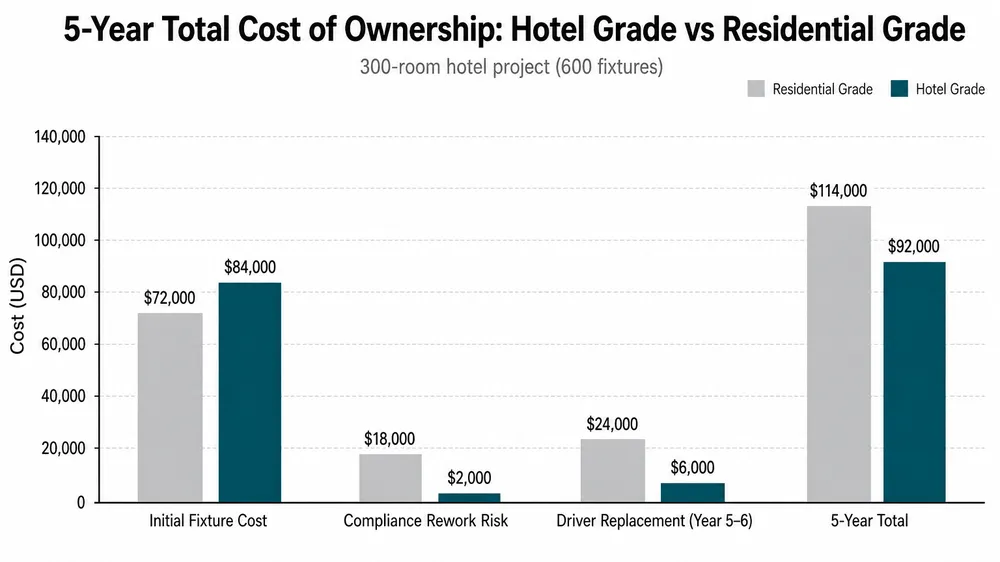
For a 300-room hotel with two decorative pendants per room (600 fixtures total):

Cost Component Residential Grade Hotel Grade Difference
Fixture unit cost (landed) $65 $85 +$20/unit
Total fixture cost $39,000 $51,000 +$12,000
Compliance rework risk High (certification gaps, dimming failure) Low
Driver replacement at year 5–6 ~$39,000 (full fixture replacement) $0 (within rated life) -$39,000
Maintenance labor (2 cycles) ~$8,000 $0 -$8,000
5-year total cost ~$86,000 ~$51,000 -$35,000

The numbers above are illustrative — actual costs depend on fixture spec, labor rates, and market. But the direction is consistent: the upfront premium for hotel-grade fixtures is recovered within the first maintenance cycle, and the compliance rework risk is eliminated entirely.

The buyers who push back hardest on hotel-grade pricing are usually the ones who haven't been through a post-handover driver failure on a large property. The ones who have been through it don't ask about the price difference.

Bar chart comparing five-year total cost of ownership for hotel-grade vs residential-grade lighting fixtures across a 300-room hotel project

Sourcing Validation: What to Verify Before You Commit

The spec on a data sheet and the spec in the shipped fixture are not always the same thing. For hotel-grade fixtures, the verification steps that matter:

Driver grade verification: Request the driver manufacturer and model number, not just the rated hours. A 50,000-hour claim from an unknown driver brand is not the same as a 50,000-hour claim from a Meanwell, Inventronics, or Tridonic driver. We specify driver brand and model per SKU — if a factory can't tell you the driver brand, the grade claim is unverifiable.

Certification currency: Ask for the current certificate, not a copy of a certificate. UL certificates have a file number that can be verified on UL's public database. CE certificates should be accompanied by the Declaration of Conformity and test report date. An expired or superseded certificate is not compliant.

Batch consistency protocol: Ask how the factory controls finish consistency across a 500-unit order. The answer should include process controls (automated application, batch parameters), not just inspection (we check samples). Inspection catches variation after it happens; process control prevents it.

IES file availability: For hotel projects requiring photometric documentation, ask whether IES files are generated from in-house measurements or from the LED module manufacturer's data. In-house measurements reflect the actual fixture performance — module manufacturer data reflects the LED source in isolation, not the fixture's optical system.

We generate IES files from our own optical lab measurements for every fixture we supply to hotel projects. The photometric data reflects the actual fixture, not the LED module spec sheet. For project submissions where the lighting designer needs to model the fixture in DIALux or AGi32, that distinction matters.

For buyers working across Lighting Applications for Premium Projects, the certification and documentation requirements vary by project type — hotel, restaurant, villa, and retail each carry different compliance thresholds. Understanding where your project sits on that spectrum before you source determines whether your fixtures pass review or get pulled.

If you're ready to spec hotel-grade fixtures for a current project, Request Quote with your fixture type, room category, target market, certification requirement, and order volume — we'll return a grade recommendation and quote based on your actual project spec.

Kitchen Pendant Lighting vs Recessed Lighting: Task Illumination, Sourcing Trade-offs, and Which Fixture Wins Over an Island

The question comes up constantly in project specs and distributor line reviews: pendants or recessed cans over the island? Most of the content out there answers it with aesthetics — "pendants add warmth," "recessed looks clean." That framing is useless if you're sourcing 200 units for a hospitality rollout or building a kitchen lighting SKU mix for a regional distributor.

The real decision turns on three things: how much usable task light actually reaches the counter, how much ceiling height you're working with, and how much customization flexibility you need when the project spec changes. On those three dimensions, the two fixture types behave very differently — and the right answer depends on which of those constraints is binding for your application.

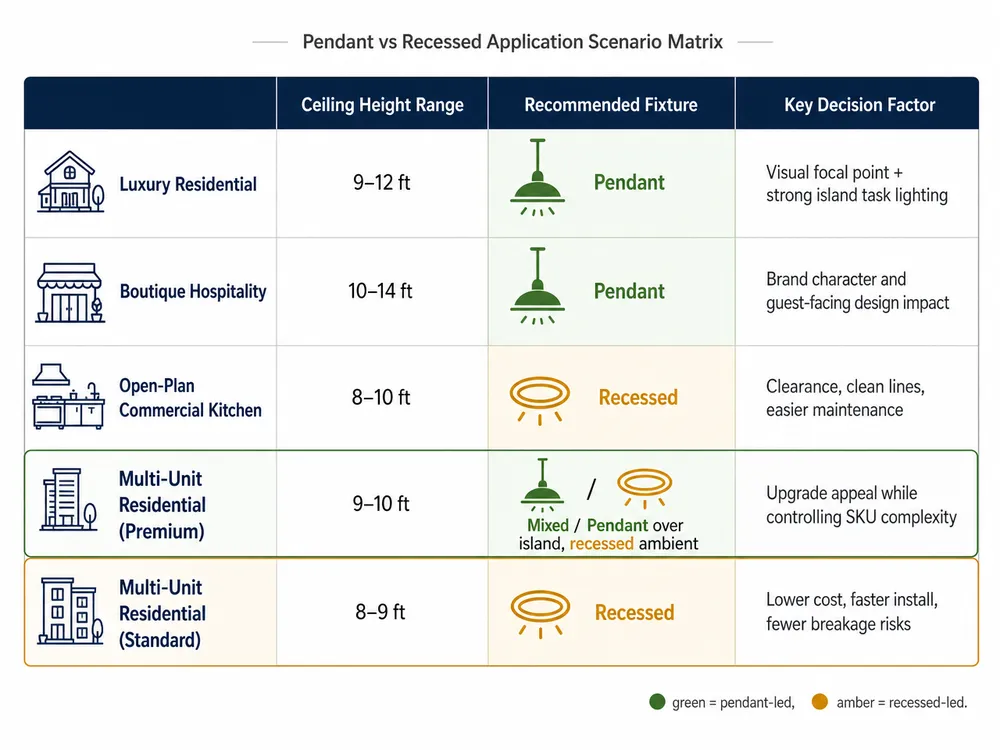
Quick verdict: For island task lighting in standard residential and hospitality kitchens with 8–10 ft ceilings, pendant fixtures deliver better lux at counter level with more sourcing flexibility for custom specs. Recessed downlights win in open-plan commercial kitchens with high ceilings, where pendant cord management becomes a liability and uniform ambient coverage matters more than focused task illumination.

Side-by-side comparison of pendant lighting and recessed downlights installed over a kitchen island showing light distribution patterns

The Photometric Reality: What Actually Reaches the Counter

This is where the comparison starts, not with aesthetics. The question is how many lux land on a 36-inch-wide island work surface, and what determines that number for each fixture type.

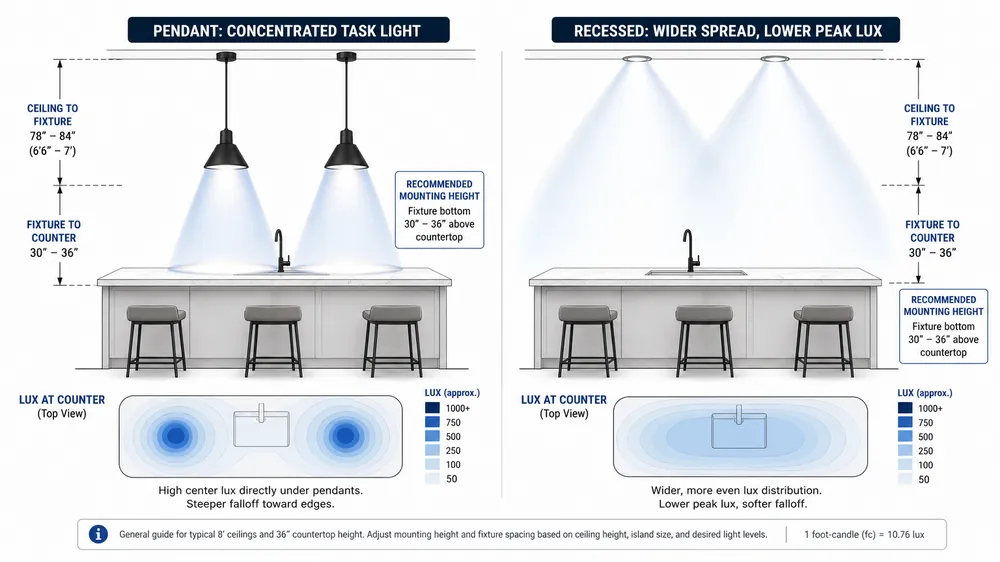
For pendant fixtures, the key variables are mounting height above the counter, lumen output, and beam angle. A pendant hung 30–36 inches above the counter surface — the standard residential spec — with a 15W LED source producing 1,200–1,500 lumens through a 60° beam angle will deliver roughly 300–500 lux at the center of the work surface directly below. That's well within the 300–500 lux range recommended for kitchen task lighting. The proximity is doing most of the work: the inverse square law means that halving the distance from source to surface roughly quadruples the illuminance. Pendants exploit this by getting the light source close to the work plane.

Recessed downlights work against that same physics. Installed in a standard 9 ft ceiling, a recessed fixture sits approximately 60–66 inches above the counter surface — roughly double the mounting height of a pendant. A 15W recessed downlight with 1,200 lumens and a 40° beam angle will deliver somewhere in the 150–250 lux range at counter center, depending on the exact ceiling height and fixture spacing. That's below the task lighting threshold for food preparation. To compensate, you either add more fixtures (typically 3–4 recessed cans over a 36-inch island versus 2 pendants) or specify higher-output sources — both of which increase cost and complexity.

The beam angle difference compounds this. Pendant shades with directional optics can focus output into a 30–60° cone aimed directly at the work surface. Most recessed downlights ship with 40–60° beam angles, but the ceiling-height penalty means that cone has spread significantly by the time it reaches the counter. The effective illuminated area is larger, but the lux density at any given point is lower.

(We run photometric testing on all pendant designs in our optical lab before production. The lux-at-counter numbers above are consistent with what we see on our own 15W pendant SKUs — the exact values shift with shade geometry and reflector design, but the directional advantage over recessed holds across configurations.)

Ceiling Height: The Threshold That Changes the Calculation

Ceiling height is the single variable that most often gets ignored in fixture selection, and it's the one that most directly determines whether recessed lighting can function as primary task illumination over an island.

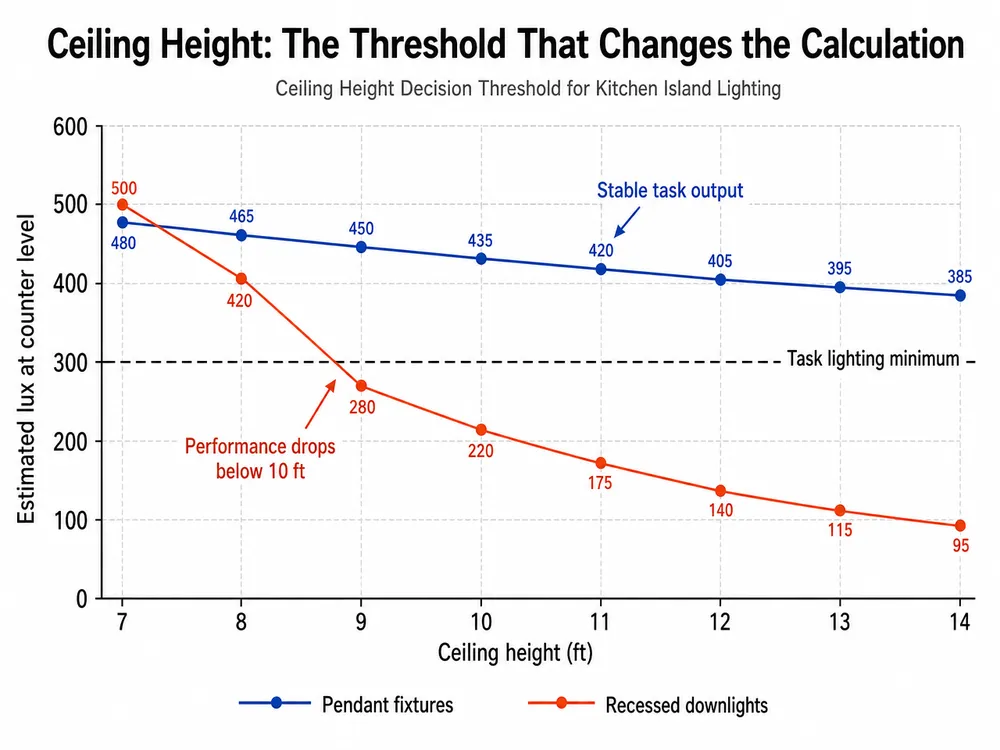
The threshold we use internally: at ceiling heights below 9 ft, recessed downlights should not be specified as the primary task light source over a kitchen island. The physics don't support it. At 8 ft ceiling height, a recessed fixture sits 54–60 inches above the counter — the lux delivery drops further, and the beam spread at counter level is wide enough that you're providing ambient fill rather than task illumination. You'd need 4–5 fixtures over a standard island to approach adequate task lighting levels, and at that point you're dealing with glare, heat load, and a ceiling that looks like a grid.

Pendant fixtures don't have this constraint in the same way. The mounting height is controlled by cord or stem length, not by ceiling height. A 10 ft ceiling with a 48-inch pendant cord still puts the fixture 30–36 inches above the counter. The ceiling height affects the visual proportion of the installation, but not the photometric performance. This is why pendants dominate in residential and boutique hospitality applications where ceiling heights run 8–10 ft — they're the only fixture type that reliably delivers task-level illumination in that range without over-specifying the source wattage.

The calculus flips above 12 ft. At that height, pendant cord management becomes a real issue — long cords are harder to install cleanly, more vulnerable to air movement, and create a visual weight that can overwhelm the space. High-ceiling commercial kitchens and open-plan restaurant environments are where recessed or track-mounted downlights make more sense, often supplemented by under-cabinet lighting for the actual task zones.

Chart showing ceiling height thresholds for pendant vs recessed lighting effectiveness over a kitchen island

Head-to-Head Specification Matrix

Dimension Pendant Fixtures Recessed Downlights
Effective ceiling height range 8–12 ft (optimal) 10 ft+ for task lighting
Lux at counter (9 ft ceiling, 15W) 300–500 lux 150–250 lux
Beam angle (typical) 30–60° (directional) 40–60° (wide spread)
Fixtures needed over 36" island 2–3 3–5
Customization depth High (housing, shade, finish, cord) Low (trim ring, finish)
IES file availability Available from manufacturer Standard from most suppliers
Installation complexity Medium (cord/stem, canopy) Low (can, trim, driver)
Driver replacement access Accessible at fixture Requires ceiling access
Finish/SKU match across project Full custom match possible Limited to standard finishes
Certification coverage (ASC) CE, UL, SAA N/A (ASC pendant focus)
MOQ for custom spec 50–200 units (housing-dependent) Commodity — no custom

The table above is a starting point. The dimensions that actually drive the sourcing decision depend on your project type — and that's where the scenarios below matter more than the matrix.

The Hidden Cost in Recessed Specifications

The spec sheet comparison makes recessed look cheaper. Lower per-unit cost, simpler installation, no cord management. The hidden cost shows up downstream.

The first place it shows up is in fixture count. If you're specifying recessed as primary task lighting over a kitchen island in a standard-ceiling residential or hospitality project, you need more fixtures to hit the same lux target. Three to five recessed cans versus two pendants — that's a 50–150% increase in fixture count, wiring runs, and installation labor. The per-unit cost advantage evaporates quickly.

The second place is in driver access. Recessed downlights embed the driver in the ceiling cavity. When a driver fails — and in hospitality environments with continuous operation, driver failures happen — replacement requires ceiling access, which means disruption to the space. Pendant fixtures hang the driver in the fixture body or canopy, accessible without touching the ceiling. For a hotel kitchen or restaurant that can't close for maintenance, that difference is real money.

The third place is in project specification lock-in. Recessed cans are commodity products. The finish options are limited, the trim ring geometry is standardized, and there's no meaningful customization available at the housing level. If your project spec calls for a specific brushed brass finish that matches the cabinet hardware, or a shade geometry that fits a particular design language, recessed can't deliver it. You're choosing from what's in the catalog. Pendant fixtures — at least from a manufacturer with in-house die-casting — can be specified to match the project exactly.

(We've had buyers come to us after committing to a recessed spec for a hospitality project, then discovering mid-project that the finish they needed wasn't available in the recessed format. The retrofit cost — re-specifying, re-ordering, re-installing — was significantly higher than the original pendant premium would have been.)

Application Scenarios: Which Fixture Wins Where

Luxury Residential and Villa Projects

Winner: Pendant fixtures.

Standard ceiling heights of 9–10 ft, custom finish requirements, and design-forward specifications make this the natural pendant territory. Two or three pendants over a 36–48 inch island deliver task-level illumination, provide a visual anchor for the space, and can be specified in finishes that match the broader interior scheme. For buyers supplying luxury residential developers or high-end kitchen renovation contractors, pendant SKUs with custom finish options are the higher-margin, lower-substitution product. Recessed cans in this segment are a commodity race to the bottom.

Boutique Hospitality: Hotel Suites, Restaurant Private Dining, Serviced Apartments

Winner: Pendant fixtures, with driver reliability as the deciding factor.

Hospitality buyers have a different cost model than residential. Field failures are expensive — not just the replacement cost, but the service disruption and the brand impact. The 100% aging test before shipment matters here: every pendant driver burns in before the container loads, so early-life failures show up at the factory, not in a hotel suite at 11 PM. For buyers sourcing for hospitality rollouts, that reliability guarantee is worth more than the per-unit cost difference versus a commodity recessed fixture.

Certification coverage also matters in this segment. A pendant SKU with CE, UL, and SAA certification can be sourced for a hotel group's properties across North America, Europe, and Australia without re-certification work. That's a meaningful supply chain simplification for a buyer managing multi-market procurement.

Open-Plan Commercial Kitchens and Restaurant Back-of-House

Winner: Recessed downlights or track-mounted fixtures.

High ceilings (12 ft+), industrial aesthetic, and the need for uniform ambient coverage rather than decorative task lighting make this the recessed use case. Pendant cord management at commercial ceiling heights is a liability — cleaning, maintenance, and the physical environment of a working kitchen all argue against hanging fixtures. Recessed or track-mounted downlights with high-output sources and wide beam angles provide the uniform illumination these spaces need. This is not ASC's primary product territory, and we'd say so directly to a buyer asking us to spec this application.

Multi-Unit Residential Developments

Winner: Pendant fixtures for premium units; recessed for standard units.

The split depends on the unit tier. Premium units in a multi-unit development — where the developer is differentiating on finish quality and design — benefit from pendant fixtures that can be specified consistently across the project. Standard units where cost-per-door is the primary constraint are better served by recessed, where the commodity pricing and simple installation reduce the per-unit cost. For buyers supplying multi-unit developers, carrying both SKU types and understanding which tier each applies to is the right approach. The pendant line is where the margin is; the recessed line is where the volume is.

Decision matrix showing which kitchen lighting fixture type wins across different project types and ceiling heights

Sourcing Trade-offs: Pendant Customization Depth vs Recessed Standardization

This is the dimension that matters most for buyers building a product line or specifying for a project portfolio — and it's the one that consumer-facing content never covers.

Recessed downlights are a commodity category. The housing geometry is standardized around common rough-in sizes (4-inch, 6-inch). Finish options are limited to what the manufacturer catalogs. There's no meaningful customization available at the housing or optical level. If you're a distributor building a kitchen lighting line, recessed cans are easy to source from multiple suppliers, easy to compare on price, and easy to substitute. The downside is that they're also easy for your competitors to source and substitute. There's no differentiation available in the product itself.

Pendant fixtures are the opposite. The housing geometry, shade design, finish, cord length, canopy style, and light source configuration are all variables that can be specified. A manufacturer with in-house die-casting — which is what we run here — can produce a custom housing geometry from approved drawings in 7–10 working days for prototyping, and commit to consistent production across a 200-unit batch. That customization depth is what allows a distributor to build a pendant SKU that their competitors can't easily replicate, because the tooling and the spec are proprietary to their line.

The IES file question is worth addressing directly, because it comes up in commercial and hospitality project submittals. When a lighting designer or architect submits a fixture specification for a commercial project, they typically need an IES file — a photometric data file that describes the fixture's light distribution — to run lighting calculations and satisfy the submittal requirements. For recessed downlights, IES files are widely available from commodity suppliers. For custom pendant designs, the IES file has to come from the manufacturer's own photometric testing. We generate IES files from our optical lab for pendant designs we produce — this is what enables our buyers to submit custom pendant specifications for commercial and hospitality projects rather than being forced to substitute a catalog fixture.

(The IES file requirement catches buyers off guard more often than it should. If you're sourcing pendants for a hospitality project and your client's lighting designer needs a submittal package, ask your supplier upfront whether they can provide IES files from their own measurements. A supplier who can't generate their own IES data is relying on generic estimates, which won't pass a rigorous submittal review.)

Spec Decision Matrix: Matching Fixture Type to Project Parameters

Use this matrix to map your project parameters to the right fixture type before you write the RFQ.

Project Parameter Pendant Recessed
Ceiling height 8–12 ft 10 ft+
Island width 24–60 in 36 in+
Project type Residential, hospitality, boutique commercial Open-plan commercial, standard multi-unit
Finish requirement Custom or matched Standard catalog
IES file required Yes — specify manufacturer optical lab Available from most suppliers
Driver access requirement Easy (fixture body) Ceiling access required
Certification market Multi-market (CE/UL/SAA) Single-market commodity
Customization need High None
Volume per SKU 50–500 units 100+ (commodity pricing)
Margin target Higher (differentiated product) Lower (commodity)

The matrix points to pendant fixtures for the majority of residential and hospitality applications where ceiling height is standard and finish quality matters. Recessed wins in the narrow band of high-ceiling commercial applications where pendant cord management is a liability and uniform ambient coverage is the primary goal.

What to Verify When Sourcing Pendant Fixtures at Volume

The pendant category has more sourcing risk than recessed, because the customization depth means there are more variables that can go wrong between sample approval and production delivery.

Housing dimensional consistency: Die-cast housings need to hold consistent dimensions across a production batch. The canopy diameter, cord entry point, and shade mounting geometry all affect installation fit. Ask your supplier for their CNC tolerance spec on critical mounting dimensions — ±0.1mm is the standard for quality production; anything looser and your installation teams will encounter fit issues on-site. We hold ±0.1mm on critical dimensions across the batch, not just on the sample.

Finish batch consistency: Finish color and texture need to match across every unit in the order, not just match the approved sample. Powder coat thickness variation is the most common cause of color inconsistency — automated application at 60–80μm is the spec that prevents it. Ask for the application method and thickness spec, not just a color reference.

Driver specification and dimming compatibility: The driver spec needs to match the destination market's voltage requirements and the installation's dimming infrastructure. A pendant specified for a North American hospitality project needs a driver compatible with the dimmer switches already installed in the property — which may be TRIAC, 0-10V, or DALI depending on the property's control system. Confirm the driver spec before production, not after delivery.

Certification documentation: For multi-market sourcing, confirm that the certification covers the specific fixture configuration you're ordering, not just a generic product family. CE, UL, and SAA certifications are SKU-specific — a certified housing with a non-certified driver combination is not a certified fixture.

IES file delivery: If your project requires photometric submittals, confirm that the IES file will be generated from the actual production fixture configuration, not from a similar design. Optical performance varies with shade geometry and reflector design — the IES file needs to reflect the specific fixture you're ordering.

For a deeper look at how these specifications interact across a full kitchen lighting project, the Kitchen Lighting Specification Guide covers the full spec workflow from zone planning through fixture selection and documentation.

The Sourcing Decision in One Framework

The pendant vs recessed decision is not a style question. It's a specification question that determines your fixture count, your lux delivery, your customization options, and your downstream sourcing risk.

For standard residential and hospitality applications with 8–10 ft ceilings: pendant fixtures deliver better task illumination with fewer fixtures, offer meaningful customization depth for differentiated product lines, and carry the certification coverage needed for multi-market sourcing. The per-unit cost is higher; the total project cost — accounting for fixture count, installation labor, and driver access — is often comparable or lower.

For high-ceiling commercial applications where pendant cord management is a liability: recessed or track-mounted downlights are the right call. Don't force pendants into an application where the physics and the installation environment argue against them.

For buyers building a kitchen lighting line: the pendant category is where the margin and differentiation live. Recessed is a commodity line that fills out the catalog; pendant is the line that builds repeat business with buyers who need a supplier that can match their project specs across multiple orders.

The Kitchen Lighting category page covers the full fixture range we manufacture for kitchen applications, including pendant configurations, mounting options, and finish availability. For buyers working through a specific project spec, the How to Layer Kitchen Lighting for Island, Task, and Ambient Zones article covers the zone-by-zone specification logic that determines how pendant and recessed fixtures work together in a complete kitchen lighting plan.

If you're sourcing for a specific project or building a kitchen lighting line and need photometric data, IES files, or a custom pendant configuration, send your project parameters — island dimensions, ceiling height, target market, finish requirements, and annual volume — to our applications team. We'll return a matched fixture recommendation with photometric data and a detailed quote. See the Lighting Applications for Premium Projects section for the full range of application contexts we support.

Frequently Asked Questions

How many pendant lights do I need over a kitchen island?

For a 36-inch island, two pendants spaced 12–16 inches from each end of the island and centered on the work surface is the standard spec. For a 48–60 inch island, three pendants with equal spacing. The spacing rule is more important than the count: pendants should be centered over the work zones, not distributed evenly across the full island length. For project sourcing, plan fixture count based on island width in 12-inch increments — it simplifies the BOM and makes reorder quantities predictable.

What ceiling height is too low for recessed lighting over a kitchen island?

Below 9 ft, recessed downlights should not be specified as the primary task light source over an island. At 8 ft ceiling height, the fixture-to-counter distance is 54–60 inches, and the lux delivery at counter level from a standard 15W recessed downlight falls below the 300 lux task lighting threshold. You'd need 4–5 fixtures to compensate, which creates glare and heat load issues. Pendant fixtures are the correct specification for 8–9 ft ceilings.

What beam angle should I specify for kitchen island pendant lighting?

For task lighting over an island, 30–45° beam angle delivers the best lux concentration at counter level. Wider beam angles (60°+) provide more ambient fill but reduce the lux density at the work surface. If the pendant is the primary task light source, specify 30–45°. If the pendant is supplementing recessed ambient lighting, 60° is acceptable. For project submittals, confirm the beam angle from the manufacturer's IES file — catalog specs are often nominal values that don't reflect the actual optical output of the production fixture.

What is the difference between pendant lighting and recessed lighting for commercial kitchen projects?

For commercial kitchen project submittals, the key differences are IES file availability, certification requirements, and maintenance access. Pendant fixtures from a manufacturer with an in-house optical lab can provide IES files generated from actual photometric testing — required for lighting calculations in commercial submittals. Recessed downlights have IES files widely available from commodity suppliers. On maintenance: pendant drivers are accessible at the fixture body; recessed drivers require ceiling access, which is a real operational constraint in a working commercial kitchen. For certification, confirm that the fixture carries the certification required for your jurisdiction — CE for Europe, UL for North America, SAA for Australia.

What MOQ applies to custom pendant fixtures for kitchen island applications?

MOQ for custom pendant fixtures depends on whether new tooling is required. For existing housing geometries with custom finish or cord length specifications, MOQ typically runs 50–100 units per SKU. For new housing geometries requiring new die-casting tooling, MOQ runs 200+ units to amortize the tooling cost. Prototyping turnaround for new tooling is 7–10 working days from approved drawings to physical sample. For distributors building a kitchen lighting line, the practical approach is to start with existing housing geometries and custom finishes — lower MOQ, faster lead time, and the tooling investment is deferred until volume justifies it.

Top 10 Premium Lighting Manufacturers for UAE Hotel and Villa Projects: Sourcing and Compliance Review

The UAE hospitality and residential fit-out market runs on a specific procurement logic: tight FF&E schedules, 5-star finish expectations, and compliance requirements that can stall a shipment at Jebel Ali if the documentation isn't right. Most buyers in this market end up sourcing through local distributors — not because it's the most cost-effective route, but because it's the most familiar one.

This review covers 10 manufacturers and supplier types actively serving UAE hotel and villa projects. The goal isn't a theatrical ranking — it's a sourcing framework that helps you understand what each supplier model actually delivers, where local distribution adds genuine value, and where factory-direct procurement improves your economics on repeat-volume orders.

We've shipped to the Gulf since our early years. The compliance requirements, the finish expectations, the documentation that UAE import teams actually ask for — we know this market from the production side. That perspective shapes how we've framed each entry below.

Diagram showing the UAE hotel and villa lighting supply chain from manufacturer to project site, including distributor and factory-direct routes

What UAE Hotel and Villa Projects Actually Demand from a Lighting Supplier

Before evaluating any supplier, it helps to be precise about what a UAE hospitality project requires — because the requirements are more specific than most generic supplier lists acknowledge.

ESMA and DEWA compliance: The Emirates Authority for Standardization and Metrology (ESMA) mandates energy efficiency standards for lighting products sold in the UAE. DEWA (Dubai Electricity and Water Authority) has its own requirements for electrical installations. CE certification is widely accepted as a baseline for import clearance, but buyers on government-linked projects or those supplying to developers with strict procurement policies should verify whether ESMA registration is required for their specific fixture categories. (In practice, most of our UAE buyers clear customs on CE documentation — but if your project has a government client or a developer with a strict compliance brief, ask the question early rather than at the port.)

Finish consistency across multi-room batches: A 200-room hotel order isn't 200 individual purchases — it's one batch that needs to look identical across every room. Brushed gold that drifts between production runs, or matte black with inconsistent texture, creates visible problems during handover inspection. This is where the distinction between a factory with in-house surface finishing and an assembly operation sourcing pre-finished components becomes commercially significant.

OEM and custom capability: UAE 5-star projects frequently involve branded environments where standard catalog fixtures don't fit the interior design brief. The ability to modify a fixture's finish, dimensions, or shade material — and to prototype it within a timeline that fits the FF&E schedule — separates manufacturers from trading companies.

Documentation for import clearance: UAE customs requires a full documentation package: CE Declaration of Conformity, test reports, packing lists, and commercial invoices with correct HS codes. Suppliers who hold certifications through third-party agents rather than in-house often struggle to produce the specific test reports that UAE import teams request.

Lead time to Dubai port: Standard ocean freight from Guangdong to Jebel Ali runs 18–22 days. Add production lead time and you're looking at 45–55 days total for a factory-direct order. That's workable for planned procurement — it's not workable for emergency replacements. Local distributors earn their margin on urgency.

How to Evaluate a Lighting Manufacturer for UAE Projects

The evaluation criteria that matter for UAE hospitality sourcing are different from what you'd apply to a commodity purchase. Here's the framework we'd use:

Criterion What to Verify Why It Matters for UAE Projects
Certification type CE held in-house vs. via agent In-house certs come with full test reports; agent certs often don't
Surface finishing In-house vs. outsourced In-house = batch consistency; outsourced = finish drift risk
OEM capability Prototype turnaround time FF&E schedules don't wait for 30-day sample cycles
Batch size flexibility MOQ and mid-project reorder policy Hotels need replacement stock; rigid MOQs create problems
Documentation package DoC, test reports, HS codes UAE customs clearance requires complete documentation
Production capacity Annual output, number of lines Large hotel orders need dedicated line allocation
Export experience Middle East references Gulf logistics and compliance have specific requirements
Supplier evaluation matrix for UAE hotel lighting procurement showing criteria weights across certification, finish consistency, OEM capability, and documentation

The 10 Manufacturers and Supplier Types in This Market

The UAE lighting supply landscape for hotel and villa projects breaks into four distinct supplier models. Understanding which model you're dealing with is more useful than any numbered ranking.

1. Philips Lighting (Signify) — Global OEM, Local Distribution Network

Website: www.signify.com

Signify (formerly Philips Lighting) operates through a regional distribution network in the UAE, with local partners handling stock and project sales. For commercial and hospitality applications, their portfolio covers architectural downlights, track systems, and connected lighting infrastructure. The brand carries strong recognition with UAE developers and consultants, which simplifies specification approval on projects where the client has brand preferences.

The trade-off: you're buying through a distributor, not the factory. Pricing reflects that layer, and customization for branded hotel environments isn't available through the standard channel. For large decorative fixture requirements — chandeliers, statement pendants, custom wall sconces — Signify's portfolio doesn't cover the decorative segment that most UAE 5-star projects require.

Best fit: Architectural and functional lighting where brand specification is required by the developer or consultant.

2. Osram — Technical Lighting, Regional Distributor Model

Website: www.osram.com

Osram's UAE presence operates similarly to Signify — regional distributors handling project sales and stock. Their strength is in technical and professional lighting: high-output downlights, track systems, and driver components. For hospitality projects with complex dimming requirements or high-specification technical zones (ballrooms, conference facilities), Osram's driver and control ecosystem is well-regarded.

Decorative fixture coverage is limited. Like Signify, the distributor model adds a margin layer that becomes significant on large-volume orders, and custom finish or OEM capability isn't available through the regional channel.

Best fit: Technical lighting zones in hospitality projects where dimming infrastructure and driver compatibility are the primary specification concerns.

3. Flos — European Design Brand, UAE Distributor

Website: www.flos.com

Flos operates in the UAE through authorized distributors and is specified on premium residential and boutique hospitality projects where the design brief calls for recognizable European design credentials. Their fixtures carry strong design identity and are frequently specified by international interior design firms working on UAE villa and boutique hotel projects.

The economics are straightforward: Flos fixtures carry European manufacturing costs plus distributor margin, which positions them at the top of the price range. For projects where the design specification is non-negotiable and the client is paying for the brand, that's the right call. For projects where the design brief can be met with a custom-manufactured alternative, the cost differential is substantial — particularly on multi-room hotel orders where the per-unit price multiplies across hundreds of fixtures.

Best fit: Boutique hospitality and high-end residential projects where European design brand specification is part of the project brief.

4. Artemide — Italian Design, Selective UAE Distribution

Website: www.artemide.com

Artemide's UAE distribution is selective — fewer stockists than Flos, with availability concentrated in Dubai's premium design showrooms. Their product range covers both architectural and decorative applications, and the brand is well-positioned for projects targeting a design-forward specification. Lead times on non-stocked items can extend significantly, which creates risk on projects with tight FF&E schedules.

Best fit: Design-led residential and boutique hospitality projects where Artemide's specific design language is part of the brief and lead time flexibility exists.

5. Eglo — Austrian Brand, Broad UAE Distribution

Website: www.eglo.com

Eglo operates a broader distribution footprint in the UAE than the premium European brands, with product available through multiple lighting showrooms and trade channels. Their range covers residential and light commercial applications at mid-market price points. For villa projects with standard specification requirements and no custom finish needs, Eglo's local availability and accessible pricing make them a practical option.

The ceiling on Eglo's suitability for 5-star hospitality is the product range itself — their catalog is designed for standard residential and light commercial use, not for the custom finish and specification requirements of premium hotel fit-outs.

Best fit: Mid-market villa projects and residential developments where standard catalog fixtures meet the specification and local availability is a priority.

6. Lutron Electronics — Lighting Control Systems, UAE Project Presence

Website: www.lutron.com

Lutron is a control systems specialist rather than a fixture manufacturer, but they're relevant to any UAE hotel lighting discussion because their dimming and control infrastructure is specified on a significant proportion of premium hospitality projects in the region. If your fixture procurement needs to integrate with a Lutron system, driver compatibility is a specification requirement — not an afterthought. We've had UAE buyers come to us specifically asking for fixtures pre-configured for Lutron compatibility, and it's a straightforward specification if you raise it at the sourcing stage.

Best fit: Any premium hospitality project where Lutron control systems are specified — relevant as a compatibility requirement for fixture sourcing, not as a fixture supplier itself.

7. Kichler Lighting — North American Brand, UAE Market Presence

Website: www.kichler.com

Kichler is a large North American decorative lighting manufacturer with a broad catalog covering residential and light commercial applications. Their product range includes chandeliers, pendants, and wall sconces that overlap with UAE villa project requirements. UAE availability is through import channels rather than local stock, which means lead times are longer than locally-stocked options.

For buyers already importing from North America or familiar with the brand from other markets, Kichler offers a wide decorative range with UL certification. The catalog depth is a genuine advantage for villa projects with varied fixture requirements across multiple room types.

Best fit: Villa projects where a wide decorative catalog is needed and the buyer has existing import infrastructure or North American market familiarity.

8. Feiss (Generation Brands) — Decorative Lighting, Import Channel

Website: www.generationbrands.com

Feiss, now part of Generation Brands, covers the decorative residential segment with a catalog that includes chandeliers, pendants, and bath fixtures. Like Kichler, UAE availability is through import rather than local stock. The brand is well-established in North American residential markets and carries UL certification across its range.

For UAE villa projects where the design brief calls for a traditional or transitional decorative aesthetic, Feiss's catalog covers that segment well. The import-only availability means planning lead times carefully.

Best fit: Residential villa projects with traditional or transitional design briefs and buyers comfortable with import procurement timelines.

9. Maxim Lighting — Decorative Manufacturer, Import Channel

Website: www.maximlighting.com

Maxim Lighting is a US-based decorative lighting manufacturer with a broad catalog spanning contemporary, transitional, and traditional styles. Their range covers chandeliers, pendants, wall sconces, and outdoor fixtures — relevant for UAE villa projects that need a consistent decorative language across interior and exterior zones. UL certification is standard across the range.

The import-only model applies here as well. For buyers sourcing a full villa fit-out from a single decorative catalog, Maxim's range depth is an advantage. For hotel-scale orders where batch consistency and custom finish capability matter, the standard catalog model has limitations.

Best fit: Villa fit-outs requiring a wide decorative catalog with consistent design language across multiple fixture types.

10. ASCLighting (Zhongshan ASC Lighting Technology Co., Ltd.) — Factory-Direct Manufacturer

Website: www.asclighting.com

This is where the sourcing logic shifts. The nine suppliers above are either brands sold through UAE distributors or import-channel catalog brands. ASCLighting is a factory — 12,000 m², six production lines, 600,000 luminaires per year, operating since 2008 out of Guzhen, Zhongshan. We manufacture; we don't distribute.

The distinction matters for UAE hotel and villa projects in specific, measurable ways. We'll cover them in the section below.

Comparison table of four lighting supplier models for UAE projects showing distributor, European brand, import catalog, and factory-direct characteristics

The Cost of the Distributor Layer on UAE Hotel-Scale Orders

Local distributors earn their place in the supply chain. For urgent small orders, emergency replacements, or projects where the client has specified a brand by name, the distributor model is the right answer. Speed and local inventory access have real value — we're not dismissing that.

The economics shift when you're looking at a 200-room hotel order or a 50-villa development. At that scale, the distributor margin — typically 30–50% above factory price on decorative fixtures — becomes a significant line item. On a 500-unit chandelier order at AED 800 per unit through a distributor, the margin layer alone can represent AED 80,000–200,000 that stays in the distribution channel rather than in your project budget or your margin.

Factory-direct procurement at that volume doesn't just save on unit price. It gives you direct control over the specification — finish, dimensions, driver configuration, packaging — without paying for catalog items that are close but not exactly right. For a 5-star hotel where the interior designer has specified a particular brushed bronze finish that doesn't exist in any distributor's catalog, the choice between "close enough from stock" and "exactly right from the factory" is a project quality decision, not just a cost decision.

The honest trade-off: factory-direct requires planning. A 25–35 day production lead time plus 18–22 days ocean freight means you need to be in the procurement process 55–60 days before your installation date. If your FF&E schedule has that runway, the economics favor factory-direct at volumes above roughly 100–150 units per fixture type. Below that threshold, or when urgency overrides cost, local distribution makes sense.

ASCLighting's Factory-Direct Profile for UAE Projects

We've been shipping to the Gulf since 2008. The Middle East was one of our first export markets, and the compliance and logistics requirements of UAE projects shaped how we built the factory's documentation and QC infrastructure.

Certifications held in-house: CE, UL, SAA, and SGS — all held and maintained by our own compliance team, not managed through a third-party certification agent. That distinction matters when your UAE import team asks for the actual test reports behind the CE mark. We can produce them because we ran the tests. (We've seen situations where buyers received CE-marked fixtures from trading companies that couldn't produce the underlying test documentation when UAE customs asked for it. That's a clearance problem that costs time and money to resolve.)

In-house surface finishing for batch consistency: The finishing line handles electroplating, powder coating, and PVD under the same roof as die-casting and assembly. Powder coat thickness runs 60–80μm with automated application across the full batch. For a 200-room hotel order, every fixture in the batch goes through the same finishing process on the same line — no variation from outsourced finishing suppliers. We run salt spray testing on finish samples before committing a batch to production, which matters for UAE coastal projects in Abu Dhabi and Ras Al Khaimah.

100% aging test before shipment: Every luminaire runs powered through a burn-in period before packing. LED driver failures and wiring faults show up in our facility, not during your hotel handover inspection. We added this protocol after a batch of LED drivers failed in the field for a Gulf distributor early in our export history — it was an expensive lesson, and it's been non-negotiable since. For a hotel project where a failed fixture during handover means a delay in room sign-off, that pre-shipment test is worth more than its cost.

OEM and custom capability: The R&D team runs 15 lighting engineers with an in-house optical lab. Prototype turnaround is 7–10 working days from approved drawings to physical sample — a functional sample with provisional surface finishing and driver integration, not a mock-up. For UAE interior designers working to tight FF&E schedules, that turnaround supports the design iteration cycle without blowing the project timeline. We've developed custom chandeliers, modified pendant dimensions, and matched proprietary finishes for branded hotel environments across the Gulf. If you're bringing a design concept rather than finished drawings, our structural engineers work from reference images and target cost to develop the production-ready design.

Documentation package for UAE import clearance: CE Declaration of Conformity, test reports, packing lists with correct HS codes, and material safety data are maintained per SKU and provided as standard with every order. We've cleared enough containers through Jebel Ali to know what UAE customs actually asks for, and we prepare the documentation accordingly.

Lead time to Dubai port: Production runs 25–35 days from order confirmation on standard items. Ocean freight from Guangdong to Jebel Ali adds 18–22 days. For OEM orders requiring new tooling, add 15–20 days for the tooling cycle. We communicate lead time milestones proactively — if a production issue is going to affect your ship date, you hear about it before the container is supposed to load.

For hotel lighting for hospitality projects and villa lighting solutions, the factory-direct route through ASCLighting covers the full decorative and architectural spectrum: pendant lighting, chandeliers, wall sconces, ceiling fixtures, spotlights, and track lighting.

When Local Supply Is the Right Answer

A credible sourcing review has to be honest about this. There are scenarios where local distribution is the better choice, and forcing a factory-direct procurement into those scenarios creates problems.

Urgent small orders: If you need 20 replacement fixtures for a hotel room that's been damaged and needs to reopen in two weeks, a local distributor with stock is the only viable option. Factory-direct lead times don't compress to fit emergency timelines.

Projects with brand-specified fixtures: If the developer or consultant has specified Flos, Artemide, or another brand by name in the project documentation, that specification needs to be met or formally changed. A factory-direct alternative requires a specification substitution process that may not be feasible on the project timeline.

Small villa projects with standard requirements: For a single villa with standard decorative requirements and no custom finish needs, the MOQ and planning requirements of factory-direct procurement may not be justified. Local distributor stock at a modest premium is often the practical choice.

Compliance timing uncertainty: If you're not certain whether ESMA registration is required for your specific fixture categories on a particular project, resolving that question before committing to a factory-direct order is the right sequence. Local distributors who have already cleared their products through UAE compliance channels remove that uncertainty.

The factory-direct model earns its economics on repeat-volume procurement, planned project timelines, and orders where custom specification is required. Outside those conditions, local supply has genuine advantages.

Qualifying a Lighting Manufacturer for a UAE Hotel Fit-Out: Red Flags and Verification Steps

The supplier landscape for UAE projects includes a significant number of trading companies presenting as manufacturers. The distinction matters because a trading company can't control batch consistency, can't produce the underlying test documentation behind a CE mark, and can't modify a specification without going back to their own supplier — adding time and uncertainty to your procurement cycle.

Red flags to watch for:

  • CE certification without the ability to produce the underlying test reports on request
  • No in-house surface finishing — all finishing outsourced to third-party suppliers
  • Prototype turnaround quoted at 30+ days (suggests no in-house tooling or engineering)
  • No photometric data or IES files available for project submissions
  • Vague answers about production capacity and line allocation for your order
  • No references for UAE or Gulf projects specifically

Verification steps before committing:

  1. Request the CE Declaration of Conformity and the underlying test report for the specific fixture type you're sourcing. A manufacturer with in-house certification can produce this within 24 hours. A trading company often can't.
  1. Ask for the factory's surface finishing process — specifically whether it's in-house or outsourced, and what thickness tolerance they hold on powder coat. A specific answer (e.g., 60–80μm automated application) indicates a real manufacturing operation. A vague answer indicates assembly.
  1. Request a sample order before committing to the full project volume. For a 200-room hotel order, a 5-unit sample that goes through your own inspection is worth the lead time investment.
  1. Ask for the production lead time broken down by stage: tooling (if applicable), production, QC, and packing. A factory that can give you a stage-by-stage breakdown is running a real production operation. One that quotes a single number without breakdown is likely a trading company.
  1. Confirm the documentation package: DoC, test reports, packing list format, and HS code assignment. UAE customs clearance requires all of these, and gaps in the documentation package create delays at Jebel Ali.
Qualification checklist for verifying a lighting manufacturer for UAE hotel and villa projects covering certification, finishing, documentation, and capacity

Sourcing Route Decision Guide for UAE Projects

The right sourcing route depends on your order profile, timeline, and specification requirements. Here's how to frame the decision:

Choose local distribution when:

  • Order volume is below 50 units per fixture type
  • Timeline is under 30 days to installation
  • The specification calls for a named brand
  • ESMA compliance status is uncertain and needs to be resolved quickly

Choose factory-direct import when:

  • Order volume exceeds 100–150 units per fixture type
  • The project timeline has 55–60 days of procurement runway
  • Custom finish, dimensions, or OEM specification is required
  • Batch consistency across multi-room orders is a project quality requirement
  • You need full certification documentation for UAE import clearance
  • The project is the first in a repeat procurement relationship (hotel chain rollout, villa development program)

For mixed projects — a hotel where the architectural lighting is specified by brand and the decorative fixtures are custom — a split sourcing strategy often makes sense. Brand-specified technical fixtures through local distribution; custom decorative fixtures factory-direct.

The lighting applications overview covers the full range of project types we supply, from hotel public areas to villa exterior zones.

FAQ: UAE Hotel and Villa Lighting Procurement

Does CE certification satisfy UAE customs requirements for decorative lighting?

CE certification is the most widely accepted compliance basis for lighting imports into the UAE and is sufficient for customs clearance in most commercial and residential applications. For projects with government clients or developers operating under specific procurement policies, ESMA registration may be required for certain product categories. The practical approach: confirm with your UAE import agent whether ESMA registration applies to your specific fixture types before the order is placed, not after the container arrives at Jebel Ali.

What's the minimum order quantity for a factory-direct hotel lighting order?

MOQ varies by fixture type and whether the order involves standard catalog items or custom specification. For standard catalog fixtures, MOQ typically starts at 50–100 units per SKU. For OEM or custom finish orders, the economics of tooling and finishing line setup generally require 100+ units per SKU to be viable. Below those thresholds, local distributor stock is usually the more practical route — the per-unit cost savings from factory-direct don't offset the fixed costs of a small custom run.

How do I ensure finish consistency across a 200-room hotel order?

Finish consistency on large hotel orders requires two things from your supplier: in-house surface finishing (not outsourced) and a single production run for the full batch. Outsourced finishing introduces variation because different batches go through different facilities with different process parameters. A single production run on an in-house finishing line, with automated application and thickness verification, is the only reliable way to ensure that room 201 looks identical to room 1. Ask your supplier directly: is your surface finishing in-house or outsourced? If they can't answer that question specifically, treat it as a red flag.

What documentation does a UAE hotel lighting import require?

Standard UAE customs clearance for lighting imports requires: CE Declaration of Conformity, underlying test reports (not just the certificate), commercial invoice with correct HS codes, packing list, and bill of lading. For projects with ESMA-registered products, the ESMA registration certificate is also required. Gaps in any of these documents can result in customs holds at Jebel Ali — which on a hotel project with a fixed handover date is a serious risk. Verify the documentation package with your supplier before the order is placed, not when the container is already at port.

Can a factory-direct supplier match a finish specified by a UAE interior designer?

Yes, with the right factory. Custom finish matching requires in-house surface finishing capability and a supplier willing to run a finish sample for approval before committing the full batch to production. The process typically involves: designer provides a physical reference sample or Pantone/RAL reference, factory produces a finish sample on the actual fixture substrate, designer approves or requests adjustment, then full batch production proceeds. Turnaround on finish samples runs 5–7 working days at our facility. The key constraint is MOQ — custom finish matching on runs below 50–100 units per SKU is generally not economical.

How to Specify Villa Lighting Across Multiple Zones Without Losing Visual Consistency Between Indoor and Outdoor Spaces

The most common failure point in a villa lighting project isn't a bad fixture. It's a good fixture in the wrong zone, specified from a different factory than the one that supplied the rest of the project.

You end up with a living room pendant in warm white at 2700K, a dining chandelier at 3000K, and outdoor wall sconces at 4000K because the contractor sourced each zone separately. The finishes don't match either — brushed gold from one supplier, champagne gold from another, antique brass from a third. On-site, under real light, the difference is obvious. The client notices. The contractor gets the call.

This guide walks through the specification workflow that prevents that outcome — zone by zone, from the entry foyer to the pool surround.

Villa lighting zone map showing indoor and outdoor spaces with CCT and IP rating assignments per zone

Why Villa Lighting Projects Lose Visual Consistency

The problem isn't that buyers don't care about consistency. It's that the specification process breaks down at the zone boundary — the point where one fixture category ends and another begins.

Indoor zones are typically specified first, often by an interior designer or lighting consultant working from a floor plan. Outdoor zones get added later, sometimes by a different team, sometimes from a different supplier catalog. By the time the project is on-site, you have fixtures from two or three sources, each with their own CCT tolerance, their own finish process, and their own driver spec.

Three failure modes show up repeatedly:

CCT drift across zones. A 300K difference between adjacent zones — say, 2700K in the living room and 3000K in the dining room — is visible to the naked eye under dimmed conditions. Across an indoor-to-outdoor transition, the gap is often wider because outdoor fixtures default to higher CCT for perceived brightness. The result is a warm interior that looks cold the moment you step outside.

Finish mismatch from different production lines. "Brushed gold" is not a standard. Every factory's brushed gold is a different alloy, a different plating thickness, a different surface texture. When you source a pendant from one factory and a wall sconce from another, the finishes will not match — even if both suppliers call it the same name. This is the most common complaint we hear from contractors after a villa project installs.

IP rating gaps at covered outdoor transitions. A covered terrace or loggia is not a dry indoor space. Humidity, condensation, and occasional water ingress from wind-driven rain mean IP44 is the practical minimum — but many buyers specify IP20 interior fixtures in covered outdoor areas because the space "feels" indoor. The fixtures fail within 18 months.

Zone Mapping: Assign Spec Parameters Before Selecting Fixtures

Before you open a catalog, build a zone matrix. This is the document that controls consistency — it defines the CCT, CRI, IP rating, and fixture category for every space in the project before any fixture is selected.

Here's the framework we use when working through villa projects with procurement teams:

Zone Fixture Category CCT Target CRI Minimum IP Rating
Entry foyer Pendant / chandelier 2700–3000K CRI 90+ IP20
Living room Pendant, ceiling, wall sconce 2700K CRI 90+ IP20
Dining room Chandelier / pendant 2700–3000K CRI 90+ IP20
Master bedroom Pendant, ceiling, bedside sconce 2700K CRI 90+ IP20
Bathroom Ceiling, mirror sconce 3000K CRI 90+ IP44
Covered terrace / loggia Wall sconce, ceiling 2700–3000K CRI 80+ IP44
Exterior facade Wall sconce, uplighter 3000K CRI 80+ IP65
Garden path Ground fixture, bollard 3000–4000K CRI 80+ IP65
Pool surround Underwater / surface 4000K CRI 80+ IP67–IP68

A few notes on this table. The CCT column shows targets, not hard limits — but the tolerance between adjacent zones should stay within 300K. If the living room is at 2700K and the covered terrace is at 3000K, that's acceptable. If the terrace is at 4000K, you'll see the shift every time someone walks outside.

The CRI minimum drops to 80+ for outdoor zones because color rendering matters less in landscape and facade lighting than it does in interior spaces where skin tones and furnishings are being evaluated. Specifying CRI 90+ across all outdoor zones adds cost without a visible benefit in most villa applications.

(The bathroom IP44 requirement catches buyers off guard sometimes — they assume IP20 is fine because the fixture is ceiling-mounted away from the shower. In practice, steam and humidity in a bathroom without adequate ventilation will corrode an IP20 driver within two years.)

Villa lighting specification matrix table showing CCT, CRI, and IP rating requirements per zone

The Step-by-Step Specification Workflow

With the zone matrix in place, the specification process follows a clear sequence. Skipping steps is where projects get into trouble.

Step 1: Select the anchor fixture. The anchor is the highest-visibility fixture in the project — usually the entry foyer chandelier or the main living room pendant. This fixture sets the finish reference and the CCT reference for the entire project. Every other fixture is specified to match it, not the other way around.

Step 2: Lock the finish reference. Once the anchor fixture is selected, document the finish precisely: the base metal, the plating or coating process, and the color reference. "Brushed gold" is not sufficient. You need the factory's internal finish code, a physical sample, or a confirmed match from the same production line. If you're sourcing all zones from one manufacturer, this is straightforward — the same finishing line runs all SKUs. If you're mixing sources, you need physical samples from each supplier before committing to production.

Step 3: Extend the CCT spec across all zones. Starting from the anchor CCT, assign CCT targets to each zone in the matrix. Work outward from the interior core to the exterior perimeter. The transition from 2700K interior to 3000K covered terrace to 3000K facade is a gradual, acceptable shift. A jump from 2700K to 4000K between adjacent zones is not.

Step 4: Specify IP ratings at every zone boundary. The indoor/outdoor boundary is where IP rating errors concentrate. For every zone that sits at or near an exterior wall, door, or opening, verify the IP rating against the actual exposure conditions — not the architectural category. A covered terrace with open sides in a coastal climate needs IP65, not IP44.

Step 5: Confirm driver compatibility across zones. If the project uses a central dimming system, every fixture in every zone needs a driver that's compatible with the dimmer protocol — DALI, 0-10V, or phase-cut, depending on the system. Mismatched drivers are the most common cause of flickering and non-uniform dimming behavior across zones. This needs to be confirmed at the specification stage, not discovered during commissioning.

Step 6: Build the consolidated fixture schedule. The fixture schedule is the procurement document — one line per SKU, with zone assignment, quantity, CCT, finish code, IP rating, driver spec, and certification requirement. This document goes to the manufacturer with the order. If the manufacturer can't confirm every parameter on the schedule, that's a sourcing risk you need to resolve before production starts.

Handling the Indoor/Outdoor Boundary

The transition from interior to exterior is where most villa lighting projects develop visible inconsistency. The challenge is that the fixture categories change — you move from decorative pendants and sconces to IP-rated wall fixtures and landscape fittings — but the visual language needs to stay continuous.

Three things control continuity at the boundary:

Finish continuity. The wall sconce on the interior side of a door and the wall sconce on the exterior side should be the same finish, or as close as the IP rating allows. Some finishes — bare brass, for example — aren't practical outdoors without a protective coating that changes the appearance. In those cases, the exterior finish needs to be specified as the closest weather-resistant equivalent, and the interior fixture may need to be adjusted to match. We've had projects where the interior finish was changed to match the exterior option rather than the other way around, because the outdoor fixture was the harder constraint.

CCT continuity. The exterior facade and terrace fixtures should be within 300K of the interior zones they're adjacent to. If the living room is 2700K and the terrace is 3000K, the transition reads as a slight warming of the outdoor space — acceptable. If the garden path fixtures are 4000K, they should be far enough from the interior zones that the shift isn't visible through glass doors or windows.

Scale continuity. A large-format interior pendant next to a small exterior wall sconce creates a visual imbalance at the boundary, even if the finish and CCT match. The fixture scale should step down gradually as you move from interior to exterior, not drop abruptly.

Diagram showing lighting fixture specification at the indoor to outdoor boundary of a villa, with IP rating and CCT transition callouts

Batch Ordering Strategy: Why Single-Source Matters for Finish Consistency

This is the part of the specification process that most buyers underestimate until they've had a project go wrong.

Finish consistency across a multi-zone villa order depends on more than specifying the same finish name. It depends on the same finishing line, the same batch of plating chemistry, and the same process parameters running across all SKUs in the order. When you source pendants from one factory, wall sconces from a second, and outdoor fixtures from a third, you have three different finishing processes — and three different interpretations of "brushed gold."

We run our surface finishing in-house: electroplating, powder coating, and PVD under the same roof. When a villa project comes through with 12 SKUs across 8 zones, all 12 SKUs go through the same finishing line in the same production window. The plating chemistry is the same batch. The process parameters don't change between the pendant housing and the outdoor wall sconce housing. That's the only way to guarantee that the finish on the fixture in the entry foyer matches the finish on the fixture at the front door.

The same logic applies to CCT. We specify drivers per SKU — not a single driver spec across the catalog. That means the 2700K pendant in the living room and the 2700K wall sconce on the terrace are both hitting the same CCT target from the same LED source spec, not from two different LED bins that happen to be labeled the same. CCT tolerance in LED production is typically ±150K within a bin — if you're sourcing from two factories using different LED suppliers, the actual CCT of your "2700K" fixtures can differ by 300K or more.

For a 500-unit villa project order, the practical recommendation is to consolidate all fixture categories with a single manufacturer who can confirm in-house finishing and per-SKU driver specification. The cost of sourcing from multiple factories to save 5% on individual SKUs is typically recovered in rework, on-site adjustments, and client complaints.

(We've seen projects where the contractor had to replace outdoor fixtures after installation because the finish oxidized differently from the interior fixtures within 12 months. The cost of the replacement — labor, logistics, client relationship — was multiples of what was saved by sourcing the outdoor fixtures from a cheaper supplier.)

Common Specification Mistakes That Create Zone Inconsistency

These are the errors we see most often when reviewing project specs before production:

Mixing CCT without a transition logic. Specifying 2700K in bedrooms, 3000K in living areas, and 4000K in bathrooms without a documented rationale creates a patchwork effect. CCT should follow a spatial logic — warmer in relaxation zones, slightly cooler in task zones — not be assigned arbitrarily by whoever specified each zone.

Specifying finishes by name without a physical reference. "Antique brass" from three different factories will look different. Always request a physical finish sample before confirming a finish spec, and confirm that the same factory can supply all fixture categories in that finish.

Under-specifying IP ratings for covered outdoor areas. IP44 is the minimum for any space with humidity exposure. IP65 is appropriate for any space with direct or indirect water exposure. IP67 is required for fixtures at or near pool level. Specifying IP20 in a covered terrace because it "feels indoor" is the most common IP rating error in villa projects.

Specifying fixtures without confirming dimmer compatibility. If the project has a home automation or dimming system, the driver spec needs to be confirmed against the dimmer protocol before production. A DALI-compatible driver in one zone and a phase-cut driver in another zone will not behave consistently on the same dimming circuit.

Ordering zones separately from different factories. Even if each factory produces good fixtures individually, the finish and CCT will drift between sources. Multi-zone villa projects need a single-source strategy or a very carefully managed multi-source strategy with physical sample confirmation at every zone boundary.

Checklist of common villa lighting specification mistakes including CCT mismatch, finish inconsistency, and IP rating errors

Manufacturer Qualification: What to Verify Before Placing a Multi-Zone Order

Not every lighting manufacturer can hold consistency across a multi-zone villa order. Before committing production, verify these capabilities:

In-house surface finishing. Ask directly: do you run your own finishing line, or do you outsource finishing to a third-party shop? Outsourced finishing means the factory cannot guarantee batch consistency across SKUs produced in different production windows. For a multi-zone order where finish matching is critical, in-house finishing is a hard requirement.

Per-SKU driver specification. Ask for the driver spec sheet for each fixture category in your order. If the factory uses a single driver spec across all products, CCT consistency across fixture types is not guaranteed. Per-SKU driver selection is what allows a manufacturer to hold the same CCT target across a pendant, a wall sconce, and an outdoor fixture.

CCT tolerance documentation. Ask for the CCT tolerance on production batches — not just the nominal spec. A factory that can confirm ±150K or tighter on production output is managing LED binning actively. A factory that can only confirm the nominal CCT is not.

IES file availability. For projects that require photometric data for submission — hotel projects, high-end residential developments with lighting design consultants — the manufacturer needs to be able to provide IES files from their own measurements, not from the LED chip manufacturer's generic data. We generate IES files from our in-house optical lab for all production fixtures, which covers project submissions across North American and European markets.

Batch documentation. For a multi-zone order, ask for batch records that confirm all SKUs in the order were finished in the same production window. This is the paper trail that protects you if a finish inconsistency is discovered on-site.

IP rating certification. Confirm that IP ratings are certified, not self-declared. CE certification covers IP rating verification for European market fixtures. For other markets, ask for the test report from the IP rating test.

If a manufacturer can confirm all six of these, you have a factory that can execute a multi-zone villa order with the consistency the project requires. If they can't confirm in-house finishing and per-SKU driver specification, the risk of zone inconsistency is real.

Putting the Workflow Together

The specification workflow for a multi-zone villa project runs in this sequence:

  1. Build the zone matrix — CCT, CRI, IP rating, and fixture category per zone — before opening any catalog.
  2. Select the anchor fixture and lock the finish reference.
  3. Extend the CCT spec outward from the interior core to the exterior perimeter, keeping adjacent zones within 300K.
  4. Assign IP ratings based on actual exposure conditions, not architectural category.
  5. Confirm driver compatibility with the project's dimming system across all zones.
  6. Build the consolidated fixture schedule and send it to a single manufacturer who can confirm in-house finishing, per-SKU driver spec, and batch documentation.

The zone matrix is the document that makes this work. Without it, each zone gets specified in isolation, and the inconsistencies accumulate. With it, you have a single reference that controls every parameter that affects visual consistency — and a clear brief for the manufacturer.

For Villa Lighting projects where finish matching and CCT consistency across zones are non-negotiable, the sourcing decision matters as much as the specification. A well-written zone matrix sent to a factory that can't hold finish consistency across SKUs will still produce an inconsistent result. The specification and the manufacturer qualification have to work together.

If you're working through a multi-zone villa project and want to review your zone matrix before placing an order, our applications team can work through the fixture schedule with you — checking CCT transitions, IP rating assignments, and finish compatibility across zones. Send your project specs to Lighting Applications for Premium Projects or submit a Request Quote with your zone matrix and fixture categories, and we'll come back with a matched fixture recommendation across all zones.

Frequently Asked Questions

What CCT should I specify for a villa living room? 2700K is the standard for high-end residential living spaces — it reads as warm and relaxed under dimmed conditions. 3000K is acceptable if the space has high ceilings or large windows where a slightly cooler tone reads better. Avoid 4000K in any interior living zone; it shifts the space toward a commercial feel that most villa clients find uncomfortable.

Can I mix fixture finishes across indoor and outdoor zones? You can, but only if the transition is intentional and the finishes are visually compatible. A brushed gold interior transitioning to a matte black exterior can work if the scale and CCT are consistent. What doesn't work is two finishes that are supposed to match but don't — brushed gold from one factory next to brushed gold from another. If you're mixing finishes intentionally, document the transition point in the zone matrix so it's a design decision, not an accident.

What IP rating do I need for a covered terrace? IP44 is the minimum for a covered terrace with open sides. If the terrace is in a coastal location, or if it's exposed to wind-driven rain, specify IP65. IP20 fixtures in covered outdoor areas are the most common cause of premature fixture failure in villa projects — the humidity alone is enough to corrode an unrated driver within 18 months.

How do I confirm that fixtures from different categories will match in finish? Request physical finish samples from the manufacturer for each fixture category in your order, produced from the same finishing batch. A photograph is not sufficient — finish appearance changes significantly under different light sources. If the manufacturer can't provide samples from the same batch, that's a signal that their finishing process isn't controlled at the batch level.

Do I need IES files for a villa lighting project? Not always. IES files are required when the project involves a lighting design consultant who needs to run photometric calculations, or when the project is subject to planning or building approval that requires lighting data. For straightforward villa projects without a formal lighting design submission, IES files are optional but useful for verifying that the specified lumen output is appropriate for the zone dimensions.