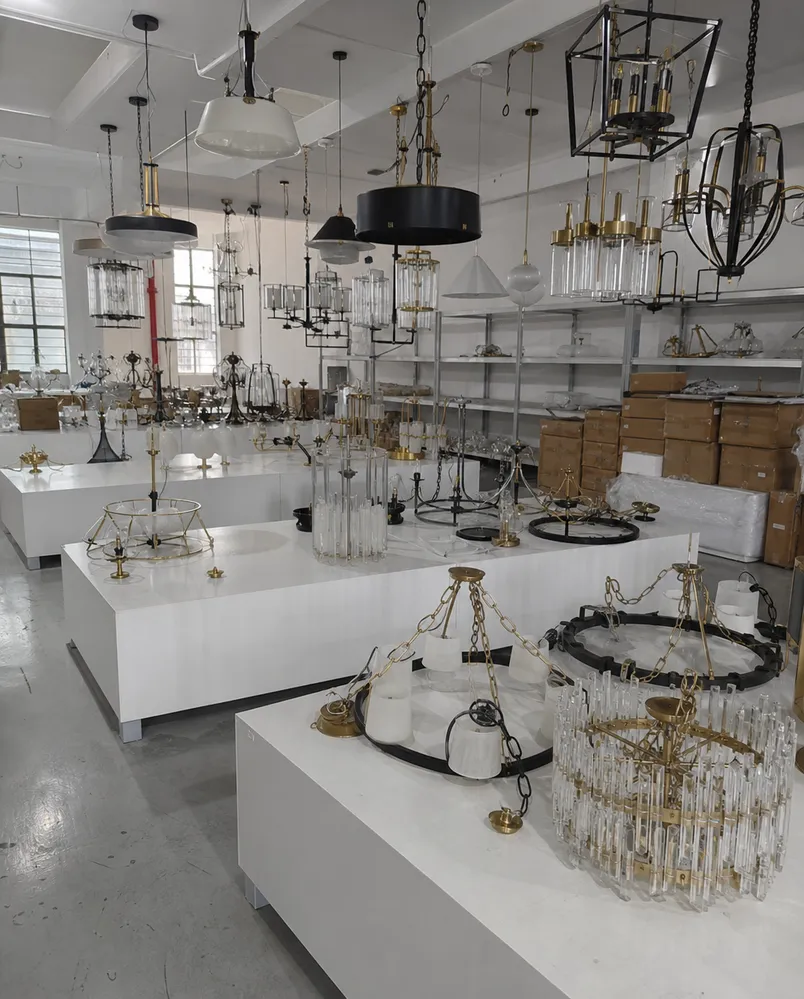

Dining Room Lighting Direct From Factory
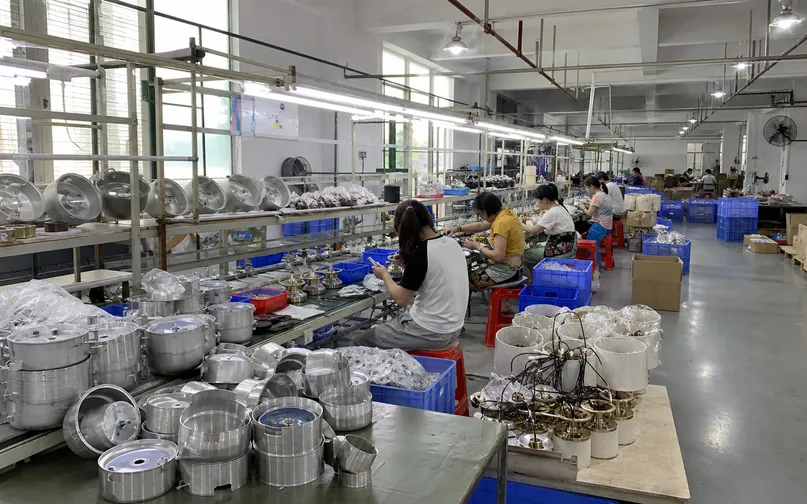
Pendants, chandeliers, and modern fixtures built for commercial and residential projects. CE, UL, and SAA certified. Full in-house production from die-casting to assembly.
OEM/ODM with 7–10 day prototype turnaround.
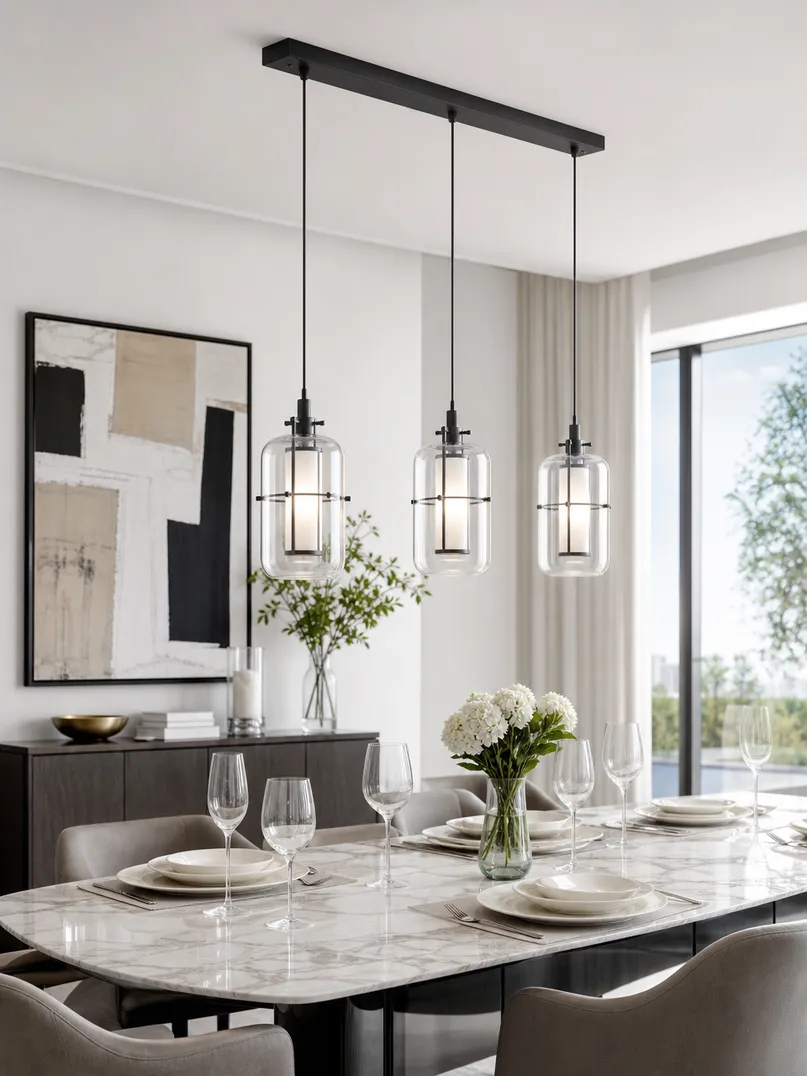
What Dining Room Lighting Buyers Actually Source From Us
Dining room lighting is one of the highest-margin decorative categories in the wholesale market — and one of the most specification-sensitive. The fixture hanging over a dining table is the visual centerpiece of the space, which means your downstream customers (hotel procurement teams, interior designers, residential developers, FF&E contractors) have strong opinions about it. They want specific proportions, specific finishes, specific light quality. That specificity is where most factories fall short, and where we've built our business.
We manufacture the full range of dining room lighting formats: pendant lighting in single and cluster configurations, linear chandeliers for rectangular tables, round chandeliers for square and circular dining spaces, and flush-mount ceiling fixtures for lower-ceiling applications.
Our buyers are importers building product lines, distributors stocking for the trade market, contractors fulfilling project specs, and overseas manufacturers sourcing components or finished fixtures under OEM arrangements. If you're evaluating us as a supplier for this category, here's what you need to know.
Importers
Building product lines
Distributors
Stocking for trade
Contractors
Fulfilling project specs
OEM Partners
Components & finished goods
Fixture Formats and Where Each One Sells
Dining room lighting isn't a single product — it's a category with distinct sub-formats that serve different market segments. Understanding which format fits your channel is the first sourcing decision.
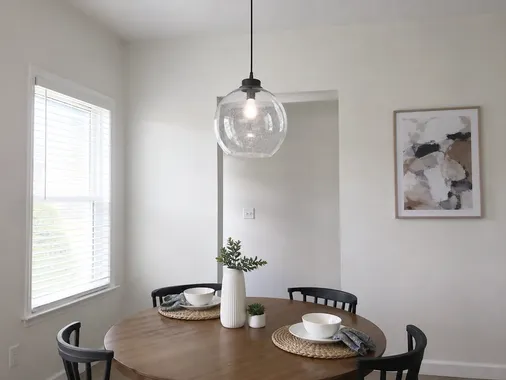
Single Pendants Over Dining Tables
Highest-volume format in the residential trade market
A single pendant — typically 30–60cm diameter, hung 70–90cm above the table surface — works for round and square tables up to 120cm. This format moves well through interior design trade accounts and residential developer programs because it's easy to specify, easy to install, and easy to photograph for catalogs. We run this format in metal, glass, and mixed-material configurations.
Sourcing note: The glass pendant variants are our fastest-moving SKUs in this category — if you're building a starter line, that's where we'd suggest beginning.
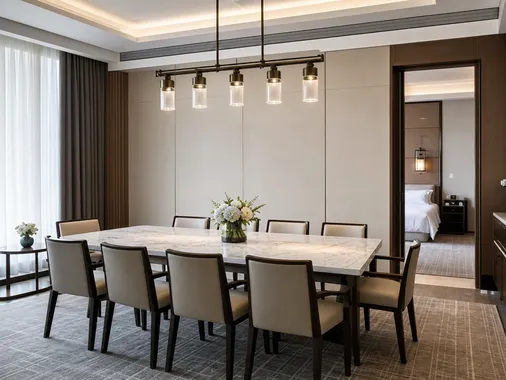
Linear Chandeliers & Multi-Pendant Bar Fixtures
Dominant format for rectangular tables & hospitality projects
A 100–150cm linear fixture over a 180–240cm dining table is the standard proportion in hotel dining rooms, private dining spaces, and high-end residential projects. This format commands higher per-unit pricing and higher margins — the complexity of the structure justifies it. We manufacture linear chandeliers in metal rod, tube, and frame configurations, with single-row and multi-tier options.
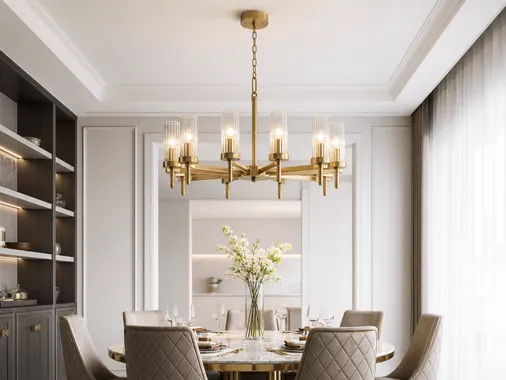
Round Chandeliers
Luxury residential & boutique hospitality segment
These are statement pieces — 60–120cm diameter, multi-arm or ring configurations, typically in brushed gold, matte black, or antique brass finishes. The order volumes are lower per SKU, but the per-unit margin is higher, and buyers in this segment reorder consistently once they find a supplier who can hold finish quality across batches.
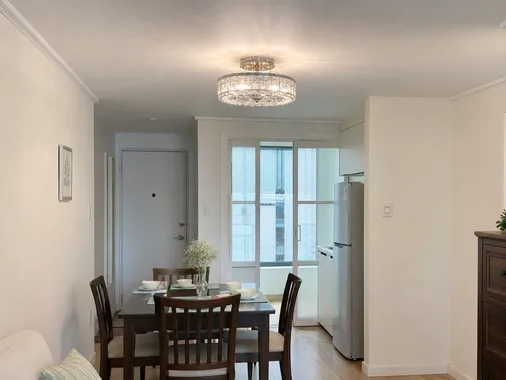
Flush-Mount & Semi-Flush Ceiling Fixtures
Lower-ceiling market — apartments, compact units, budget hospitality
This format covers the lower-ceiling dining room market — apartments, compact residential units, and budget hospitality projects where pendant drop length is a constraint. This format is often overlooked by decorative lighting distributors, but it's a steady-volume segment with less competition than the pendant and chandelier categories.
Market insight: Steady-volume segment with less competition — often overlooked by decorative lighting distributors focused on pendants and chandeliers.
Technical Specifications
Specifications below reflect industry-standard values for this product category. Actual specifications vary by SKU and configuration — contact us for detailed product data sheets on specific models.
| Parameter | Typical Range |
|---|---|
| Housing material | Aluminum alloy, zinc alloy, iron |
| Shade/diffuser material | Borosilicate glass, acrylic, fabric, metal |
| Finish options | Brushed gold, matte black, antique brass, chrome, brushed nickel, white, custom RAL |
| Canopy diameter | 10–20cm (standard); custom sizes available |
| Pendant diameter | 15–80cm |
| Linear fixture length | 60–200cm |
| Cord/rod length | Adjustable, typically 100–200cm total drop |
| Light source | E27 socket (standard); integrated LED module (OEM option) |
| Wattage | 40–100W per socket; LED modules 12–40W |
| Voltage | 110–120V (UL), 220–240V (CE/SAA) |
| IP rating | IP20 standard (indoor); IP44 available for covered outdoor dining |
| Dimmer compatibility | TRIAC and 0-10V dimming available |
| Color temperature | 2700K–4000K |
| CRI | ≥80 standard; ≥90 available on request |
| Certifications | CE, UL, SAA, SGS |
Specifications are industry-standard values for this product type. Contact us for exact data sheets on specific models.
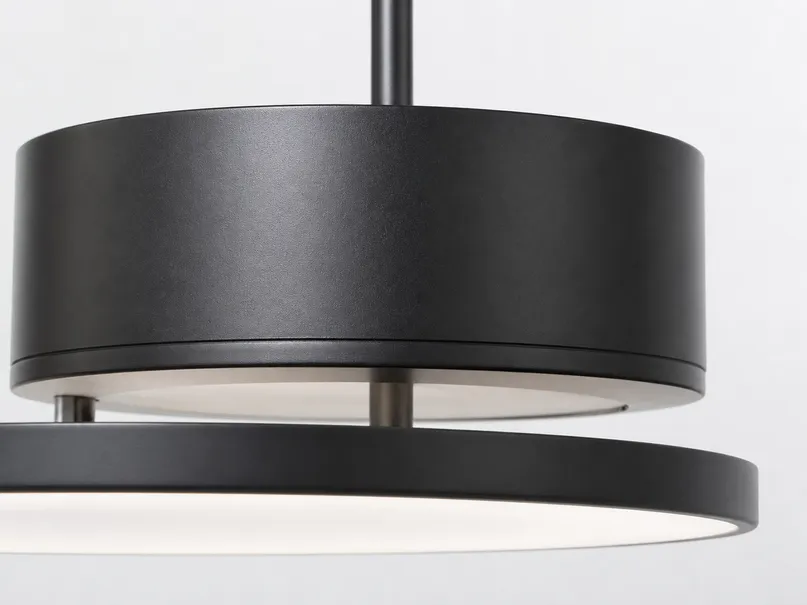
2700K–3000K
Dining standard CCT
CRI ≥90
Available on request
CE / UL / SAA
Per destination market
TRIAC / 0-10V
Dimming compatible
View specification notes
Housing: Die-cast aluminum standard for pendants; iron for decorative chandeliers
Glass options: Clear, frosted, smoked, amber
Finish: PVD and electroplating in-house
Voltage: Specified per destination market
CCT: 2700K–3000K standard for dining applications
Dimming: Specify at order stage
Certifications: Per destination market
Market Segments Worth Building a Line Around
The dining room lighting category intersects several high-value B2B market segments. Each has different order patterns, margin profiles, and specification requirements.
Hospitality FF&E Supply
Hotels, resorts, and restaurant groups specify dining fixtures in quantities of 50–500 units per project, with repeat orders as properties expand or renovate. The specification requirements are strict — CE or UL certification is non-negotiable, finish consistency across the full order is expected, and documentation (test reports, Declaration of Conformity) is required for procurement sign-off.
We've supplied this segment since our early years, and the compliance infrastructure is already in place. If you're a distributor or FF&E contractor serving hospitality clients, our certification portfolio and batch consistency are the two things that will matter most to your procurement team.
Residential Developer & Builder Programs
A growing segment for dining room lighting, particularly in markets where new residential construction is active (Southeast Asia, Middle East, Australia). Developers specify fixtures for entire projects — 20–200 units of the same SKU across multiple units.
The margin profile is lower than hospitality, but the order volumes are predictable and the reorder cycle is tied to construction phases, which means you can plan inventory. For this segment, finish durability and installation simplicity matter — your installation crews are fitting the same fixture dozens of times, and any dimensional inconsistency or wiring complication multiplies across the project.
Interior Design Trade Accounts
Smaller quantities but at higher margins. A design firm specifying fixtures for a luxury residential project might order 2–10 units of a single SKU, but they're paying trade pricing and they're specifying based on aesthetics and quality, not just cost.
This segment is where our OEM capability adds the most value — designers often want a fixture that isn't in any catalog, and our 7–10 day prototype turnaround means we can develop a custom piece without the 6–8 week lead time that kills most custom projects. We've done this enough times that we now keep a library of base tooling — canopy forms, rod profiles, shade molds — that can be recombined for custom projects without starting from scratch.
E-Commerce & Catalog Distributors
This channel needs fixtures that photograph well, ship without damage, and generate minimal returns. The key sourcing criteria are packaging durability, finish consistency across batches (so product photos stay accurate), and a clean, well-documented SKU structure.
We pack decorative pendants and chandeliers in individual foam-lined cartons with outer carton reinforcement — the packaging is engineered for the drop and compression forces of courier and LTL freight, not just ocean container stacking.
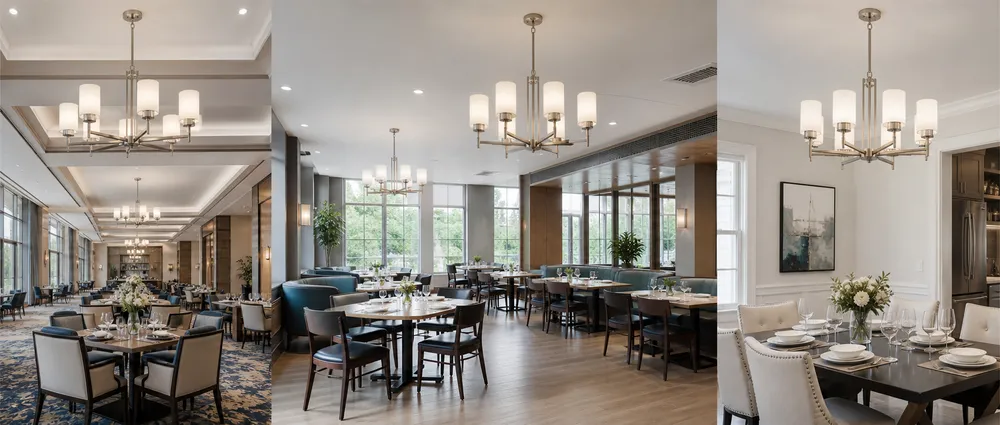
Finish Quality Across Batches: The Problem Most Factories Don't Solve
Finish consistency is the single biggest quality problem in decorative lighting sourcing, and it's worth explaining how we handle it because most factories don't.
The issue is this: a brushed gold pendant looks perfect in the sample. The first production batch looks right. By the third or fourth batch, the color has drifted — slightly warmer, slightly cooler, slightly more yellow — and your customer notices because they're placing the new fixtures next to the old ones. This happens because most decorative lighting factories outsource their surface finishing to third-party plating shops, and those shops don't hold tight color standards across runs.
We run our own electroplating, PVD, and powder coating lines in-house. That means we control the process variables — bath chemistry, temperature, current density, coating thickness — rather than depending on a subcontractor to match a color chip. For brushed gold (our highest-volume finish in the dining room category), we maintain a reference standard and check every batch against it before assembly. Powder coat thickness runs 60–80μm with automated application — consistent across the batch, not just the first few units.
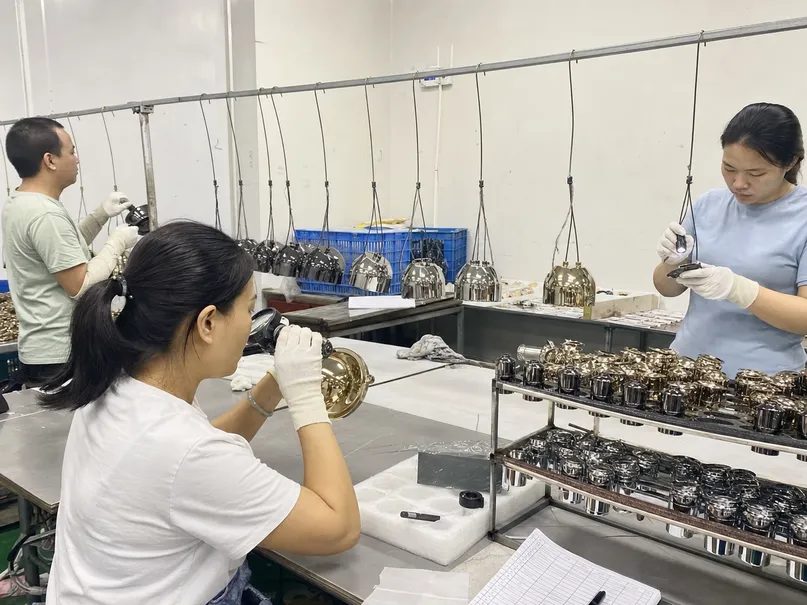
60–80μm
Powder coat thickness
200+ hrs
Salt spray testing
Salt Spray Validation for Coastal & Humid Markets
For buyers supplying coastal markets or humid climates, we run salt spray testing on finish samples before committing a batch to production. A finish that looks identical to the reference but fails at 200 hours of salt spray is a warranty problem waiting to happen. We catch it before it ships.
This matters commercially because finish inconsistency is the primary driver of returns and warranty claims in the decorative lighting category. Fewer returns means higher effective margin on your program.
In-House Capabilities
- Electroplating lines
- PVD coating
- Powder coating (automated)
- Batch reference matching
- Salt spray testing
OEM and Custom Dining Room Lighting: What's Actually Possible
OEM and ODM work is a meaningful part of our dining room lighting business — probably 40% of our volume in this category comes from buyers who want something that isn't in our standard catalog.
Dimension Modifications
Adjusting pendant diameter, linear fixture length, or canopy size to fit a specific table proportion or ceiling height. These are typically low-tooling-cost modifications if we can work from existing base tooling. We'll tell you upfront whether a requested dimension requires new tooling or can be achieved from existing molds.
Finish Customization
Custom RAL colors, custom PVD finishes, or specific patina effects. We can match a finish from a reference sample or a Pantone/RAL specification. Minimum run for custom finishes is typically 100 units per SKU — below that, the line changeover cost doesn't make sense for either side.
Shade & Diffuser Customization
Custom glass shapes, custom fabric shades, custom metal shade profiles. Glass customization requires tooling for non-standard shapes; standard geometric forms (cylinder, cone, globe, dome) can often be sourced from our existing glass supplier relationships without new tooling.
Integrated LED Module Options
For buyers who want a socket-free, integrated LED design, we can specify and integrate LED modules matched to the fixture's thermal and optical requirements. This is more complex than a socket-based design and requires photometric validation in our optical lab, but it's a capability we have in-house.
Private Label & White-Label Packaging
We can pack under your brand name with your packaging design. This is standard for our OEM buyers — custom carton printing, branded inserts, and retail-ready packaging configurations are all available.
Prototype Turnaround
7–10 working days from approved drawings to physical sample. If you're bringing a concept rather than finished drawings, our engineering team can develop production-ready drawings from reference images and target dimensions — add 3–5 days for the drawing stage.
Typical OEM Timeline
Brief & Drawing Development
3–5 days if concept-stage; skip if drawings provided
Physical Prototype
7–10 working days from approved drawings
Sample Approval & Tooling
Tooling only if non-standard shapes required
Production Run
Min 100 units/SKU for custom finishes
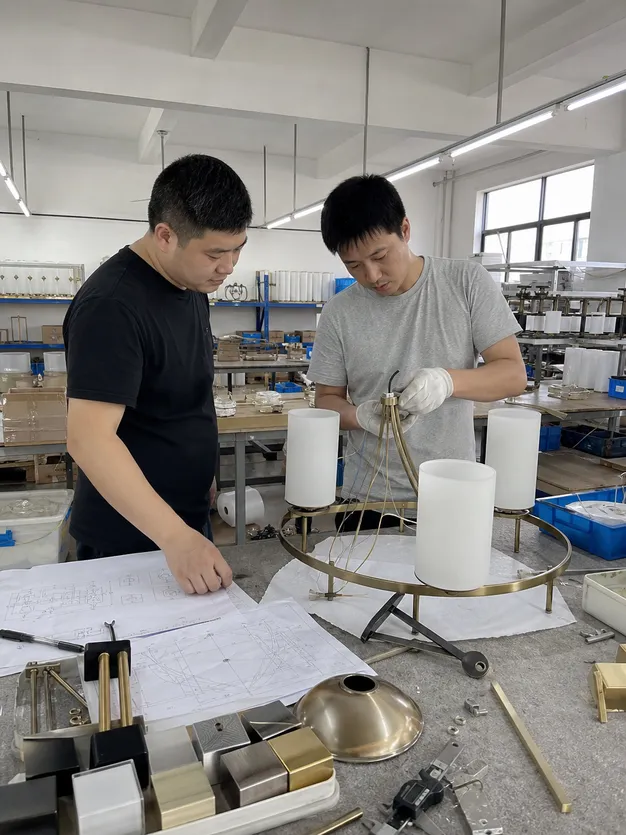
Have a custom dining room lighting concept? Send us your brief and we'll scope the project.
Send Us Your OEM BriefCertifications and Market Compliance
The certifications we hold cover the major import markets for dining room lighting.
CE
European market. Required for sale in EU member states. Covers the relevant Low Voltage Directive and EMC requirements for decorative luminaires.
UL
North American market. UL listing is required or strongly preferred by most US and Canadian distributors and is mandatory for hospitality procurement in many states.
SAA
Australian market. Required for sale in Australia and New Zealand.
SGS
General export quality verification.
ISO 9001:2015
Process quality management system, covering our full production operation.
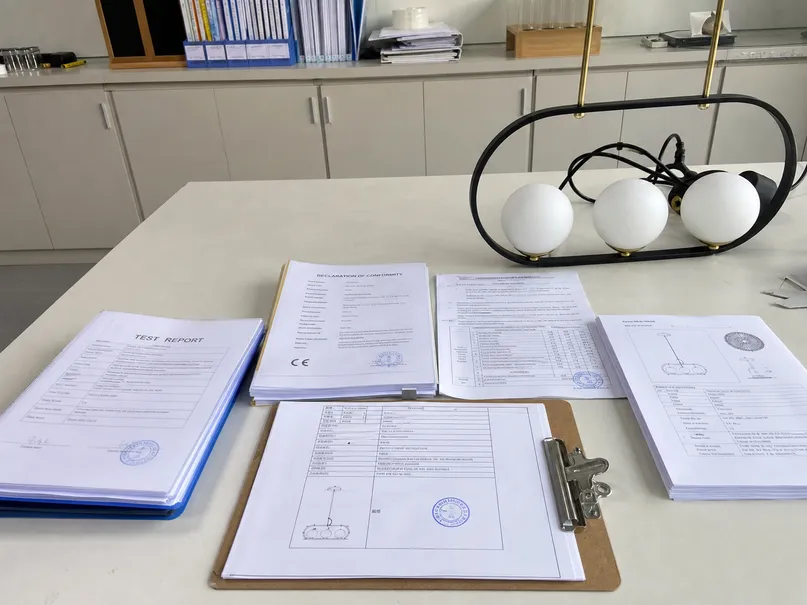
Per-SKU Documentation
For buyers entering markets with specific compliance requirements beyond these certifications, we maintain test reports and Declaration of Conformity documentation per SKU. If your import team needs a specific documentation package for customs clearance or procurement sign-off, we can provide it as part of the order documentation.
RoHS compliance: our standard LED components and drivers are RoHS-compliant. If your market requires explicit RoHS documentation, request it at the order stage.
Packaging for Freight and E-Commerce Channels
Decorative lighting is fragile, and the packaging decisions we make directly affect your damage rate in transit.
Pendant Lighting
Each fixture ships in an individual foam-lined inner carton with the glass shade or diffuser separately wrapped and cushioned. The outer carton is rated for the compression forces of ocean freight container stacking — we've tested the stack height and adjusted carton wall thickness accordingly.
Multi-Arm Chandeliers
Arms are individually wrapped and packed in a custom-formed foam insert that prevents contact between components during transit.
E-Commerce & Courier Shipments
For e-commerce and courier-shipped orders, we can pack to a higher protection standard — double-wall outer carton, additional internal bracing — at a small per-unit cost premium. If you're selling through Amazon FBA or similar fulfillment channels, ask us about our e-commerce packaging spec.
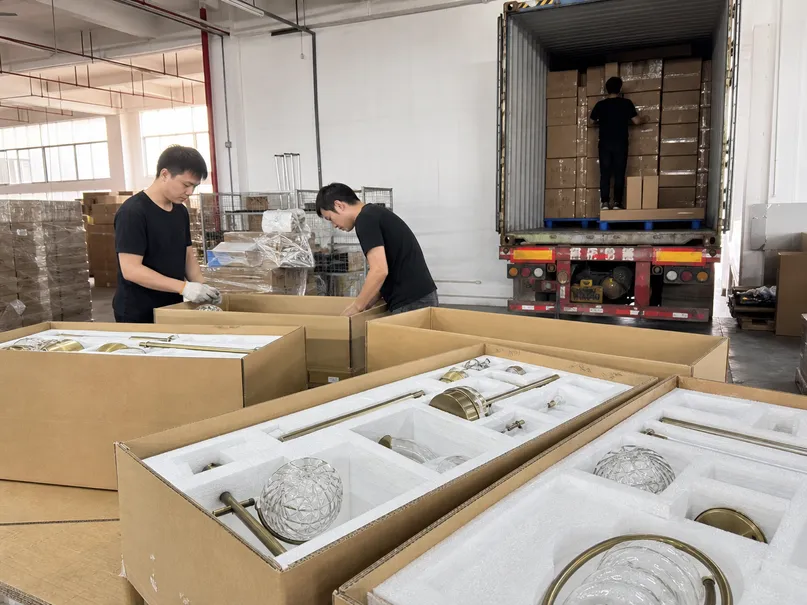
Container Loading Capacity
800–1,200
Pendant fixtures per 40HQ
(depending on size)
400–600
Chandelier units per 40HQ
We optimize carton dimensions for container loading efficiency — a 5–8% improvement in units per container is real money on a large order.
Sourcing Dining Room Lighting: Common Questions
What is the MOQ for dining room lighting?
MOQ varies by product type and configuration. Standard catalog items typically start at 50–100 units per SKU. OEM and custom orders have higher MOQs depending on tooling requirements — we specify the MOQ when we quote.
We work wholesale only; we don't fulfill single-unit orders.
What CRI should I specify for dining room applications?
CRI ≥80 is the standard for most residential and commercial dining applications.
For luxury hospitality and high-end residential projects where food presentation and skin tone rendering matter, specify CRI ≥90. The difference in component cost is modest; the difference in perceived light quality is significant enough that your hospitality clients will notice.
We stock both — specify at order stage.
How do I match a new order to an existing installation?
Finish matching across orders is the most common quality concern in this category. We maintain production records for every batch — finish parameters, material lot numbers, and reference samples — so we can match a reorder to a previous batch.
For critical matching requirements (adding fixtures to an existing installation), send us a sample from the original order and we'll verify the match before committing to production.
What's the lead time for standard catalog items vs. OEM orders?
Standard Catalog
25–35 days
from order confirmation
OEM (No New Tooling)
30–40 days
from order confirmation
OEM (New Tooling)
+15–20 days
added tooling cycle
We communicate lead time milestones proactively — if a production issue affects your ship date, you hear about it before the container is supposed to load.
Can you supply IES files for project submissions?
Yes. Our in-house optical lab generates IES files from photometric measurements on production samples. For project submissions requiring photometric data, request IES files at the sampling stage.
Related Lighting Categories
Dining room lighting often ships alongside other decorative fixtures in the same project or product line. If you're building a broader range:
Pendant Lighting
The full pendant range, including formats beyond dining room applications.
Chandelier Lighting
Including linear chandeliers, luxury chandeliers, and custom chandelier development.
Living Room Lighting
Complementary fixtures for the same residential and hospitality projects.
Restaurant Lighting
Commercial dining applications with higher-volume project specifications.
Start a Sourcing Conversation
Tell us your target market, fixture format, volume, and any certification requirements — we'll come back with a detailed quote and, where relevant, a recommendation on configuration based on what's working for our existing buyers in your region.
New to this category? Tell us your target retail price point and distribution channel — we'll suggest a starter SKU mix based on what's moving for our current distributors in similar markets.
Wholesale only. Strict MOQ applies.