

Ceiling Lighting Manufactured to Spec
Flush Mount to Luxury Statement Fixtures
Six sub-categories, full in-house production, and CE/UL/SAA certification already in place. Your ceiling lighting program ships from a factory that controls every step from die-casting to final aging test.
What We Make and Why Ceiling Lighting Is a Different Manufacturing Problem
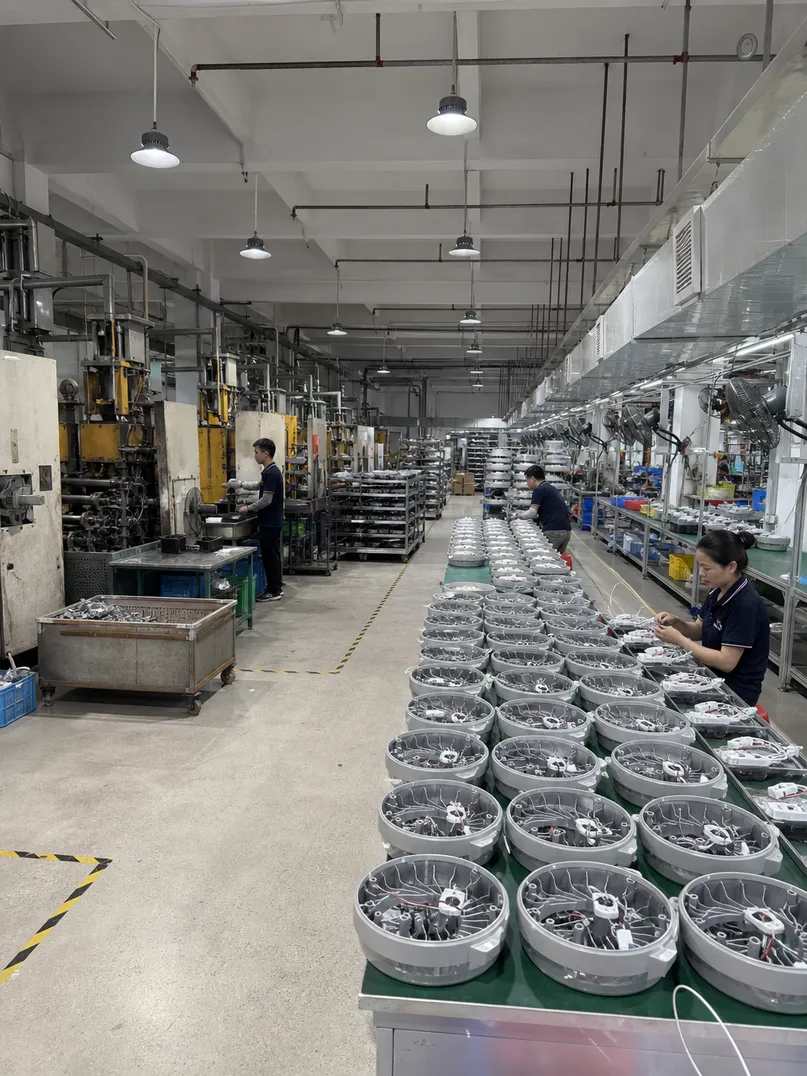
Ceiling fixtures are the most structurally demanding category in decorative lighting. A pendant hangs from a single canopy point — the load path is simple. A ceiling fixture mounts flush or semi-flush against a surface, which means the housing has to distribute weight across a wider footprint, manage heat without the airflow a pendant gets, and maintain a flat, gap-free fit against ceiling surfaces that are rarely perfectly level. We've been manufacturing ceiling lighting since 2008, and the tolerances that matter here are tighter than most buyers realize until they've had a field complaint.
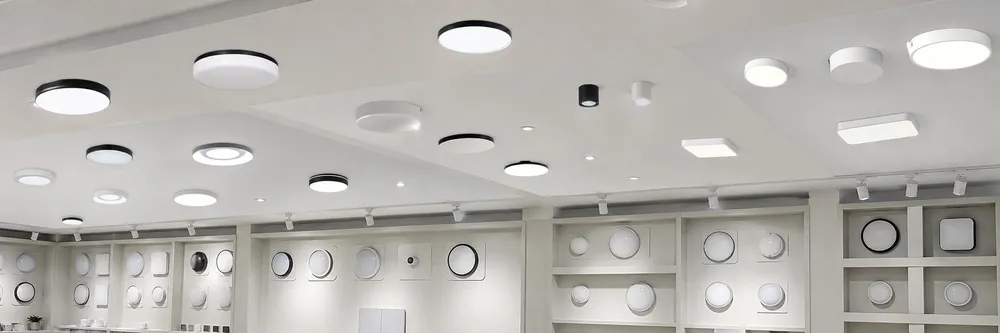
The category spans a wide commercial range: flush mount fixtures for low-ceiling corridors and hospitality back-of-house, recessed downlights for retail and office fit-outs, decorative surface-mount fixtures for residential and boutique hotel applications, and large-format luxury ceiling pieces for villa lobbies and high-end F&B spaces. Each sub-type has different structural requirements, different driver configurations, and different certification implications depending on your destination market.
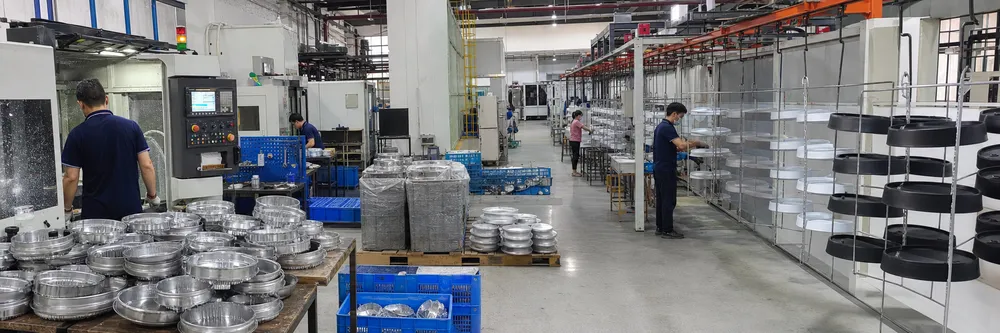
We manufacture across all of them from the same 12,000 m² facility in Guzhen — China's lighting manufacturing hub — with the same in-house die-casting, CNC machining, surface finishing, and assembly process that gives us control over the variables that cause the most problems in this category.
The Core Question for Buyers
If you're sourcing ceiling lighting for a product line or a project program, the question isn't just "can you make it" — it's whether the factory controls enough of the process to deliver consistent quality across a 500-unit batch, not just a sample. That's the distinction we're built around.
Weight Distribution
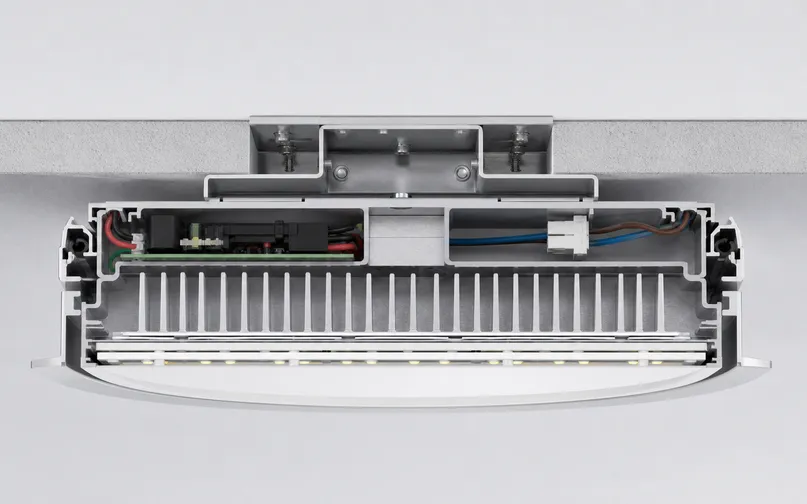
Housing distributes load across a wider footprint than pendants — requires precision die-casting tolerances for flush, gap-free mounting.
Thermal Management
No airflow gap means heat must be managed through engineered cavity geometry and material selection — not afterthought ventilation.
Surface Fit Tolerance
Ceiling surfaces are rarely perfectly level. Fixtures must maintain a flat, gap-free fit — tolerances tighter than most buyers realize until field complaints arrive.
Ceiling Lighting Product Line
Six sub-categories cover the full commercial and decorative ceiling lighting spectrum. Each links to its own product page with detailed specifications, finish options, and configuration guidance.
Modern Ceiling Lighting
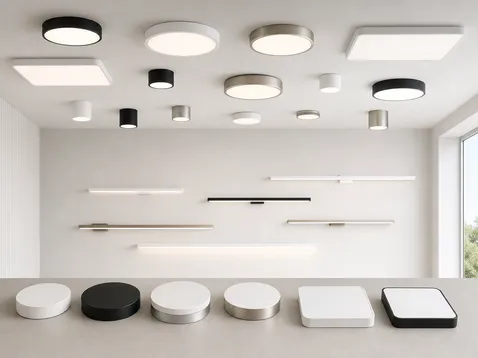
Clean geometry, minimal profile, and finish options that hold up across a full product line. The highest-volume segment for most distributors — the design language travels across markets without localization, and the price-to-margin ratio is strong at mid-tier retail. Dedicated line allocation ensures batch consistency doesn't drift between reorders.
View Products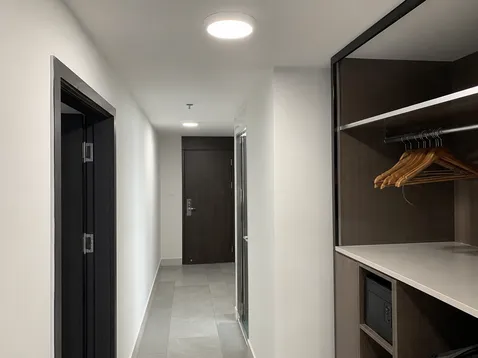
Flush Mount Ceiling Lighting
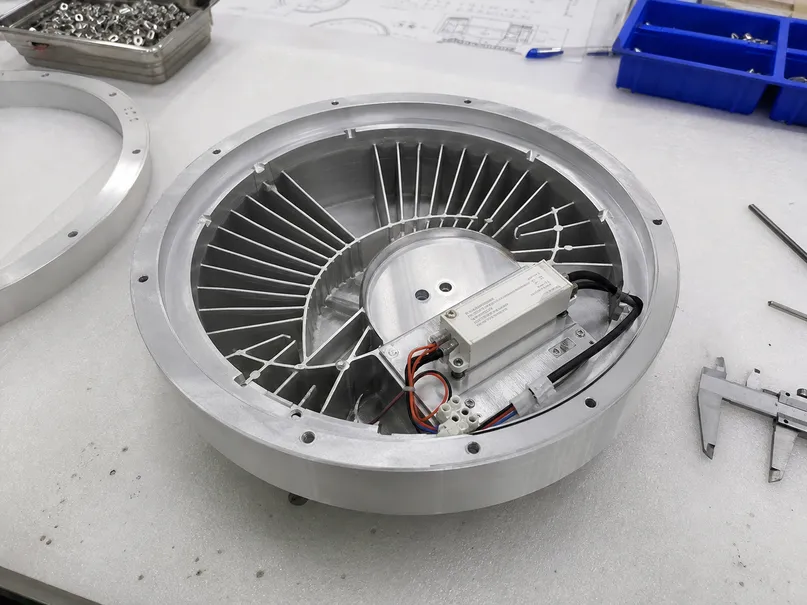
Low-profile fixtures for spaces where ceiling clearance is a constraint — corridors, low-ceiling hospitality rooms, residential bedrooms, and commercial fit-outs with strict height requirements. The structural challenge is heat management: without the air gap a semi-flush fixture gets, the driver cavity runs hotter. We spec the driver cavity depth and ventilation geometry per fixture, not as a standard template. Assembly-only factories run into field failures here — they fit a standard driver into a housing that wasn't designed around it.
View Products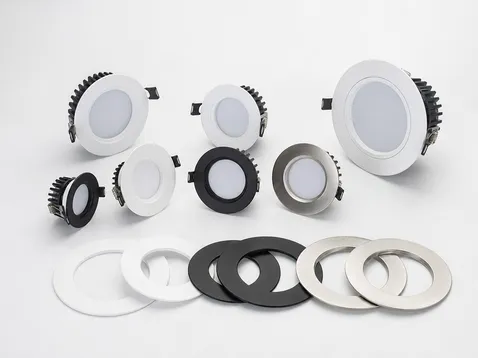
Recessed Ceiling Lighting
Recessed downlights and trim rings for retail, office, and hospitality applications. A volume category — projects spec them in quantities of 50 to 500 units per space, which means container economics matter as much as unit price. We optimize carton dimensions for 40HQ loading efficiency on recessed fixtures specifically because the cylindrical housing geometry wastes container space if packaging isn't engineered around it.
View Products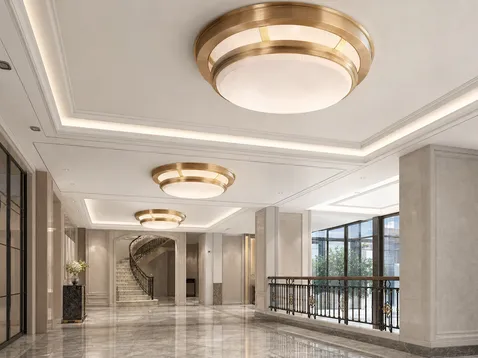
Luxury Ceiling Lighting
Large-format decorative ceiling fixtures for villa lobbies, boutique hotel public areas, and high-end residential projects. This is where die-casting and CNC machining capability matters most — complex housing geometries, multi-element assemblies, and premium surface finishes (PVD brushed gold, antique bronze, champagne) that must be consistent across every unit. A 20-unit lobby installation where two fixtures have a visible finish mismatch is a warranty claim and a relationship problem. We run photometric verification and finish inspection on every unit in luxury batches, not on a sample basis.
View Products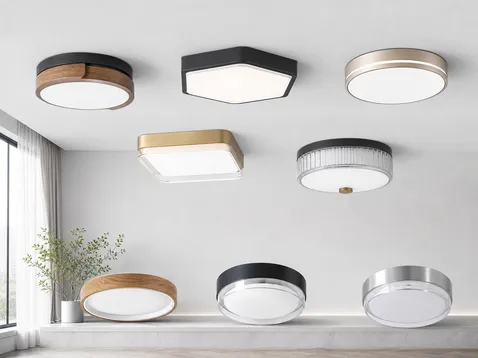
Decorative Ceiling Lighting
Surface-mount decorative fixtures that carry design intent — geometric forms, mixed-material combinations (metal and glass, metal and acrylic), and finish treatments that position above commodity. This sub-category is where OEM development is most active: buyers bring a design direction, we develop the production-ready version. Prototyping turnaround runs 7–10 working days from approved drawings to physical sample.
View Products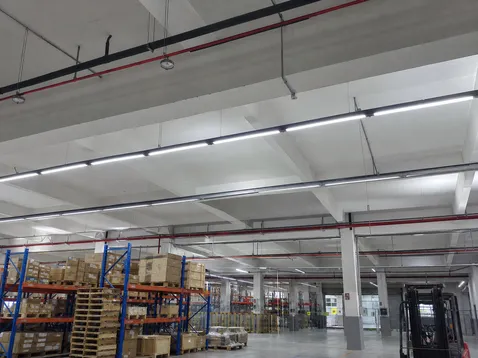
Industrial Ceiling Lighting
Robust ceiling fixtures for commercial and light-industrial environments — warehouses, workshops, retail back-of-house, and F&B kitchens. Higher IP ratings, heavier-gauge housings, and driver configurations suited to continuous-operation environments. CE and UL certification coverage applies across this sub-category for European and North American market entry.
View ProductsIn-House Production: What It Means for Your Ceiling Lighting Order
Most decorative lighting factories in Guzhen are assembly operations. They source die-cast housings from one supplier, drivers from another, glass or acrylic shades from a third, and put them together. That model works until something goes wrong — a housing batch with dimensional drift, a driver lot with early-failure rates, a shade batch with color inconsistency — and then the factory has no leverage over the supplier and no visibility into the root cause.
We run die-casting, CNC machining, surface finishing, and assembly under the same roof. For ceiling lighting specifically, that integration matters in three places.
Housing Dimensional Control
Ceiling fixtures mount against a surface, so the flange geometry and mounting hole pattern have to be consistent across a batch. Our CNC machining holds ±0.1mm on critical mounting dimensions.
When your installation team is fitting 200 fixtures across a hotel floor, they're not adjusting for dimensional variation unit to unit.
Surface Finishing Consistency
The finishing line runs automated powder coat application at 60–80μm thickness — consistent across the batch, not just the first units off the line.
For PVD and electroplating finishes on luxury fixtures, we run the same chemical bath parameters across a production run and pull finish samples at the start, middle, and end of each batch. Color and sheen consistency across a 50-unit project order is something we verify, not assume.
Driver Integration
We don't use a single driver spec across all ceiling fixtures. The driver is selected per SKU based on wattage, the thermal environment of the housing, dimming compatibility, and the certification requirements of your destination market.
A flush mount running a driver that wasn't specified for its thermal profile will show lumen depreciation within 12 months — that's a warranty claim your downstream customer brings back to you. We spec the driver to the fixture, not the other way around.
Technical Specifications: Ceiling Lighting Category Range
These are category-wide parameter ranges. Exact specifications for individual products are on each product page.
| Parameter | Category Range |
|---|---|
| Housing Material | Aluminum alloy (ADC12), zinc alloy, steel |
| Shade / Diffuser Material | Tempered glass, acrylic, polycarbonate, fabric |
| Surface Finish | Powder coat (60–80μm), electroplating, PVD, anodizing |
| Color Temperature | 2700K–6500K (warm white to daylight) |
| CRI | ≥80 (standard); ≥90 (available on request for retail/hospitality) |
| Wattage Range | 6W–120W depending on fixture type and size |
| IP Rating | IP20 (standard indoor); IP44–IP65 available for wet/damp locations |
| Dimming Compatibility | Non-dim, TRIAC, 0–10V, DALI (specified per SKU) |
| Voltage | 100–240V AC (universal); 12V/24V DC available for specific configurations |
| Certifications | CE, UL, SAA, SGS |
| Driver Type | Constant current / constant voltage, integrated or remote |
| Mounting Type | Flush mount, semi-flush, recessed (J-box or can), surface mount |
CRI ≥90 Available Across Most Ceiling Fixtures
CRI ≥90 is available across most of our ceiling fixture range — it's worth specifying if you're supplying retail, gallery, or hospitality accounts where color rendering is a selling point your buyers can mark up on.
Selecting the Right Ceiling Fixture Type for Your Market
Ceiling lighting is not a single buying decision — the right fixture type depends on the end application, the ceiling construction, and the compliance requirements of your destination market. Here's how we think about it from a sourcing perspective.
Flush Mount vs. Semi-Flush
Flush mount fixtures sit directly against the ceiling surface and are the right choice for low-ceiling environments (below 2.7m) and for buyers supplying residential or hospitality markets where a clean, unobtrusive ceiling line is the design brief. The trade-off is thermal — flush mounts need more careful driver selection because heat dissipation is constrained.
Semi-flush fixtures with a 10–15cm drop get better airflow around the housing and are more forgiving on driver longevity. If your buyers are in markets where ceiling heights vary widely, a semi-flush configuration gives you more margin for error.
Sourcing note: Semi-flush gives better thermal margin. Flush mount requires tighter driver spec to avoid early lumen depreciation.
Recessed vs. Surface Mount
Recessed fixtures require a ceiling cavity — they're the right choice for new construction and full fit-out projects where the ceiling is being built around the lighting spec.
Surface mount fixtures work in retrofit and renovation scenarios where cutting into the ceiling isn't an option. For distributors supplying both project contractors and renovation contractors, carrying both sub-types covers the full market.
We manufacture both, and the driver and optical configurations can be matched across the two types so your product line has visual consistency even when the mounting method differs.
Sourcing note: Matched driver and optical configs across both types means visual consistency for your catalog without doubling your SKU complexity.
Decorative vs. Functional
The ceiling lighting category splits cleanly between fixtures that are primarily functional (recessed downlights, flush mount utility fixtures) and fixtures that carry design intent (decorative surface mount, luxury statement pieces).
These serve different buyer segments and different price tiers:
- Functional ceiling lighting competes on specification, certification, and price.
- Decorative ceiling lighting competes on design differentiation, finish quality, and the ability to customize — which is where our OEM/ODM capability becomes the relevant factor.
IP Rating Selection
Specify your destination application and we'll confirm the right rating and the certification documentation that comes with it. We manufacture across all three IP tiers:
Standard dry indoor environments. Sufficient for most residential and commercial interior applications.
Minimum for bathroom zones and damp locations. Relevant for hospitality buyers whose projects include bathroom ceiling fixtures.
Required for outdoor-rated ceiling fixtures and covered exterior spaces.
Where Ceiling Lighting Fails in the Field — and How We Prevent It
Ceiling lighting has a specific set of failure modes that experienced buyers have seen before. We've seen them too, which is why our process is built around preventing them rather than managing warranty claims after the fact.
Lumen Depreciation Within the First Year
The Problem
The most common complaint in the ceiling fixture category. The cause is almost always thermal — a driver running above its rated temperature because the housing wasn't designed to dissipate heat adequately, or because the driver was undersized for the actual wattage draw.
Our Prevention
- Thermal simulation on new fixture designs before tooling is committed
- Driver specified to the fixture's thermal profile, not to a standard catalog spec
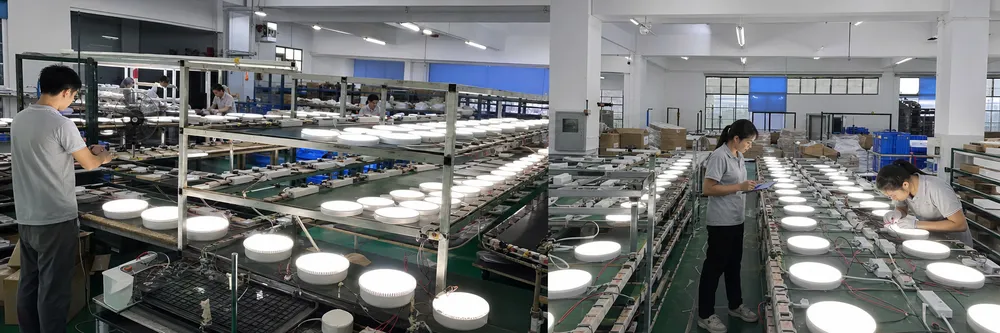
- Minimum burn-in aging test before packing — early-life driver failures show up here, not in your customer's installation
Finish Inconsistency Across a Project Batch
The Problem
A 50-unit hotel lobby order where three fixtures have a visible color shift is a project failure, not a product defect. The root cause is usually inconsistent surface finishing — powder coat thickness variation, electroplating bath chemistry drift, or PVD process parameter changes mid-run.
Our Prevention
- Automated powder line holds 60–80μm across the batch
- PVD and plating finishes: pull and inspect finish samples at the start, middle, and end of each production run
- If a batch drifts outside the approved finish standard, it doesn't ship
Mounting Fit Issues On-Site
The Problem
Ceiling fixtures that don't sit flush against the ceiling surface, or where the mounting hole pattern doesn't align with standard J-box spacing, create installation problems that your buyers' electricians will remember.
Our Prevention
- CNC machining holds ±0.1mm on mounting dimensions
- Mounting geometry verified against the destination market's standard electrical box spacing before production
- North American J-box spacing and European ceiling rose dimensions are different — we spec the mounting pattern to the destination market, not to a single global standard
Glass and Shade Breakage in Transit
The Problem
Decorative ceiling fixtures with glass diffusers or acrylic shades are the highest-risk category for transit damage. If you're seeing high breakage rates from your current supplier, the packaging engineering is the first place to look.
Our Prevention
- Individual foam-lined inner cartons per fixture type
- Outer carton compression ratings matched to ocean freight stacking loads
- Internal bracing for multi-element fixtures
- Breakage rate on glass ceiling fixtures shipped to North America and Europe: below 0.5% on standard export packaging
Driver-Dimmer Incompatibility
The Problem
Ceiling fixtures installed with incompatible dimmers flicker, buzz, or fail to dim smoothly — and the complaint comes back to the fixture, not the dimmer. This is a detail that matters at the project specification stage, not after installation.
Our Prevention
- Dimming compatibility specified per SKU with compatible dimmer range in product documentation
- TRIAC drivers configured for North American markets where TRIAC dimmers are standard
- DALI or 0–10V systems configured for commercial European fit-outs
OEM and Custom Ceiling Lighting Development
Custom ceiling lighting is a meaningful part of our business — roughly a third of our ceiling fixture volume is OEM or ODM work. The development process is straightforward: you bring a design direction, reference images, target dimensions, and a target cost, and our engineering team develops the production-ready design.
Prototyping: 7–10 Working Days
From approved drawings to physical sample — that's a CNC-machined housing, provisional surface finishing, and driver integration, not a 3D-printed mock-up.
Physical samples let you evaluate thermal performance, optical output, and finish quality before committing to production tooling.
Customization Dimensions Available
Housing Geometry
Custom die-cast tooling for unique forms. Tooling cost and lead time depend on complexity — simple geometric forms run faster and cheaper than organic or multi-element designs. We flag tooling cost traps early in the design review rather than quoting them in and surprising you at the sample stage.
Dimensions
Size scaling within the structural limits of the housing design. Flush mount fixtures can typically be scaled ±30% from a base design without new tooling; larger changes require tooling modification or new tooling.
Surface Finish
Any finish in our standard range (powder coat colors, electroplating, PVD, anodizing) is available on custom orders. Custom RAL colors are available on powder coat runs over 100 units — below that, the line changeover cost doesn't make sense for either side.
Light Source Configuration
Wattage, color temperature, CRI, and dimming compatibility are all configurable per SKU. We can also configure for specific driver brands if your market has a preference.
Branding & Packaging
Custom logo on the fixture, custom packaging design, and private label documentation are all standard OEM services.
New to Ceiling Lighting?
For buyers entering the ceiling lighting category for the first time, we can suggest a starter SKU mix based on what's moving for our existing distributors in your region. The modern flush mount and recessed downlight categories are the highest-volume entry points for most new distribution programs.
Certifications and Market Compliance
CE, UL, SAA, and SGS certification coverage is already in place across the ceiling lighting range — these aren't certifications we're working toward, they're part of the product development process. When you're ready to import, your compliance documentation is ready.
| Certification | Market Coverage | What It Covers |
|---|---|---|
| CE | European Union, EEA | LVD, EMC, RoHS compliance |
| UL | North America (US, Canada) | Electrical safety, listed for residential and commercial use |
| SAA | Australia, New Zealand | Electrical safety and compliance with AS/NZS standards |
| SGS | General export, buyer audit | Third-party quality and safety verification |
| ISO 9001:2015 | Process certification | Quality management system across all production |
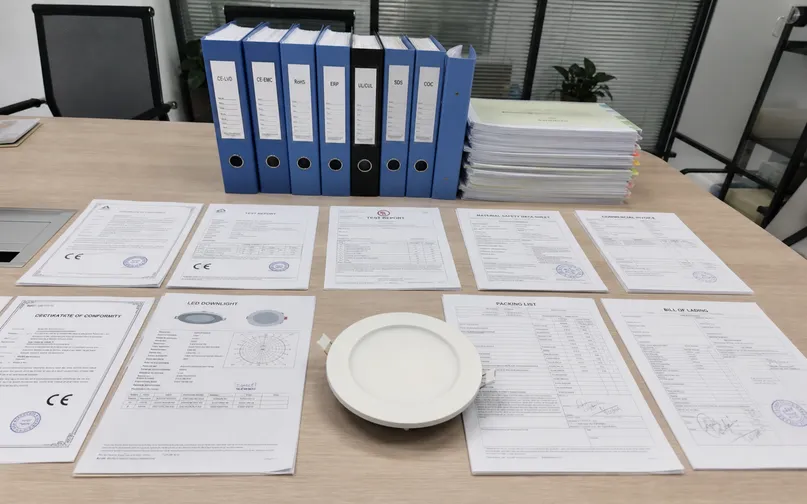
Documentation Packages Per SKU
For buyers who need specific documentation packages — Declaration of Conformity, test reports, material safety data sheets — we maintain these per SKU and provide them as part of the order documentation.
Available Documentation
- Declaration of Conformity (DoC)
- Full test reports (LVD, EMC, photometric)
- Material safety data sheets (MSDS)
- Custom documentation for retailer compliance programs
- Customs clearance documentation packages
If your import team has specific documentation requirements for customs clearance or retailer compliance programs, tell us at the inquiry stage and we'll confirm what's available.
Export Packaging and Container Economics
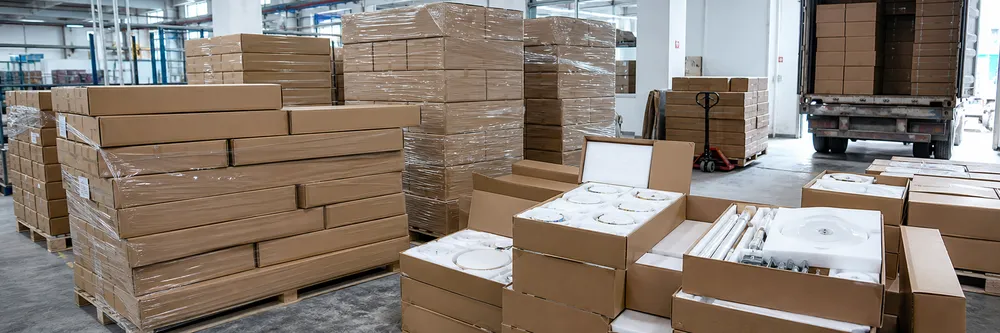
Ceiling fixtures are a mixed-fragility category — recessed downlights are relatively robust, while decorative surface-mount fixtures with glass diffusers need careful packaging engineering. We handle both differently.
Recessed & Flush Mount Fixtures
Carton dimensions are optimized for 40HQ container loading. Cylindrical recessed housings are the worst-case geometry for container efficiency — if you pack them in round cartons, you're shipping air.
We use rectangular outer cartons sized to the fixture's actual footprint, which typically improves loading density by 15–20% versus round packaging.
On a 2,000-unit recessed fixture order, that's real freight cost savings — fewer containers, lower per-unit landed cost.
Decorative & Luxury Fixtures
Each fixture ships in an individual foam-lined inner carton with the glass or shade element separately wrapped and cushioned. Outer cartons are rated for the compression loads of ocean freight stacking.
We've tested packaging for specific routes — the Middle East and Australian routes have different handling characteristics than European port routes, and we've adjusted internal bracing accordingly.
Route-specific packaging engineering reduces breakage claims and protects your margin on high-value decorative orders.
Lead Time Milestones
Standard catalog ceiling fixtures from order confirmation to shipment readiness.
Custom and OEM orders with new tooling — added to production lead time for the tooling cycle.
We communicate lead time milestones proactively — if a production issue is going to affect your ship date, you hear about it before the container is supposed to load.
Market Segments: Where Ceiling Lighting Generates Repeat Volume
Ceiling lighting is one of the highest-repeat-order categories in decorative lighting distribution. The segments below generate consistent volume for our existing buyers — not because the end-user experience is compelling, but because the commercial structure of each segment drives repeat purchasing.
Hospitality Fit-Out & Renovation
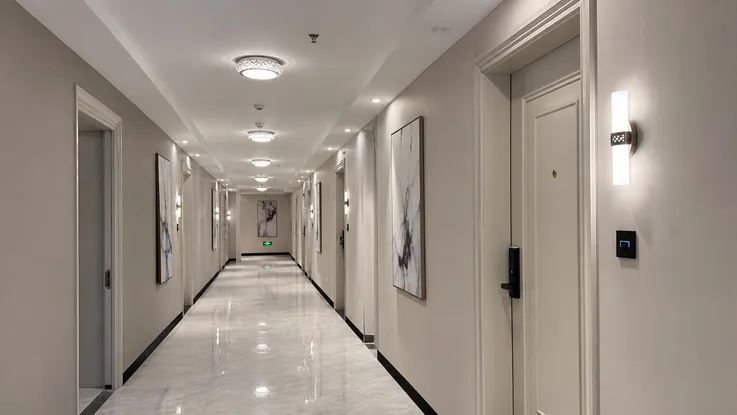
Hotels, serviced apartments, and boutique hospitality properties replace ceiling fixtures on 5–8 year renovation cycles, and they order in project quantities (50–500 units per property).
Distributors supplying FF&E procurement companies or hotel chains have a predictable reorder cycle once they're on the approved supplier list.
Residential Development
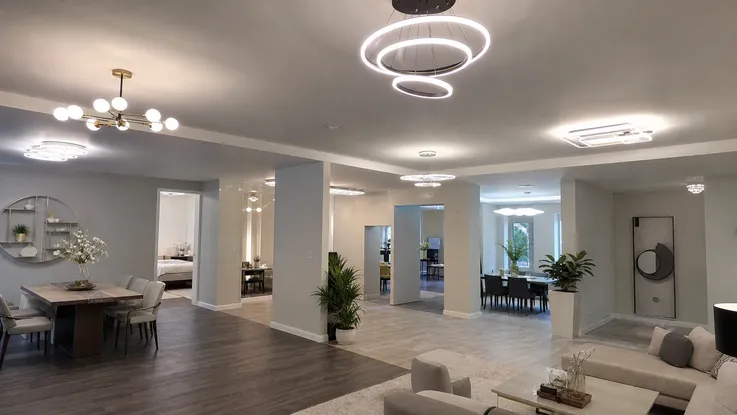
Property developers and interior design firms specifying ceiling lighting for multi-unit residential projects order in quantities that make MOQ requirements straightforward.
The design brief in this segment changes every 2–3 years as aesthetic trends shift, which creates a natural product refresh cycle — buyers who can offer new designs on a regular cadence retain developer accounts better than those with static catalogs.
Commercial Office & Retail Fit-Out
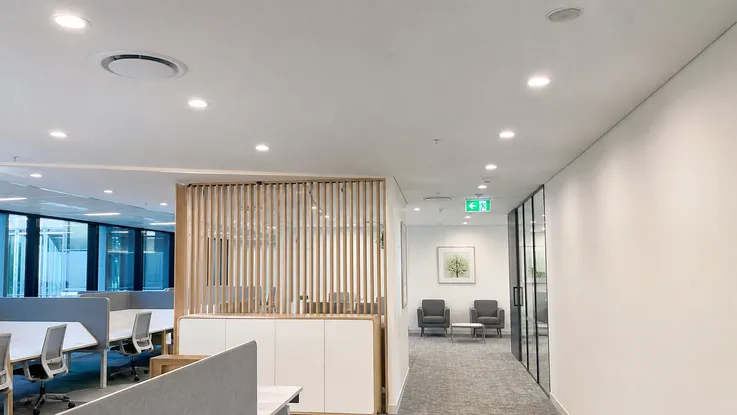
Recessed ceiling lighting is the dominant sub-type in this segment. Office and retail fit-outs spec recessed downlights in quantities of 100–1,000 units per project.
Project contractors who have a reliable recessed fixture supplier with consistent lead times and documentation tend to consolidate purchasing. CE and UL certification is a prerequisite for most commercial fit-out projects in regulated markets.
Retail Lighting Distribution
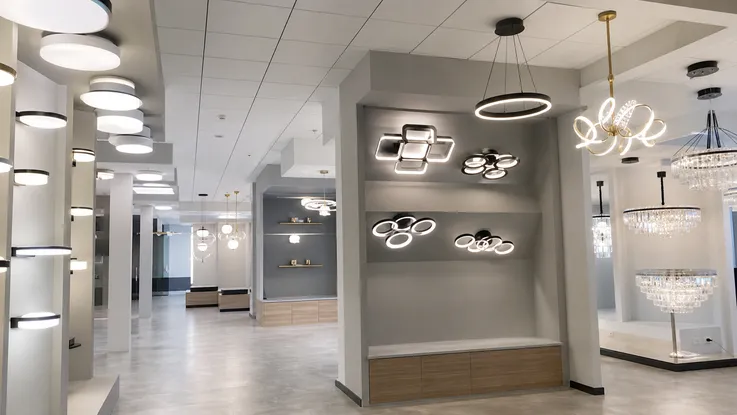
Lighting showrooms and online retailers carrying ceiling fixtures need a range that covers multiple price tiers and design directions.
The ceiling lighting category is well-suited to a tiered product line strategy — functional flush mount at the entry tier, modern decorative at the mid tier, and luxury statement fixtures at the premium tier.
We manufacture across all three tiers, which means you can build a coherent ceiling lighting range from a single factory relationship.
Frequently Asked Questions
What IP rating do I need for ceiling lighting in bathroom and wet-area applications?
What IP rating do I need for ceiling lighting in bathroom and wet-area applications?
For standard bathroom ceiling zones (Zone 2 — areas within 0.6m of a bath or shower), IP44 is the minimum requirement under IEC 60598 and most national standards derived from it. For Zone 1 (directly above a bath or shower, up to 2.25m height), IP45 or higher is required. For outdoor covered areas and exterior ceiling applications, IP65 is the standard minimum. IP20 is sufficient for dry indoor environments — living rooms, bedrooms, corridors, and standard commercial interiors.
If you're supplying hospitality buyers whose projects include bathroom ceiling fixtures, specify IP44 as your baseline and confirm the zone classification with the project spec.
We manufacture ceiling fixtures across IP20, IP44, and IP65 ratings; the certification documentation is included with the order.
Why do LED ceiling fixtures lose brightness after 6–12 months in service?
Why do LED ceiling fixtures lose brightness after 6–12 months in service?
Lumen depreciation at that rate is almost always a thermal problem, not an LED chip problem. The LED chips themselves are rated for 50,000+ hours at their specified junction temperature — but if the driver is running hot because the housing wasn't designed to dissipate heat adequately, the driver degrades faster than the LEDs, and the output drops.
The second cause is driver undersizing: a driver running at 95% of its rated load runs significantly hotter than one running at 70–80%, and the thermal stress accumulates.
Supplier evaluation tip: When evaluating ceiling fixture suppliers, ask specifically how the driver is specified relative to the fixture's thermal profile — not just the wattage rating.
We run thermal simulation on new designs and specify the driver to the fixture's actual thermal environment, not to a standard catalog spec.
What is the difference between TRIAC dimming and DALI dimming for ceiling fixtures, and which should I specify?
TRIAC (Phase-Cut) Dimming
The standard in residential and light commercial applications in North America and most of Europe. Compatible with the wall dimmers already installed in most buildings.
Specify TRIAC for:
- Residential projects
- Hospitality applications
- Retrofit commercial applications with existing dimmer infrastructure
DALI (Digital Addressable Lighting Interface)
A two-wire digital control protocol used in commercial building management systems. Allows individual fixture addressing, scene programming, and integration with building automation.
Specify DALI for:
- New commercial fit-outs
- Office buildings
- Hospitality properties with centralized lighting control systems
What is the minimum order quantity for custom ceiling lighting, and what does the development process look like?
MOQ Depends on Tooling Requirements
Designs executed within our existing housing forms, mounting configurations, and shade types.
Depending on fixture type
Designs requiring new tooling to amortize the tooling investment.
Specific MOQ confirmed at design review
Development Process
You Provide
Reference images, target dimensions, target cost, and destination market certification requirements.
Engineering Review
Our engineering team reviews the design for manufacturability and cost, then delivers a DFM (design for manufacturing) assessment and a tooling cost estimate.
Physical Sample
Once the DFM assessment is approved, we produce a physical sample in 7–10 working days.
Production
Production starts after sample approval.
How do I verify that ceiling fixture certifications are valid for my destination market?
CE certification for the EU requires a Declaration of Conformity (DoC) and a technical file — the DoC is the document your import team needs, and we provide it per SKU. For UL, the fixture should carry the UL Listed mark and the UL file number, which can be verified directly on UL's public database. For SAA (Australia/New Zealand), the certification is issued by a registered testing body and includes a certificate number that can be verified with the issuing body.
Ask any supplier for the actual certificate documents, not just a claim of certification — a certificate has an issue date, an expiry date, a scope of products covered, and a certificate number. If a supplier can't provide the certificate document, the certification claim should be treated as unverified.
Our standard practice: We maintain current certification documents per SKU and provide them as part of standard order documentation.
What causes ceiling fixture housings to discolor or yellow over time?
Yellowing on ceiling fixture housings is almost always a UV degradation issue on the surface finish or the shade material, not a structural problem. Powder-coated aluminum housings don't yellow — the powder coat is UV-stable and the aluminum substrate doesn't oxidize visibly.
Acrylic diffusers and shades will yellow under prolonged UV exposure, which is why we use UV-stabilized acrylic grades on fixtures intended for environments with natural light exposure. Polycarbonate is more UV-resistant than standard acrylic but has lower optical clarity — the right material depends on the application.
High-UV environments (skylights, conservatories, covered outdoor areas): specify UV-stabilized diffuser materials and confirm the material grade with us at the inquiry stage.
Start Your Ceiling Lighting Sourcing Conversation
New to Ceiling Lighting as a Category?
Looking to consolidate your current supplier base? Send us your target market, volume expectations, and the sub-types you're prioritizing — we'll suggest a starter SKU mix based on what's moving for our existing distributors in your region, and come back with a detailed quote including certification documentation.
Already Have a Design or Project Spec?
Send us the drawings, reference images, or the current product you're sourcing — our engineering team will review it and respond with a configuration recommendation and a quote within 2 business days.
Wholesale only. Strict MOQ applies.
Contact Us Directly
Phone
+86 134 2021 9307Address
No. 14 Beisan Rd, Gusan Ind. Zone, Guzhen, Zhongshan, Guangdong, China