

Pendant Lighting Manufacturer
Wholesale pendant lighting from a factory that has been making them since 2008 — not assembling them, making them.
10 pendant sub-categories, full in-house production from die-casting to surface finishing, and OEM/ODM capability with 7–10 day prototype turnaround. CE, UL, and SAA certified for your target markets.
What We Manufacture and How We Do It
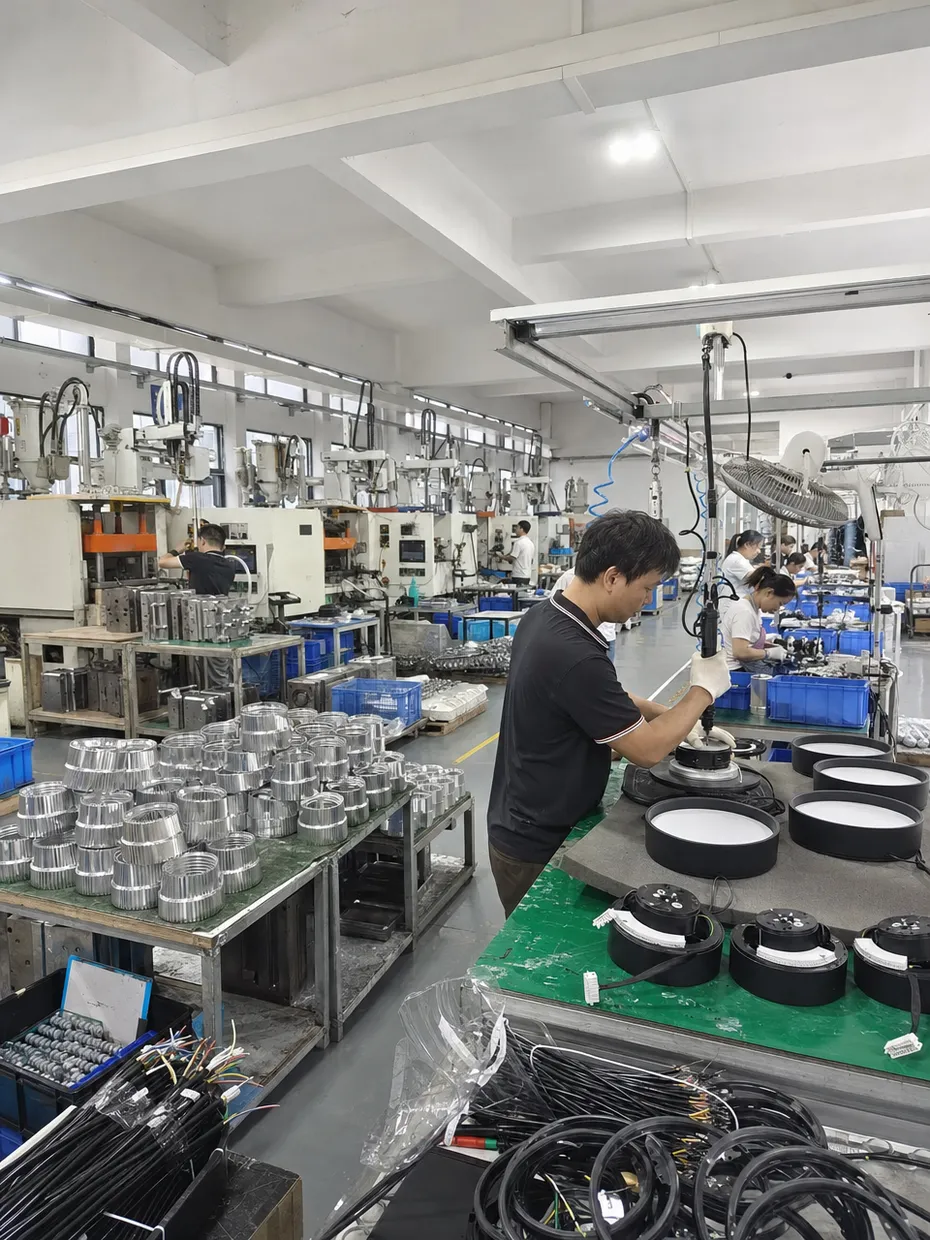
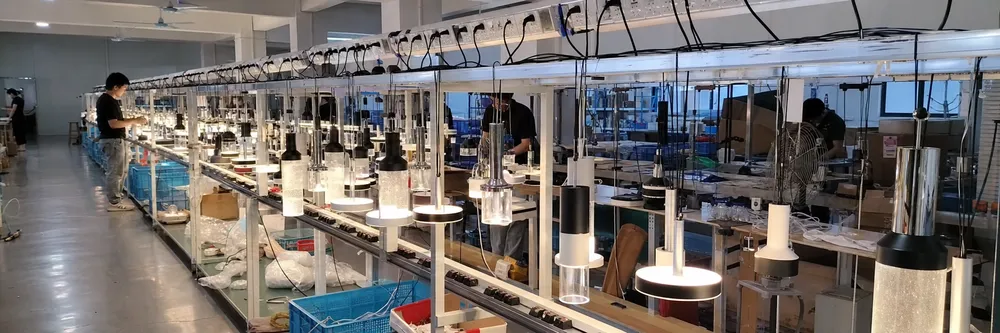
Pendant lighting is where we started. When we opened the factory in Guzhen in 2008, decorative pendants and chandeliers were the core of the business — and they still are. Over 18 years, we've built the production infrastructure specifically around this category: die-casting for aluminum and zinc alloy housings, CNC machining for mounting hardware and canopy components, in-house surface finishing for the finishes that pendant buyers actually specify, and an optical lab that validates photometric performance before a design goes into production.
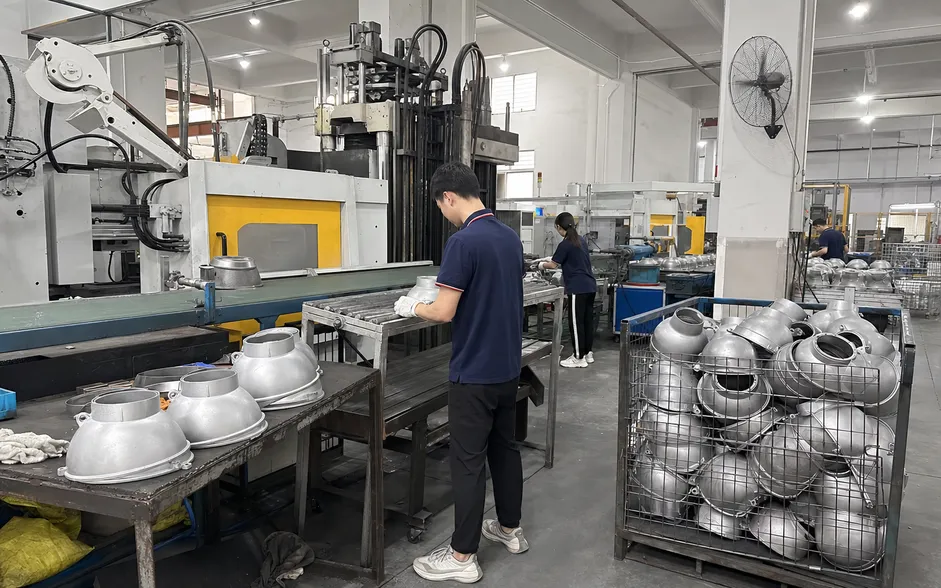
Most lighting factories in Guzhen are assembly operations. They source die-cast housings from one supplier, drivers from another, glass shades from a third, and put them together. We run die-casting, CNC machining, and surface finishing under the same 12,000 m² roof. That matters for pendant lighting specifically because the three most common quality complaints in this category — dimensional inconsistency on mounting hardware, finish variation across a batch, and driver-to-fixture compatibility failures — all trace back to fragmented supply chains. When we control the casting, the machining, and the finishing ourselves, we control those variables.
Our pendant lighting range covers 10 sub-categories, from minimalist modern cylinders to multi-drop cluster configurations to long-drop staircase installations. The full line is designed for buyers building a product catalog or fulfilling project specs across multiple segments — not for one-off purchases. We work wholesale only, with strict MOQ requirements.
Why In-House Production Matters for Pendants
Pendant Lighting Product Line
Ten sub-categories, each with its own design logic and target market. Here's the full picture.
Modern Pendant Lighting
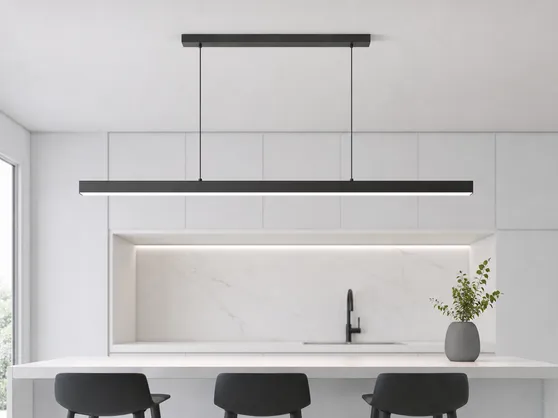
Clean geometry, minimal ornamentation, aluminum and steel construction. The volume segment for residential developers, hospitality fit-outs, and mid-to-high-end retail. Consistent demand across North American and European markets — if you're building a core catalog, this is where most buyers start.
Glass Pendant Lighting
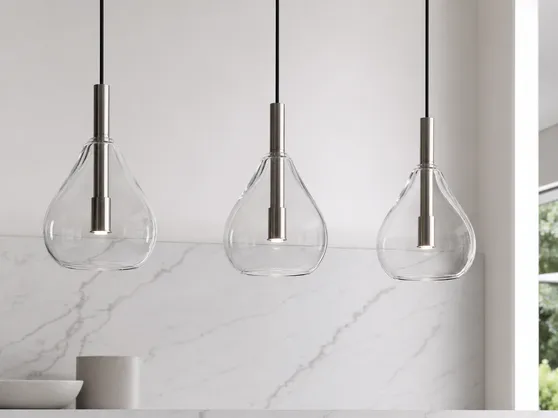
Blown and molded glass shades with metal hardware. The glass is sourced from specialist suppliers in the Guzhen supply chain; we handle the hardware, wiring, and assembly in-house. Glass pendants carry higher retail margins than all-metal designs — the material cost is visible to the end buyer, which supports your pricing.
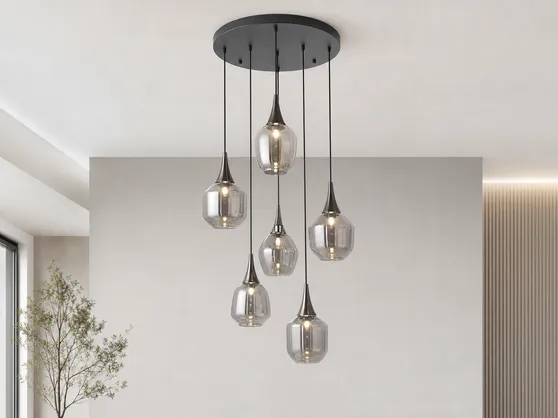
Cluster Pendant Lighting
Multi-drop configurations on a single canopy — typically 3, 5, 7, or custom counts. Popular in restaurant and hospitality fit-outs where a single fixture needs to fill a large ceiling zone. We've done custom cluster configurations up to 24 drops for hotel lobby projects — if you have a project spec that goes beyond standard counts, send it over.
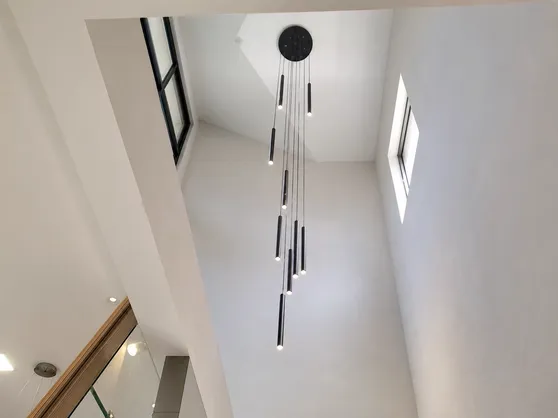
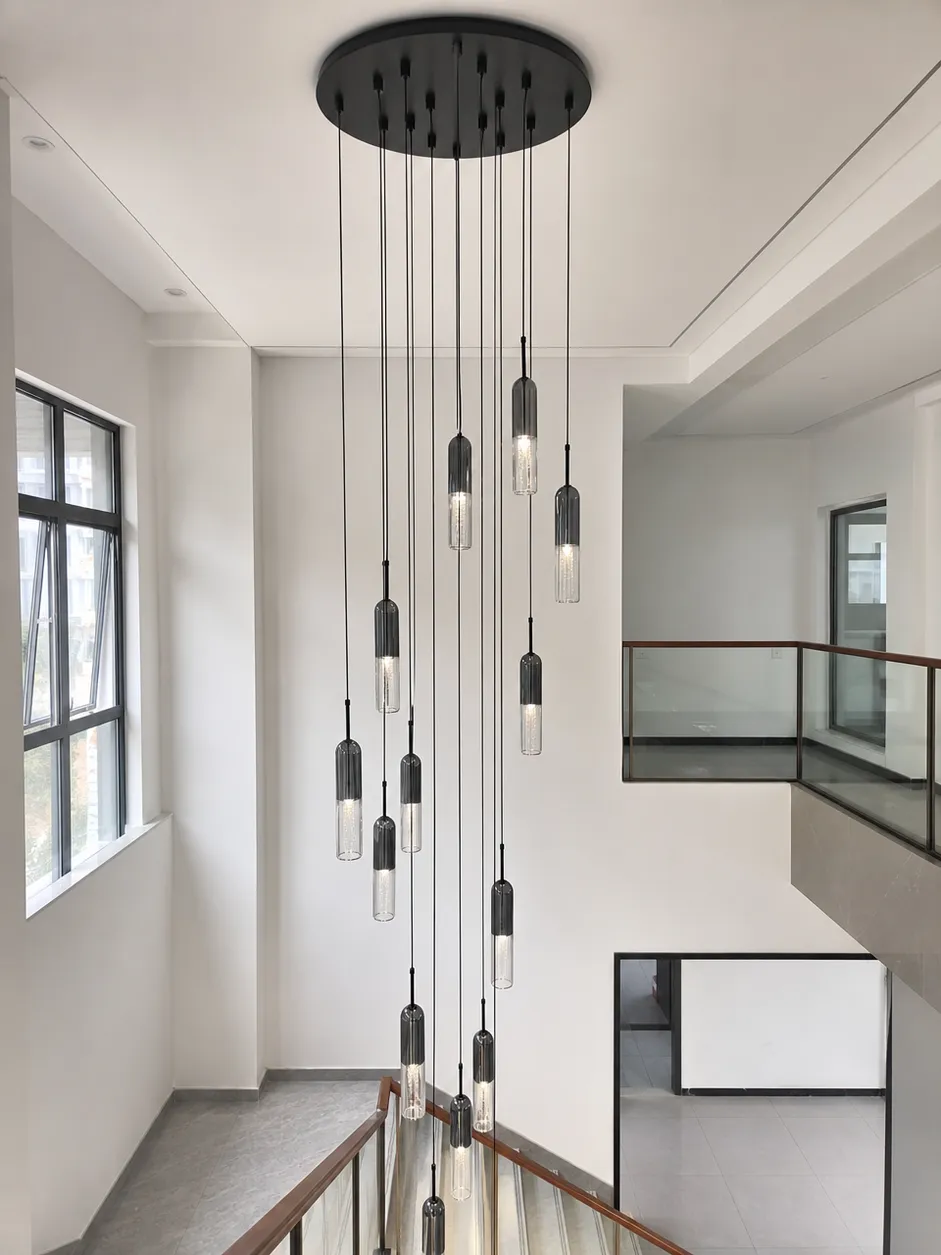
Staircase Pendant Lighting
Long-drop designs engineered for high-ceiling installations — stairwells, double-height lobbies, atrium spaces. Drop lengths are customizable; the cable and canopy hardware are rated for the extended suspension load. This sub-category requires more careful packaging than standard pendants — we use individual foam-lined cartons with reinforced outer packaging for ocean freight.
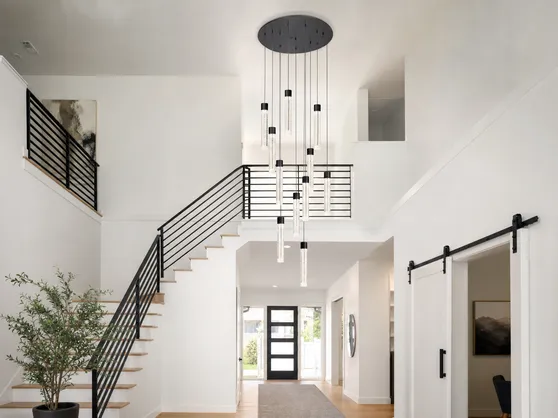
Entryway Pendant Lighting
Statement fixtures for foyer and entrance applications — typically larger diameter, more decorative detailing, and finishes that photograph well for project documentation. Strong segment for luxury residential developers and hotel chains specifying entrance lighting across multiple properties.
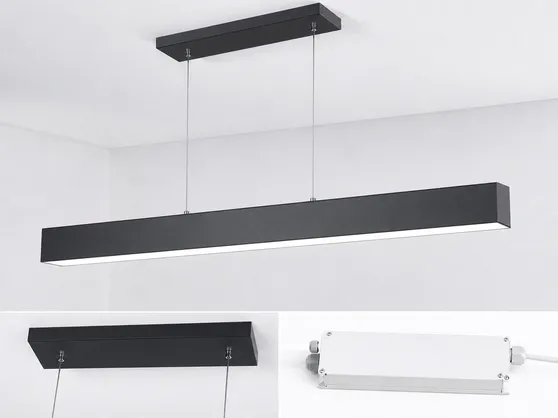
LED Pendant Lighting
Integrated LED designs where the light source is built into the fixture rather than using a replaceable bulb. Driver selection is matched per SKU to wattage, dimming compatibility, and destination market voltage. For buyers supplying markets with strict energy efficiency requirements, we can provide photometric data and IES files for project submissions.
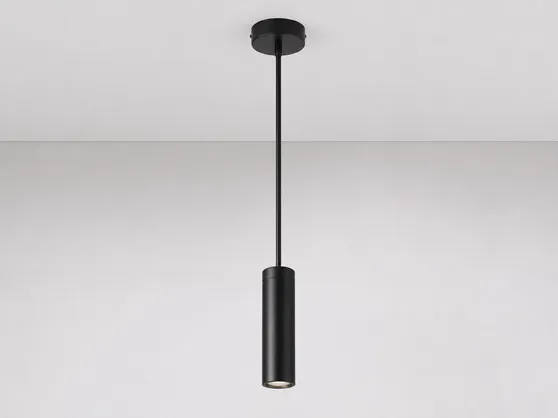
Cylinder Pendant Lighting
Single-drop cylindrical housings — the most versatile form factor in the pendant category. Works across residential, commercial, and hospitality applications. High container loading efficiency due to the compact geometry, which reduces your landed cost per unit on volume orders.
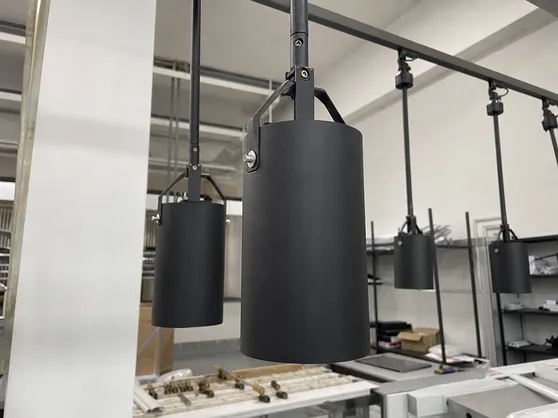
Industrial Pendant Lighting
Exposed hardware, matte black and raw metal finishes, cage and shade configurations. Strong demand in restaurant, bar, and commercial retail fit-outs. The industrial aesthetic has been consistent for a decade — it's a reliable catalog segment with predictable reorder patterns.
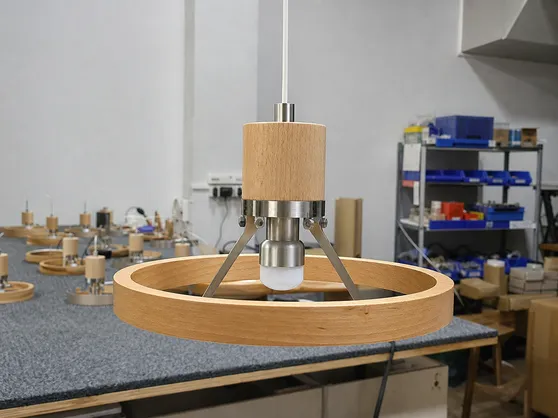
Wood Pendant Lighting
Natural wood elements combined with metal hardware. The wood components are sourced and finished to our spec — we don't use MDF or veneer on the visible surfaces. Biophilic design segments in residential and hospitality have driven steady growth in this sub-category over the past few years.
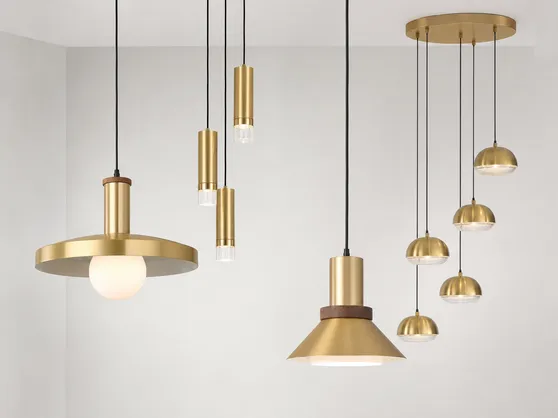
Gold Pendant Lighting
Brushed gold, antique brass, and champagne gold finishes on metal housings. Finish consistency across a batch is the critical quality variable here — gold tones are unforgiving of color drift. Our PVD and electroplating lines hold finish color within ΔE < 1.5 across a production run, so your 200-unit hotel order arrives with consistent color throughout.
Technical Specifications: What to Expect Across the Range
Category-level parameters for pendant lighting from our facility. Individual product pages carry exact specifications per SKU.
| Parameter | Range / Options |
|---|---|
| Housing Materials | Aluminum alloy (ADC12), zinc alloy (ZA-8), steel, wood + metal combinations |
| Shade Materials | Blown glass, molded glass, fabric, metal, acrylic |
| Finish Options | Matte black, brushed gold, brushed nickel, chrome, antique brass, white, custom PVD/powder coat |
| Light Source | Integrated LED (built-in driver), E26/E27 socket, GU10 socket |
| Wattage Range | 5W – 60W (LED integrated); socket types support up to 100W equivalent |
| Color Temperature | 2700K, 3000K, 4000K standard; custom CCT on OEM orders |
| CRI | ≥80 standard; ≥90 available on specified SKUs |
| Parameter | Range / Options |
|---|---|
| Dimming Compatibility | TRIAC, 0-10V, DALI (driver-dependent; specified per SKU) |
| Voltage | 100–240V AC (universal); 120V and 230V dedicated versions available |
| Suspension Drop | 0.5m – 3m standard; custom lengths available |
| IP Rating | IP20 standard (indoor); IP44 available on selected designs |
| Certifications | CE, UL, SAA, SGS; RoHS compliant |
| MOQ | Strict MOQ applies; contact for category-specific minimums |
Custom Finish Options
Finish options are where most buyers have questions — the table above lists standard finishes, but we run custom colors on OEM orders above a minimum run size. Below that threshold, the powder line changeover cost doesn't make sense for either side.
If you're evaluating a custom color, send us a Pantone reference or a physical sample and we'll confirm feasibility and minimum run before you commit.
In-House Production: Why It Affects Your Order Quality
The vertical integration point is worth explaining in detail because it directly affects what you receive.
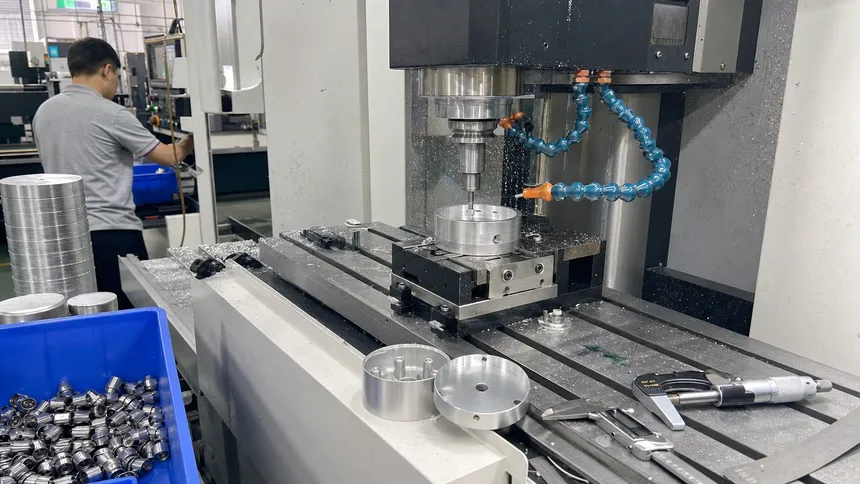
Die-Casting & CNC Machining
Aluminum and zinc alloy housings are cast and machined on-site. CNC tolerances hold to ±0.1mm on critical mounting dimensions — canopy plates, ceiling rose fittings, and suspension hardware.
When these dimensions drift, your installation teams deal with fit issues on-site, which generates callbacks and warranty claims.
We run the same tooling across a production batch with no mid-run swaps, so the 500th unit off the line fits the same as the first.
Surface Finishing
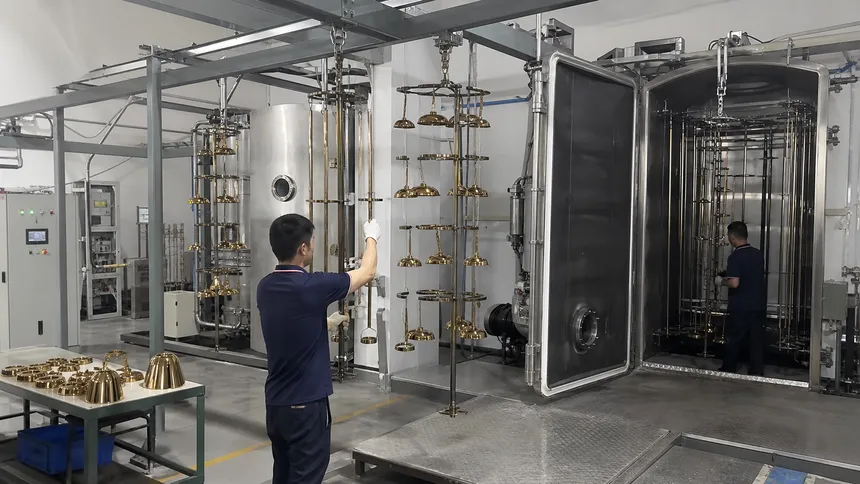
The finishing line handles electroplating, powder coating, and PVD in-house. Powder coat thickness runs 60–80μm with automated application — consistent across the batch, not just the sample units.
For gold and brass finishes, we use PVD rather than liquid paint because PVD holds color consistency across a run in a way that paint cannot.
The salt spray test runs on finish samples before we commit a batch to production — for buyers supplying coastal markets, this is the checkpoint that prevents RMA claims from your downstream customers.
Driver Integration
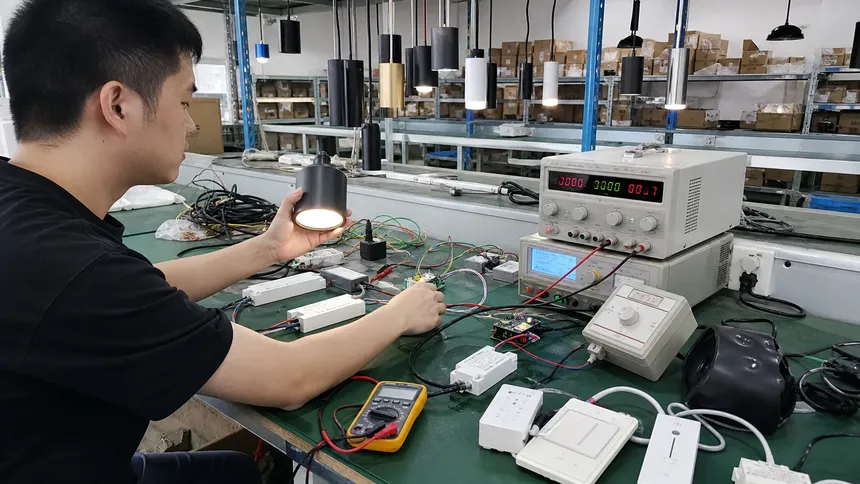
LED driver selection is matched to fixture type, wattage, and destination market requirements. We don't use a single driver spec across all products.
The driver is specified per SKU based on dimming compatibility and the certification requirements of your target market.
This matters when your buyer's electrician is on-site and the fixture needs to work with their existing dimmer infrastructure — a driver mismatch at installation is an expensive problem.
Optical Lab
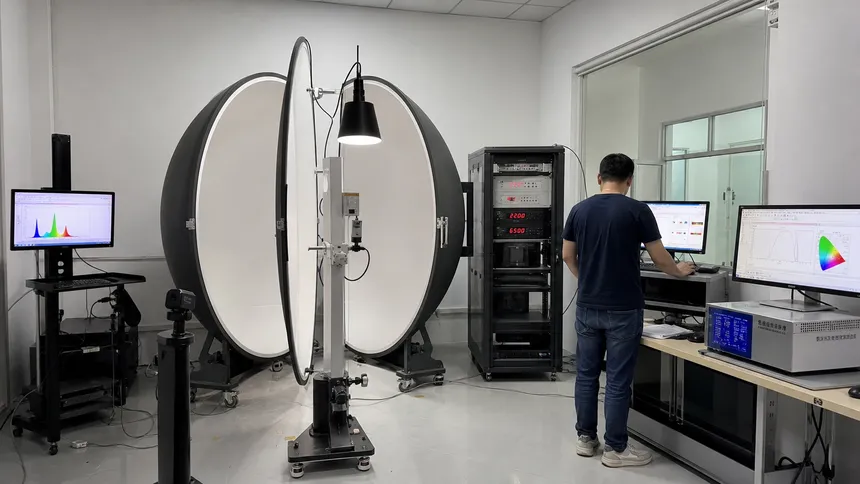
Photometric testing runs on new designs and on production samples. Lumen output, beam angle, and color rendering are verified against spec before a design goes into production and spot-checked during runs.
For buyers who need IES files for project submissions, we generate them from our own measurements — not from the driver manufacturer's datasheet.
Quality Control Before Your Container Loads
100% Aging Test — Non-Negotiable
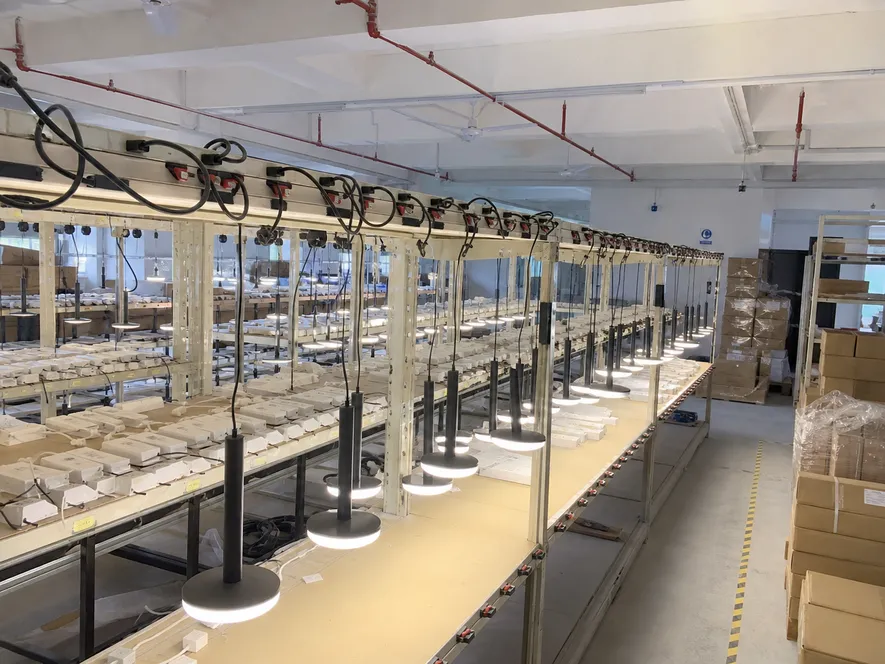
Every pendant luminaire runs powered for a minimum burn-in period before packing. LED driver failures, wiring faults, and early-life component failures show up during aging — not in your customer's installation.
We added this protocol after a batch of LED drivers failed in the field for a Gulf distributor years ago. That was an expensive lesson for both sides, and it's why the aging test is now a hard requirement before any container leaves.
Four-Stage Quality Control Process
Incoming Inspection
Raw materials and purchased components — aluminum alloy grade verification, driver batch testing, glass shade dimensional checks — before anything enters production.
In-Process Inspection
Three checkpoints — after die-casting and machining, after surface finishing, and after assembly.
The finishing checkpoint is where most defects in decorative pendant lighting get caught: adhesion failures, color inconsistency, and surface contamination are visible and fixable at this stage.
Photometric Verification
Lumen output and color temperature are checked against the approved spec on a sample basis from each production batch. If a batch drifts outside tolerance, it doesn't ship.
Pre-Shipment Inspection
Final dimensional check, packaging integrity, and documentation review before container loading.
Certifications Held
For buyers who need specific documentation packages — test reports, Declaration of Conformity, material safety data — we maintain these per SKU and provide them as part of the order documentation.
OEM and ODM: Custom Pendant Lighting for Your Product Line
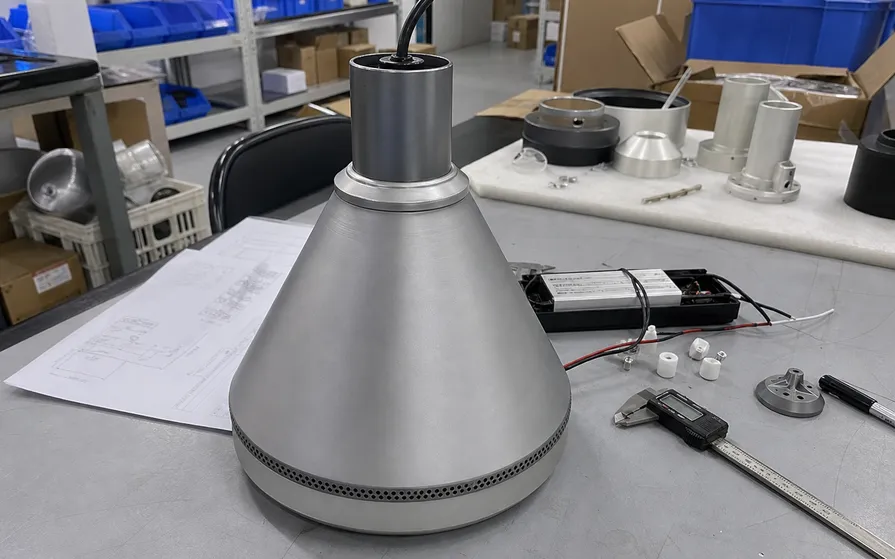
Custom pendant lighting is a significant part of what we do — not a side service. The R&D team runs 15 lighting engineers with an in-house optical lab, and rapid prototyping turnaround is 7–10 working days from approved drawings to physical sample.
7–10 Day Rapid Prototyping
That timeline covers CNC-machined prototype housings, provisional surface finishing, and driver integration — a functional sample, not a mock-up.
OEM
Your design, our production
You provide drawings or detailed specifications; we manufacture to your spec. We work from CAD files, technical drawings, or detailed reference samples.
The engineering team reviews for production feasibility and flags cost traps early — overly complex casting geometry, non-standard driver cavities, finishes that require multiple process steps — before you commit to tooling.
We accept:
ODM
Your concept, our design and production
You bring a design direction, target retail price point, and destination market. Our structural engineers develop the production-ready design from reference images and dimensions.
We've done this enough times to know where decorative pendant designs get expensive in production, and we flag those decisions before tooling is cut.
You provide:
Custom Finish Programs
Proprietary finishes for your brand — custom powder coat colors, PVD tones, or multi-layer finish combinations. Minimum run requirements apply; contact us with your Pantone reference or physical sample.
Private Label
Full private label capability — your brand name, packaging design, and documentation. Standard for buyers building a branded lighting line.
Pendant Lighting for High-Value Market Segments
Pendant lighting moves across several distinct B2B segments, each with different volume patterns and margin profiles. Here's where our product line fits:
Hospitality Fit-Out Supply
Hotels, restaurants, serviced apartments
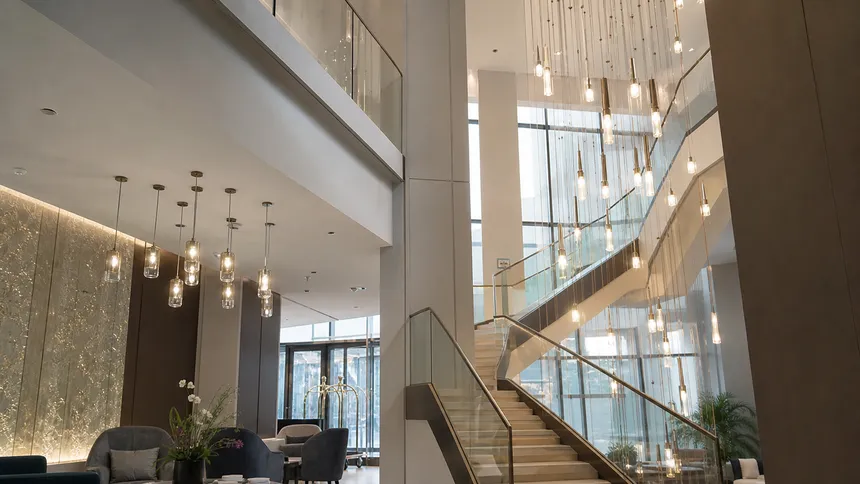
Hotels, restaurants, and serviced apartments specify pendant lighting in volume — a single hotel project can run 200–2,000 units across multiple fixture types. Cluster pendants, statement entryway fixtures, and long-drop staircase designs are the high-specification end of this segment.
Buyers supplying hospitality fit-out contractors need CE or UL certification, consistent finish quality across large batches, and documentation packages for project sign-off.
Margin Protection
This is where our QC infrastructure and certification coverage directly protect your margin.
Residential Developer Supply
North America, Europe, Middle East
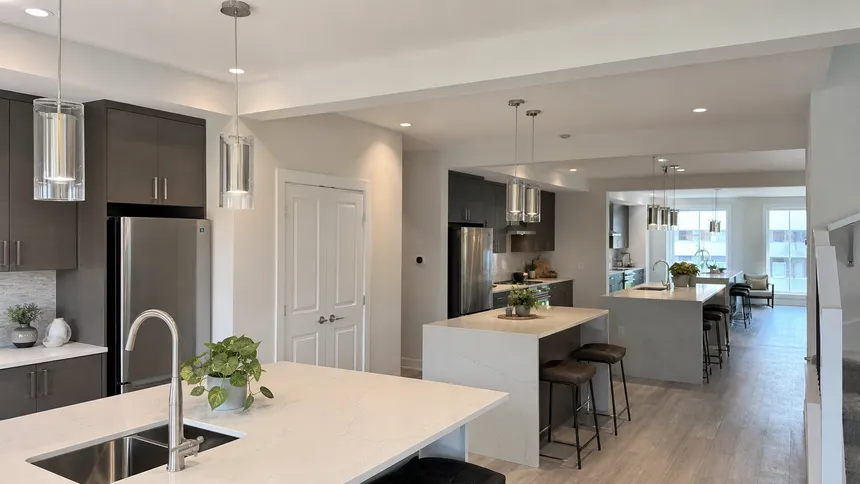
Mid-to-high-end residential developers specify pendant lighting for kitchen islands, dining areas, and entrance spaces across multiple units. Modern cylinder and glass pendant designs are the volume movers here.
The key commercial variable is batch consistency — a developer specifying the same fixture across 50 apartments needs every unit to match.
Consistency Controls
Our in-house finishing and 100% aging test are the controls that make that consistency reliable.
Lighting Distributor Catalog Programs
Catalog breadth, reorder reliability, OEM
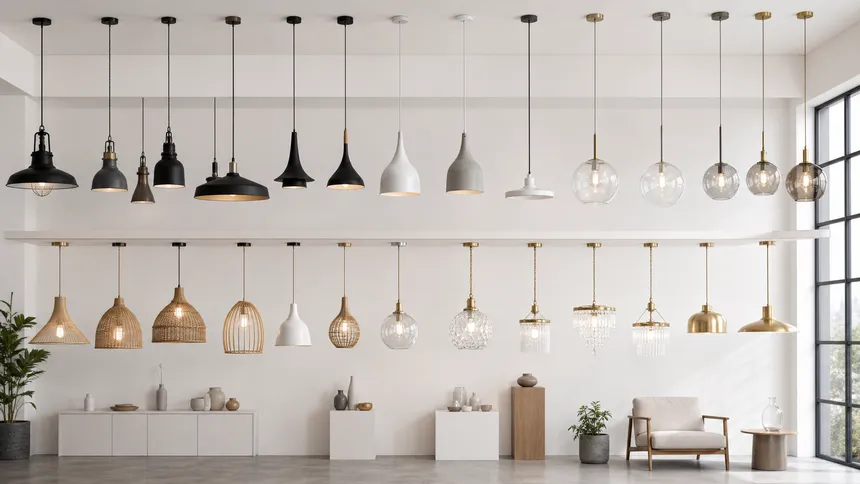
Distributors building a pendant lighting catalog need breadth across styles and price points, reliable reorder availability, and OEM capability for house-brand SKUs.
Our 10 sub-categories cover the full style spectrum from industrial to luxury, and our production capacity — 600,000 luminaires per year across 6 lines — means your reorder doesn't queue behind other customers' programs.
Interior Design & Specification Supply
High-end residential & commercial projects
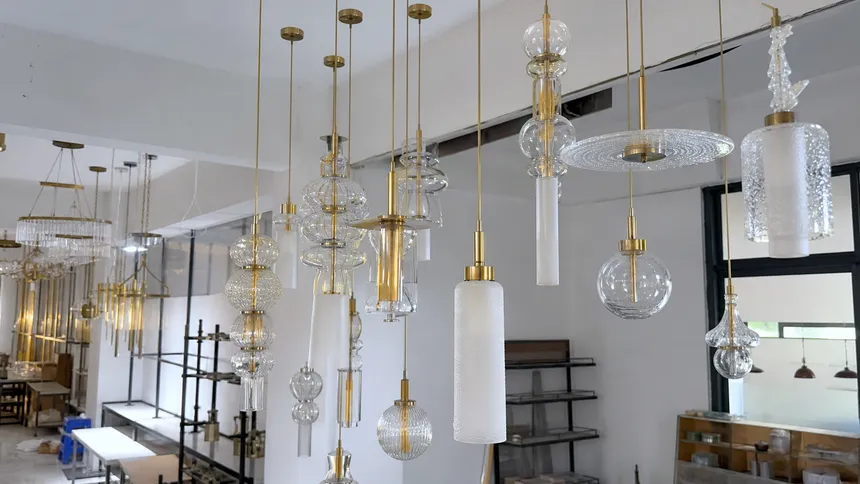
Design-led buyers sourcing for high-end residential and commercial projects prioritize finish quality, customization capability, and the ability to produce project-specific configurations.
Gold pendant lighting, glass pendants, and custom cluster configurations are the primary products in this segment.
Project Documentation
IES files and photometric data for project submissions are available from our optical lab.
Selecting the Right Pendant Configuration for Your Market
Pendant lighting has more configuration variables than most decorative categories — suspension length, light source type, finish, shade material, and dimming compatibility all interact with each other and with the destination market's requirements. Here's how we think about the key decisions:
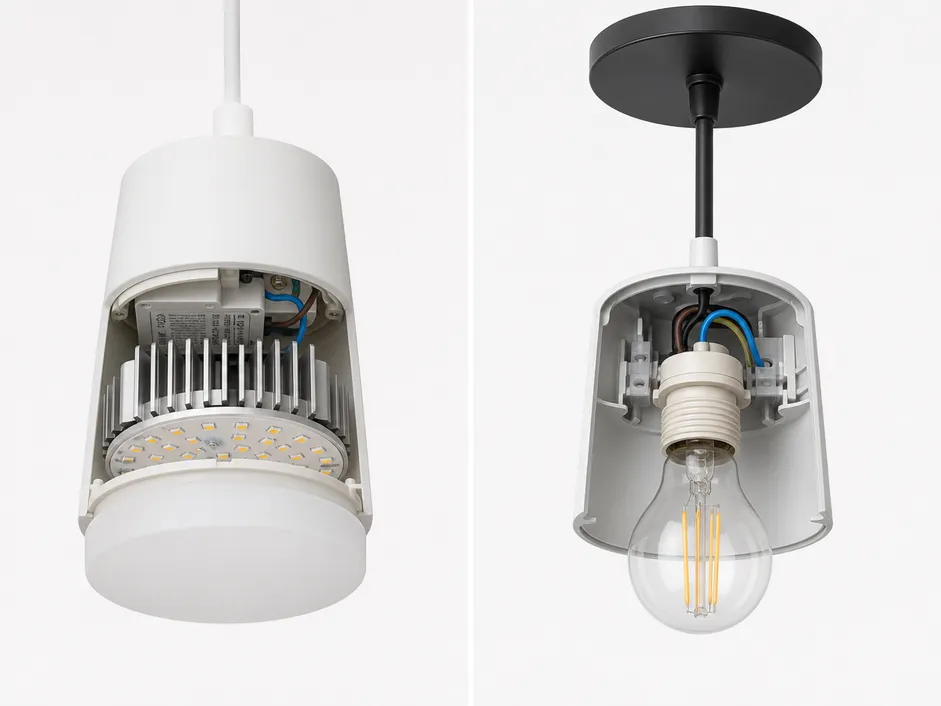
Integrated LED vs. Socket-Type
Integrated LED designs offer better energy efficiency and a cleaner aesthetic, but they're non-field-serviceable — when the LED module reaches end of life, the fixture is replaced.
Socket-type designs (E26/E27, GU10) allow bulb replacement, which matters for buyers supplying markets where end-user serviceability is a selling point or a code requirement.
| Application | Recommended Type | Reason |
|---|---|---|
| Hospitality & commercial | Integrated LED | Maintenance managed centrally; cleaner aesthetic; standard choice |
| Residential markets | Socket-type (E26/E27, GU10) | End-user serviceability matters; reduces warranty exposure |
Dimming Compatibility
TRIAC
Standard for North American residential markets. Works with most existing dimmer infrastructure.
0-10V
Standard for commercial and hospitality applications where centralized lighting control systems are specified.
DALI
Required for high-end commercial projects with building management system integration.
We specify the driver per SKU based on your target market — don't assume a driver that works in one market will work in another. We've seen containers arrive in North America with 0-10V drivers that were incompatible with the residential dimmers the end buyers had installed. That's an avoidable problem if the driver is specified correctly at the order stage.
Finish Selection for Your Market
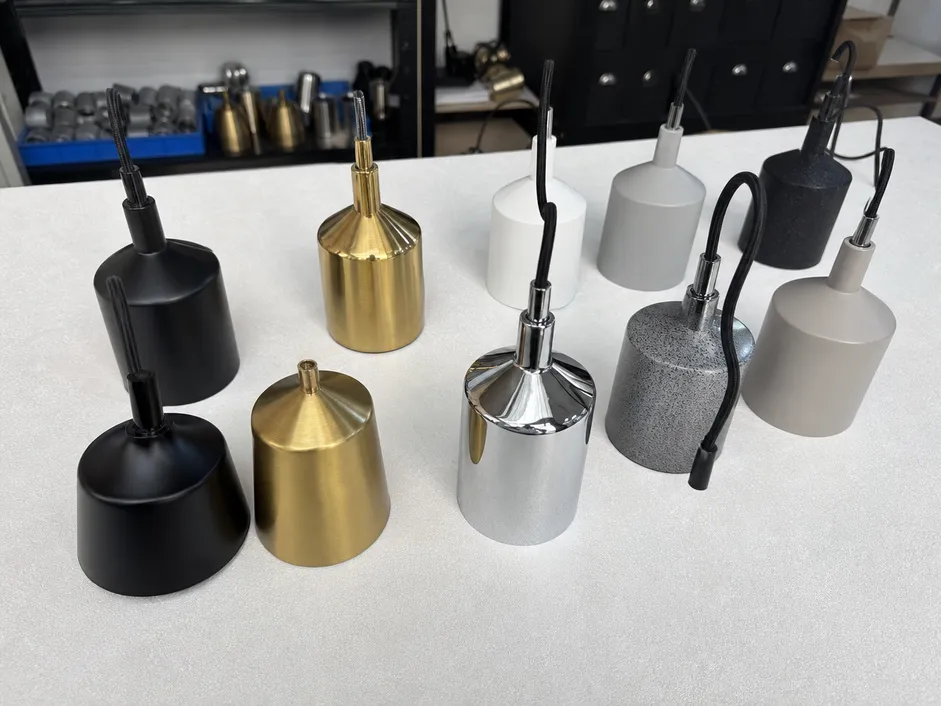
Matte black and brushed gold are our two highest-volume finishes and the most consistent to produce.
Chrome and polished finishes require more careful handling in packaging and are more sensitive to surface contamination during production — they're available, but expect slightly tighter MOQ requirements.
For buyers supplying coastal or humid-climate markets, we recommend powder-coated finishes over electroplated ones for corrosion resistance; our powder coat passes 500-hour salt spray testing.
| Finish | Volume / Consistency | Handling Notes | Best For |
|---|---|---|---|
| Matte Black | Highest volume, most consistent | Standard handling | All markets |
| Brushed Gold | Highest volume, most consistent | Standard handling | All markets |
| Chrome / Polished | Available; tighter MOQ | Careful packaging; sensitive to surface contamination | Interior / dry-climate markets |
| Powder-Coated | Available; standard MOQ | 500-hour salt spray tested | Coastal / humid-climate markets |
Suspension Length
Standard drops run 0.5m to 3m.
For staircase and atrium applications, custom lengths are available — specify the finished drop length from ceiling to bottom of fixture, and we'll configure the cable and canopy hardware accordingly.
For cluster configurations, all drops in a set are matched to the same length unless you specify a tiered arrangement.
How to Specify
- Provide finished drop length: ceiling to bottom of fixture
- Cable and canopy hardware configured to match
- Cluster sets: matched length or tiered — specify at order
What Goes Wrong with Pendant Lighting — and How We Prevent It
Pendant lighting has a specific set of failure modes that experienced buyers have seen before. Here's where the problems typically originate and what we do about them.
Finish Color Drift Across a Batch
The problem: The most common complaint in decorative pendant lighting, especially on gold and brass tones. It happens when surface finishing is done in small batches with manual process controls — the chemical bath concentration, temperature, and immersion time vary between runs, and the color shifts.
Our prevention: We run automated powder coat application at 60–80μm consistent thickness, and PVD for metallic finishes where color consistency is critical. Finish color is checked against the approved sample at the finishing checkpoint before assembly.
Driver Failure in the Field
The problem: LED driver failures are the leading cause of warranty claims in pendant lighting. The failure mode is usually thermal — the driver is undersized for the fixture's thermal environment, or it's a low-grade component that passes initial testing but fails under sustained load.
Our prevention: We run 100% aging test on every luminaire before packing. Every fixture runs powered for a minimum burn-in period; thermal-related driver failures show up here. We also specify drivers from established manufacturers with documented MTBF data — not the cheapest component that passes the initial certification test.
Mounting Hardware Dimensional Inconsistency
The problem: Canopy plates and ceiling rose fittings that don't align with standard junction box dimensions create installation problems — callbacks, site delays, and warranty claims.
Our prevention: Our CNC machining holds ±0.1mm on critical mounting dimensions across a production batch. We run the same tooling throughout a batch with no mid-run swaps that introduce dimensional drift.
Glass Shade Breakage in Transit
The problem: Glass pendant shades are the highest-risk component for transit damage.
Our prevention: We use individual foam-lined cartons for glass shade fixtures, with internal bracing that prevents the shade from contacting the housing during the compression and drop forces of ocean freight. Outer carton reinforcement is rated for the specific route — we've adjusted packaging specs based on damage patterns from specific shipping lanes over the years.
Wiring Faults at Installation
The problem: Loose connections and incorrect polarity are the two most common wiring faults in pendant lighting.
Our prevention: Both are caught during the aging test — a loose connection will cause intermittent failure under thermal cycling, and incorrect polarity will cause immediate failure. The aging test is the checkpoint that catches these before the fixture leaves the factory.
Export Packaging and Container Loading
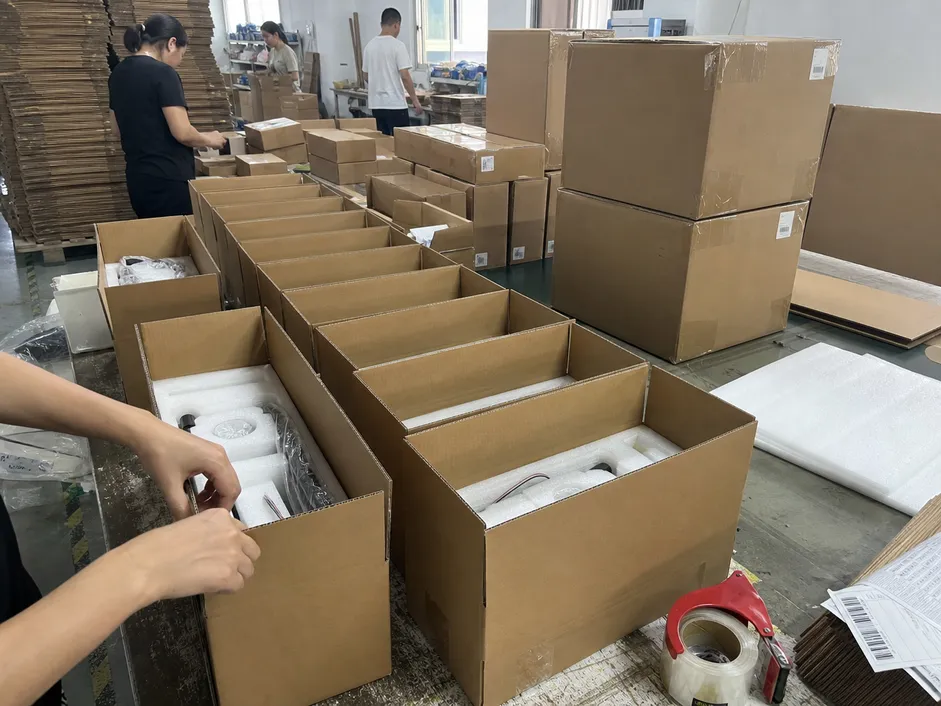
Pendant lighting is one of the more packaging-intensive categories in decorative lighting — the combination of fragile shades, long suspension cables, and decorative metal components requires more protection than a simple ceiling fixture.
Standard Export Packaging
Individual Carton
Each fixture in its own carton with foam-lined interior. Glass shade fixtures use custom-cut foam inserts that immobilize the shade relative to the housing.
Suspension Cable Management
Cables are coiled and secured to prevent tangling and stress on the canopy connection during transit.
Outer Carton
Master cartons are rated for ocean freight compression and drop forces. Carton dimensions are optimized for 40HQ container loading efficiency.
Documentation
Packing list, installation instructions, and certification documentation included per carton or per master carton depending on buyer preference.
Container Loading Efficiency
For large-volume orders, we optimize carton dimensions for container loading efficiency. Cylinder pendant designs, due to their compact geometry, load efficiently — a 5–8% improvement in units per container versus non-optimized packaging is real money on a 2,000-unit order.
Cluster pendants and large-diameter decorative fixtures load less efficiently by nature of their geometry; we'll provide exact CBM per unit and estimated container loading quantities when you request a quote.
Lead Times
Standard Catalog Items
25–35 days from order confirmation.
OEM & Custom Orders
Depends on tooling requirements — if new tooling is needed, add 15–20 days for the tooling cycle before production starts.
Frequently Asked Questions
What is the minimum order quantity for wholesale pendant lighting?
Strict MOQ applies across all pendant lighting categories. The specific minimum varies by product type and customization level — standard catalog items have lower minimums than OEM or custom finish orders. Contact us with your target SKU and volume, and we'll confirm the MOQ and lead time for your specific requirement.
What certifications do your pendant lights carry, and which markets do they cover?
CE covers European market requirements. UL covers North American market requirements. SAA covers the Australian market. SGS is our general export quality certification. ISO 9001:2015 governs our quality management system.
For buyers importing into specific markets, we can provide test reports and Declaration of Conformity documentation per SKU. If your target market requires a certification not listed here, contact us — we can assess feasibility for your volume.
What IP rating do I need for pendant lighting in commercial applications?
For standard indoor commercial applications — offices, retail, restaurants, hotels — IP20 is sufficient and is our standard rating. IP20 protects against solid objects but not moisture, which is appropriate for dry interior environments.
For kitchen pendant lighting above cooking areas, bathroom pendants, or any application with steam or moisture exposure, specify IP44 minimum — this provides protection against water splashing from any direction. We offer IP44 on selected pendant designs; confirm the IP requirement when requesting a quote so we can specify the correct design.
Why do LED pendant lights lose brightness after 6–12 months in some installations?
Lumen depreciation in that timeframe is almost always a thermal management problem, not an LED chip problem. The LED chip itself is rated for 50,000+ hours at its specified junction temperature.
When the fixture runs hotter than designed — because the heat sink is undersized, the driver is generating excess heat in a confined space, or the fixture is installed in an enclosed ceiling recess that traps heat — the junction temperature rises and lumen output drops faster than the rated depreciation curve.
We size heat sinks and driver cavities based on thermal modeling for each fixture design, and we verify thermal performance during prototyping. If you're seeing rapid depreciation in fixtures from another source, the first thing to check is whether the fixture is installed in a thermally restricted environment.
Can you produce custom pendant lighting with our brand name and proprietary finishes?
Yes — full OEM and private label capability. Custom finishes require a Pantone reference or physical sample for color matching, and minimum run requirements apply (below a certain volume, the powder line changeover or PVD setup cost doesn't make commercial sense for either side).
Prototype turnaround is 7–10 working days from approved drawings to physical sample. Send us your design files, target retail price point, and destination market, and we'll come back with a feasibility assessment and quote.
What causes pendant lighting canopy hardware to fail at the ceiling junction?
The two failure modes are mechanical — the canopy plate deforms under the fixture weight, or the mounting screws pull out of the junction box — and both trace back to undersized hardware.
Standard pendant fixtures up to 3kg use our standard canopy hardware rated for 5kg static load with a 3× safety factor. Heavier fixtures, cluster configurations, and long-drop staircase pendants use reinforced canopy plates with additional mounting points.
We specify hardware based on the fixture's actual weight, not a generic standard, and CNC machine the canopy components to ±0.1mm dimensional tolerance so they align correctly with standard junction box configurations in your target market.
Request a Quote or Sample
Most buyers in this category start with a 2–5 unit sample order to test finish quality and fit with their existing product line before committing to a volume order. We can ship samples within the standard lead time for the specific product.
If you're evaluating pendant lighting for a project spec or building a new catalog segment, send us:
- The sub-category or specific design you're interested in
- Your target market and any certification requirements
- Your target volume and price point
- Any customization requirements (finish, suspension length, light source type)
We'll come back with a detailed quote and, where relevant, a recommendation on configuration based on what's working for our existing buyers in your region.
Contact Us Directly
Phone / WhatsApp
+86 134 2021 9307Address
No. 14 Beisan Rd, Gusan Ind. Zone, Guzhen, Zhongshan, Guangdong, China
Wholesale only. Strict MOQ applies.