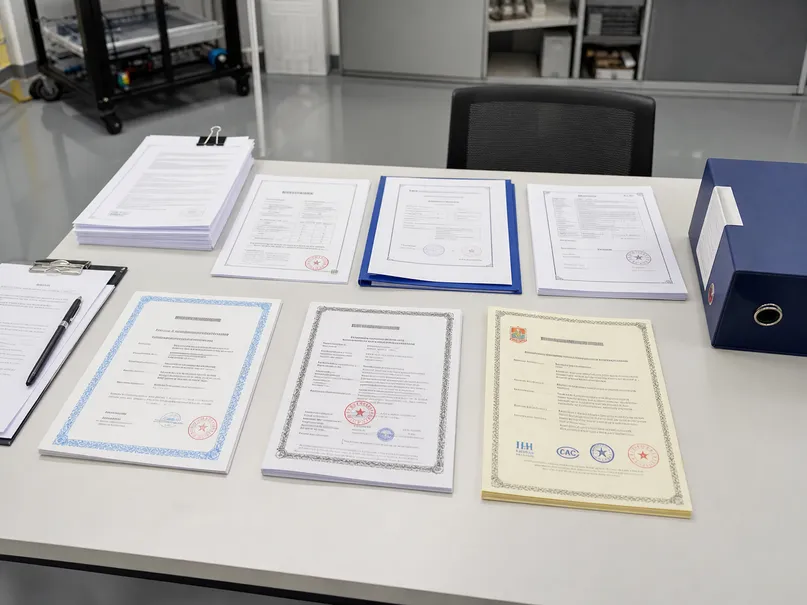

Lighting Certifications & Compliance
Multi-market lighting compliance — CE, UL, SAA, and ISO 9001:2015 held and maintained since 2008.
Full documentation packages available per SKU. Your import team gets what they need before the container loads, not after.
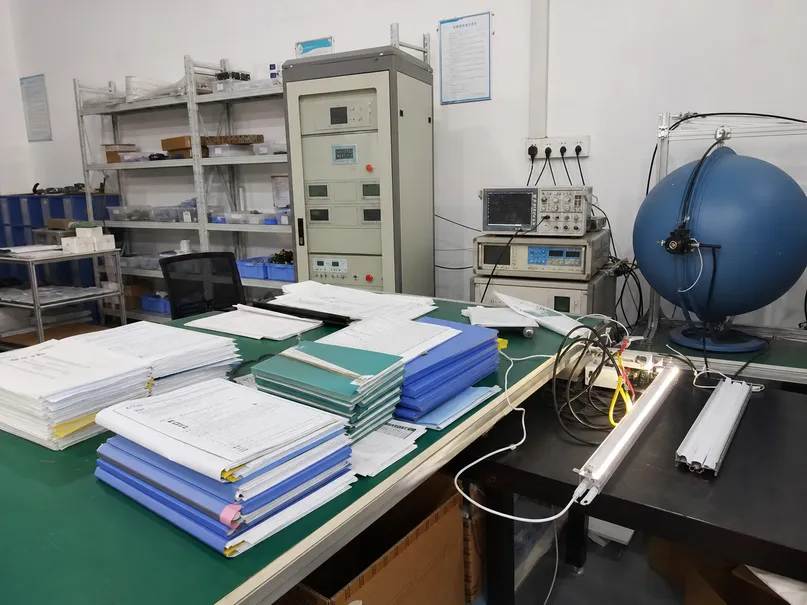
The Certification Portfolio: What We Hold and What It Covers
We've been exporting to North America, Europe, the Middle East, Southeast Asia, and Australia since 2008. That range isn't a marketing claim — it's the reason we built and maintain a multi-market certification stack rather than holding a single regional credential and hoping buyers in other markets work around it.
| Certification | Issuing Body / Standard | Market Coverage | What It Covers |
|---|---|---|---|
| ISO 9001:2015 | International Organization for Standardization | Global — quality management system | Our entire production process: incoming inspection, in-process QC, finished product testing, and corrective action procedures |
| CE Marking | EU Directives (LVD, EMC, RoHS) | European Union, EEA, UK (UKCA equivalent process) | Low Voltage Directive compliance, electromagnetic compatibility, RoHS substance restrictions — required for legal sale in EU markets |
| UL Listing | Underwriters Laboratories | North America (US and Canada) | Electrical safety testing to UL standards — required or strongly preferred by US distributors, contractors, and building code compliance |
| SAA Certification | Standards Australia | Australia and New Zealand | Compliance with AS/NZS electrical safety standards — required for legal sale in the Australian market |
| SGS | SGS Group | General export, third-party verification | Independent third-party product testing and factory audit — used by buyers who require external verification beyond self-declared compliance |
We added SAA in 2016 when our Australian distributor volume grew enough to justify the certification cycle. Before that, we were losing orders to factories that had it. If you're building a line for the Australian market, this one matters more than buyers sometimes realize.
Ongoing Certification Maintenance
CE, UL, and SAA are maintained on an ongoing basis — not one-time certifications that sit in a drawer. When standards update, we run the re-certification process. Your compliance team isn't inheriting outdated documentation.
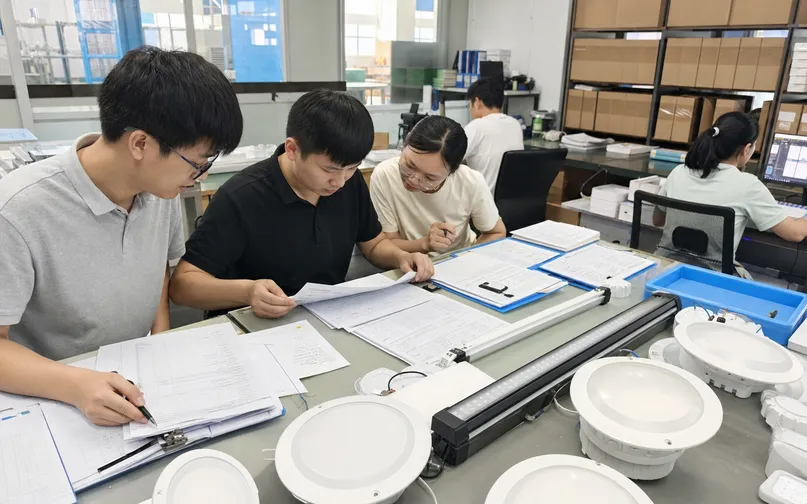
What CE Marking Actually Requires for Decorative Lighting
CE is the certification we get the most questions about, partly because the mark itself doesn't tell you much — it covers a wide range of directives, and what's required depends on the product type.
For decorative luminaires — pendants, chandeliers, wall sconces, ceiling fixtures, spotlights, and track lighting — CE compliance involves three primary directives:
Low Voltage Directive
LVD, 2014/35/EU
Covers electrical safety for luminaires operating between 50V and 1000V AC. Test items include:
- Insulation resistance
- Dielectric strength
- Earth continuity
- Protection against electric shock
Key detail: For LED luminaires, the driver is tested as part of the assembly — not just the fixture housing. We specify drivers per SKU based on wattage, dimming compatibility, and destination market voltage, and the driver selection is part of the CE compliance scope.
Electromagnetic Compatibility
EMC, 2014/30/EU
Covers both emissions and immunity testing:
- Emissions: The fixture doesn't interfere with other equipment
- Immunity: The fixture operates correctly in the presence of electromagnetic interference
Key detail: LED drivers are the primary source of EMC issues in luminaires — a driver that passes LVD can still fail EMC if the switching frequency generates interference. We test driver-fixture combinations, not components in isolation.
RoHS Directive
2011/65/EU, amended by 2015/863/EU
Restricts hazardous substances in electrical and electronic equipment:
- Lead, mercury, cadmium
- Hexavalent chromium
- PBB, PBDE
- Four phthalates (DEHP, BBP, DBP, DIBP)
Key detail: The 2015 amendment added four phthalates to the restricted list. These show up in wire insulation and some plating processes — we updated our material sourcing in 2019 to ensure full compliance across all SKUs, not just new designs.
What You Receive: CE Documentation Package
When we ship CE-marked product, the documentation package includes everything your compliance team or customs broker needs:
Declaration of Conformity (DoC)
Per product family, referencing applicable standards
Test Reports
LVD and EMC test reports from accredited lab
RoHS Declaration
Material compliance declaration with substance list
Technical File Reference
Available on request for market surveillance authorities
UL Listing — What It Means and Why It's Non-Negotiable for the U.S.
UL listing isn't legally required at the federal level in the United States, but it's effectively mandatory. Most local building codes reference NEC (National Electrical Code), which requires listed equipment. Inspectors won't sign off on unlisted fixtures. Retailers won't stock them. Liability insurers won't cover them.
For decorative lighting, the relevant standard is UL 1598 (Luminaires). Our UL listing covers:
- Construction evaluation — materials, wiring methods, component ratings
- Performance testing — temperature, strain relief, grounding
- Follow-up service — quarterly factory inspections by UL representatives
Important distinction: UL Listed is not the same as UL Recognized. Listed means the complete luminaire has been evaluated. Recognized means only a component (like a driver) has been evaluated. Inspectors and retailers require the Listed mark on the finished fixture.
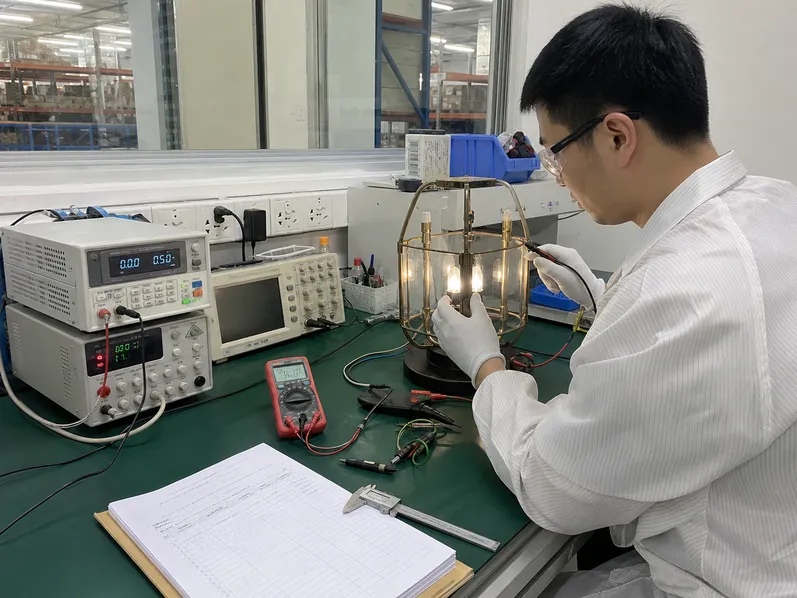
UL Follow-Up Service
Unlike CE (which is self-declared), UL requires ongoing factory inspections. A UL representative visits our facility quarterly to verify:
- Production samples match the listed design
- Materials and components haven't been substituted
- Manufacturing processes remain consistent
- Labeling and marking are correct
A note on ETL and CSA: Some buyers ask whether we carry ETL (Intertek) or CSA marks instead of UL. All three are NRTLs (Nationally Recognized Testing Laboratories) accepted by OSHA, and all are accepted by AHJs (Authorities Having Jurisdiction) for code compliance. We chose UL because it has the widest brand recognition with inspectors and end-users in the U.S. market. If your project specifically requires ETL or CSA, we can discuss options.
How Certification Integrates Into Our Production Process
Certification isn't a final step before shipping — it's built into the production workflow from design through packaging. Here's how it works in practice:
Design Phase
New designs are reviewed against certification requirements before prototyping. Wire gauge, insulation class, creepage distances, and thermal management are specified to meet UL 1598 and EN 60598 from the start — not retrofitted after a failed test.
Component Sourcing
All electrical components (drivers, lampholders, terminal blocks, wire) are sourced from UL-recognized or CE-compliant suppliers. We maintain an approved vendor list (AVL) that's reviewed annually. Substitutions require re-evaluation against the certification file.
In-Line Testing
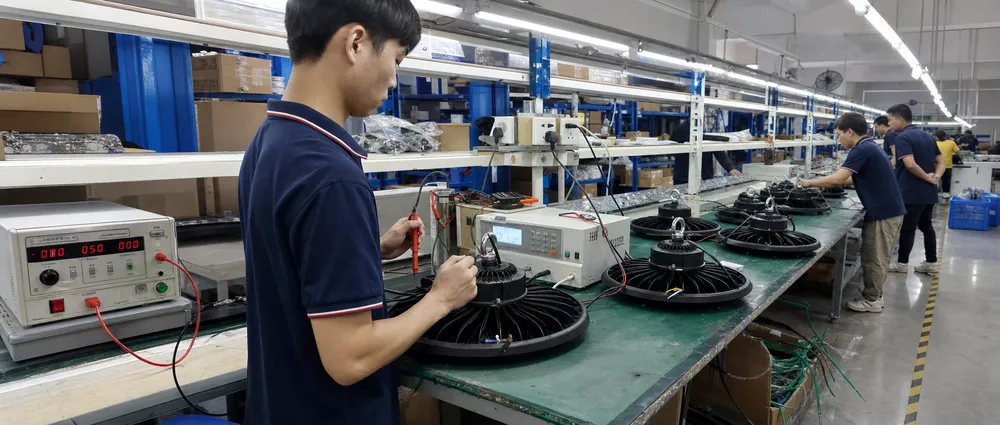
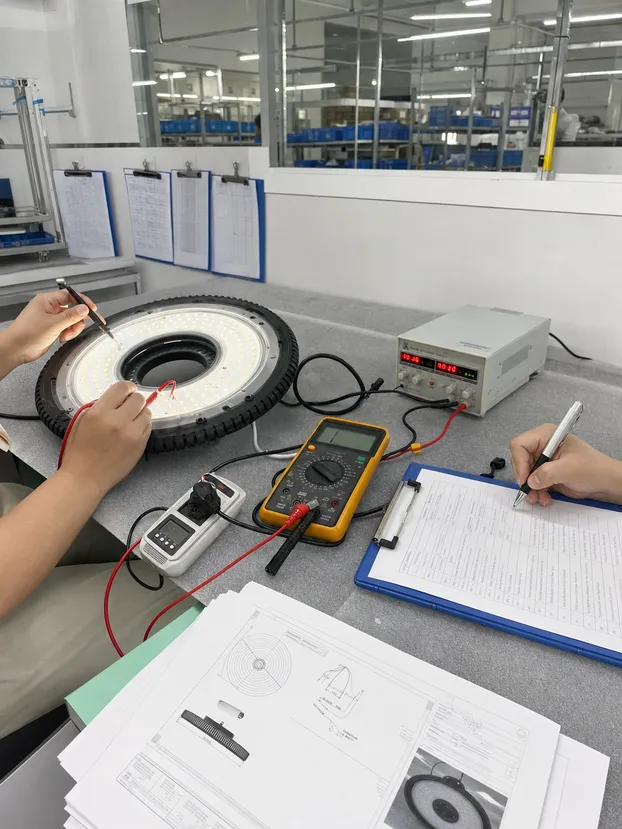
Every fixture undergoes hi-pot (dielectric strength) testing and ground continuity testing on the production line. This isn't sampling — it's 100% testing. Failures are pulled, documented, and root-caused before the line continues.
Final QC & Labeling
Final inspection verifies correct certification labels are applied based on destination market. A fixture shipping to Germany gets CE + WEEE marking. A fixture shipping to the U.S. gets the UL Listed mark. Mislabeling is treated as a stop-ship defect.
Documentation & Shipping
Certification documents are compiled per shipment and included with commercial documentation. Digital copies are available through our order management system. Your logistics team and customs broker receive what they need without chasing paperwork.
Custom & OEM Projects — Certification for Your Designs
If you're developing a custom fixture or an OEM product line, certification is part of the development timeline — not an afterthought. Here's how we handle it:
Extending Existing Listings
If your custom design is a variation of an existing certified product family (same construction type, similar materials, within the same power range), we can often extend the existing UL or CE file rather than starting from scratch. This reduces both cost and timeline — typically 4–6 weeks instead of 12–16 weeks for a new listing.
New Certification Projects
For genuinely new designs that don't fit an existing file, we manage the full certification process: sample preparation, test coordination with the lab, documentation compilation, and follow-up service setup. We've done this enough times to know where the common failure points are and design around them upfront.
White-Label Certification
For OEM/white-label customers, the certification can be held under our name (with you as the brand owner) or transferred to your company's UL file if you maintain one. We'll advise on which approach makes sense based on your volume, market, and long-term plans.
Typical Certification Timelines
UL Certification and the North American Market
UL is the certification that generates the most friction for buyers importing decorative lighting into the US market. The confusion usually comes from the difference between UL Listed, UL Recognized, and ETL Listed — and what each means for your buyers' compliance exposure.
UL Listed
Means the complete luminaire has been tested and certified by Underwriters Laboratories to the applicable UL standard (typically UL 1598 for luminaires). A UL Listed fixture carries the UL mark and can be specified in projects requiring listed equipment. This is what most US distributors and contractors require when they say "UL certified."
UL Recognized
Applies to components (drivers, connectors, wire) rather than complete assemblies. A fixture built from UL Recognized components is not itself UL Listed — the complete assembly still needs to be tested.
ETL Listed
Issued by Intertek, ETL Listed is equivalent to UL Listed for most US building code purposes — both are NRTL (Nationally Recognized Testing Laboratory) certifications. Some buyers specify UL by name; others accept ETL. Worth confirming with your buyers before placing an order.
Our UL certification covers the luminaire product lines we export to North America. If you're sourcing for a specific project with a UL requirement, send us the project spec — we'll confirm which SKUs are covered and provide the certification documentation your contractor needs for the submittal package.
CE ≠ UL
One thing we see regularly: buyers assume CE certification transfers to the US market. It doesn't. CE and UL test to different standards and different failure criteria. A CE-marked fixture needs separate UL testing for North American compliance. We hold both, so this isn't an issue for our standard range — but it's worth knowing if you're evaluating other suppliers.
The Four-Stage QC Process: What Happens Before Your Container Loads
Certifications establish the floor. The QC process is what keeps production above it, batch after batch. We run four inspection stages — each with defined scope, pass/fail criteria, and a documented non-conformance procedure.
Incoming Material Inspection
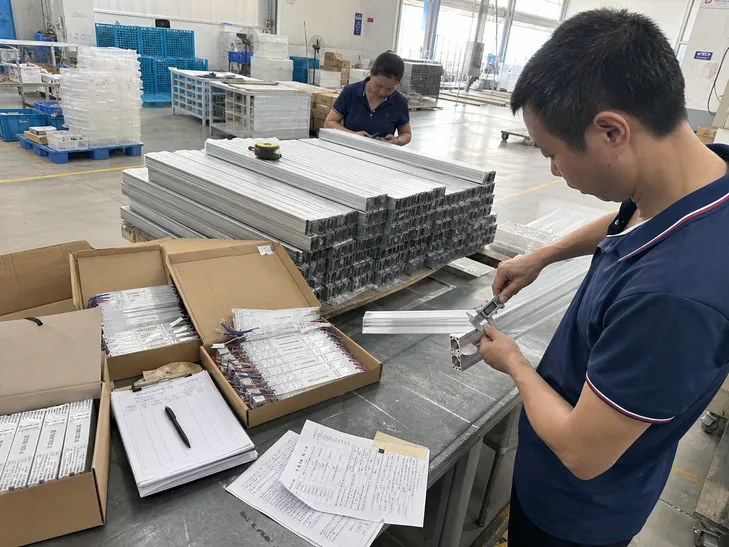
Every production run starts with incoming inspection on raw materials and purchased components. Aluminum alloy billets are checked for grade and chemical composition — we specify alloy grades per product family and verify against mill certificates.
LED drivers are batch-tested before entering the production line: voltage input range, output stability, and power factor are checked against the driver spec sheet. Glass shades and diffusers are dimensionally checked — a 1mm variance in shade diameter sounds minor until you're assembling 500 pendants and the shade doesn't seat correctly on the housing.
Components that fail incoming inspection don't enter production. They go back to the supplier with a non-conformance report. We maintain dual-source approval for critical components — drivers and glass — so a supplier quality issue doesn't stop a production run.
In-Process Inspection (Three Checkpoints)
In-process inspection runs at three points during production:
After Die-Casting & CNC Machining
Dimensional verification on critical features — mounting hole positions, thread depths, and canopy-to-housing fit. CNC tolerances hold to ±0.1mm on critical mounting dimensions. Fixtures that don't meet dimensional spec at this stage are reworked or scrapped before surface finishing — catching them here costs less than catching them after coating.
After Surface Finishing
The finishing checkpoint is where most defects in decorative lighting get caught. Powder coat adhesion, color consistency, and surface contamination are all visible at this stage. We check adhesion with a cross-cut test on samples from each batch.
Color is checked against the approved color standard under standardized lighting — not under the factory floor lights, which can shift perception. Brushed gold is the finish where we see the most color drift risk — the PVD process is sensitive to temperature variation, so we run tighter process controls on that finish than on powder coat.
After Assembly & Wiring
Electrical continuity, correct driver installation, and wiring integrity are checked before the fixture goes to the aging test station. This checkpoint catches assembly errors — wrong driver installed, wiring polarity reversed, ground connection missed — before the aging test runs.
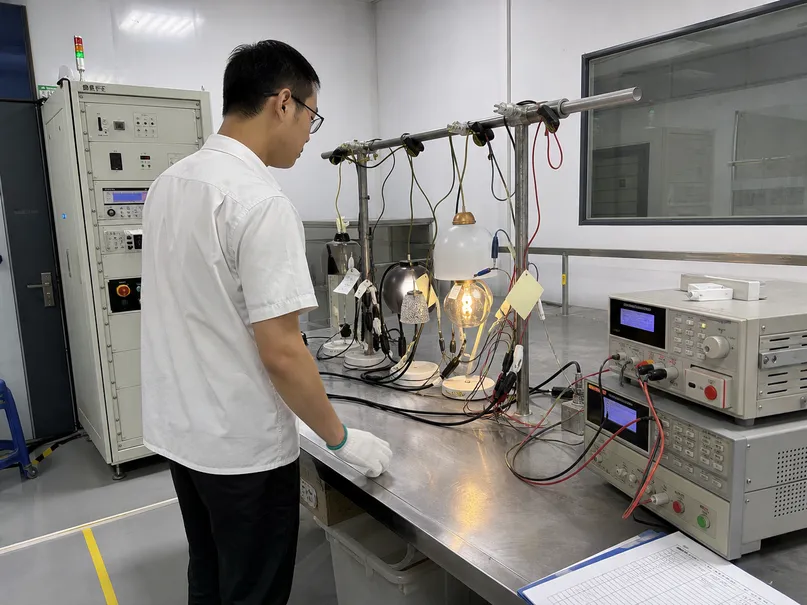
100% Aging Test
Every luminaire runs powered for a minimum burn-in period before packing. This is non-negotiable — it's been part of our process since 2012, when a batch of LED drivers failed in the field for a Gulf distributor.
Early-life failures in LED drivers follow a bathtub curve: the failure rate is highest in the first few hours of operation, drops sharply, and then stays low for the product's rated life. The aging test burns through that early-failure window in the factory, not in your customer's installation.
During the aging test, each fixture is monitored for driver failure, flickering, and abnormal heat. Fixtures that fail are pulled, diagnosed, and either repaired and re-tested or scrapped. The aging test result is logged per production batch.
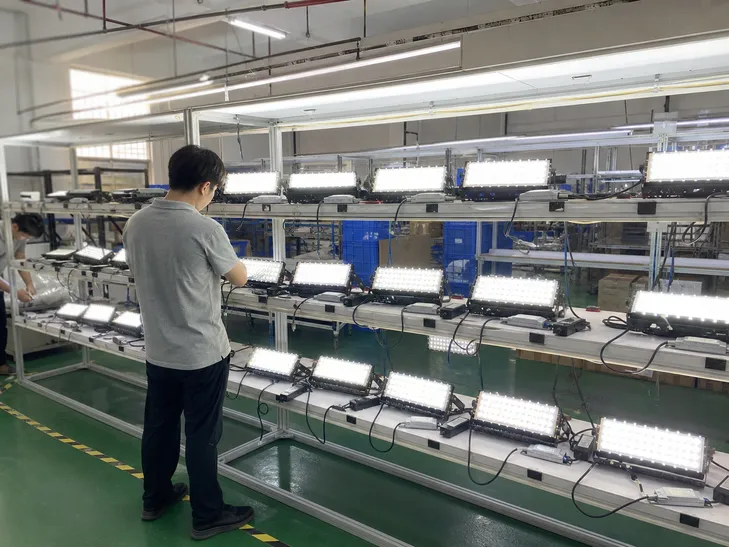
Bathtub Curve Logic: Early-life failure rate is highest in the first hours of operation, drops sharply, then stays low for rated life. The aging test eliminates that early-failure window before shipment.
Pre-Shipment Photometric Verification & Final Inspection
Before a batch ships, photometric verification runs on a sample from the production run. Lumen output, color temperature (CCT), and color rendering index (CRI) are measured in our in-house optical lab and checked against the approved spec.
If a batch drifts outside tolerance — typically ±10% on lumen output, ±150K on CCT — it doesn't ship until the cause is identified and corrected.
Final visual inspection covers finish quality, packaging integrity, and documentation completeness. The documentation package — test reports, Declaration of Conformity, packing list — is assembled per order before the container loads.
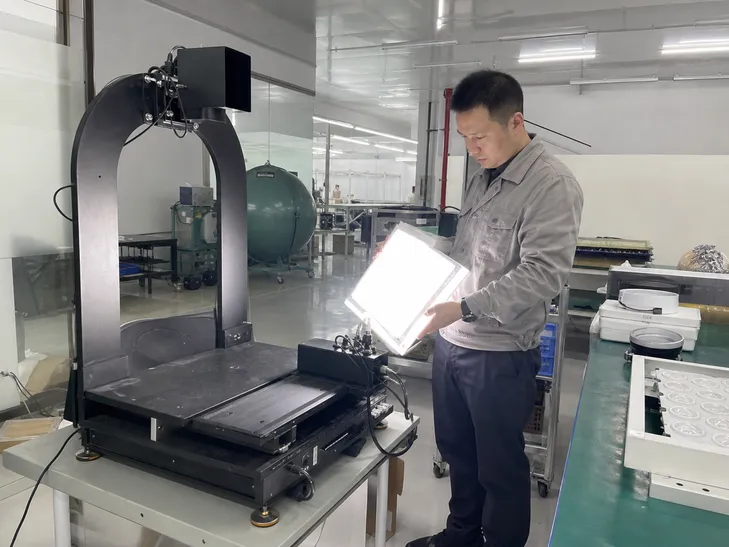
Tolerance Thresholds
Market-by-Market Compliance: What Your Destination Requires
Different export markets have different mandatory requirements. Here's a practical summary for the markets we ship to regularly.
European Union and UK
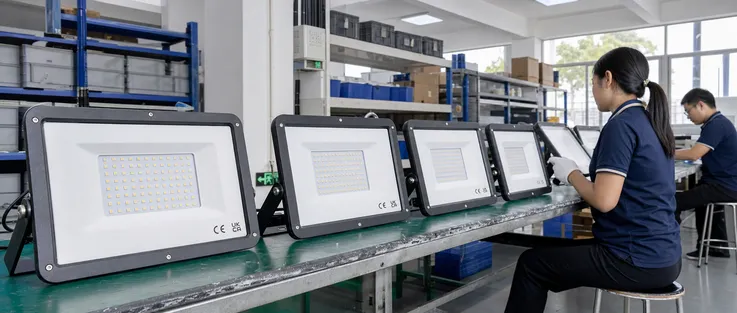
CE marking is mandatory for luminaires sold in the EU. Post-Brexit, the UK requires UKCA marking for products placed on the UK market — the technical requirements are largely aligned with CE, but the marking and declaration process is separate. We handle both.
RoHS compliance is mandatory in both markets. WEEE (Waste Electrical and Electronic Equipment) registration is the importer's responsibility in most EU member states — we can provide the product data your WEEE compliance team needs.
Energy efficiency labeling (EU Ecodesign Regulation 2019/2020) applies to light sources and luminaires sold in the EU. For LED luminaires, this covers minimum efficacy requirements and product information requirements. Our LED product range is specified to meet current Ecodesign requirements — if you're building a line for the EU market, confirm the target efficacy with us at the specification stage.
North America
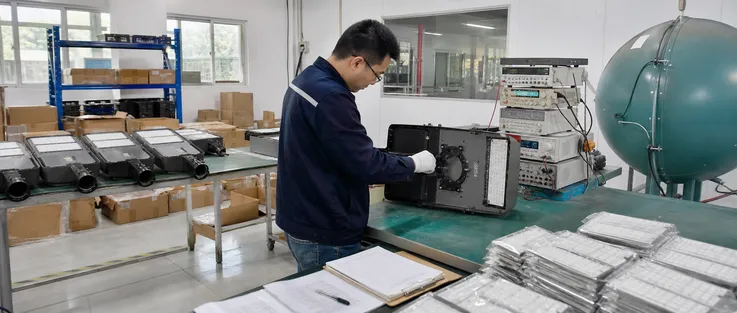
UL listing (or equivalent NRTL certification) is required or strongly preferred for most US commercial and residential applications.
California Title 24 energy efficiency requirements apply to luminaires sold in California — if your buyers are in California, confirm Title 24 compliance at the specification stage.
Canada requires CSA certification or equivalent for electrical products — our UL certification covers most Canadian requirements, but confirm with your Canadian buyers for specific applications.
Australia and New Zealand
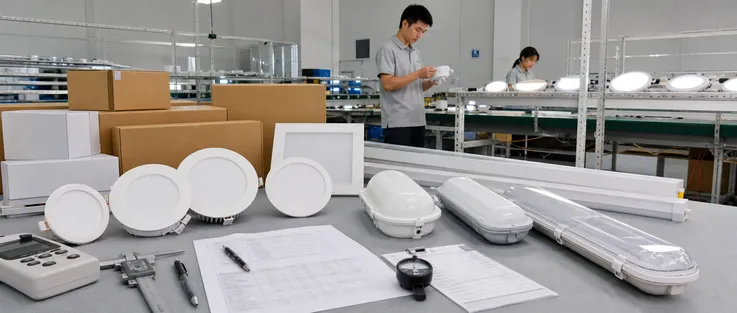
SAA certification (compliance with AS/NZS standards) is mandatory for electrical products sold in Australia and New Zealand.
The Regulatory Compliance Mark (RCM) is required on products — we can provide RCM-marked product for the Australian market.
Energy efficiency requirements under the Equipment Energy Efficiency (E3) program apply to some luminaire categories.
Middle East

GCC countries (Saudi Arabia, UAE, Kuwait, Bahrain, Qatar, Oman) require SASO certification for Saudi Arabia and ESMA certification for the UAE for electrical products.
Requirements vary by country and product category. We've been shipping to the Middle East since our early years and can advise on current requirements for your target market — send us the destination country and product type.
Southeast Asia

Requirements vary significantly by country. We can advise on current requirements and, where we have existing certification coverage, provide the relevant documentation.
Singapore
Requires the SAFETY Mark for electrical products
Malaysia
Requires SIRIM certification
Indonesia
Requires SNI certification
Not sure what your destination market requires?
Send us the destination country and product type — we'll confirm current certification requirements.
Third-Party Audits and Factory Inspections
SGS is part of our standard certification portfolio — not a one-time audit we ran for a specific buyer. SGS product testing and factory audit reports are available on request as part of the supplier qualification documentation package.
Beyond SGS, we support customer-requested factory audits. If your compliance team or a third-party auditor needs to visit the facility, review our QC documentation, or inspect production in progress, that's a standard part of how we work with buyers in regulated markets.
We don't require advance notice beyond what's needed to schedule the visit — the factory runs the same way whether or not an auditor is present.
Supported Audit Formats
For buyers who require specific audit formats, contact us to discuss the process. We've completed audits for buyers in the European and North American markets and have the documentation infrastructure to support them.
SMETA
Sedex Members Ethical Trade Audit
BSCI
Business Social Compliance Initiative
Custom Protocols
Customer-specific audit requirements
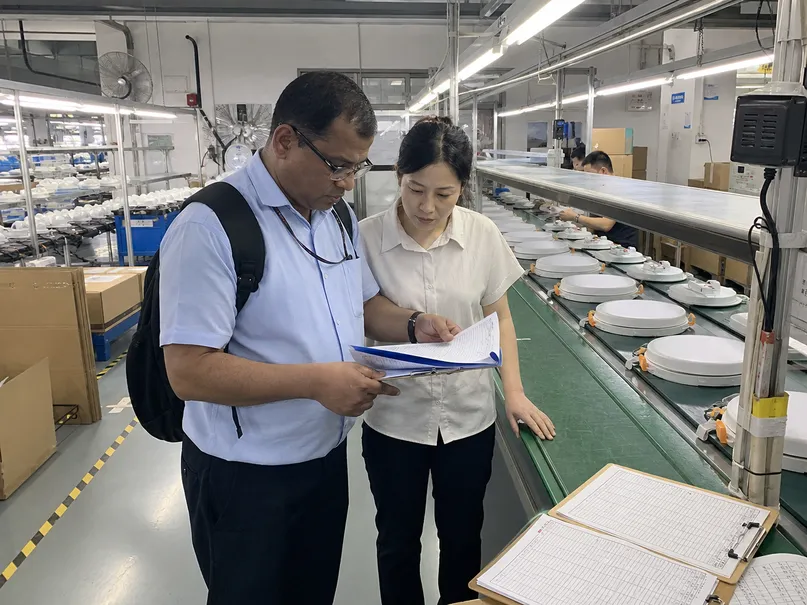
What Auditors Can Access
-
Full facility walkthrough and production line inspection
-
QC documentation and testing records review
-
In-progress production inspection
-
SGS product testing and factory audit reports
-
Supplier qualification documentation package
Documentation Packages: What We Provide Per Order
Compliance documentation is only useful if it's organized and complete when your import team needs it. Here's what we maintain and can provide:
| Document | Availability | Notes |
|---|---|---|
| CE Declaration of Conformity | Per SKU, on request | Includes applicable directives and standards |
| CE Technical File | Per SKU, on request | Test reports, component specs, risk assessment |
| UL Certification Documentation | Per SKU, on request | Certification scope and applicable standard |
| SAA Certification Documentation | Per SKU, on request | AS/NZS standard reference |
| SGS Test Reports | Per product family, on request | Third-party test results |
| ISO 9001:2015 Certificate | Factory-level, on request | Current certificate with validity period |
| RoHS Compliance Declaration | Per SKU, on request | Substance restriction compliance |
| IES Photometric Files | Per SKU, on request | For project submissions requiring photometric data |
| Material Safety Data Sheets | Per component, on request | For hazardous substance compliance |
Documentation Maintenance & Custom Formats
Documentation is maintained per SKU and updated when certifications are renewed or standards change. If you need a specific document format for your import process — a particular Declaration of Conformity template, a specific test report format — let us know at the order stage and we'll confirm whether we can accommodate it.
Common Compliance Questions
Which products does your CE certification cover?
CE certification covers our full decorative luminaire range: pendant lighting, chandeliers, wall sconces, ceiling fixtures, spotlights, and track lighting. The certification applies to the complete luminaire assembly — housing, driver, and light source — not just the fixture body. If you're sourcing a specific SKU for the EU market, we can confirm CE coverage and provide the Declaration of Conformity for that product.
Can you provide test reports for specific certification standards?
Yes. We maintain test reports per SKU for CE (LVD, EMC, RoHS), UL, and SAA. SGS test reports are available for product families that have been through SGS testing. If you need a test report for a specific standard or a specific SKU, contact us with the product reference and the standard you need — we'll confirm availability and send the documentation.
What is the difference between UL Listed and CE marked for lighting?
CE and UL test to different standards and serve different markets. CE marking is required for the EU and covers LVD, EMC, and RoHS directives. UL listing is required or preferred for North America and tests to UL 1598 (or applicable UL standard) for electrical safety. A CE-marked fixture is not automatically compliant for the US market, and vice versa. We hold both, so for our standard range, your import team doesn't need to manage this gap — but it's a real issue when sourcing from factories that hold only one.
Do your certifications cover OEM and custom products?
Standard catalog products are covered by our existing certifications. For OEM products with significant design changes — new housing geometry, different driver specifications, modified electrical configuration — re-certification may be required depending on the scope of the change.
We assess this at the OEM project specification stage and advise on certification requirements before production starts. See our OEM/ODM capabilities page for more on the custom product development process.
How do I know your certifications are current?
We maintain certifications on an active basis — not as one-time credentials. ISO 9001:2015 undergoes annual surveillance audits and three-year recertification. Product certifications (CE, UL, SAA) are reviewed when standards update. If you need to verify currency, request the certificate documents — they carry validity dates and issuing body information. We don't provide fabricated certificate numbers or validity periods in marketing materials; the actual documents are the verification.
Request Certification Documentation
If you're at the supplier qualification stage and need documentation for your compliance review, contact us directly. Tell us the product type, destination market, and which certifications or test reports you need — we'll pull the relevant documents and send them as part of the qualification package.
For buyers building a new product line for a specific market, it's worth having this conversation at the specification stage rather than after samples are approved. Certification requirements can affect driver selection, wiring configuration, and labeling — catching those requirements early avoids rework.
Wholesale only. Strict MOQ applies.