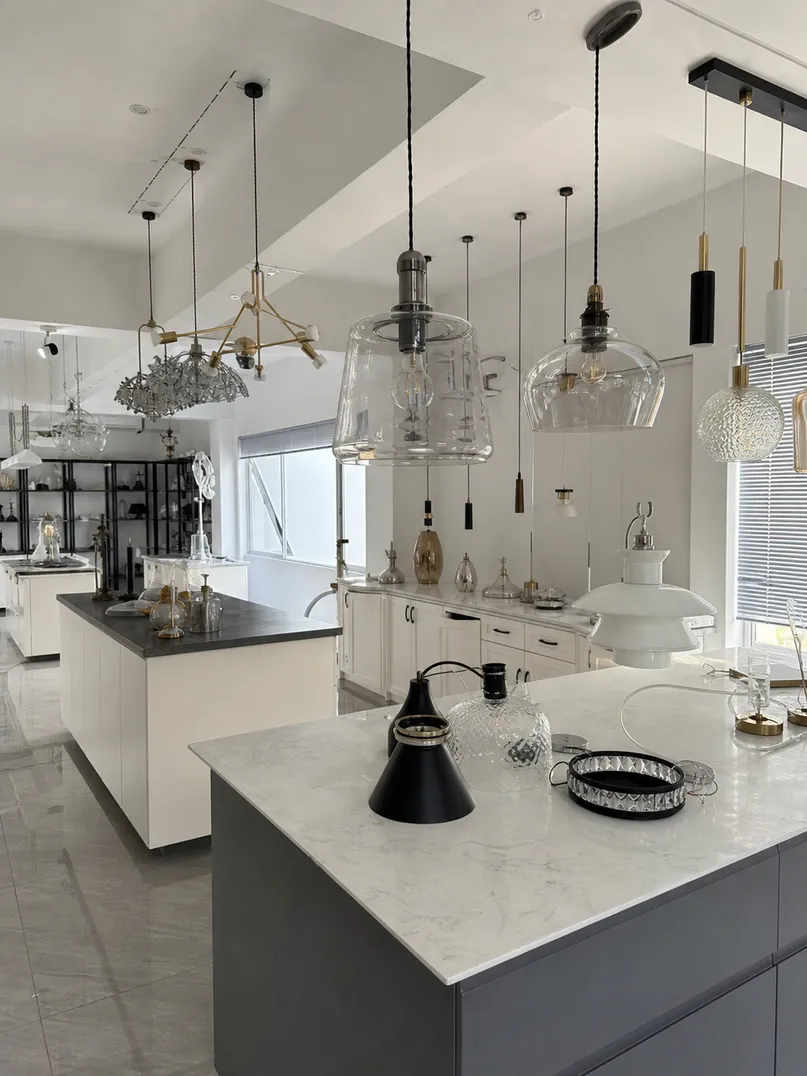

Kitchen Lighting Built for Wholesale
Pendants, island fixtures, chandeliers, and ceiling mounts — full in-house production from die-casting to assembly. CE, UL, and SAA certified. OEM/ODM with 7–10 day prototype turnaround.
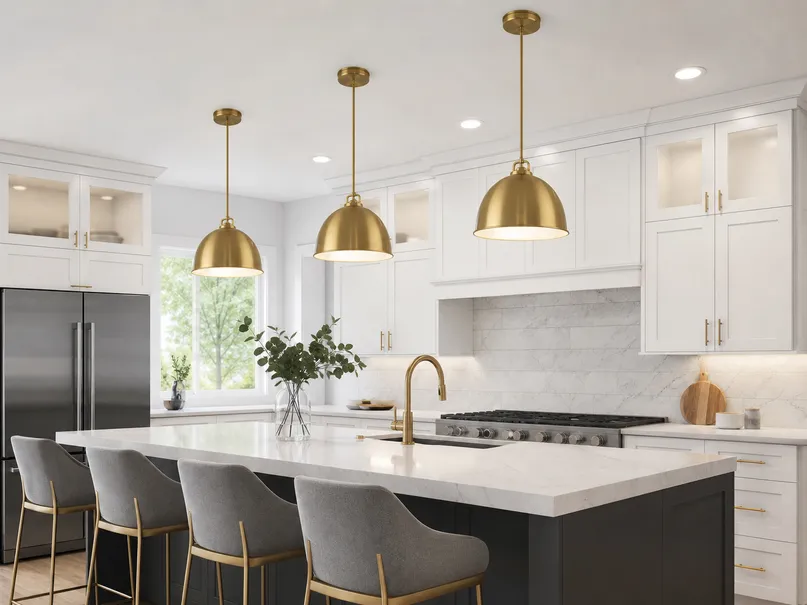
What Kitchen Lighting Buyers Are Actually Sourcing
Kitchen lighting is one of the most specification-sensitive categories in decorative lighting. The same space needs ambient coverage, task illumination over work surfaces, and a focal fixture above the island — and your downstream customers expect all three to coordinate visually and perform reliably. That means you're not sourcing a single SKU; you're sourcing a layered system, and the factory you choose needs to produce across pendant, chandelier, ceiling, and track formats with consistent finish quality and matching hardware.
We've been manufacturing kitchen lighting for residential and hospitality projects since 2008. The category has changed — LED integration, dimmer compatibility, and finish trend cycles have all accelerated — but the sourcing fundamentals haven't: your buyers need fixtures that install cleanly, hold their finish, and don't generate warranty calls. Our kitchen lighting range covers the full format spectrum, all produced in our 12,000 m² Guzhen facility with in-house die-casting, CNC machining, surface finishing, and assembly.
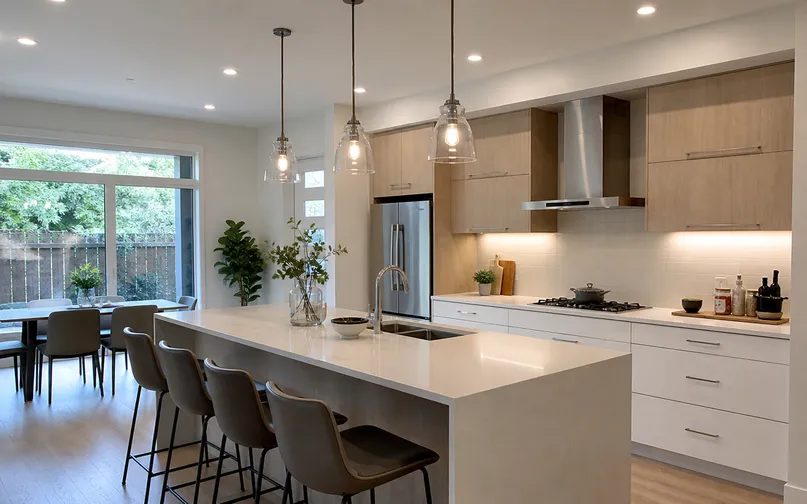
Layered System
Finish Matching
LED Integrated
Kitchen Lighting Formats We Manufacture
Full-format production capability across every kitchen lighting category — from high-margin island pendants to volume flush mounts.
Island Pendants and Linear Suspension Fixtures
Kitchen island lighting is the highest-margin segment in this category. Buyers supplying kitchen renovation contractors, interior design firms, or premium residential developers consistently find that island pendants command the strongest retail markup — the fixture is visible, it's the design statement of the space, and end customers are willing to pay for it.
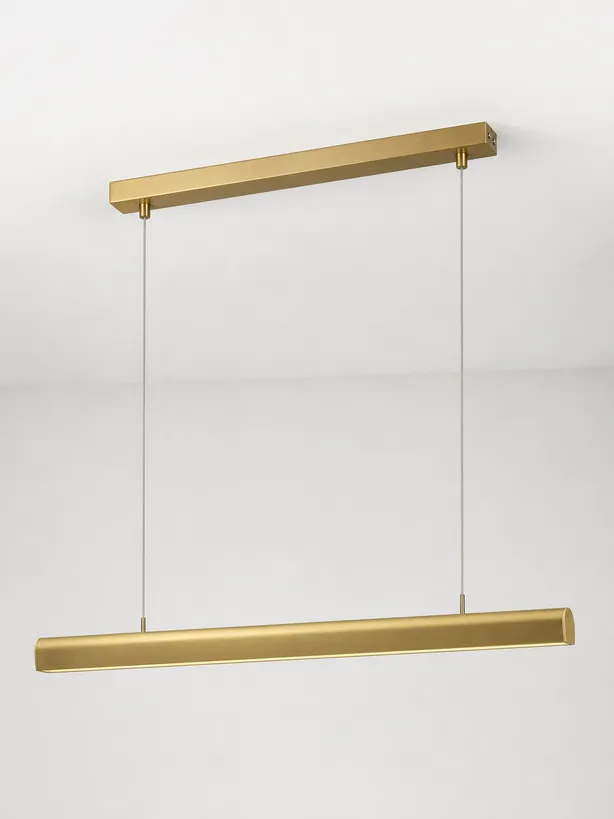
We produce island pendants in single-drop, multi-drop cluster, and linear bar configurations. Linear suspension fixtures — typically 600mm to 1200mm in length — are the format most requested by our North American and European buyers for open-plan kitchen projects. The structural challenge with linear fixtures is canopy engineering: the ceiling mount needs to distribute load evenly across the suspension points while allowing cord-length adjustment on-site. We machine our canopy components in-house on CNC, which means the mounting tolerances are consistent across a production batch rather than varying by hand-fit.
We've seen linear fixtures from other factories arrive with canopy plates that don't sit flush — it's a small thing that generates disproportionate installer complaints.
Single-drop pendants over islands run in glass, metal, and mixed-material configurations. Glass shades — blown, seeded, or ribbed — are sourced from our established glass suppliers in the Guzhen supply chain and assembled in-house. Metal pendants in matte black, brushed brass, and brushed nickel are our three highest-volume finishes for this format; all three are produced on our in-house finishing line with PVD or powder coat depending on the finish specification.
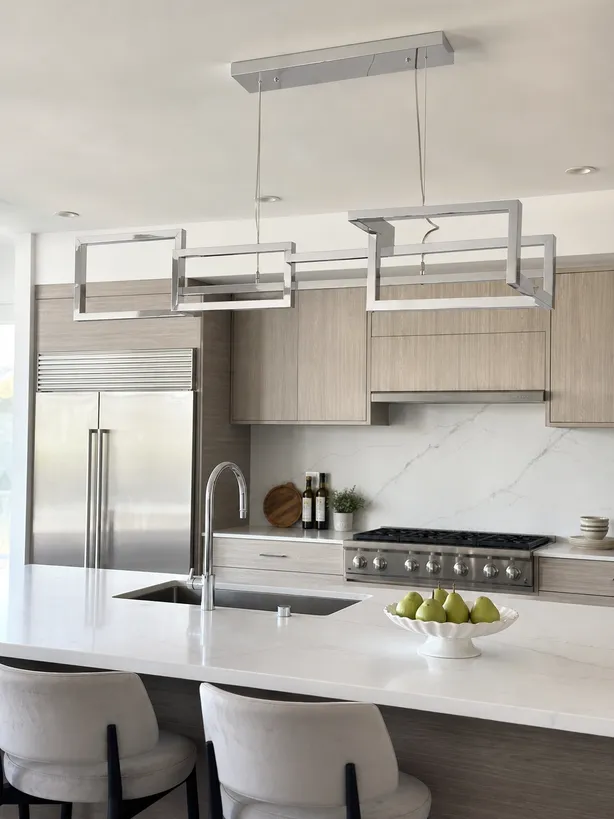
Kitchen Chandeliers
Modern kitchen chandeliers — particularly linear and geometric forms — have moved from dining rooms into open-plan kitchen spaces over the past several years. Buyers supplying luxury residential developers and high-end kitchen showrooms are sourcing these actively. The format overlaps with our kitchen chandelier lighting range, which covers both traditional multi-arm configurations and the cleaner linear forms that work in contemporary kitchen design.
For buyers building a kitchen lighting line, chandeliers serve the premium anchor SKU — the fixture that justifies the catalog and supports margin on the rest of the range. We produce kitchen chandeliers in aluminum and zinc alloy with electroplated and PVD finishes. Arm counts, drop lengths, and shade configurations are all adjustable within our standard tooling, which keeps customization lead times shorter than starting from new tooling.
Ceiling Fixtures and Flush Mounts
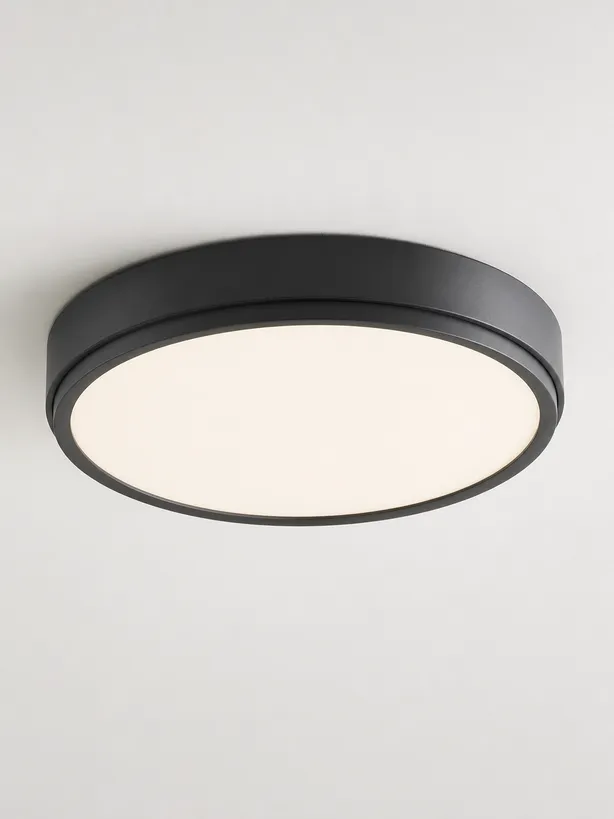
Not every kitchen project has ceiling height for pendants. Flush mount and semi-flush ceiling fixtures are the volume segment — they move in larger quantities, they're specified across a wider range of project types, and they're the format your mid-market buyers need to fill out a kitchen lighting catalog. We produce flush mount kitchen ceiling fixtures in round and rectangular profiles, with LED panels integrated or with decorative shade elements.
Track and Recessed Spotlights for Task Lighting
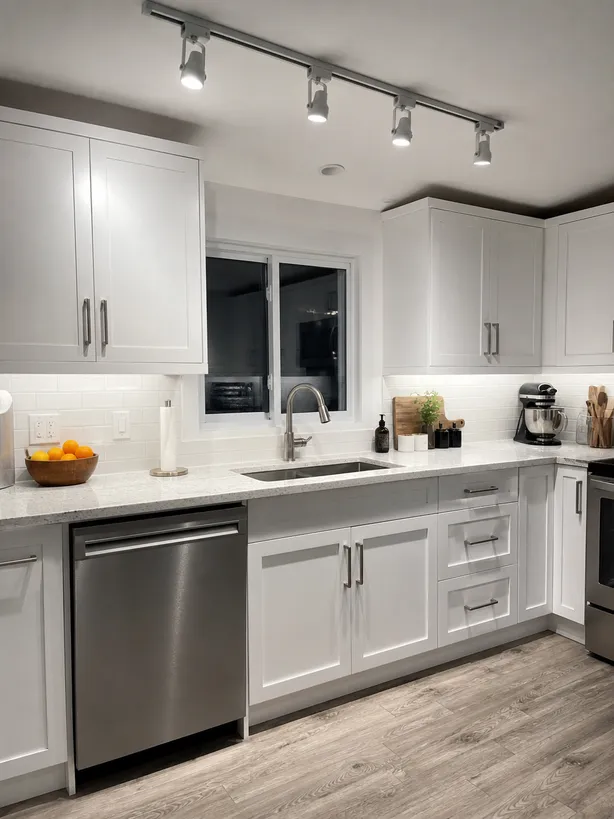
Kitchen task lighting — over countertops, prep areas, and under-cabinet zones — is increasingly specified as track or recessed spotlight systems rather than fixed ceiling fixtures. This is a growing segment for buyers supplying kitchen renovation contractors and commercial kitchen fit-out projects. Our track lighting and recessed spotlight ranges are designed to coordinate with our decorative pendant and ceiling fixture lines, so your buyers can source a complete kitchen lighting package from a single supplier.
Specification Reference: Kitchen Lighting Parameters
Specifications below represent industry-standard values for this product category. Actual specifications vary by SKU and configuration — contact us for detailed product data sheets on specific models.
| Parameter | Typical Range | Notes |
|---|---|---|
| Light source | LED integrated / E26 / E27 / GU10 | Driver spec matched to destination market voltage |
| Wattage | 5W – 60W per fixture | Varies by format and lamp count |
| Color temperature | 2700K / 3000K / 4000K | 2700K–3000K most common for residential kitchen |
| CRI | ≥80 (standard) / ≥90 (premium) | CRI ≥90 available for luxury kitchen and hospitality specs |
| Dimming compatibility | TRIAC / 0-10V / DALI | Specify at order; driver selected per dimming protocol |
| Voltage | 100–240V AC | Dual-voltage drivers available for multi-market distribution |
| IP rating | IP20 (standard interior) / IP44 (over-sink zones) | IP44 available for wet-zone specifications |
| Finish options | Matte black, brushed brass, brushed nickel, chrome, antique bronze, custom RAL | PVD and powder coat; custom finishes on qualifying MOQ |
| Shade materials | Blown glass, seeded glass, ribbed glass, spun aluminum, fabric | Glass sourced from established Guzhen supply chain partners |
| Suspension cord/rod | Adjustable 300mm–2000mm | Fixed rod lengths available; specify at order |
| Certifications | CE, UL, SAA, SGS | Market-specific certification available; confirm at inquiry |
Specifications are industry-standard reference values. Contact us for exact data sheets, IES files, and test reports for specific SKUs.
Production Process: Where Kitchen Lighting Quality Is Won or Lost
Kitchen lighting fails in the field in predictable ways: finish degradation, driver failure, and structural looseness at the canopy or shade mount. We've engineered our production process around preventing all three.
Finish Durability
Finish durability is the most visible quality variable in kitchen lighting. Kitchens generate heat, humidity, and grease vapor — conditions that accelerate finish failure on fixtures with inadequate surface preparation or thin coating.
- Powder coat line runs at 60–80μm thickness with automated application
- Every batch goes through adhesion testing before shipping
- PVD over electroplating for brushed brass and brushed nickel finishes — the two most popular kitchen lighting finishes in North American and European markets
- PVD produces a harder surface layer with better resistance to humidity cycling that kitchen environments create
We made the switch to PVD on these finishes after seeing electroplated brass fixtures from our earlier production develop micro-pitting in coastal market installations. The PVD process costs more per unit, but the warranty claim rate dropped to near zero.
Driver Reliability
Driver reliability is the failure mode that generates the most after-sale cost. A fixture that stops working six months after installation creates a warranty claim, a service call, and a customer who doesn't reorder.
- LED drivers specified per SKU based on wattage, dimming protocol, and destination market voltage — no single driver spec across the range
- 100% aging test before packing: every luminaire powered for a minimum burn-in period
- Catches early-life driver failures and wiring faults before they reach your customer's installation
The aging test protocol was formalized after a batch of LED drivers failed in the field for a Gulf distributor — it's now non-negotiable before any container loads.
Structural Integrity
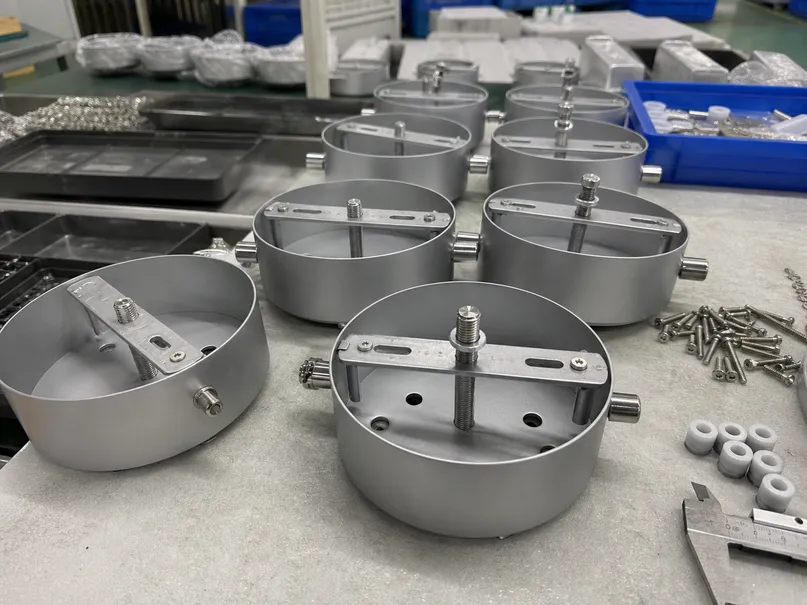
Structural integrity at mounting points matters more in kitchen lighting than in most decorative categories because kitchen fixtures are often installed in high-traffic areas where vibration from appliances and foot traffic is constant.
- CNC-machined canopy components hold ±0.1mm tolerances on critical mounting dimensions
- Fixture sits flush and mounting hardware engages correctly
- Same tooling across a production batch — no mid-run tooling swaps that introduce dimensional drift
In-House Optical Lab
Our in-house optical lab verifies lumen output, beam angle, and color temperature against spec on new designs and on production samples.
For buyers who need IES files for project submissions — kitchen renovation contractors working with lighting designers, or hospitality buyers specifying kitchen areas in hotel projects — we generate IES files from our own photometric measurements.
Market Segments: Where Kitchen Lighting Moves at Volume
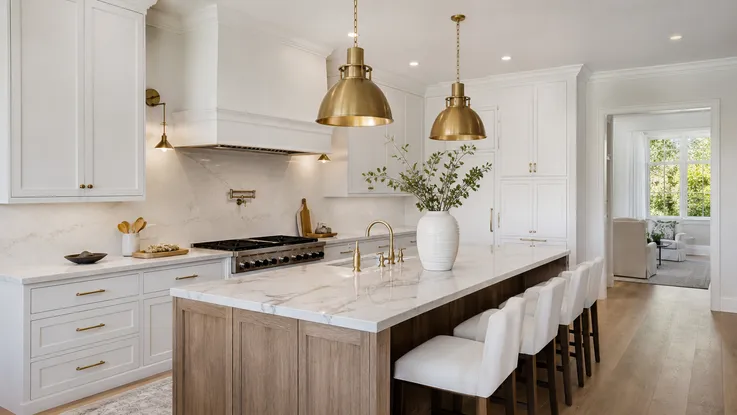
Luxury Residential Development and Kitchen Showrooms
High-end residential developers and kitchen showroom operators are the premium end of this market. They're sourcing modern kitchen lighting and luxury kitchen lighting for projects where the fixture is a design element, not just a utility item. Island pendants in brushed brass and matte black, linear chandeliers in geometric forms, and coordinated ceiling fixture sets are the SKUs that move in this segment.
Margins are strong — buyers in this segment are selling design, not commodity — and reorder patterns follow project pipelines, which means a buyer who lands a developer relationship orders repeatedly across multiple projects.
Finish Consistency Across SKUs
For distributors building a premium kitchen lighting catalog, the key is finish consistency across SKUs. Your buyers are specifying multiple fixtures for the same space — if the brushed brass on the island pendant doesn't match the brushed brass on the wall sconce, you get returns. Our in-house finishing line produces all finishes from the same process parameters, so cross-SKU color consistency is controlled rather than approximate.
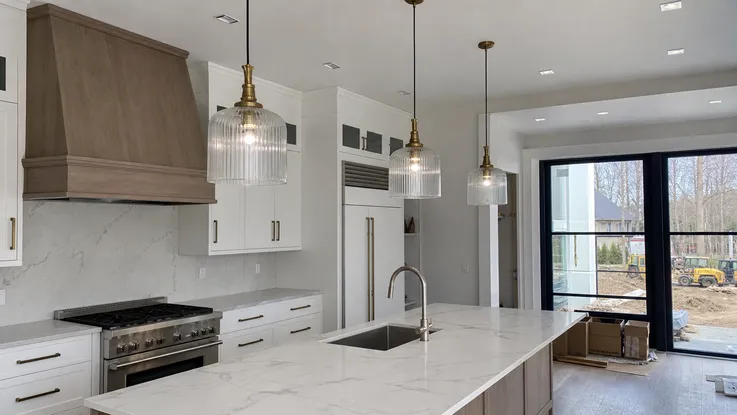
Kitchen Renovation Contractors and Trade Buyers
Renovation contractors and trade buyers are the volume segment. They're sourcing kitchen island lighting and modern kitchen lighting for residential renovation projects — typically mid-to-high-end kitchens where the homeowner has a budget and a design direction. This segment orders in smaller quantities per project but at high frequency, and the buyers who serve it well build repeat business on reliability: the fixture arrives on time, installs without issues, and the finish holds.
Practical Specifications That Matter
- Adjustable suspension lengths to accommodate varying ceiling heights
- Dual-voltage drivers for buyers distributing across multiple markets
- IP44 ratings for fixtures specified near sink zones
We build all of these into our standard kitchen lighting range.
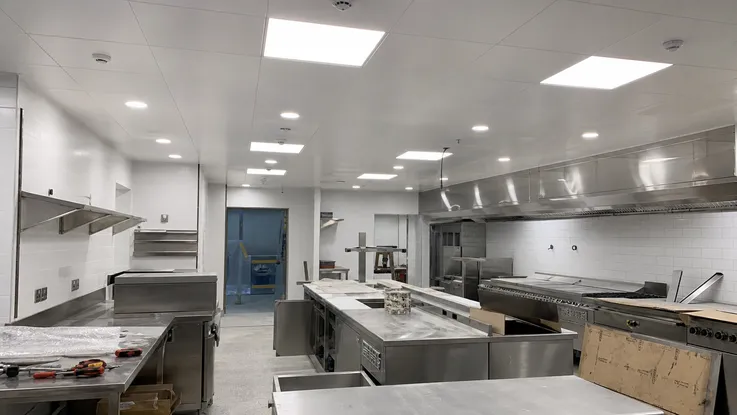
Hospitality and Commercial Kitchen Projects
Hotels, restaurants, and commercial kitchen fit-outs are a distinct sourcing pattern. Project quantities are larger — a hotel kitchen renovation might specify 50–200 fixtures across multiple zones — and the compliance requirements are stricter. CE and UL certification are typically mandatory for hospitality projects in European and North American markets.
Our certification portfolio covers both, and we maintain test reports and Declaration of Conformity documentation per SKU for buyers whose import teams need compliance documentation packages.
This segment has grown steadily for us over the past several years — hospitality buyers tend to be more systematic about sourcing and more loyal once they've qualified a supplier. If you're building a hospitality lighting line, it's worth the qualification investment.
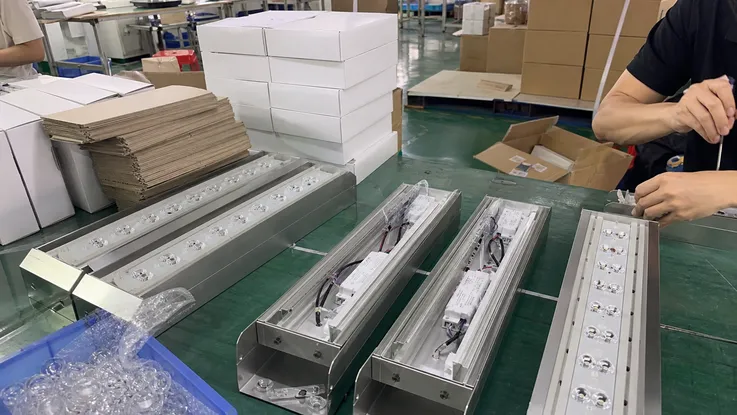
Overseas Manufacturers and Private Label Programs
Lighting manufacturers in markets without full in-house production — Southeast Asia, the Middle East, parts of Europe — source finished kitchen lighting from us for private label distribution. For these buyers, OEM/ODM capability is the primary requirement: the ability to produce to their design specifications, apply their branding, and ship in their packaging.
Prototype & Fulfillment Capabilities
- 7–10 working day prototype turnaround: CNC-machined housings, provisional surface finishing, and driver integration — a functional sample, not a mock-up
- White-label packaging available
- Blind drop-shipping for e-commerce or direct-to-trade distribution models
Customization: What You Can Specify and What Affects Lead Time
Kitchen lighting customization requests fall into three categories: finish and color, dimensional configuration, and electrical specification. Here's how each works in practice.
Finish and Color
Standard finishes — matte black, brushed brass, brushed nickel, chrome, antique bronze — are available on all SKUs within standard MOQ.
Custom RAL colors and non-standard metallic finishes are available on runs of 100 units or more per finish; below that, the powder line changeover cost doesn't make sense for either side.
PVD finishes in custom tones (rose gold, gunmetal, champagne) are available on qualifying MOQ — ask us at inquiry.
Dimensional Configuration
Within standard tooling — suspension length, arm count on multi-arm fixtures, and linear fixture length are adjustable without new tooling cost.
New tooling required — non-standard canopy profiles, custom shade geometries, new mounting configurations add 15–20 days for the tooling cycle before production starts.
Our engineering team will flag tooling requirements early in the quoting process so you're not surprised by lead time additions.
Electrical Specification
Driver selection, dimming protocol, voltage range, and color temperature are specified at order.
We don't lock a single electrical spec across a SKU — the driver is matched to your destination market and your buyers' dimmer infrastructure.
If you're distributing across multiple markets with different voltage standards, we can configure dual-voltage drivers on most SKUs.
MOQ and Lead Time
Standard Catalog Items
25–35 days from order confirmation
Custom Configurations (Existing Tooling)
Add 5–10 days to standard lead time
New Tooling Required
Add 15–20 days to the tooling cycle before production starts
We communicate lead time milestones proactively — if a production issue is going to affect your ship date, you hear about it before the container is supposed to load.
Tell us your target configuration and volume — we'll quote within 24 hours.
Request a QuoteCertifications and Compliance for Your Target Market
Kitchen lighting sold into North American, European, and Australian markets carries mandatory certification requirements. Our certification portfolio covers the primary markets:
CE
European market — covers Low Voltage Directive and EMC requirements
UL
North American market — required for most US and Canadian retail and project channels
SAA
Australian market certification
SGS
General export compliance
ISO 9001:2015
Quality management system certification
Documentation Packages
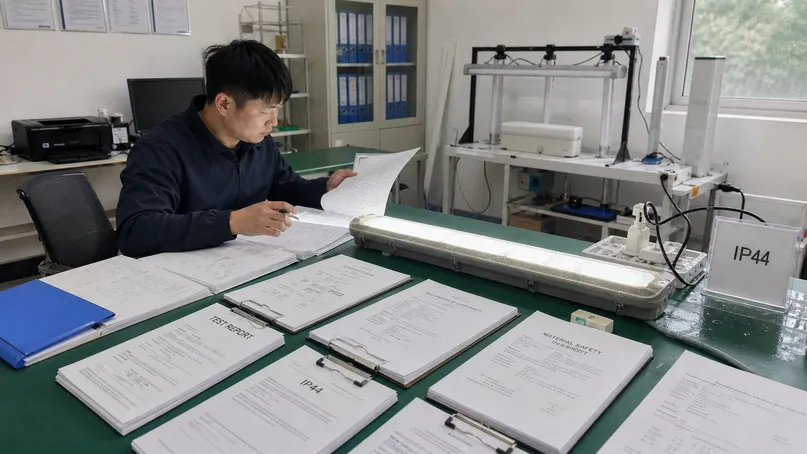
For buyers whose import teams need documentation packages — test reports, Declaration of Conformity, material safety data — we maintain these per SKU and provide them as part of the order documentation.
If your target market requires a certification not listed above, ask us at inquiry — we can advise on availability or development timeline.
IP44-Rated Wet-Zone Fixtures
IP44-rated fixtures for wet-zone kitchen applications (over-sink, near dishwasher zones) are available and carry the relevant IP rating documentation. For hospitality buyers specifying kitchen areas in hotel or restaurant projects, we can provide the full compliance documentation package required for project submissions.
Packaging and Container Loading for Kitchen Lighting Orders
Kitchen lighting — particularly glass pendant fixtures and multi-arm chandeliers — requires packaging engineered for ocean freight, not just domestic shipping. We pack each fixture in individual foam-lined cartons with outer carton reinforcement rated for the drop and compression forces of a 40HQ container.
Glass shades ship with additional internal bracing; we've mapped the damage patterns from specific routes and adjusted the packaging accordingly.
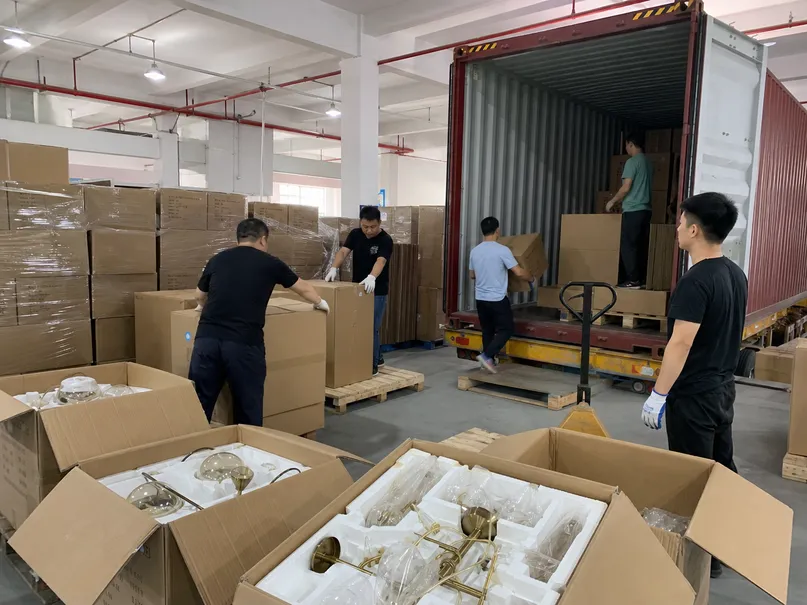
40HQ Container Loading Optimization
For large-volume orders, we optimize carton dimensions for 40HQ container loading efficiency. A 5–8% improvement in units per container is real money on a 2,000-unit order — it's the kind of detail that shows up in your landed cost calculation, not in the product spec sheet.
more units per container
Packaging by Distribution Channel
E-commerce & FBA
- White-label packaging with your branding
- Barcode labeling to your warehouse spec
- Blind drop-shipping available
Project-Based Buyers
- Palletized by project zone
- Labeled for site delivery logistics
- Simplified zone-based unpacking
Ocean Freight Protection
- Individual foam-lined cartons
- Outer carton reinforcement for drop/compression
- Route-specific glass shade bracing
Frequently Asked Questions
What is the minimum order quantity for kitchen lighting?
MOQ varies by SKU and configuration. Standard catalog items typically start at 50–100 units per SKU. Custom configurations and OEM orders have separate MOQ requirements depending on tooling and production line allocation. Contact us with your target SKU mix and volume — we'll confirm MOQ and lead time together.
What dimmer compatibility do your kitchen pendant lights support?
We specify the driver per SKU based on your dimming protocol requirement. TRIAC (leading and trailing edge), 0-10V, and DALI are all available. The key is to specify your target dimmer infrastructure at order — we match the driver to it rather than using a generic driver that may not perform correctly with your buyers' existing dimmers. If you're distributing across multiple markets with different dimmer standards, we can advise on the driver configuration that covers the broadest compatibility range.
Can you match finishes across different kitchen lighting fixture types — pendants, ceiling fixtures, and wall sconces?
Yes. Because all finishes are produced on our in-house finishing line using the same process parameters, cross-SKU color consistency is controlled. This matters when your buyers are specifying multiple fixture types for the same kitchen — the brushed brass on the island pendant needs to match the brushed brass on the ceiling fixture. We recommend ordering finish samples across your intended SKU mix before committing to a full production run, particularly for custom or non-standard finishes.
What CRI should I specify for kitchen lighting?
For standard residential kitchen applications, CRI ≥80 is sufficient and is what most mid-market buyers specify. For luxury residential, kitchen showroom, and hospitality applications where food presentation and surface color accuracy matter, specify CRI ≥90. The driver and LED module selection changes, which affects unit cost — worth confirming at the quoting stage so the cost difference is visible before you commit to a spec.
How do you handle kitchen lighting for wet zones near sinks?
Fixtures specified for installation within 600mm of a sink or other water source in most markets require a minimum IP44 rating. We produce IP44-rated versions of our pendant and ceiling fixture range — the housing sealing and driver enclosure are modified for the rating. Confirm the IP requirement for your target market at inquiry; the relevant certification documentation is available per SKU.
What's the lead time for a new OEM kitchen lighting design?
Prototype turnaround runs 7–10 working days from approved drawings to physical sample — CNC-machined housing, provisional surface finishing, and driver integration. If you're bringing a design concept rather than finished drawings, our engineering team works from reference images, dimensions, and target cost to develop the production-ready design. Full production lead time after sample approval runs 25–35 days for standard configurations; new tooling adds 15–20 days to the tooling cycle.
Related Kitchen Lighting Formats
Depending on your sourcing requirement, these related ranges may be relevant to your kitchen lighting program.
Kitchen Chandelier Lighting
Multi-arm and linear chandelier formats for premium kitchen and open-plan spaces
Modern Pendant Lighting
Minimalist pendant formats that work across kitchen and dining applications
Linear Chandelier Lighting
Rectangular linear suspension fixtures for island and dining table applications
Track Lighting
Adjustable track systems for kitchen task lighting and accent zones
Recessed Spotlights
Recessed downlights for kitchen ambient and task lighting layers
Ceiling Lighting
Full ceiling fixture range including flush mount and semi-flush formats
Start Your Kitchen Lighting Inquiry
Send us your target SKU mix, destination market, volume, and any certification or customization requirements. We'll come back with a detailed quote and, where relevant, a recommendation on configuration based on what's working for our existing buyers in your region.
New to sourcing kitchen lighting from China? Most buyers start with a sample order across 3–5 SKUs to test finish quality and installation with their own customers before committing to a full production run. We can ship samples within standard lead time — ask us about sample terms at inquiry.
Phone / WhatsApp
+86 134 2021 9307Address
No. 14 Beisan Rd, Gusan Ind. Zone, Guzhen, Zhongshan, Guangdong, China
Wholesale only. Strict MOQ applies.