

Decorative Ceiling Lighting Manufactured to Spec
Flush mounts, semi-flush, and surface-mounted designs built for wholesale and project supply. Full in-house production from die-casting to surface finishing.
OEM/ODM with 7–10 day prototype turnaround · 600,000 luminaires/year capacity · 100% aging test before shipment
What Decorative Ceiling Lighting Is — and Where It Sits in the Ceiling Range
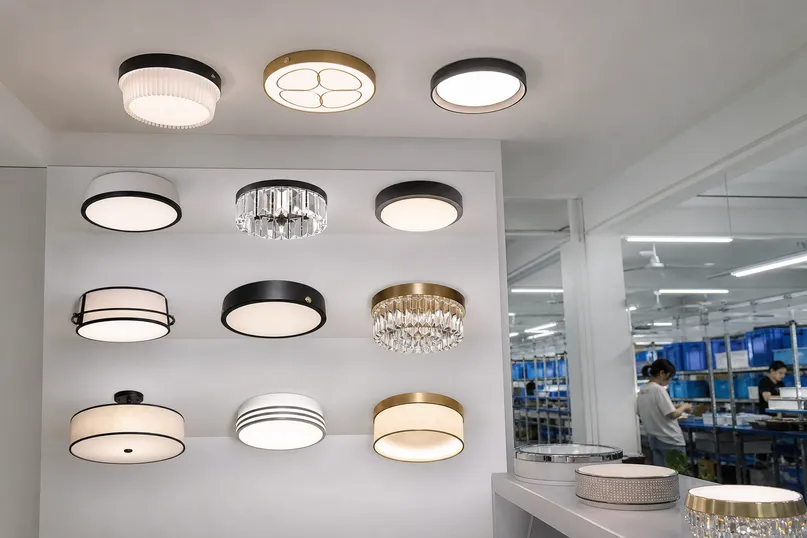
Decorative ceiling lighting covers surface-mounted and semi-flush fixtures where the housing itself is a visible design element, not just a functional enclosure. The distinction matters when you're building a product line: flush mounts and recessed downlights are largely commodity items competing on price; decorative ceiling fixtures compete on form, finish, and the ability to carry a design language across a space. That's a different margin conversation.
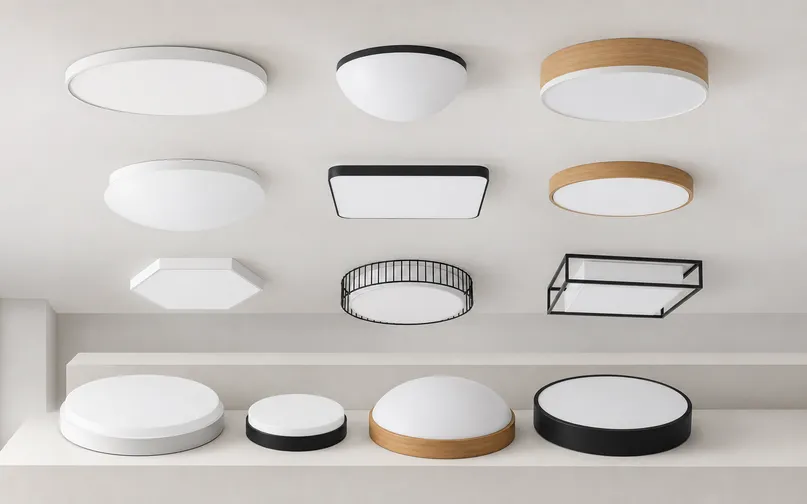
Within our ceiling range, decorative ceiling lighting sits between flush mount ceiling lighting — which prioritizes low-profile utility — and luxury ceiling lighting, which targets premium residential and hospitality specifications. Decorative ceiling fixtures occupy the middle ground: enough visual presence to anchor a room's aesthetic, priced and specified for volume distribution and mid-to-upper residential or commercial projects.
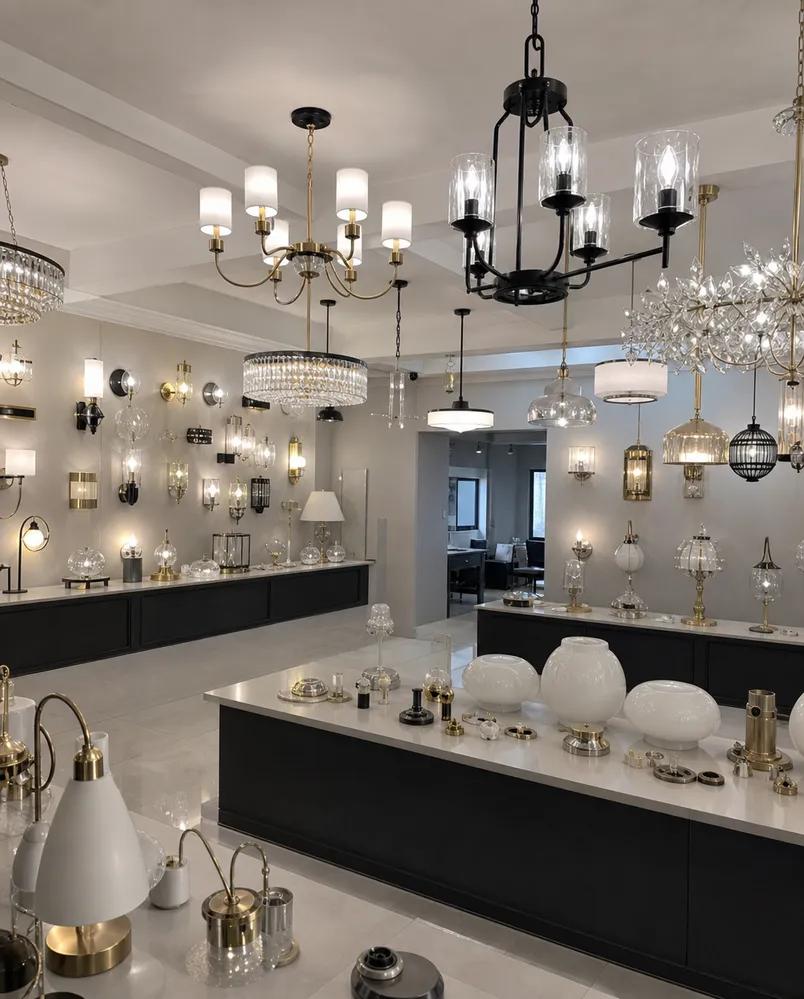
The housing forms we produce in this category include circular and square surface-mounted plates, dome and bowl profiles, multi-ring suspended ceiling mounts, and geometric frame designs. Shade materials run from opal and clear glass to acrylic diffusers and metal mesh. The common thread is that the fixture is meant to be seen — which means finish consistency across a batch matters more here than in a purely functional product.
Where It Sits in the Range
Fixture Configurations and Typical Specifications
Decorative ceiling fixtures span a wider dimensional range than most ceiling categories because they serve spaces from compact bedrooms to hotel corridors and restaurant dining rooms. The table below reflects industry-standard parameters for the configurations we produce most frequently. Contact us for exact specifications on any SKU.
| Configuration | Typical Diameter / Size | Typical Height | Wattage Range | CCT Options | Mounting |
|---|---|---|---|---|---|
| Circular surface mount | 300–600mm | 80–150mm | 18–48W | 2700K / 3000K / 4000K | Ceiling plate, direct |
| Square surface mount | 300×300 – 500×500mm | 60–120mm | 18–36W | 2700K / 3000K / 4000K | Ceiling plate, direct |
| Semi-flush dome | 400–700mm | 200–350mm | 24–60W | 2700K / 3000K | Ceiling canopy |
| Multi-ring ceiling mount | 500–900mm | 150–300mm | 36–80W | 2700K / 3000K | Ceiling canopy, adjustable drop |
| Geometric frame ceiling | 400–800mm | 100–250mm | 24–60W | 2700K / 3000K / 4000K | Ceiling plate |
Housing Materials
- •Die-cast aluminum (primary)
- •Cold-rolled steel (flat-panel designs)
- •Zinc alloy (decorative hardware)
Shade / Diffuser
- •Opal glass
- •Clear glass
- •Frosted acrylic
- •Smoked glass
- •Metal mesh
Finish Options
- •Matte black
- •Brushed gold / nickel
- •Chrome / antique brass
- •White powder coat
- •Custom RAL (qualifying volumes)
Driver & Electrical
- •Dimmable & non-dimmable
- •TRIAC and 0–10V dimming
- •110V / 120V / 220V / 240V
- •CRI ≥80 Ra standard
- •CRI ≥90 Ra on request
Specifications shown are industry-standard values for this product type. Actual specifications vary by SKU. Contact us for detailed product data sheets and exact parameters.
In-House Production: Why Finish Consistency Matters More Here Than in Other Categories
Decorative ceiling lighting is the category where surface finishing problems show up most visibly — and most expensively. A flush mount with a slightly off-color housing gets installed on a ceiling and nobody notices. A decorative ceiling fixture is a focal point. If you're supplying a hotel corridor with 80 units and three of them have a slightly different brushed gold tone, you hear about it.
We run the surface finishing line in-house: electroplating, powder coating, and PVD under the same roof. Powder coat thickness runs 60–80μm with automated application — consistent across the batch, not just the first units off the line.
For metallic finishes like brushed gold and brushed nickel, we use PVD rather than liquid paint because PVD gives us tighter color consistency across a production run and better abrasion resistance. We switched the brushed gold line to PVD in 2021 after seeing color drift on a 200-unit hotel order — the liquid paint process was sensitive to ambient humidity in a way PVD isn't.
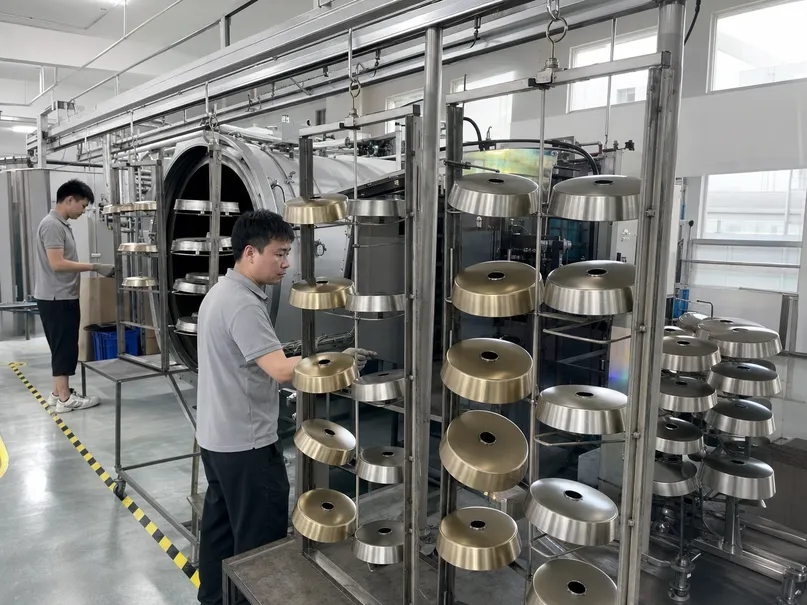
Powder Coating
60–80μm thickness with automated application. Consistent across the full batch, not just the first units off the line.
PVD for Metallics
Tighter color consistency and better abrasion resistance than liquid paint. Immune to ambient humidity drift that caused color variation on earlier processes.
Electroplating
In-house electroplating completes the surface finishing capability set — all three processes under one roof for full batch control.
Die-Casting and Dimensional Control
The die-casting operation feeds directly into finishing. Aluminum housings are cast and CNC-machined on-site, with critical mounting dimensions held to ±0.1mm. That tolerance matters for decorative ceiling fixtures specifically because the canopy-to-ceiling interface is visible — a housing that doesn't sit flush against the ceiling plate is a warranty call.
We run the same tooling across a production batch with no mid-run swaps, so dimensional consistency holds from unit one to unit five hundred.
Key Tolerances
Glass and Acrylic Shade Components
For glass and acrylic shade components, we source from approved suppliers within the Guzhen supply chain and run incoming dimensional checks before shades enter assembly. Glass shade thickness tolerance is held to ±0.3mm — loose enough to be manufacturable, tight enough that the shade seats correctly in the housing without shimming.
Buyers supplying project contractors will recognize why this matters: a shade that requires on-site adjustment adds installation time and creates a callback risk.
Certifications and Market Compliance
CE, UL, and SAA are held and maintained — covering European, North American, and Australian import requirements respectively. ISO 9001:2015 governs the production process framework. SGS audit reports are available on request.
For decorative ceiling lighting specifically, the compliance picture has a few nuances worth knowing:
Europe
Covers the full LVD and EMC requirements for luminaires. For buyers supplying EU markets, we can provide Declaration of Conformity and test reports per SKU.
ENEC marking is available on select designs for buyers who need it for public building specifications.
North America
UL 1598 listed for luminaires. For buyers importing into the US and Canada, we maintain the UL file and can provide listing documentation for your import team.
Damp-location and wet-location ratings are available on specific configurations — confirm at the inquiry stage if your project requires them.
Australia / New Zealand
SAA certification covers the Australian market. For buyers building a line for AU/NZ distribution, we can provide the relevant compliance documentation as part of the order package.
RoHS / REACH
All materials comply with RoHS Directive 2011/65/EU and REACH SVHC requirements. Material safety documentation available on request — relevant for buyers whose downstream customers include EU retailers or specification architects who require material declarations.
Energy Efficiency Requirements
For buyers entering markets with specific energy efficiency requirements (California Title 24, EU ErP Directive), we can configure fixtures with compliant drivers and provide the relevant photometric data. Confirm your target market's requirements at the inquiry stage and we'll spec accordingly.
Custom Decorative Ceiling Lights: OEM and ODM Options
The majority of our decorative ceiling lighting volume is OEM or ODM — buyers bringing their own designs, or working with our engineering team to develop designs for their specific market. Standard catalog items exist, but the more interesting commercial opportunity for most buyers is a product that carries their brand identity rather than a generic catalog number.
OEM — Your Design, Our Production
Send us your drawings, reference samples, or detailed specifications. Our engineering team reviews for production feasibility and flags any cost traps early — overly complex casting geometry, non-standard driver cavities, finishes that require multiple process steps.
We've seen enough OEM projects to know where the surprises hide, and we'd rather surface them before tooling is committed than after.
Prototype turnaround: 7–10 working days from approved drawings to physical sample.
ODM — Concept Development
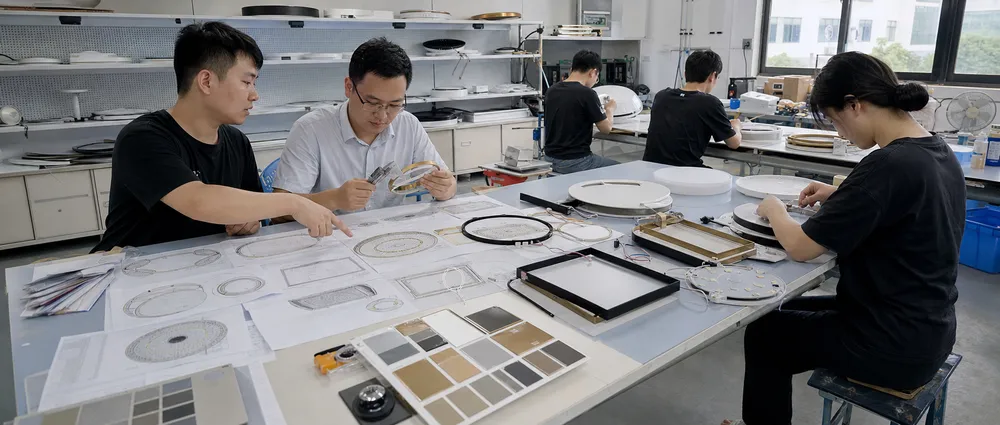
If you're entering the decorative ceiling category without finished drawings, our structural engineers work from reference images, target dimensions, and cost parameters to develop a production-ready design.
We've done this for buyers entering new markets who needed a product that looked locally relevant rather than generically Chinese-export. The optical lab validates beam angle and lumen output on prototypes before tooling is finalized.
Optical lab validates beam angle and lumen output before tooling is finalized.
Customization Parameters for Decorative Ceiling Lights
| Dimension | Customization Range | MOQ Impact |
|---|---|---|
| Housing size | ±20% from standard dimensions | Standard MOQ |
| Finish / color | Any RAL powder coat; PVD colors on request | Standard MOQ for common finishes; +50 units for custom PVD |
| Shade material | Glass, acrylic, metal mesh; custom glass shapes | Custom glass shapes require tooling; confirm lead time |
| CCT / CRI | 2700K–6500K; CRI ≥80 standard, ≥90 on request | Standard MOQ |
| Dimming protocol | TRIAC, 0–10V, DALI on request | Standard MOQ |
| Branding | Logo on housing, custom packaging, private label | Standard MOQ |
| Voltage | 110V / 120V / 220V / 240V | Standard MOQ |
New tooling for custom housing designs adds 15–20 days to the lead time before production starts.
For buyers who need to hit a specific ship window, flag this at the inquiry stage and we'll work the timeline backward from your target date.
Market Segments Where Decorative Ceiling Lighting Moves Volume
Decorative ceiling lighting isn't a single market — the same fixture category serves very different buyer segments with different order patterns, margin profiles, and compliance requirements. Understanding where your buyers sit helps you spec the right product from the start.
Mid-to-Upper Residential New Construction & Renovation
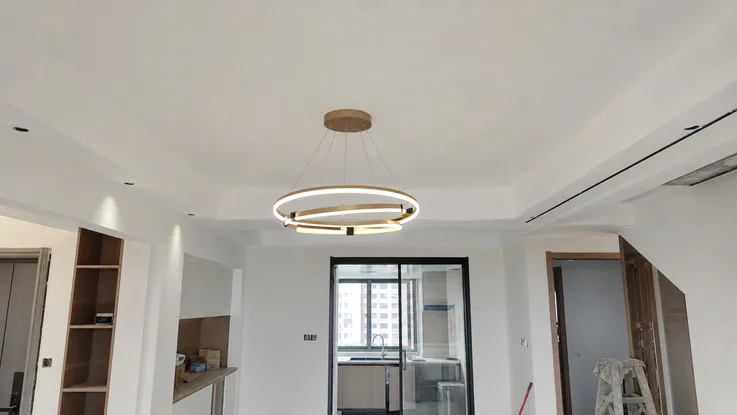
Developers and fit-out contractors specifying 50–500 units per project, typically across multiple SKUs to cover different room types. The commercial logic here is repeat business — a developer who uses your ceiling fixtures on one project and has no warranty issues will spec the same supplier on the next.
Finish consistency and documentation (CE or UL depending on market) are the primary qualification criteria.
This segment has grown steadily in Southeast Asia and the Middle East, where residential construction volumes remain high.
Hospitality — Hotels, Serviced Apartments, Boutique Properties
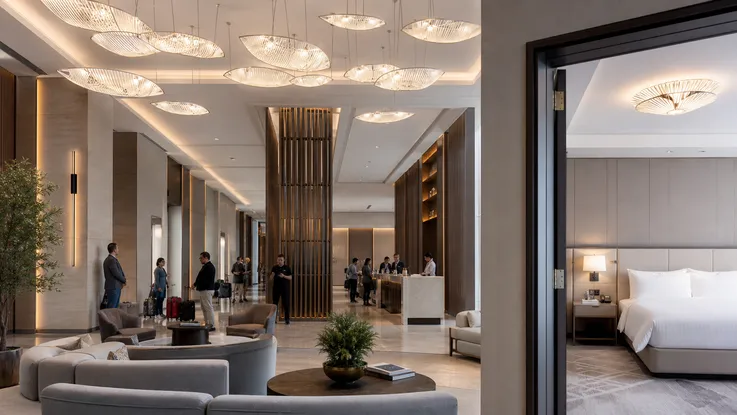
Hotel projects order in larger batches (200–1,000+ units per property) with tighter specification control. The fixture needs to match the interior designer's spec sheet exactly — finish, CCT, beam angle, and housing profile.
This is where CRI ≥90 and DALI dimming compatibility become relevant, and where our in-house photometric lab earns its keep: IES files for project submissions are generated from our own measurements, not borrowed from a driver manufacturer's datasheet.
Hospitality has been our fastest-growing segment for the past two years — worth building into your line if you're not already there.
Restaurant and Retail Fit-Out
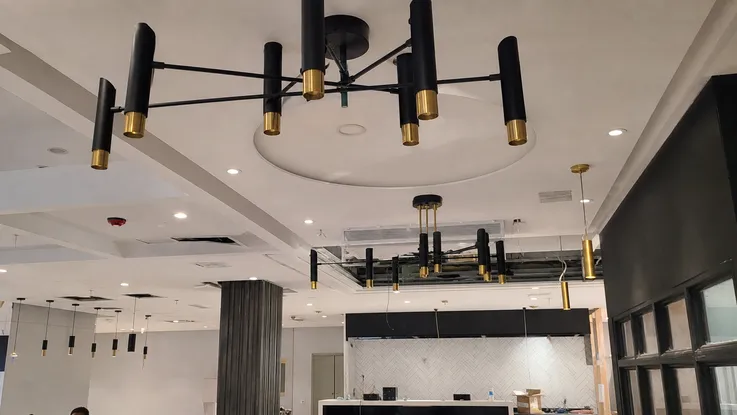
Smaller per-project volumes but higher reorder frequency as chains expand or refresh. Decorative ceiling fixtures in this segment need to work with existing dimmer infrastructure and hold their finish under commercial cleaning schedules.
Dominant finishes right now: Matte black and brushed gold — both are high-volume for us and well-dialed in on the finishing line.
E-Commerce and Catalog Distribution
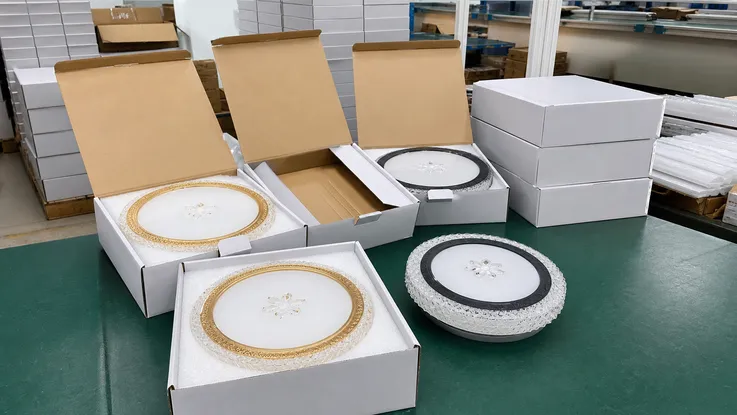
Buyers building a decorative ceiling range for online retail need fixtures that survive mail-order logistics and photograph well. We engineer export packaging per SKU for ocean freight, but for buyers supplying e-commerce channels, we can configure individual retail packaging with foam-lined cartons rated for the drop and compression forces of last-mile delivery.
White-label and private-label packaging is standard.
Overseas Manufacturers and Brand Owners
Buyers who manufacture under their own brand but source ceiling fixture components or complete fixtures from China. We handle blind shipments and can provide neutral packaging without ASCLighting branding.
Documentation packages for customs clearance are prepared per destination market.
Packaging, Container Loading, and Landed Cost
Decorative ceiling fixtures are fragile by category — glass shades, exposed metallic finishes, and multi-component assemblies all create damage risk in ocean freight. We engineer packaging per SKU rather than using a generic carton spec.
Standard export packaging for decorative ceiling fixtures uses individual foam-lined inner cartons with EPE foam inserts molded to the fixture profile. Outer cartons are double-wall corrugated, rated for the stacking loads of a 40HQ container. Glass shade components are individually wrapped and packed separately from the housing in the same carton — this reduces the risk of shade-to-housing contact during transit, which is the most common damage mode we see on decorative fixtures.
For buyers optimizing container economics, we can provide carton dimension data and loading calculations before you commit to an order. A 5–8% improvement in units per 40HQ container is real money on a 500-unit order — and it's something we can often achieve by adjusting carton dimensions without changing the fixture itself.
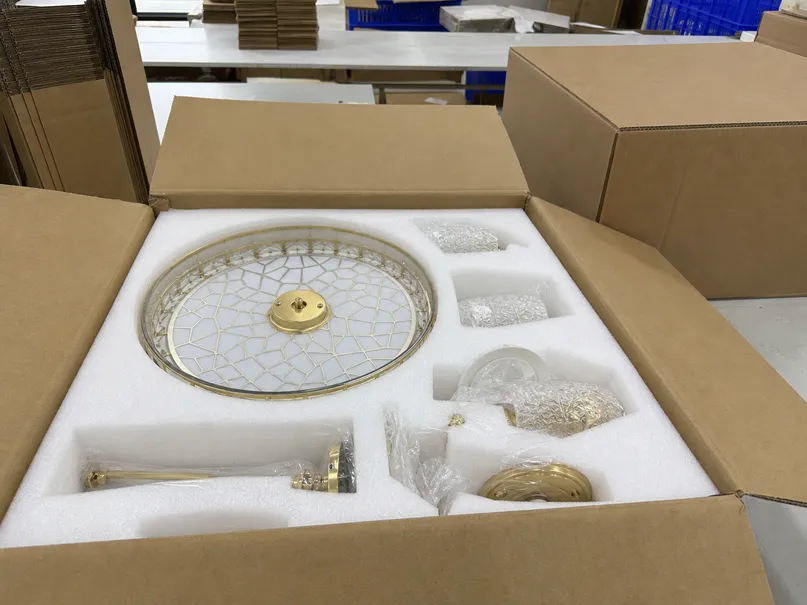
EPE Foam Inserts
Molded to fixture profile for individual SKU protection against transit shock and vibration.
Double-Wall Corrugated
Outer cartons rated for full stacking loads in a 40HQ container environment.
Separated Glass Shades
Glass components individually wrapped and packed separately from housing to eliminate contact damage.
5–8% More Per 40HQ
Carton dimension optimization available pre-order to improve units per container on 500+ unit orders.
E-Commerce & Retail-Ready Packaging
For e-commerce buyers, retail-ready packaging with product photography windows, barcode placement, and FBA-compliant labeling is available. Confirm your channel requirements at the inquiry stage.
Lead Times
From order confirmation. Add tooling time only if new tooling is required.
Quality Control: What Happens Before Your Container Loads
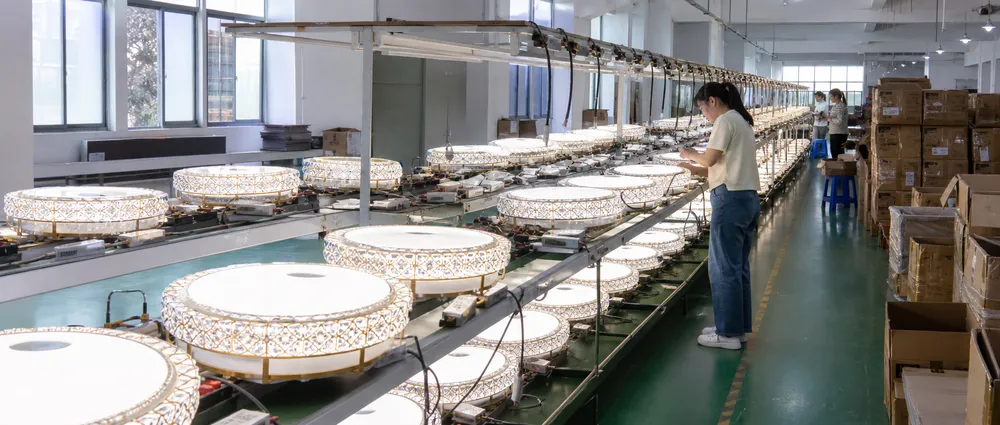
Every decorative ceiling fixture goes through a four-stage QC process before it ships. The stages that matter most for this category are finishing inspection and the outgoing aging test.
Finishing Inspection
Runs after surface finishing and before assembly. This is where adhesion failures, color inconsistency, and surface contamination get caught — while the housing is still accessible and fixable.
For decorative fixtures, we also check finish uniformity under directional lighting at this stage, because color drift that's invisible under flat overhead light becomes obvious when the fixture is installed and lit from below.
This inspection step was added after a batch of brushed nickel housings passed standard inspection but showed visible banding under installed lighting conditions. We've run it ever since.
Assembly Inspection
Checks shade seating, wiring integrity, and hardware torque. For multi-component decorative fixtures, we verify that all visible hardware — screws, canopy plates, shade rings — is the correct finish and correctly installed.
A mismatched screw finish on a decorative fixture is a warranty call. We catch it here so you don't field it later.
100% Aging Test
Every luminaire runs powered for a minimum burn-in period before packing. LED driver failures and wiring faults show up here, not in your customer's installation.
For decorative ceiling fixtures with dimmable drivers, we run the aging test at both full power and at the low-end dimming threshold — early-life driver failures are more likely to manifest at low load.
Photometric Verification
Lumen output and color temperature are checked against the approved spec on a sample basis from each production batch.
If a batch drifts outside tolerance, it doesn't ship.
Certifications Held
Test reports and Declaration of Conformity available per SKU.
Decorative Ceiling Lighting vs. Other Ceiling Categories: Finding the Right Fit
If you're evaluating the full ceiling range, here's how decorative ceiling lighting sits relative to the sibling categories:
Flush Mount Ceiling Lighting
Low-profile, utility-first. Suited for spaces where ceiling clearance is limited and the fixture is functional rather than focal. Lower per-unit price point, higher volume per SKU.
Modern Ceiling Lighting
Overlaps with decorative but emphasizes clean geometric forms and minimalist aesthetics. If your market skews toward contemporary residential or Scandinavian-influenced design, modern ceiling is the stronger fit.
Luxury Ceiling Lighting
Higher specification, higher price point. Crystal elements, premium metal finishes, larger dimensions. Suited for high-end residential, boutique hospitality, and premium retail.
Industrial Ceiling Lighting
Exposed hardware, raw material aesthetics, IP-rated options. Suited for commercial and F&B spaces with an industrial design language.
Recessed Ceiling Lighting
Fully concealed in the ceiling plane. Different installation requirement (requires ceiling void), different buyer profile.
Decorative Ceiling Lighting
The right category when your buyer needs a fixture that reads as a design element — visible, finished, and consistent across a batch — without the price premium of the luxury tier.
Frequently Asked Questions
What is the minimum order quantity for decorative ceiling lighting?
MOQ varies by configuration and customization level. Standard catalog items have lower MOQ thresholds; OEM designs with new tooling require higher minimums to amortize tooling cost. Contact us with your target SKU and volume — we'll confirm MOQ and lead time together.
What dimming protocols do your decorative ceiling fixtures support?
Standard configurations support TRIAC dimming (compatible with most residential and commercial dimmers). 0–10V dimming is available on request for commercial and hospitality applications. DALI is available on select configurations for building management system integration.
Confirm your dimming requirement at the inquiry stage — the driver is specified per SKU, so it's easier to configure correctly at the start than to retrofit.
What CRI should I specify for hospitality and retail applications?
For hospitality and retail, specify CRI ≥90 Ra. Standard production runs CRI ≥80 Ra, which is sufficient for residential and general commercial use.
The ≥90 Ra option uses a different phosphor blend in the LED module — it adds a small cost premium but makes a visible difference in how merchandise and interior finishes render under the light. Most of our hotel buyers in Europe and North America specify ≥90 Ra as a baseline.
How do you handle finish consistency across a large batch?
Automated powder coat application at 60–80μm thickness, PVD for metallic finishes, and a dedicated finishing inspection step under directional lighting before assembly.
For orders over 200 units in a single finish, we run a finish approval sample before committing the full batch — you approve the sample, then we run production to match it. This is standard practice for hospitality and project orders where finish consistency is a specification requirement.
Can you provide IES files for project submissions?
Yes. Our in-house optical lab generates IES files from our own photometric measurements — not borrowed from component supplier datasheets.
For OEM designs, IES files are generated from prototype measurements before production is confirmed. For standard catalog items, IES files are available on request per SKU.
What certifications are required for decorative ceiling lighting in the US market?
UL 1598 listing is the standard requirement for luminaires sold in the US. We hold UL listing and can provide listing documentation for your import team.
For California specifically, Title 24 energy efficiency compliance may be required for new construction — this affects driver efficiency and control compatibility. Confirm your target state and application at the inquiry stage and we'll configure accordingly.
Get a Quote for Decorative Ceiling Lighting
Send us your target SKU, volume, destination market, and any certification or customization requirements. We'll come back with a detailed quote, lead time, and — for OEM projects — a recommendation on configuration based on what's working for our existing buyers in your region.
Most new buyers in this category start with a sample order to test finish quality and fit with their own customers. We can ship samples within the standard lead time for catalog items.
Phone / WhatsApp
+86 134 2021 9307Address
No. 14 Beisan Rd, Gusan Ind. Zone, Guzhen, Zhongshan, Guangdong, China
Wholesale only. Strict MOQ applies.
18+
Years Manufacturing
Explore More Ceiling Lighting Categories
Modern Ceiling Lighting
Clean lines, contemporary finishes
Flush Mount Ceiling Lighting
Low-profile, high-volume staples
Recessed Ceiling Lighting
Integrated, architectural solutions
Luxury Ceiling Lighting
Premium materials, statement pieces
Industrial Ceiling Lighting
Raw finishes, commercial durability
All Ceiling Lighting
Browse the full category