

Bespoke Chandelier Manufacturing
Your specification, your finish, your brand.
We build custom chandelier lighting from die-cast housing to final photometric verification, entirely in-house. No third-party assembly, no finish inconsistency across batches, no certification surprises at the border.
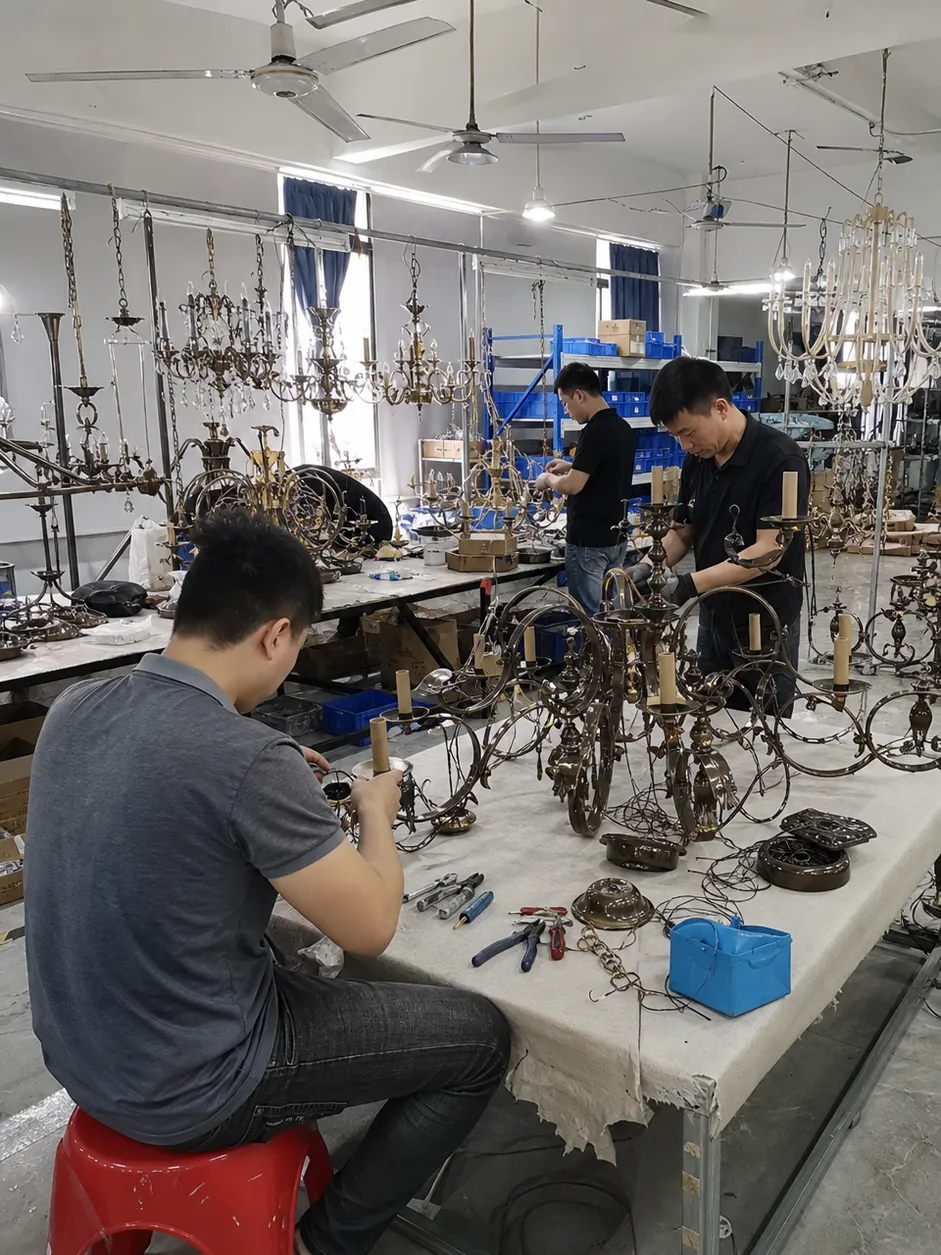
What "Custom" Actually Means at the Factory Level
Most buyers have been burned by the word "custom" before. A factory says yes to everything in the sample stage, then delivers a production run that drifts from the approved sample in finish tone, arm geometry, or driver spec. We've heard this story from buyers who come to us after that experience, and it's almost always the same root cause: the factory was assembling components from multiple suppliers and had no real control over the variables that matter.
Custom chandelier lighting at ASCLighting means something specific. We die-cast the aluminum and zinc alloy housings on-site. We machine the critical mounting and joinery dimensions on our own CNC equipment, holding ±0.1mm tolerances on the features that determine how your fixture assembles and hangs. We run the surface finishing — electroplating, powder coating, PVD — on our own line, with automated powder application at 60–80μm thickness. When you approve a sample, the production batch is made on the same tooling, the same finishing line, and the same driver spec. That's what makes batch consistency achievable rather than aspirational.
The practical consequence for your business: when your downstream customer receives unit 500 of a 500-unit order, it matches unit 1. That consistency is what protects your margin on repeat orders and keeps warranty claims off your desk.
Discuss your custom chandelier project with our engineering team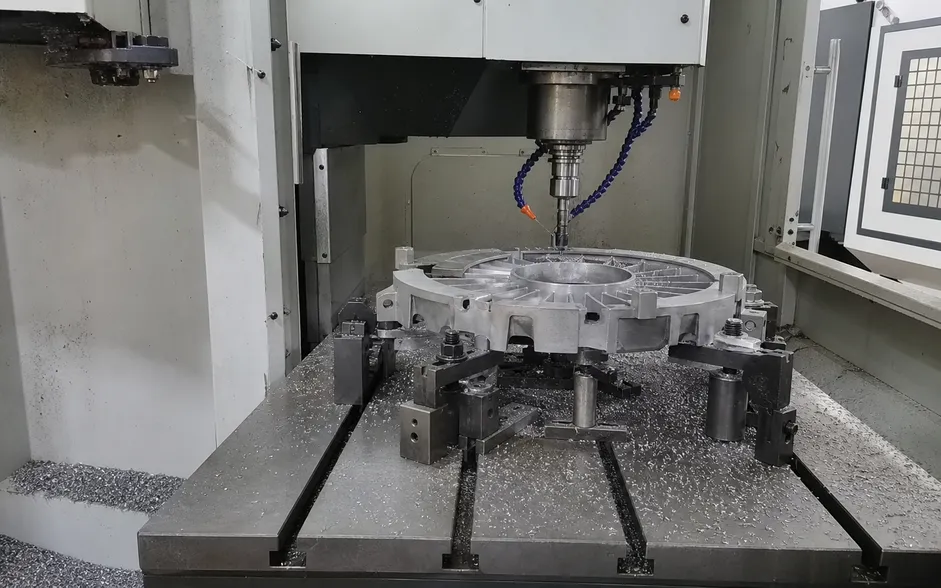
On-Site Die-Casting
Aluminum & zinc alloy housings cast in our own foundry
±0.1mm CNC Tolerance
Critical mounting & joinery dimensions machined in-house
In-House Finishing
Electroplating, powder coat (60–80μm), PVD on our own line
Batch Consistency
Unit 500 matches unit 1 — same tooling, same line, same spec
From Concept to Production Sample: The 7–10 Day Prototype Path
This is where we spend the most time with new buyers, and it's worth explaining how it actually works — because the prototype stage is where custom chandelier projects either get locked in correctly or accumulate problems that show up later in production.
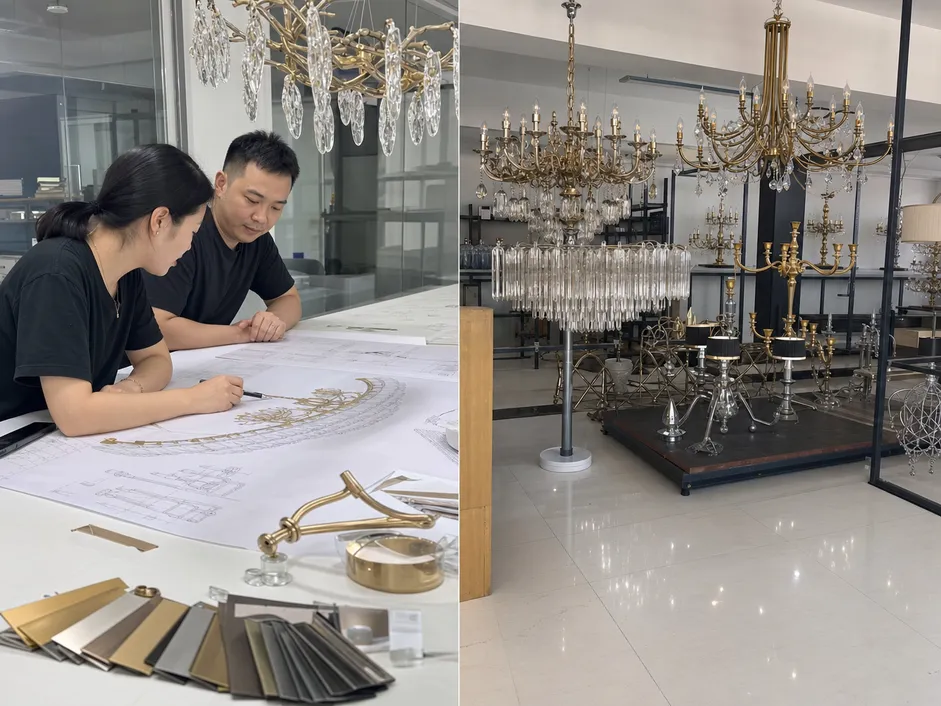
When you bring us a project, you don't need finished engineering drawings. Most of our OEM buyers start with reference images, a target retail price point, and a destination market. Our structural engineers work from that starting point to develop a production-ready design. We flag the cost traps early — overly complex casting geometry that adds 20–30% to tooling cost, non-standard driver cavities that require custom brackets, multi-step finishes that look identical to single-step finishes in photos but double the finishing time. We'd rather have that conversation at the design stage than quote it in and surprise you when the production invoice arrives.
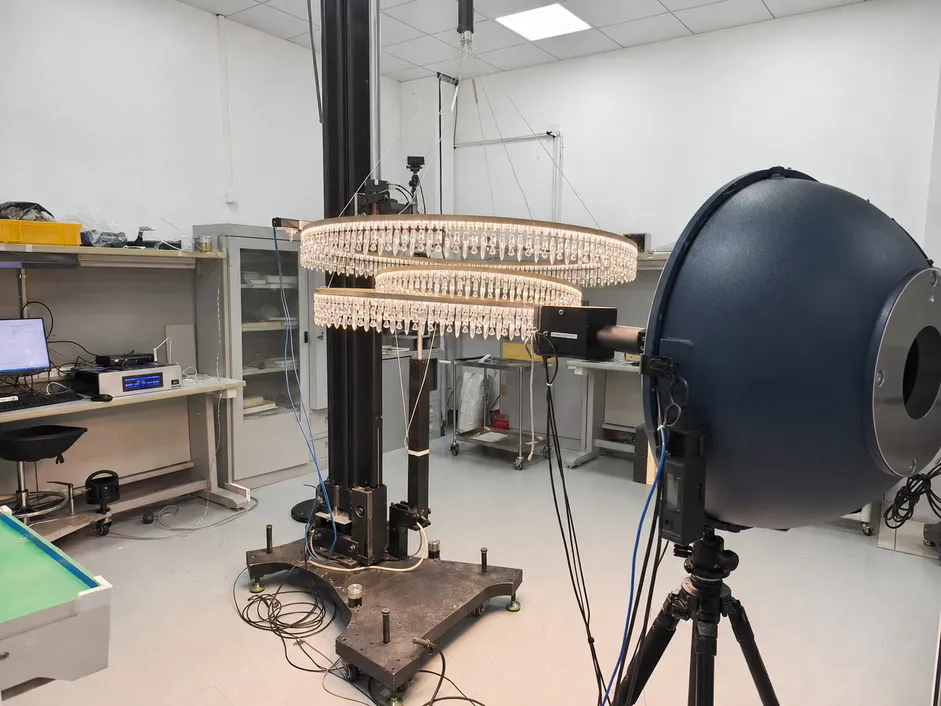
Once the design is locked, prototype turnaround runs 7–10 working days. That covers CNC-machined prototype housings, provisional surface finishing in your specified color and texture, driver integration with the correct voltage and dimming spec for your target market, and a functional sample you can test with your own customers. It's not a mock-up — it's a working fixture built to the production spec. The optical lab runs photometric measurements on the prototype: lumen output, beam angle, and color temperature are verified against your spec before we commit tooling. If the numbers are off, we adjust the optics at this stage, not after 500 units are on the water.
(We've had buyers tell us the 7–10 day turnaround sounds too fast to be real. It's real because we're not waiting on external suppliers for housings or components — everything that goes into the prototype is made or sourced within our facility and the local Guzhen supply chain.)
What the 7–10 Day Prototype Includes
CNC-Machined Housings
Production-spec prototype housings machined from the same alloys used in final production
Surface Finishing
Provisional finish in your specified color and texture — electroplating, powder coat, or PVD
Driver Integration
Correct voltage and dimming spec for your target market, fully wired and functional
Photometric Verification
Lumen output, beam angle, and color temperature measured and verified against your spec
Cost Traps We Flag at Design Stage
- Overly complex casting geometry that adds 20–30% to tooling cost
- Non-standard driver cavities that require custom brackets
- Multi-step finishes that look identical to single-step finishes in photos but double the finishing time
No finished engineering drawings required — start with reference images and a target price point
Specification Parameters for Custom Chandelier Orders
The table below covers the standard customization envelope for our chandelier program. These are the parameters we work within on a regular basis — if your project falls outside these ranges, contact us directly and we'll assess feasibility.
| Parameter | Standard Range | Notes |
|---|---|---|
| Overall diameter | 300mm – 2,400mm | Larger installations available; contact for structural assessment |
| Drop / suspension height | 400mm – 4,000mm | Adjustable cable or rod systems; specify ceiling height and desired hanging height |
| Number of light points | 1 – 120+ | Multi-tier and cluster configurations available |
| Housing material | Aluminum alloy, zinc alloy, steel | Material selection affects weight, finish options, and tooling cost |
| Finish options | Brushed gold, matte black, chrome, antique brass, brushed nickel, custom RAL/PVD | Custom finishes available on runs ≥100 units |
| Light source | LED integrated, E27/E14 socket, G9 | Driver spec matched to destination market voltage (110V/220V) and dimming requirement |
| Wattage range | 5W – 400W total | Configuration-dependent; photometric output verified against spec before production |
| Dimming compatibility | TRIAC, 0–10V, DALI, Zigbee | Specify dimmer infrastructure in your target market at inquiry stage |
| Shade / diffuser options | Glass, crystal, fabric, metal, acrylic | Glass and crystal sourced from Guzhen supply chain; custom shapes available |
| Certifications available | CE, UL, SAA | Specify destination market at inquiry; certification scope confirmed before production |
| MOQ | Varies by configuration | Standard catalog adaptations have lower MOQ than full custom tooling |
| Lead time (production) | 25–35 days from approved sample | Add 15–20 days if new tooling is required |
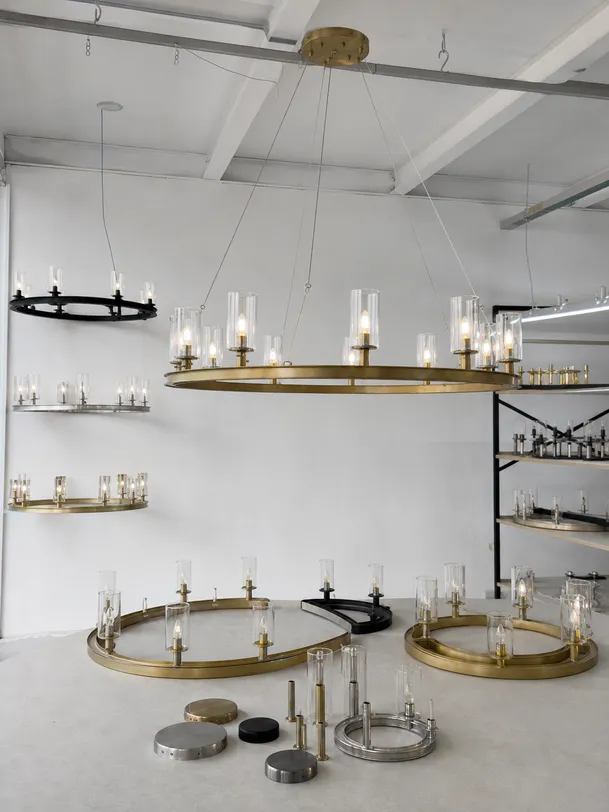
Specifications shown represent our standard production envelope. Actual parameters depend on design complexity and destination market requirements.
Get a Quote for Your SpecificationMarket Segments Where Custom Chandeliers Drive Repeat Business
Custom chandelier lighting isn't a single market — the buyers who source from us are selling into segments with very different order patterns, margin structures, and reorder logic. Understanding which segment you're serving shapes how we configure the product.
Hospitality Fit-Out & FF&E Supply
Highest-volume segment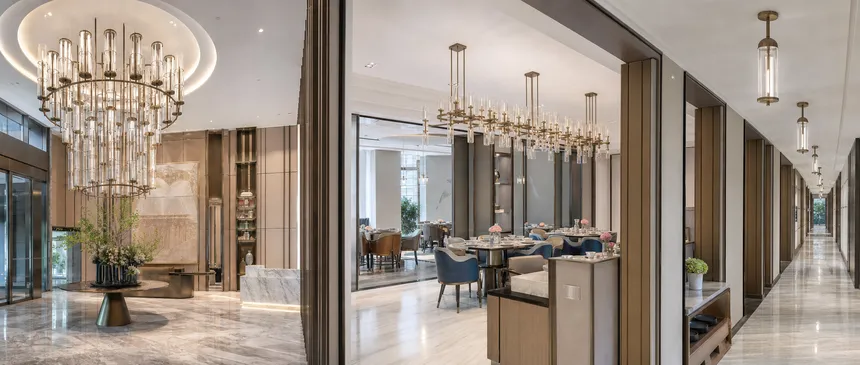
Hotels, resorts, and serviced apartments are the highest-volume segment for custom chandeliers. A single property fit-out can run 50–300 chandelier units across lobby, restaurant, corridor, and suite applications — and the same property group typically has a pipeline of 3–8 properties in development at any given time.
The commercial logic here is straightforward: if you're the supplier who delivered the first property on spec and on time, you're the default supplier for the next one. We've seen buyers build their entire hospitality lighting business on two or three property group relationships.
For this segment, the critical variables are:
- Finish consistency across a multi-SKU order (lobby chandelier, corridor pendant, and suite sconce all need to match)
- Documentation for the FF&E contractor's handover package
- Ability to supply replacement units 18–24 months after the original order
We maintain tooling and finish records per project for exactly this reason.
Luxury Residential Developers & Interior Design Firms
Higher margin per unit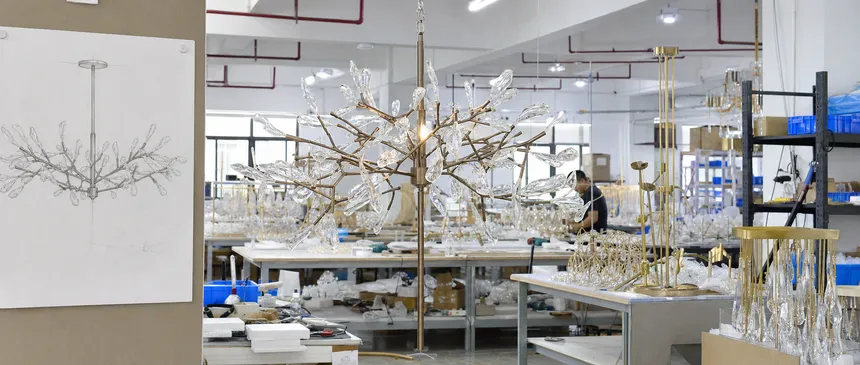
High-end residential projects — villas, penthouses, luxury apartment buildings — typically specify chandeliers as signature pieces for entry halls, living rooms, and dining spaces. Order volumes per project are lower (5–30 units), but the margin per unit is higher and the design brief is more specific.
Buyers in this segment are often sourcing on behalf of an interior designer who has a precise vision: a specific arm profile, a particular finish tone, a shade shape that doesn't exist in any catalog. This is where our OEM capability earns its keep — we can develop a fixture from a designer's sketch to a production sample in 7–10 days, which is fast enough to fit into a project timeline without holding up the interior design schedule.
The Middle East and Southeast Asian luxury residential markets have been our strongest growth segments for custom work over the past three years — if you're building a product line for those markets, we have relevant reference projects we can share.
Lighting Distributors Building Private-Label Lines
Strong reorder logic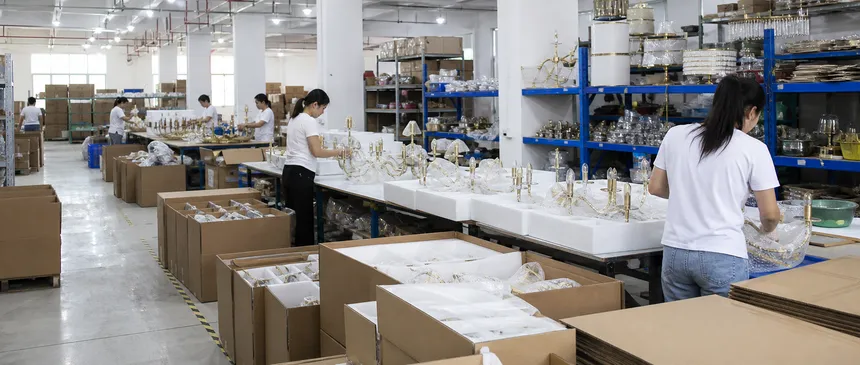
Distributors who want to differentiate from commodity catalog products use custom chandelier programs to build SKUs that can't be price-compared on Alibaba. The typical entry point is a catalog adaptation — take an existing design, modify the finish, adjust the arm count, add a proprietary shade shape — which keeps tooling cost manageable while creating a product that's genuinely exclusive to your catalog.
We've structured programs like this for distributors in North America, Europe, and Australia. The reorder logic is strong: once a distributor's customers are specifying your SKU by name, the reorder is automatic.
For this segment, the operational requirements we focus on:
- White-label packaging
- Blind shipping capability
- Consistent batch-to-batch finish matching
Commercial Interior Contractors
Certification-critical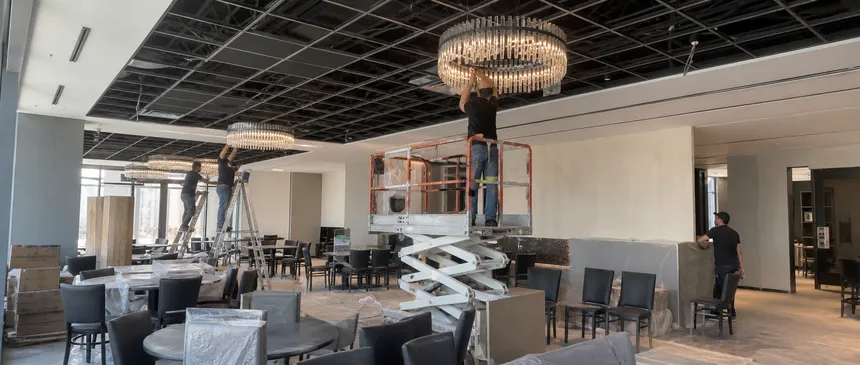
Restaurant groups, retail chains, and office developers often need chandeliers in quantities of 20–200 units per project, with tight installation timelines and specific electrical compliance requirements for the destination market.
The key concern here is certification — a fixture that isn't UL-listed can't be installed in a US commercial space, and a fixture without CE marking can't be sold in the EU. We hold CE and UL on our standard chandelier configurations, and we can extend certification scope to custom designs where the design changes don't affect the certified electrical components.
Certification path clarity: Confirm your destination market at the inquiry stage and we'll tell you exactly what the certification path looks like for your specific design.
How We Control Finish Quality Across a Custom Batch
Finish is where custom chandelier orders most commonly go wrong, and it's worth being specific about how we handle it — because "consistent finish" is something every factory claims and very few deliver reliably across a 200-unit batch.
Our surface finishing line handles electroplating, powder coating, and PVD in-house. Powder coat application is automated, running at 60–80μm thickness across the batch. We don't hand-spray production runs — the automated line eliminates the thickness variation that causes color inconsistency between units.
Before a custom finish goes into production, we run a salt spray test on finish samples: 500 hours minimum for standard finishes, longer for buyers supplying coastal or high-humidity markets. If the finish doesn't pass, we adjust the pre-treatment process before committing the batch.
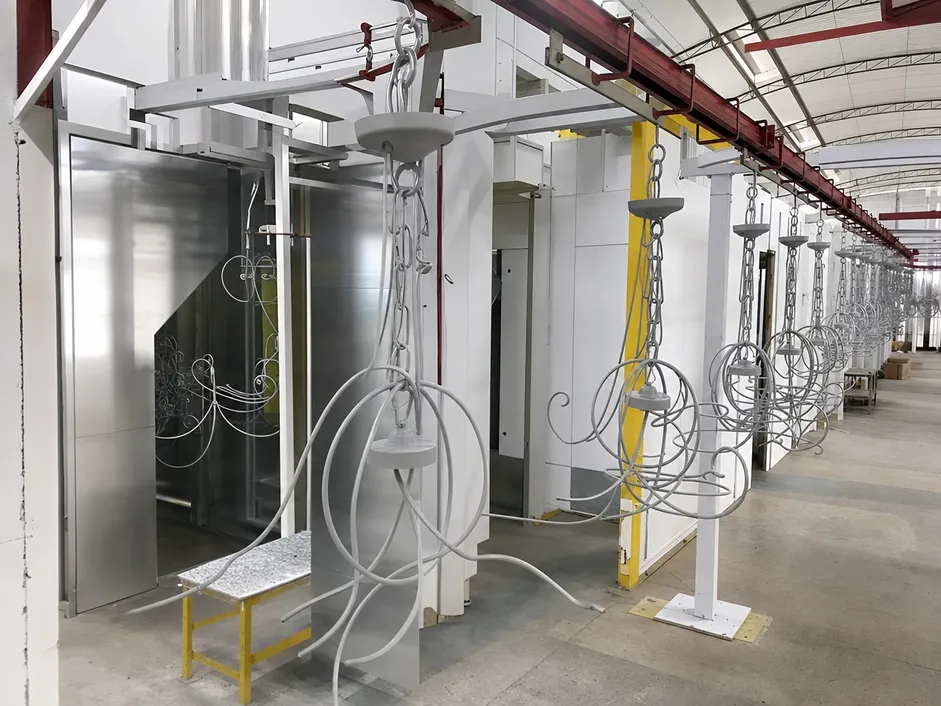
Metallic Finish Consistency: Electroplating & PVD
For metallic finishes — brushed gold, antique brass, chrome, PVD titanium — the color consistency challenge is more complex than powder coat because the electroplating process is sensitive to bath chemistry, temperature, and part geometry.
We run color reference panels at the start of each production batch and compare against the approved sample. If the panel drifts outside the approved tolerance, we stop and adjust before running the full batch.
This adds a half-day to the production schedule, but it's faster than re-running 200 units because the finish was off.
Finish QC Process at a Glance
- 1 Salt spray test on finish samples — 500 hr minimum
- 2 Pre-treatment adjustment if sample fails
- 3 Automated powder coat at 60–80μm thickness
- 4 Color reference panel comparison per batch start
- 5 Stop-and-adjust protocol if drift detected
RoHS Compliance
For buyers supplying markets where RoHS compliance is required — EU, UK, and increasingly North America — our powder coat materials are RoHS-compliant and we can provide material safety documentation as part of the order package.
Certifications and Compliance for Your Destination Market
We hold CE, UL, SAA, and SGS certifications, maintained and current. ISO 9001:2015 governs the production process. Here's what that means practically for your import documentation.
CE
Europe & UK
Declaration of Conformity and test reports available per SKU. For custom designs, we assess whether design changes affect the certified electrical configuration — if they don't, the existing CE scope applies. If they do, we initiate a new test cycle and quote the timeline.
UL
North America
UL listing is required for commercial installation in the US and Canada. Our standard chandelier configurations carry UL listing. Custom designs that use the same certified driver and wiring configuration can typically be covered under the existing listing — confirm at the inquiry stage.
SAA
Australia & New Zealand
Held and maintained for the Australian market. If you're supplying Australian distributors or contractors, we can provide the SAA documentation package with your order.
SGS
General Export
General export quality certification, useful for markets where CE/UL aren't the primary requirement. Provides third-party validation of manufacturing quality and material compliance.
Import Documentation Support
For buyers entering new markets or dealing with customs documentation requirements, we maintain test reports, Declaration of Conformity documents, and material safety data per SKU. ISO 9001:2015 governs the full production process.
Packaging, Container Loading, and Landed Cost
Custom chandeliers are fragile, high-value, and awkward to pack efficiently — three characteristics that make packaging decisions commercially significant. A damaged container costs you the product margin, the replacement freight, and the customer relationship.
We engineer export packaging per SKU, not per product category. Multi-arm chandeliers ship with arms individually foam-wrapped and nested in a custom-cut EPE foam insert inside a double-wall carton. The outer carton is rated for the drop and compression forces of ocean freight — we've tested against the damage patterns we've seen on specific routes and adjusted the packaging spec accordingly.
For glass and crystal shade components, we use individual bubble-wrap sleeves inside the foam insert, with a separate inner carton for shade components to prevent contact with metal parts during transit.
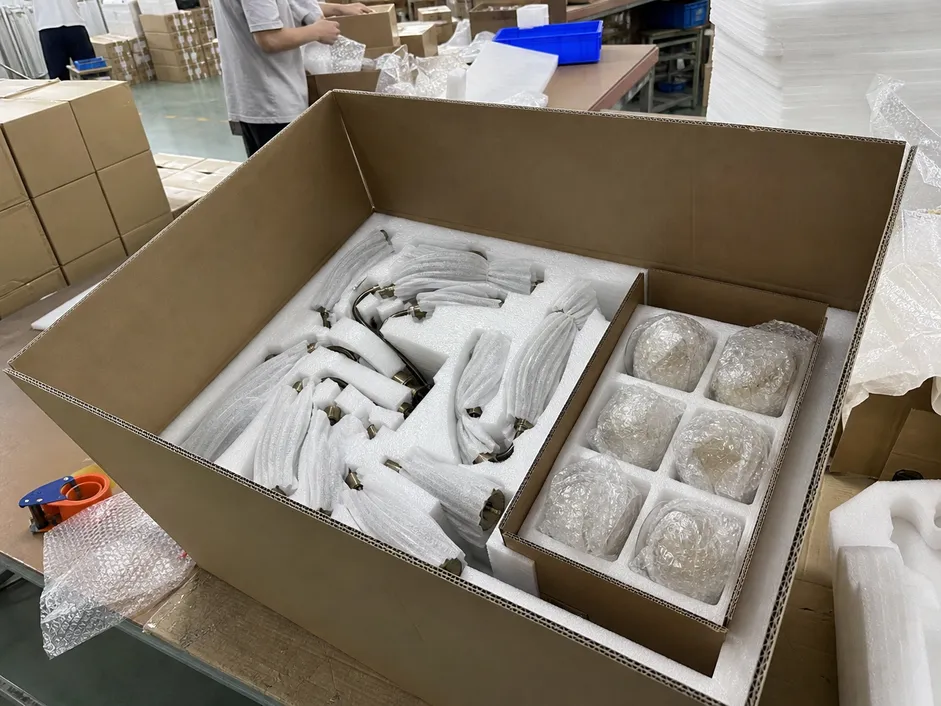
Container Loading Optimization
We optimize carton dimensions for 40HQ loading — a 5–8% improvement in units per container is real money on a 500-unit order. For buyers who need to know container quantities for import planning, we provide a packing list with carton dimensions and loading calculations as part of the pre-shipment documentation.
White-Label Packaging
For distributors running e-commerce or drop-ship programs, we can configure white-label packaging with your brand identity — outer carton printing, inner packaging inserts, and assembly instruction cards in your brand format.
Blind Shipping
Blind shipping (no ASCLighting branding on outer cartons) is standard for buyers who need it. Your customers see only your brand from unboxing through installation.
Custom Chandelier vs. Catalog Chandelier: When to Choose Which
This page is specifically about custom chandelier lighting — fixtures built to your specification rather than selected from a standard catalog. The distinction matters for your sourcing decision.
If your project requires a specific arm count, a proprietary finish, a non-standard diameter, or a design that doesn't exist in any catalog, custom is the right path. The tooling investment is real (typically amortized over the first production run), but the result is a product that's exclusive to your catalog or project.
If your project can be served by a standard design with minor configuration adjustments — finish color, light source type, suspension length — our catalog chandelier range may be a faster and lower-cost path. View our full chandelier lighting range to assess whether a catalog option fits your requirement.
For projects where you're not sure which path makes sense, send us your brief and we'll give you an honest assessment. We'd rather point you to a catalog option that fits than sell you a custom tooling program you don't need.
Sibling Products in the Chandelier Range
Clean-line contemporary designs, standard catalog with finish customization
Premium materials and complex configurations, catalog-based with OEM options
Rectangular and linear formats for dining and commercial table applications
Dining-optimized proportions and light distribution
Frequently Asked Questions
What is the minimum order quantity for custom chandelier lighting?
What is the minimum order quantity for custom chandelier lighting?
MOQ depends on the degree of customization. Catalog adaptations — modifying finish, arm count, or suspension length on an existing design — typically have lower MOQ than full custom tooling programs.
For full custom designs requiring new die-cast tooling, the tooling cost is amortized over the first production run, which affects the minimum viable order quantity.
Contact us with your design brief and target volume and we'll give you a specific MOQ and tooling cost breakdown.
How do I specify the right chandelier size for a project space?
How do I specify the right chandelier size for a project space?
The standard rule of thumb for residential dining spaces is to add the room dimensions in feet and use that number in inches as the chandelier diameter — a 12×14 ft room suggests a 26-inch (660mm) fixture.
For commercial and hospitality spaces with higher ceilings, scale up proportionally: a hotel lobby with 6m ceilings typically needs a fixture diameter of 1,200–2,000mm to read correctly in the space.
We can review your ceiling height, room dimensions, and mounting point constraints and recommend a size range — send us the project specs and we'll come back with a recommendation.
What dimming systems are compatible with your custom chandeliers?
What dimming systems are compatible with your custom chandeliers?
We specify the driver to match your dimming infrastructure:
- TRIAC (leading-edge and trailing-edge) — covers most residential and light commercial dimmer systems in North America and Europe.
- 0–10V — standard for commercial building management systems.
- DALI — available for projects with centralized lighting control.
- Zigbee and other smart home protocols — available on request.
The key is to specify your dimmer brand and model at the inquiry stage — we'll confirm compatibility and, if needed, test the driver-dimmer combination before production.
Can you match a finish from an existing fixture or material sample?
Can you match a finish from an existing fixture or material sample?
Yes, with a physical reference sample. We run color matching against a provided sample using our finishing line reference panels.
For powder coat finishes, we can match to within a ΔE of 1.5–2.0 from the reference. For metallic electroplated finishes, matching is more complex — we can get close, but exact replication of a third-party finish depends on the original process, which we can't always reverse-engineer precisely.
Send us the reference sample and we'll give you an honest assessment of how close we can get before you commit to the program.
What documentation comes with a custom chandelier order?
What documentation comes with a custom chandelier order?
Standard documentation includes: packing list, commercial invoice, bill of lading, and a product compliance declaration.
For CE-certified products, we include the Declaration of Conformity and test report summary. For UL-listed products, we provide the UL file number and listing documentation.
For buyers who need material safety data (RoHS compliance, REACH declarations), we maintain these per SKU and include them on request.
If your import team has a specific documentation checklist, send it to us before the order is placed and we'll confirm what we can provide.
How does the 100% aging test work and what does it catch?
How does the 100% aging test work and what does it catch?
Every luminaire runs powered for a minimum burn-in period before packing — typically 24–48 hours depending on the driver type and wattage.
The aging test catches LED driver failures, wiring faults, and early-life component failures that wouldn't be visible in a visual inspection. It's the difference between a defect showing up in your customer's installation (a warranty claim, a return, a damaged relationship) and showing up on our floor where we can fix it before the container loads.
Photometric output is also spot-checked from each production batch against the approved spec — if lumen output or color temperature drifts outside tolerance, the batch doesn't ship.
Start Your Custom Chandelier Project
Send us your project brief — reference images, target dimensions, destination market, volume estimate, and any certification requirements. Our engineering team will review it and come back with a design assessment, prototype timeline, and indicative pricing within 2 business days.
For projects where you're still in the specification stage, we're happy to get on a call and work through the design parameters with you. Most custom chandelier programs start with a 30-minute conversation that saves weeks of back-and-forth later.
Direct Contact
Factory Address
No. 14 Beisan Rd, Gusan Ind. Zone, Guzhen, Zhongshan, Guangdong, China
Typical response within 2 business days
Wholesale only. Strict MOQ applies. Please include your target volume in your inquiry.