

Dining Room Chandelier Lighting
Manufactured in Guzhen, certified for North America, Europe, and Australia. 18 years of decorative chandelier production, full in-house die-casting and surface finishing, 100% aging test before every container loads.
OEM/ODM prototypes in 7–10 working days.
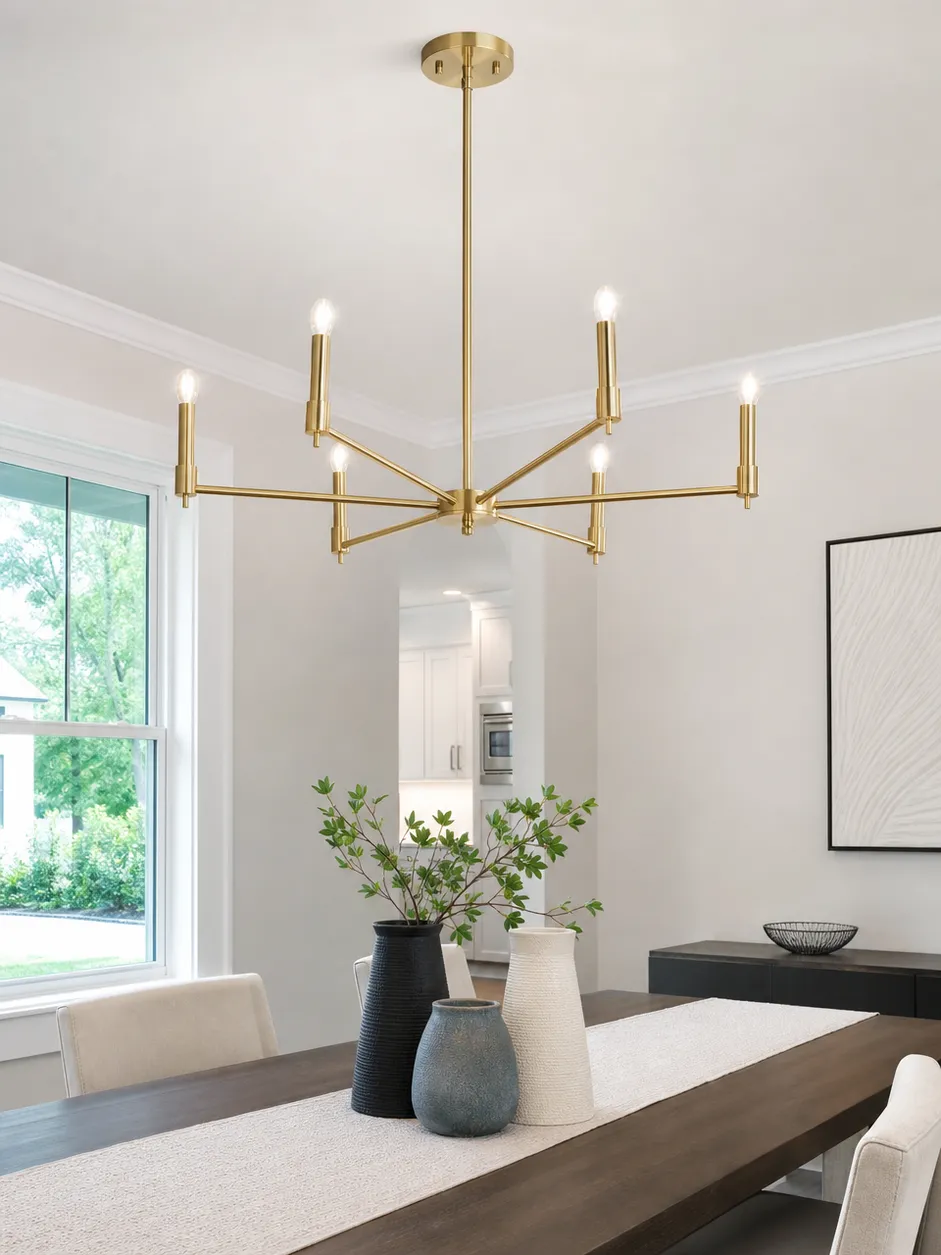
What Makes a Dining Room Chandelier a Reliable SKU — and What Doesn't
Dining room chandelier lighting is one of the highest-visibility SKUs in any decorative lighting catalog. It's the fixture your downstream customer photographs for their listing, the one that drives returns when the finish chips after six months, and the one that earns repeat orders when it arrives consistent across a 200-unit batch. We've been manufacturing chandeliers since 2008, and the dining room category specifically is where we've seen the most variation in what separates a reliable product from a warranty problem.
The core issue isn't design — it's process control. A dining chandelier typically combines a die-cast or fabricated metal frame, a surface finish that has to hold up under close inspection at eye level, and a multi-arm wiring harness that has to pass electrical safety certification in multiple markets. Any one of those three can fail independently.
We run all three in-house — die-casting, surface finishing, and assembly — which means we control the variables that cause the most field failures rather than depending on subcontractors to meet a spec we can't verify.
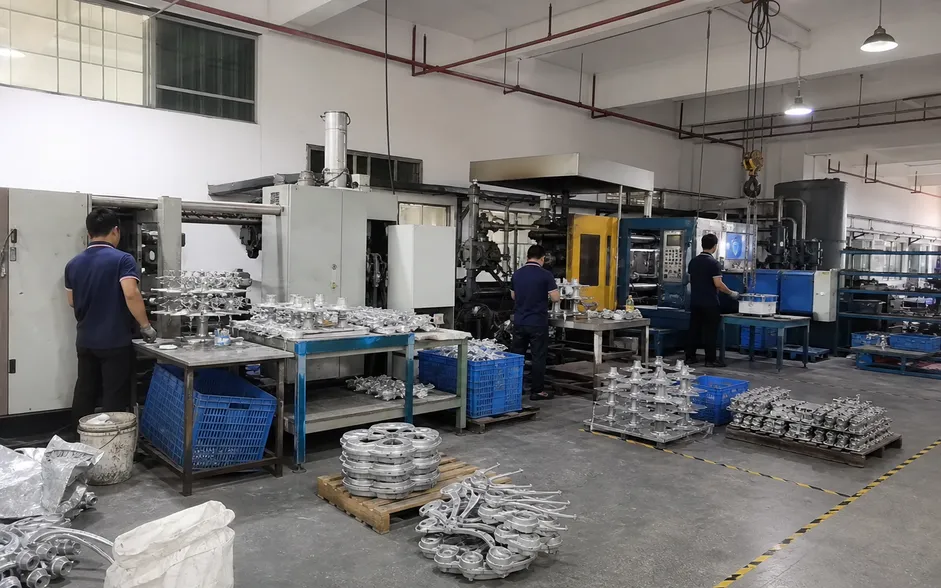
Die-Casting
In-house
Surface Finishing
In-house
Assembly
In-house
What this means for your catalog
A lower RMA rate and a product you can position at a margin that reflects the quality, not one you have to discount to move after the first round of returns.
Technical Specifications
Dining room chandeliers span a wide range of configurations — single-tier round, multi-tier, linear, and cluster formats — and the specs below reflect the standard parameters we produce across this range. For OEM projects, all dimensions and configurations are adjustable.
| Parameter | Standard Range |
|---|---|
| Diameter | 400mm – 1200mm |
| Height (adjustable drop) | 400mm – 2000mm |
| Frame material | Aluminum alloy / iron / zinc alloy |
| Finish options | Brushed gold, matte black, chrome, antique brass, satin nickel, custom RAL |
| Light source | E27 / E14 socket, or integrated LED module |
| Wattage (integrated LED) | 20W – 120W |
| Color temperature | 2700K / 3000K / 4000K |
| CRI | ≥80 standard; ≥90 available |
| Dimming compatibility | TRIAC / 0-10V / DALI |
| Voltage | 100–240V AC, 50/60Hz |
| IP rating | IP20 standard (indoor) |
| Certifications | CE, UL, SAA, SGS |
| Suspension | Ceiling canopy + adjustable rod/cable |
View specification notes
Diameter: Custom sizes available; larger formats require structural review
Height: Adjustable suspension rod or cable; site-specific drop confirmed at order
Frame material: Die-cast aluminum for complex forms; iron for linear and geometric frames
Finish: PVD and electroplating in-house; powder coat for iron frames
Light source: LED module option includes driver; socket version is source-agnostic
Wattage: Depending on arm count; driver matched per SKU
Color temp: 2700K and 3000K are highest volume for dining applications
CRI: High-CRI option for hospitality and premium residential segments
Dimming: Spec confirmed at order; affects driver selection
Voltage: Single driver spec covers most export markets
IP rating: IP44 available for covered outdoor dining or humid environments
Certifications: Market-specific certification confirmed at order
Suspension: Canopy diameter typically 100–150mm; custom canopy available
Specifications shown are standard production parameters. Actual values vary by SKU and customization requirements. Contact us for product-specific data sheets.
Get a QuoteSurface Finish Quality: The Variable That Drives Returns
We spend more time on surface finishing than on any other single process in chandelier production, and there's a reason for that. A dining room chandelier hangs at eye level, often over a table where people sit and look up at it. Finish defects that would be invisible on a ceiling fixture are obvious here — and they're the number-one source of returns in the decorative lighting category.
Our finishing line handles electroplating, PVD, and powder coating in-house. For brushed gold and antique brass — the two finishes that account for the largest share of dining chandelier volume in our export markets — we run PVD over a base electroplate layer.
PVD gives you a harder surface than straight electroplating: scratch resistance is meaningfully better, and the color consistency across a batch is tighter because the deposition process is controlled rather than dependent on bath chemistry.
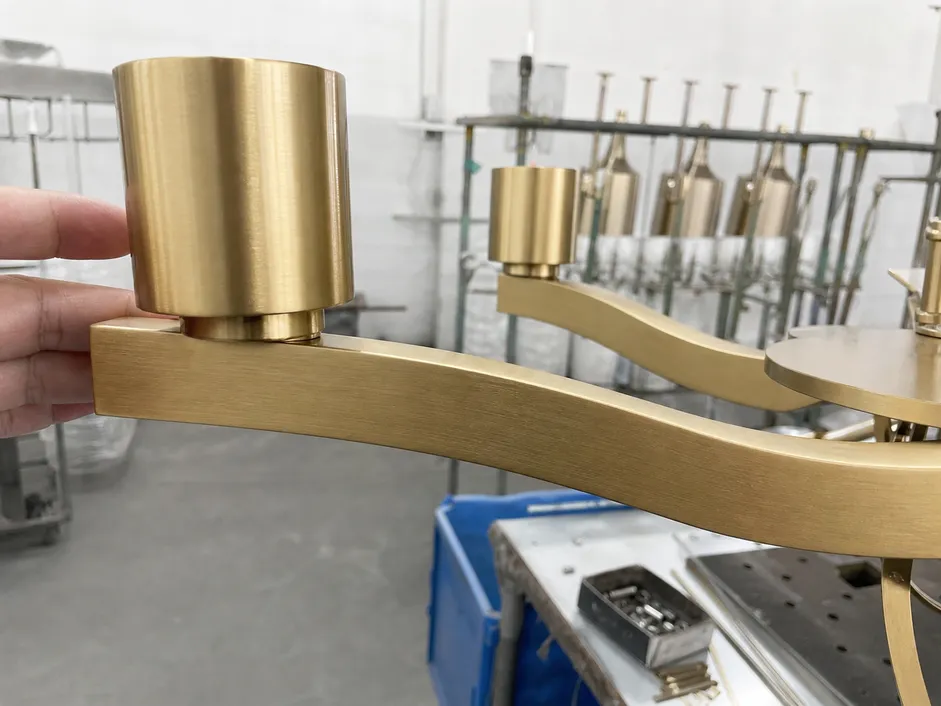
Why We Switched to PVD-Over-Plate
We switched the brushed gold spec to PVD-over-plate about four years ago after seeing too many finish inconsistencies on large batches using straight electroplating. The process cost is higher, but the RMA rate dropped significantly. For buyers running repeat programs in brushed gold or antique brass, this is the process that protects your margin on the back end.
PVD Over Electroplate
- Harder surface than straight electroplating
- Superior scratch resistance
- Tighter color consistency across batch
- Controlled deposition vs. bath chemistry
Primary use: Brushed gold, antique brass
Powder Coat on Iron Frames
- 60–80μm thickness, automated application
- Consistent thickness across full batch
- Salt spray tested before production commit
- Documentation for coastal/humid markets
Primary use: Iron frame chandeliers
Matte Black — Highest Volume
- Highest-volume single finish in range
- Dedicated production schedule
- Tight sheen-level control across batch
- Controlled powder application & cure temp
Not mixed with other finishes mid-run
Salt Spray Testing for Coastal Markets
Before committing a finish batch to production, we run salt spray testing on samples. For buyers supplying coastal markets or humid climates, that test result is part of the documentation package — available on request with your order confirmation.
Frame Construction and Structural Integrity
The structural side of a dining chandelier matters more than it looks on a spec sheet. A multi-arm chandelier with a 1000mm diameter and eight arms carries meaningful weight — typically 8–15kg for a mid-range fixture — and it's suspended from a single ceiling mount point.
The canopy-to-rod connection and the arm-to-body joints are the two points where structural failures occur in the field. Our engineering approach addresses both failure modes at the manufacturing stage rather than relying on field assembly to compensate.
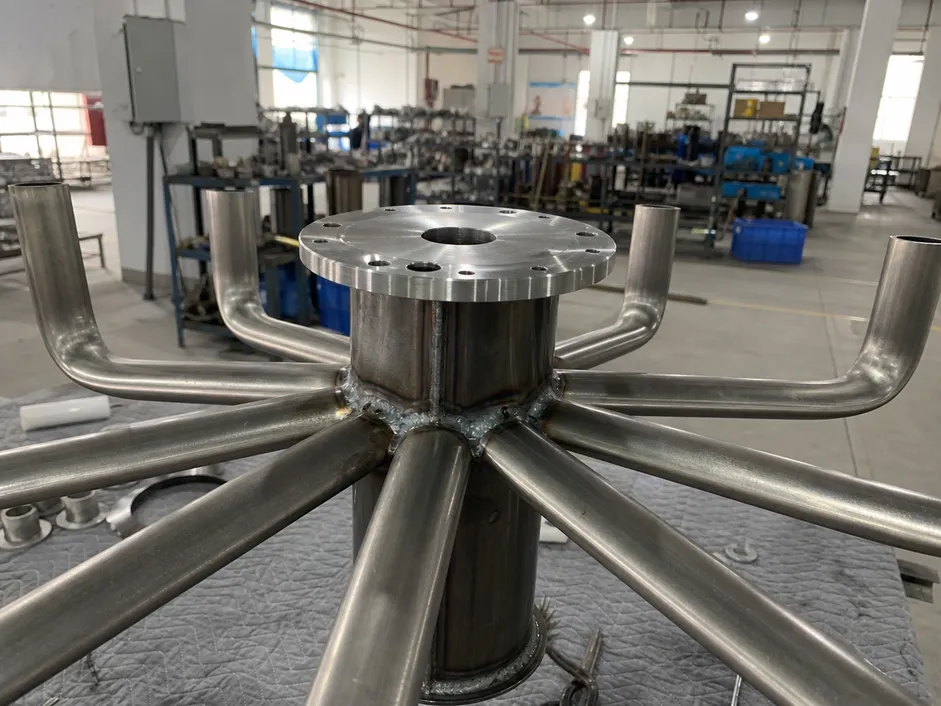
Canopy & Housing — Die-Cast + CNC
We die-cast aluminum housings and canopy components in-house, holding CNC tolerances to ±0.1mm on critical mounting dimensions. That precision matters at the ceiling mount: if the canopy doesn't seat flush and level, the installer has a problem that no amount of adjustment will fix cleanly.
We've seen this issue on fixtures sourced from assembly-only operations where the canopy is a purchased component — dimensional variation from the casting supplier shows up as installation headaches for your contractor customers.
Arm-to-Body — Welded & Ground
For multi-arm designs, the arm-to-body connection is welded and then finished — we don't rely on mechanical fasteners alone at that joint. After welding, the joint is ground smooth before finishing, which eliminates the surface discontinuity that causes powder coat adhesion failures at weld points.
This is the most common defect we see on competitor fixtures that come back for quality review — the finish lifts at the weld seam within six months because the pre-treatment step was skipped.
Iron Frame Chandeliers — Linear & Geometric Formats
Iron frame chandeliers use 1.2–1.5mm cold-rolled steel tube and flat bar, bent and welded to tolerance. The wall thickness is specified per design based on span and arm count — we don't use a single tube spec across all iron frame products.
Each design is engineered for its specific load case. A 1200mm linear frame with six lamp holders requires different material cross-sections than a compact geometric pendant, and we spec accordingly.
Material Specs
- Tube: Cold-rolled steel, 1.2–1.5mm wall
- Form: Tube + flat bar, bent to tolerance
- Thickness: Per-design, based on span & arm count
- Formats: Linear, geometric, cage
Market Segments Where Dining Room Chandeliers Move Volume
Dining room chandelier lighting sells into several distinct B2B channels, and the product configuration that works in one doesn't always translate to another. Here's how we see the segments from the factory side.
Hospitality FF&E Supply
Highest-volume single segment
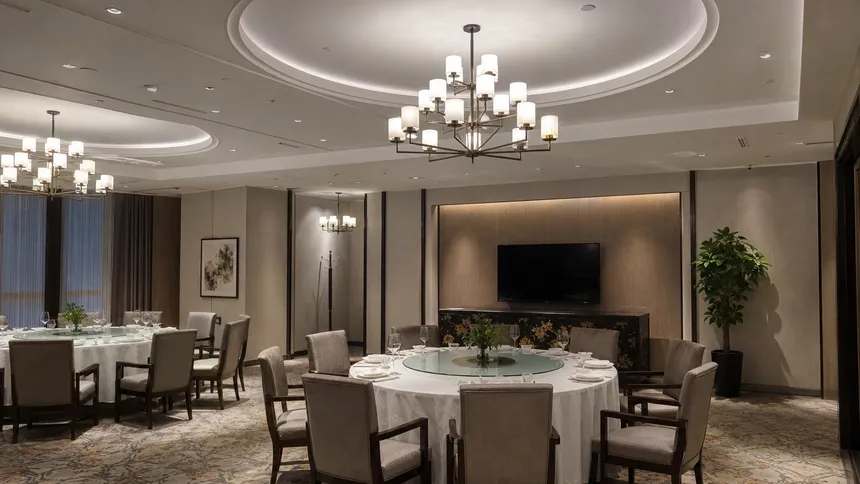
Hotels, restaurants, and private dining clubs specify chandeliers in quantities of 20–200 units per project, often with custom finish or dimension requirements to match an interior design spec.
The key commercial factor here is documentation: hospitality projects require CE or UL certification, photometric data for lighting design submissions, and often a Declaration of Conformity.
We maintain these per SKU and can provide them as part of the order package. For buyers supplying FF&E contractors, having a factory that can produce the documentation without a separate request is a meaningful operational advantage.
Luxury Residential Distribution
Finish quality drives margin
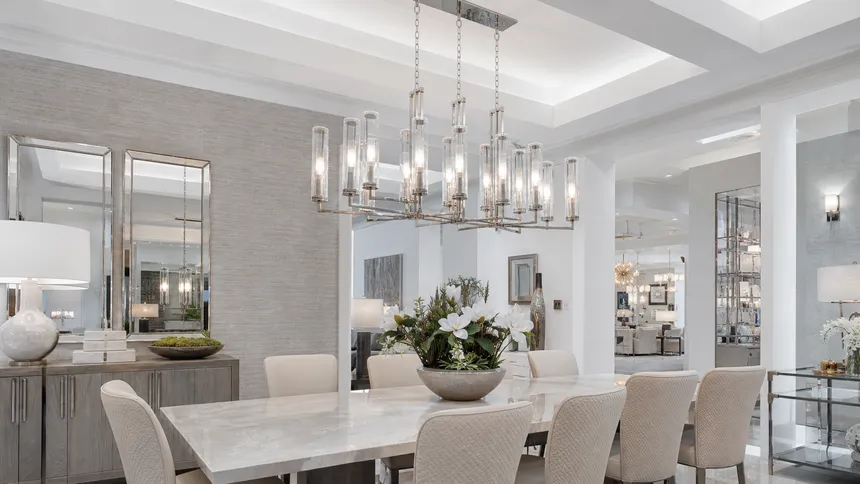
Importers and distributors supplying high-end residential builders, interior designers, and kitchen/bath showrooms — this is the segment where finish quality and design differentiation drive margin.
Buyers in this channel are selling to customers who compare fixtures side by side in a showroom or on a project board. The finish consistency and design execution are what justify the price point in this channel.
Typical order patterns run 50–300 units per SKU per season, with reorders driven by project pipeline rather than inventory turns.
E-commerce & Catalog Retail
Packaging durability is the differentiator
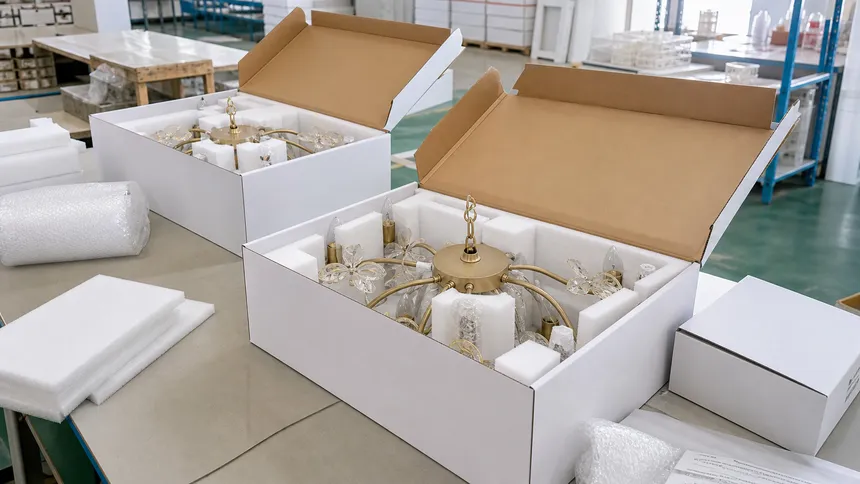
Amazon, Wayfair, independent lighting stores — this is a segment where packaging durability and listing-ready documentation matter as much as the fixture itself.
We engineer export packaging per SKU — dining chandeliers ship in individual foam-lined cartons with internal bracing for the arms, rated for the drop and compression forces of ocean freight and last-mile delivery.
Damage rates on properly packaged chandeliers are low; damage rates on under-packaged ones are not.
For buyers building an e-commerce SKU, we can provide white-label packaging and product photography support.
Overseas OEM Manufacturing
In-house tooling is the differentiator
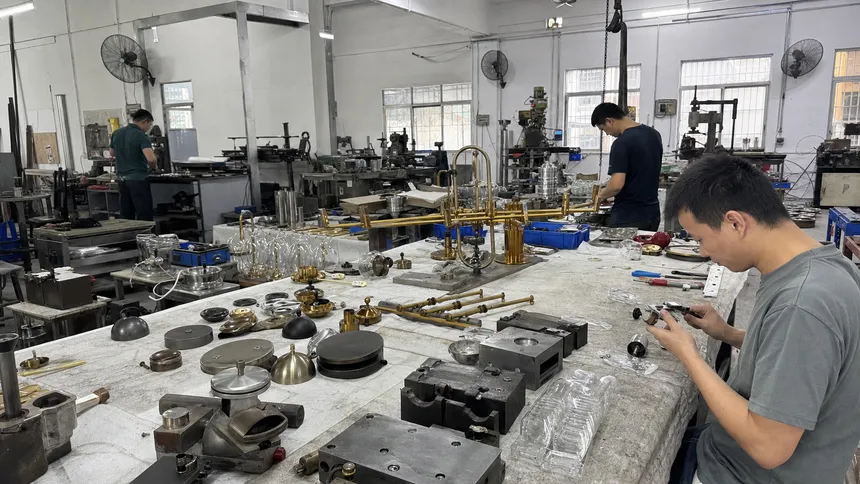
Brands that design their own fixtures and need a factory to produce them — this is where our in-house tooling and prototyping capability is the differentiator.
If you have a design concept or finished drawings, we can have a functional prototype in 7–10 working days and a production quote with tooling cost breakdown within the same window.
OEM and ODM: From Concept to Production Sample in 7–10 Days
We've been doing OEM and ODM work since the early years of the factory, and the dining chandelier category is one where custom development requests are common — buyers want a design that's exclusive to their catalog, or a finish that matches a specific interior palette, or a dimension that fits a particular ceiling height range.
The OEM Path
Starts with your drawings or specifications
Our structural engineers review for production feasibility — casting geometry, finish compatibility, driver cavity sizing — and flag any cost traps before we quote.
Common Cost Traps in Chandelier Design
- Overly complex casting geometry that requires multi-part tooling
- Non-standard arm attachment methods that add assembly time
- Finish combinations that require multiple process steps
We flag these early because discovering them after tooling is committed is expensive for both sides.
The ODM Path
Starts with a concept
A reference image, a target retail price, a market segment, or a combination of all three. Our design team develops the production-ready design from that starting point.
Structural engineering and optical design are integrated from the beginning rather than added as an afterthought.
Design-to-Production Intelligence
We've done enough ODM projects to know that the designs that look best in a rendering don't always produce well — we build that feedback into the design phase rather than the sampling phase.
Prototype & Production Timeline
Drawings Approved
Your specs or our ODM design finalized
7–10 Working Days
Functional sample with production-intent finishing — not a mock-up
Revision Round
Second iteration typically 5–7 days if revisions needed
Production Approval
Most OEM projects reach approval within two sample rounds
MOQ & Tooling
MOQ for OEM/ODM projects varies by tooling investment and design complexity. Standard catalog items have established MOQs; custom tooling projects are quoted individually. Contact us with your project scope and we'll give you a realistic MOQ and tooling cost estimate.
Certifications and Compliance Coverage
The certifications we hold — CE, UL, SAA, and ISO 9001:2015, with SGS audit coverage — reflect the markets we actually ship to: Europe, North America, and Australia. These aren't certifications we obtained for marketing purposes; they're the result of building compliance into the product development process from the beginning rather than retrofitting it.
CE (Europe)
Covers the Low Voltage Directive and EMC requirements. Our CE-certified dining chandeliers ship with a Declaration of Conformity and test reports. For buyers importing into EU markets, we maintain the technical file per SKU.
UL (North America)
UL listing is the standard requirement for the US and Canadian markets. Our UL-listed fixtures carry the UL mark and are listed in the UL product directory. For buyers supplying electrical contractors or hospitality projects in North America, UL listing is typically a non-negotiable requirement.
SAA (Australia/NZ)
SAA certification covers the Australian and New Zealand markets. For buyers in those markets or supplying into them, we can confirm SAA status per SKU at the inquiry stage.
RoHS / REACH
Our LED components and surface finishing materials comply with RoHS and REACH requirements. Material safety documentation is available on request for buyers in regulated markets.
Need a certification not listed here?
For buyers whose target market requires a certification we haven't listed, contact us — we can advise on whether existing test reports cover the requirement or whether additional testing is needed.
Quality Control: What Happens Before Your Container Loads
Every dining room chandelier we ship goes through a four-stage QC process. The stages aren't a formality — they're where we catch the defects that would otherwise show up in your customer's installation.
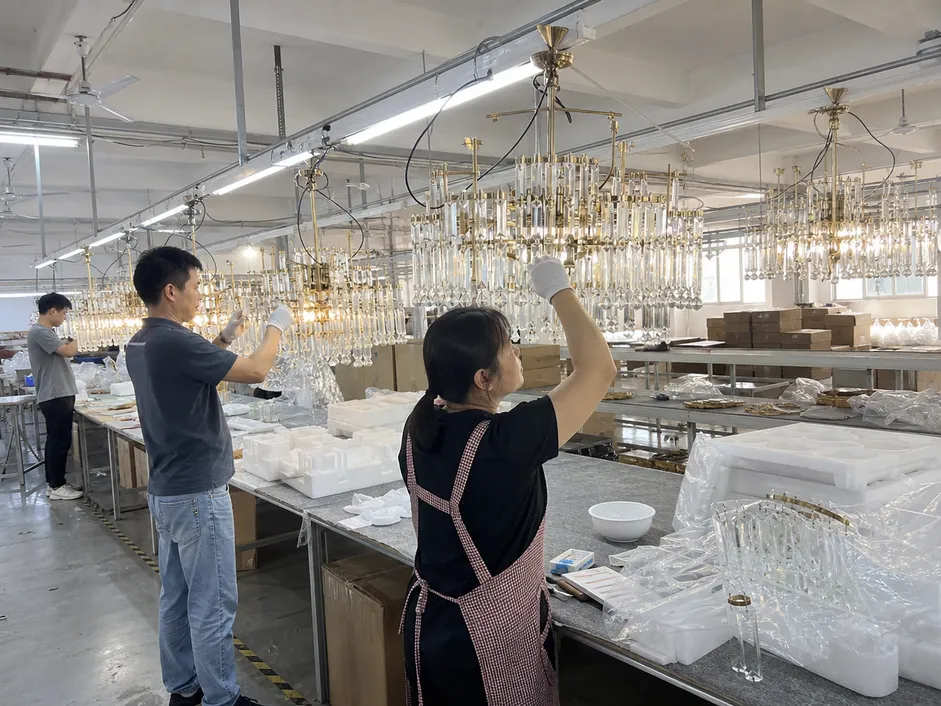
Incoming Inspection
Covers raw materials and purchased components: aluminum alloy grade verification, LED driver batch testing, glass shade dimensional checks, and hardware inspection before anything enters production. We don't assume supplier consistency — we verify it.
In-Process Inspection
Runs at three checkpoints: after die-casting and machining, after surface finishing, and after assembly. The finishing checkpoint is the most critical for dining chandeliers — this is where adhesion failures, color inconsistency, and surface contamination are visible and fixable. A defect caught at this stage costs a re-finish; a defect that ships costs a return.
100% Aging Test
Every fixture burns in powered before packing. LED driver failures, wiring faults, and early-life component failures show up here, not in your customer's dining room. This is a 100% test — every single luminaire, not a sample.
Photometric Verification
Runs on a sample basis from each production batch: lumen output and color temperature are checked against the approved spec. If a batch drifts outside tolerance, it doesn't ship.
Third-Party Inspection Support
For buyers who need third-party inspection (SGS, Bureau Veritas, Intertek), we accommodate pre-shipment inspection as a standard part of the process. Our QC documentation — inspection reports, aging test records, photometric data — is available as part of the shipment package.
Packaging and Container Loading
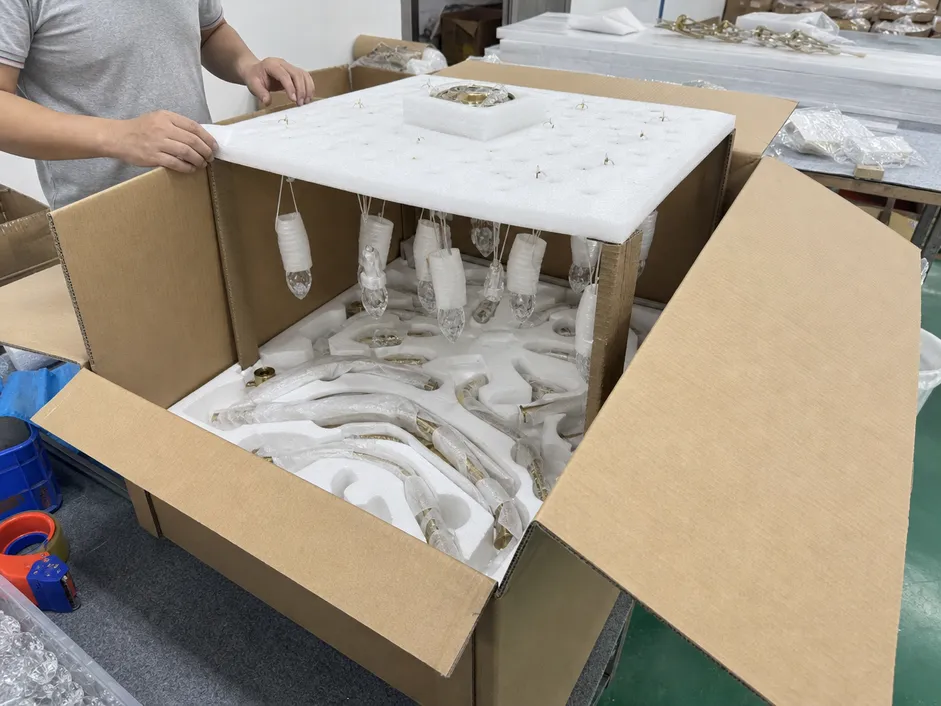
Dining room chandeliers are fragile in transit — multi-arm designs with glass or crystal elements are particularly vulnerable to the compression and impact forces of ocean freight. We engineer packaging per SKU rather than using a generic carton spec.
Standard Packaging for Dining Chandeliers
- Individual foam-lined inner carton with arm-specific foam inserts to prevent contact between arms during transit
- Outer carton with double-wall corrugated construction and corner reinforcement
- For fixtures with glass shades or crystal elements: internal suspension packaging that isolates the glass from the frame during impact
Development note: We developed the suspension packaging spec after seeing damage patterns on a specific crystal chandelier design that was failing at a rate that made the product unviable for ocean freight. The fix added about 15% to packaging cost but eliminated the damage claims.
40HQ Container Optimization
For large-volume orders, we optimize carton dimensions for 40HQ container loading efficiency. A 5–8% improvement in units per container is real money on a 2,000-unit order — we run the loading calculation as part of the order confirmation process.
E-Commerce & FBA Compliance
For e-commerce buyers, we configure packaging for last-mile delivery durability and FBA compliance:
- FNSKU labeling
- Poly-bag requirements
- Suffocation warning labels
- White-label outer carton printing (on qualifying runs)
Dining Room Chandelier Lighting: Frequently Asked Questions
What is the minimum order quantity for dining room chandeliers?
MOQ varies by product type and customization level. Standard catalog items have established MOQs — contact us with the specific SKU or configuration and we'll confirm the MOQ and lead time. OEM/ODM projects with custom tooling are quoted individually based on tooling investment and design complexity.
What lead time should I plan for a dining chandelier order?
Standard catalog items: 25–35 days from order confirmation.
OEM/ODM orders with new tooling: Add 15–20 days for the tooling cycle before production starts.
We communicate lead time milestones proactively — if a production issue is going to affect your ship date, you hear about it before the container is supposed to load.
What's the difference between PVD and electroplated finishes on chandeliers, and which holds up better?
PVD (Physical Vapor Deposition) deposits a harder, more wear-resistant layer than standard electroplating. For dining chandeliers — where the fixture is at eye level and subject to close inspection — PVD finishes show better scratch resistance and more consistent color across a batch. The trade-off is higher process cost.
PVD — Premium Applications
Brushed gold and antique brass in premium residential and hospitality applications. Better scratch resistance, more consistent batch color.
Electroplating — Mid-Market
Matte black and chrome in mid-market applications. Sufficient performance, more cost-effective.
We can advise on finish selection based on your target market and price point.
Do your dining room chandeliers support dimming, and what dimmer compatibility should I specify?
Yes — dimming is available on our LED-integrated dining chandeliers. The dimming protocol (TRIAC, 0-10V, or DALI) is specified at the driver selection stage and confirmed at order.
Protocol Selection Guide
- TRIAC: Most common spec for residential and light commercial applications in North America and Europe
- DALI: Typically specified for hospitality and commercial projects with building management system integration
- 0-10V: Available for projects requiring analog dimming control
Important: If your buyers are specifying into projects, confirm the dimmer infrastructure before placing the order — driver-dimmer compatibility is the most common installation issue we see in the field.
Can you match a specific finish color or texture from a reference sample?
Yes, for runs that justify the development cost. Send us a physical sample or a Pantone/RAL reference and we'll evaluate finish feasibility and provide a development quote.
Custom finish development typically adds one sample round to the timeline.
For buyers building a branded product line with proprietary finishes, this is a standard part of our OEM process.
What CRI should I specify for dining room chandeliers going into hospitality projects?
For hospitality applications — hotel dining rooms, restaurants, private clubs — specify CRI ≥90. At CRI 80, food and skin tones render acceptably but not optimally; at CRI 90+, the difference is visible and it's a selling point your hospitality buyers will notice.
The cost premium for high-CRI LED modules is modest relative to the fixture price, and it's a specification detail that differentiates your product from commodity alternatives.
We offer CRI ≥90 as a standard option on our LED-integrated dining chandeliers — confirm at order.
Related Chandelier Lighting
Dining room chandeliers are one configuration in our full chandelier range. Depending on your catalog requirements, explore these complementary product lines:
Linear Chandelier Lighting
Rectangular and linear formats suited to long dining tables and open-plan spaces; popular in contemporary hospitality and residential projects.
Luxury Chandelier Lighting
Crystal and high-specification decorative formats for premium residential and five-star hospitality; higher unit value, lower volume per SKU.
Modern Chandelier Lighting
Clean-line geometric and minimalist formats for contemporary residential and commercial interiors.
Custom Chandelier Lighting
Fully bespoke development for brands and projects requiring exclusive designs.
Start Your Dining Room Chandelier Program
We work wholesale only, with strict MOQ requirements. Our buyers are businesses building a product line or fulfilling project specs — not one-off purchasers.
If you're evaluating dining room chandelier lighting for your catalog or a specific project, send us your requirements: target market, volume, finish preferences, certification requirements, and any design references. We'll come back with a detailed quote, certification confirmation for your market, and — if you're considering OEM development — a feasibility assessment and tooling cost estimate.
Most new buyers in this category start with a sample order to evaluate finish quality and construction before committing to a production run. We can ship samples on a standard lead time — contact us to discuss.
Wholesale only. Strict MOQ applies.
Contact Details
+86 134 2021 9307
Phone
+86 134 2021 9307
Address
No. 14 Beisan Rd, Gusan Ind. Zone, Guzhen, Zhongshan, Guangdong, China
Sample orders ship on standard lead time
CE, UL, SAA certification confirmation included