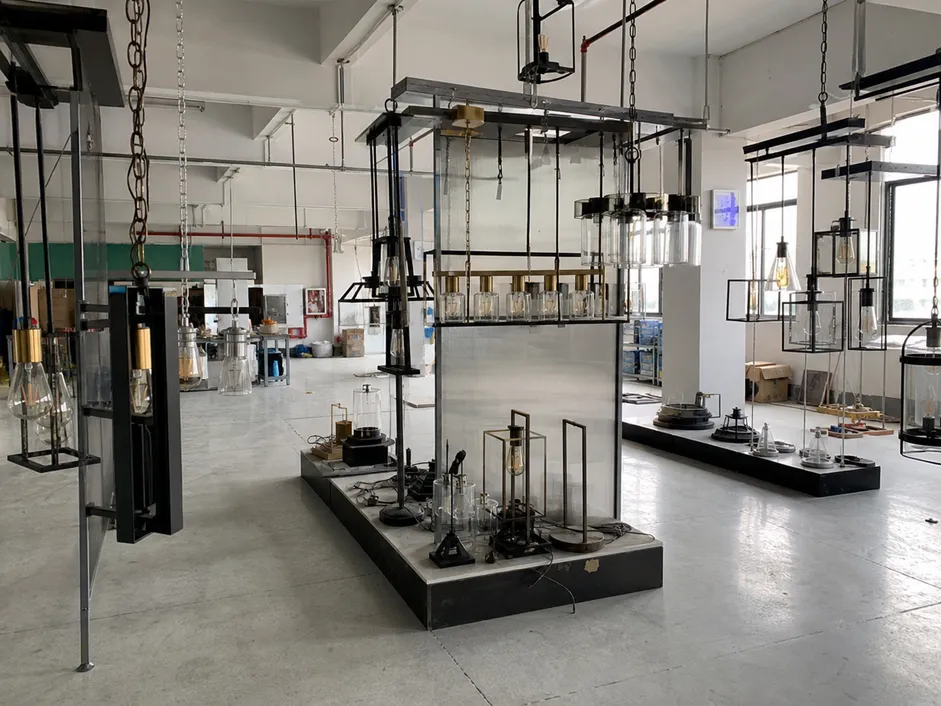

Kitchen Chandelier Lighting Built for Volume Sourcing
We manufacture kitchen chandeliers for importers, distributors, and project contractors who need batch-consistent product across repeat orders. CE, UL, and SAA certified. Full in-house production from die-casting to assembly.
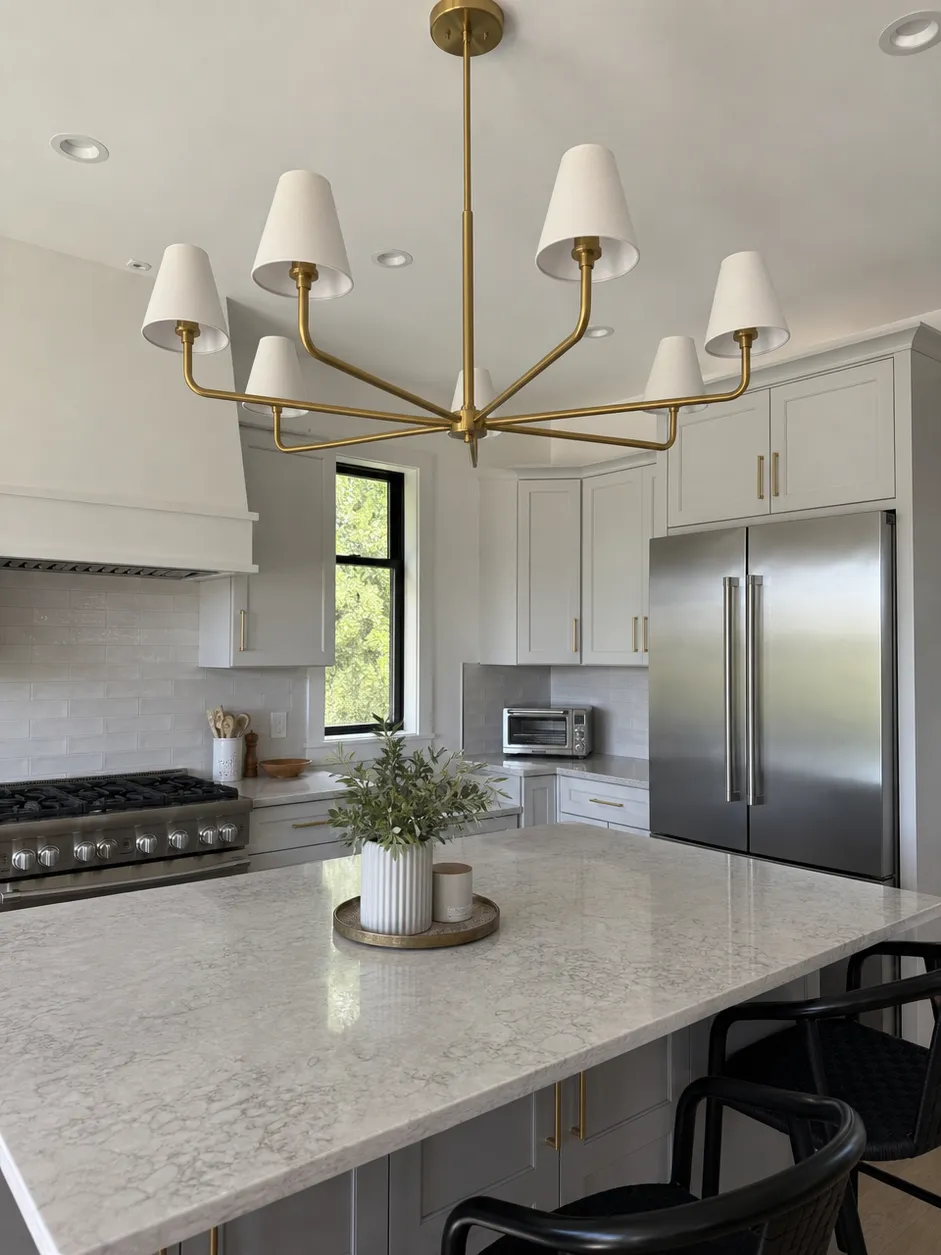
What Makes Kitchen Chandelier Lighting a Different Sourcing Problem
Kitchen chandelier lighting sits at an awkward intersection in the decorative lighting market: it needs to look like a statement piece while surviving a functional environment. Kitchens run heat, humidity, and grease vapor — conditions that expose finish quality problems that a dining room or living room installation would never reveal. Your downstream customers notice when a brushed gold arm starts showing adhesion failure at the 18-month mark. You absorb the warranty claim.
That's the sourcing problem we've been solving since 2008. Our kitchen chandelier range is built around the same in-house production stack we use across all decorative fixtures — die-cast aluminum housings, CNC-machined mounting hardware, and a surface finishing line that runs 60–80μm powder coat with automated application. The difference for kitchen-specific product is in the finish selection and the pre-treatment process: we run phosphate pre-treatment on all metal components before powder coat, which is what gets you past 500-hour salt spray without adhesion failure.
We learned the hard way that skipping pre-treatment on kitchen fixtures generates RMA rates that eat your margin fast — it's been standard on this product line for years.
The result is a fixture that holds up in the environment your customers are actually installing it in, which means fewer warranty claims landing back on your desk.
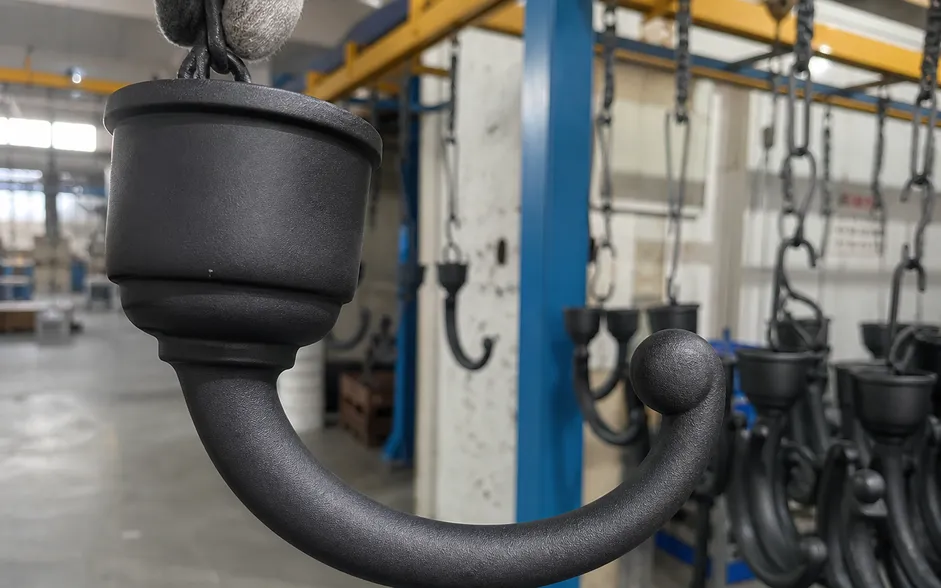
500-Hour Salt Spray
Phosphate pre-treatment standard
60–80μm Powder Coat
Automated application line
Die-Cast Aluminum
ADC12 alloy housings
CNC-Machined
Mounting hardware in-house
Technical Specifications
Kitchen chandeliers span a wide range of configurations — single-tier, multi-tier, linear bar, and cluster formats — and the specs below reflect the standard parameters we produce to. Custom dimensions, arm counts, and finish combinations are available; see the customization section below.
| Parameter | Typical Specification |
|---|---|
| Housing material | Die-cast aluminum (ADC12 alloy) |
| Arm / frame material | Steel tube or aluminum extrusion, depending on design |
| Canopy diameter | 100–200mm (standard); custom sizes available |
| Fixture diameter | 400–1200mm (single-tier); up to 1600mm (multi-tier) |
| Suspension height | Adjustable, 600–2000mm standard drop range |
| Light source | E26/E27 socket (lamp-ready) or integrated LED module |
| Wattage (integrated LED) | 18W–80W depending on arm count and configuration |
| Color temperature | 2700K / 3000K / 4000K (specify at order) |
| CRI | ≥90 Ra (standard); ≥95 Ra available on request |
| Voltage | 110–120V (UL) / 220–240V (CE/SAA) |
| Dimming compatibility | TRIAC / 0-10V / DALI (specify at order) |
| Surface finish | Brushed gold, matte black, chrome, antique brass, satin nickel — others available |
| Powder coat thickness | 60–80μm (automated application) |
| IP rating | IP20 standard (dry kitchen environments) |
| Certifications | CE, UL, SAA, SGS |
| Carton packaging | Individual foam-lined carton with outer reinforcement |
Specifications shown are standard production parameters. Actual values may vary by SKU and configuration. Contact us for product-specific data sheets.
Finish Durability: The Variable That Drives Your Return Rate
We spend more time on surface finishing for kitchen chandeliers than for almost any other product in our range, and the reason is straightforward: finish failure in a kitchen environment is visible, it's fast, and it generates warranty claims that are hard to dispute.
The finishing line runs three processes in-house — powder coating, electroplating, and PVD. For kitchen chandeliers, the majority of our volume runs through powder coat and PVD, because those two processes give the best adhesion performance in humid, grease-vapor environments. Electroplating alone isn't sufficient for kitchen applications; the adhesion layer is thinner and more susceptible to the thermal cycling that happens above a range or island cooktop.
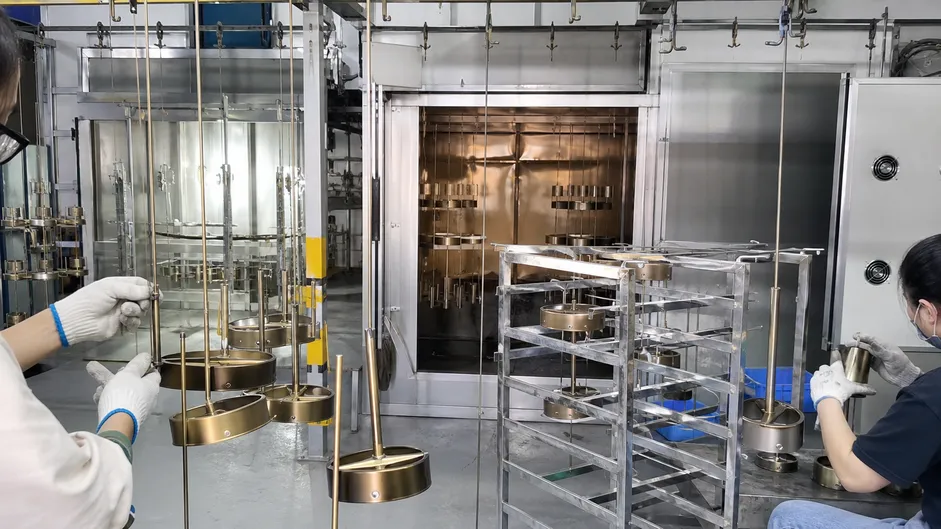
Powder Coat with Phosphate Pre-Treatment
Our powder coat process starts with phosphate pre-treatment on every metal component — this is the step that most assembly-only factories skip because it adds process time and cost.
Pre-treatment creates a conversion coating on the aluminum surface that the powder bonds to chemically, not just mechanically. The difference shows up at the 12–18 month mark in a real kitchen environment: pre-treated fixtures hold their finish; untreated ones start showing micro-delamination at edges and weld points.
For your coastal accounts or buyers in humid climates (Southeast Asia, the Gulf, Florida), this is the difference between zero RMA and a steady stream of warranty replacements.
PVD Vacuum Deposition
PVD finishes — brushed gold, rose gold, gunmetal — go through a vacuum deposition process that produces a harder surface layer than electroplating.
PVD hardness: 2000–3000 HV vs. Electroplating: 400–600 HV
In practical terms, that means the finish survives the cleaning products your customers' end users are actually using in their kitchens.
100% Outgoing Inspection
We run adhesion cross-cut tests and salt spray tests on finish samples before committing a batch to production. If a batch doesn't pass, it doesn't ship — that's not a policy statement, it's what the 100% outgoing inspection process enforces.
Highest-Volume Kitchen Finishes
Brushed gold and matte black are our two highest-volume finishes on kitchen chandeliers right now. If you're building a line around either, we have the process parameters dialed in and can hold color consistency across reorders.
Market Segments Where Kitchen Chandelier Lighting Moves Volume
Kitchen chandeliers aren't a single market — they're three or four distinct segments with different order patterns, margin profiles, and product requirements. Understanding which segment you're serving shapes which configuration and price tier makes sense to stock.
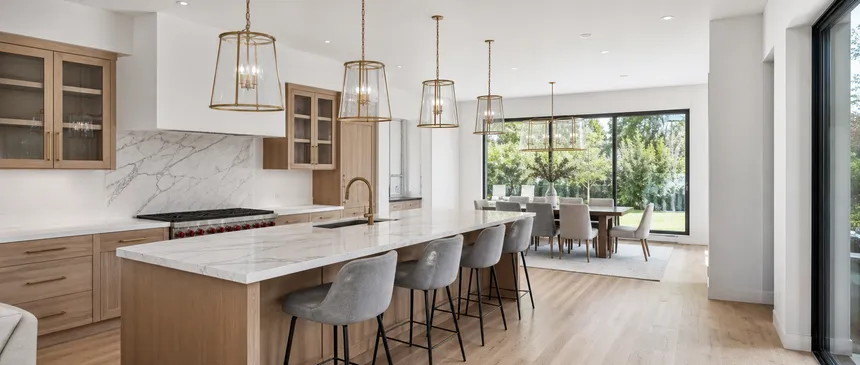
Luxury Residential New Construction & Renovation
Villas, luxury apartments, custom homes
Developers and interior contractors specifying kitchens in high-end residential projects. These buyers typically specify by finish and aesthetic rather than by price, which means the margin ceiling is higher.
Order pattern: 20–200 units per project, repeat business tied to developer pipeline
Key requirement: Finish consistency across a project batch + documentation for contractor specification files
We provide: Photometric reports, CE/UL certificates, batch finish consistency via in-process QC checkpoints
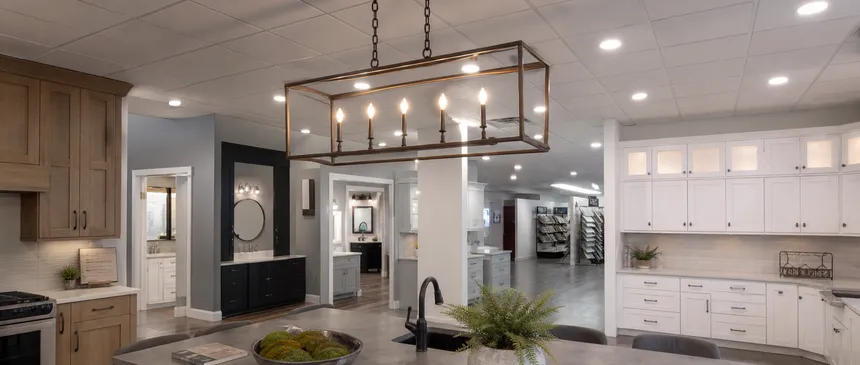
Kitchen & Bath Showrooms
Display inventory + customer fulfillment
Showroom operators stocking display inventory and fulfilling customer orders. This segment runs smaller per-order quantities but higher reorder frequency — a well-placed SKU in a showroom generates steady reorders as customers see it on display and order it for their own projects.
Pull-through effect: One display unit generates 10–30 customer orders over its showroom life
Pattern: Consistent with North American and European distributor accounts
Growth note: This segment has grown significantly over the last three years — worth building into your SKU mix if you're not already there
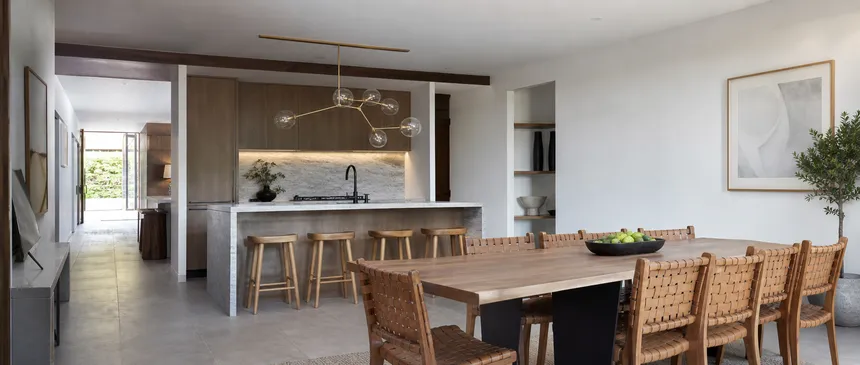
Hospitality Fit-Out
Boutique hotels & restaurant groups
Kitchen chandeliers appear in open-plan kitchen-dining concepts, hotel suite kitchens, and restaurant bar areas where the kitchen is part of the visual experience. Hospitality buyers order in project quantities — typically 50–500 units per property — and often need custom finishes or dimensions to match a design brief.
OEM capability: 7–10 working days to a physical prototype from approved drawings
Production lead: 25–35 days for standard configurations
Margin note: Custom hospitality work carries higher margin than standard catalog product
Documentation: CE/UL certificates, photometric reports, material declarations — handled as standard
E-Commerce & Online Retail Distribution
Amazon, Wayfair, independent online stores
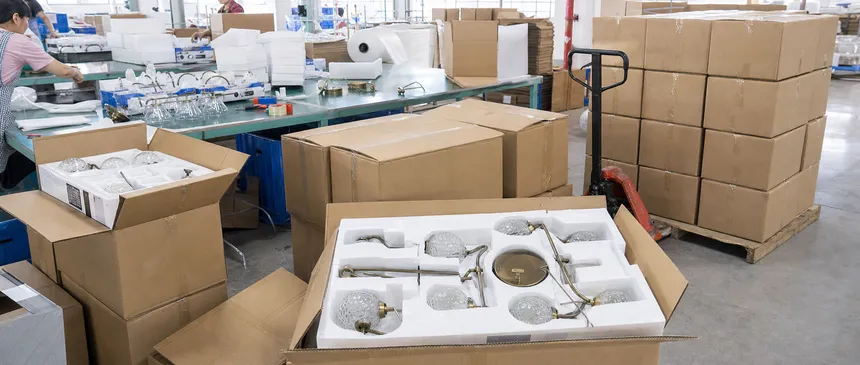
Importers supplying Amazon, Wayfair, or independent online stores. This segment runs higher volumes on fewer SKUs, with packaging and labeling requirements that differ from project-based supply.
Packaging: Individual foam-lined cartons engineered for drop and compression forces of ocean freight and last-mile delivery
FBA ready: Carton dimensions and labeling configurable to meet Amazon inbound requirements
Container optimization: Carton dimension engineering for 40HQ efficiency typically recovers 5–8% more units per container versus standard packing — real margin on a 500-unit order
Customization: What You Can Specify and What It Costs You
Kitchen chandelier customization at our factory runs across four dimensions: dimensions, finish, light source configuration, and branding. Here's what's practical at different order volumes.
Dimensions & Configuration
Fixture diameter, arm count, tier count, and suspension drop length are all adjustable within our standard tooling range. Changes within the tooling range add no tooling cost and no lead time.
Outside standard tooling — a non-standard canopy diameter, a custom arm profile, a unique tier geometry — requires new tooling, which adds 15–20 days and a one-time tooling cost.
For most buyers building a product line, the standard tooling range covers 80–90% of what the market needs; custom tooling makes sense when you're developing a signature SKU that differentiates your catalog.
Finish
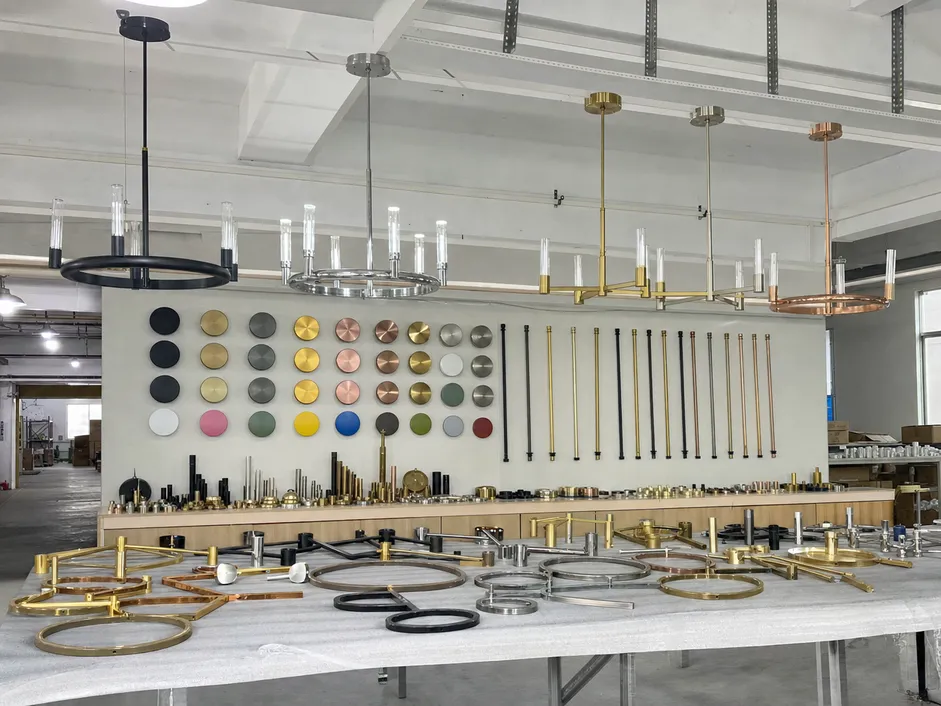
Any RAL color available on powder coat runs of 100 units or more — below that, the line changeover cost doesn't make sense for either of us.
PVD finishes (brushed gold, rose gold, gunmetal, champagne) available on runs of 200 units or more.
Standard finishes (matte black, chrome, brushed nickel, antique brass) available at standard MOQ with no minimum run requirement beyond the base order quantity.
Light Source Configuration
Lamp-ready (E26/E27 socket) versus integrated LED module is specified at order.
North America — lamp-ready preferred, where customers want to choose their own bulb.
Europe & Australia — integrated LED standard. We specify the driver and LED module to match destination market voltage and dimming infrastructure.
Dimming protocol — TRIAC, 0-10V, or DALI — is specified per order; we don't assume.
OEM/ODM & Private Label
Logo placement on canopy or packaging, custom packaging design, and private label documentation are all standard OEM services.
ODM projects — bring a design concept rather than finished drawings. Our engineering team works from reference images and target cost to develop the production-ready design.
Prototype turnaround: 7–10 working days from approved drawings.
Most new OEM buyers start with a 2-unit sample order to validate design and finish before committing to production quantities.
Finish Minimums at a Glance
| Finish Type | Minimum Run | Examples |
|---|---|---|
| Standard | Base MOQ | Matte black, chrome, brushed nickel, antique brass |
| RAL Powder Coat | 100 units | Any RAL color |
| PVD | 200 units | Brushed gold, rose gold, gunmetal, champagne |
Certifications and Market Compliance
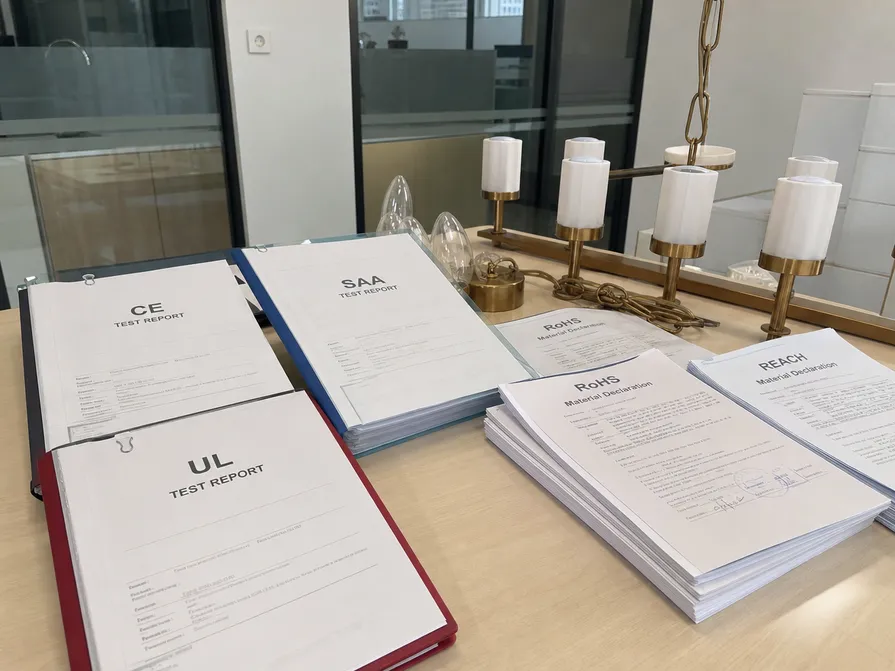
Kitchen chandeliers sold into North America, Europe, and Australia carry mandatory certification requirements. We hold CE, UL, and SAA as maintained certifications — not one-time test passes, but active certifications with current test reports available per SKU.
CE
Europe
Covers the Low Voltage Directive and EMC Directive requirements for the European market. Declaration of Conformity and test reports are available per SKU as part of the order documentation package.
UL
North America
UL listing covers the US and Canadian market requirements. For buyers supplying US retail or project channels, UL listing is typically a non-negotiable requirement from their downstream customers. Our UL-listed fixtures ship with the UL mark and the associated documentation.
SAA
Australia / New Zealand
SAA certification covers the Australian and New Zealand market. For buyers in those markets, SAA is the compliance baseline for residential and commercial installation.
SGS
General Export
General export quality certification, useful for buyers in markets without specific mandatory certification requirements.
Additional Compliance Documentation
For buyers supplying markets with additional requirements — RoHS compliance for EU electronics regulations, REACH material declarations, or specific energy efficiency standards — we maintain material safety documentation per SKU and can provide it as part of the order package.
If your import compliance team has specific documentation requirements, send them to us before the order; we'd rather sort out documentation before production than hold a container at customs.
Packaging, Container Loading, and Landed Cost
Kitchen chandeliers are fragile in transit — multi-arm fixtures with glass or crystal elements are the highest-damage-risk category in decorative lighting. We've engineered the packaging around that reality.
Individual Fixture Packaging
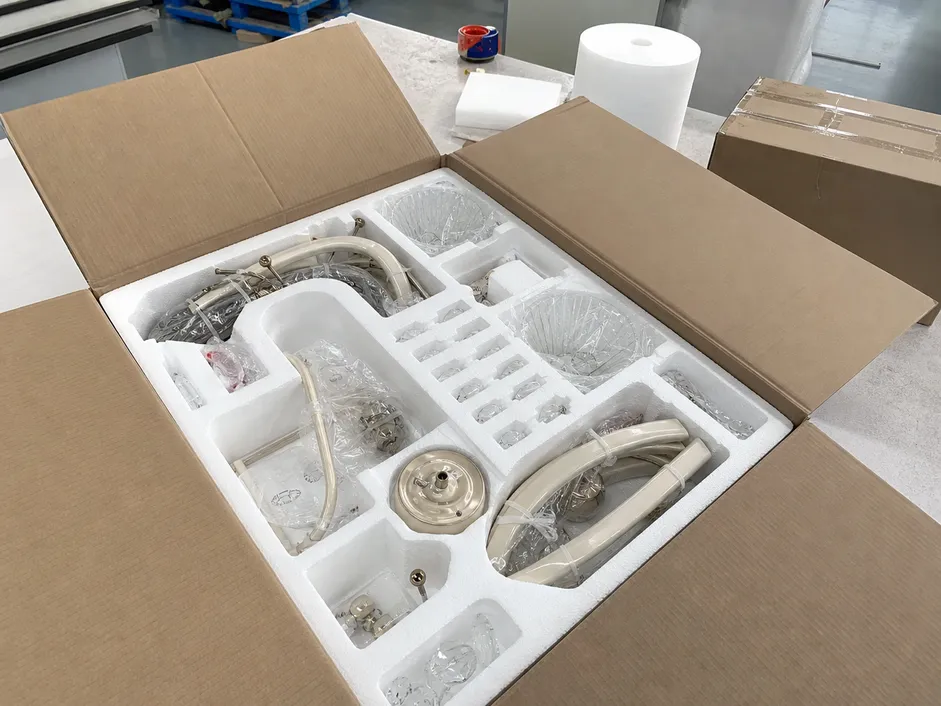
Each fixture ships in an individual foam-lined carton with internal component separation for arms, shades, and canopy hardware. The outer carton uses double-wall corrugated rated for the compression forces of ocean freight stacking.
For fixtures with glass or crystal elements, we add internal foam inserts that immobilize each element individually — the most common damage pattern we've seen on competitor product is glass-on-glass contact during transit, which is entirely preventable with the right insert geometry.
40HQ Container Optimization
For large-volume orders, we optimize carton outer dimensions for 40HQ container loading. We calculate the loading plan before production and adjust carton dimensions where possible to recover dead space.
Lead Time and Communication
Other Chandeliers in This Range
Kitchen chandelier lighting is one product in our full chandelier range. If your sourcing requirement extends beyond kitchen-specific configurations, these sibling products may be relevant.
Dining Room Chandelier Lighting
Larger-format chandeliers optimized for dining room ceiling heights and table proportions — overlapping aesthetic with kitchen chandeliers but different sizing conventions.
Linear Chandelier Lighting
Bar-format chandeliers suited for kitchen islands and long dining tables — a natural companion SKU to round kitchen chandeliers for buyers building a complete kitchen lighting line.
Luxury Chandelier Lighting
Crystal and premium-material configurations for high-end residential and hospitality projects where the fixture is the focal point of the space.
Modern Chandelier Lighting
Minimalist and geometric designs for contemporary kitchen aesthetics — lower material cost, higher volume potential in the mid-market segment.
Custom Chandelier Lighting
Full OEM/ODM development for buyers who need a proprietary design rather than a catalog product.
View Full Chandelier Range
Browse all chandelier lighting categories and configurations
Explore RangeFrequently Asked Questions
What is the minimum order quantity for kitchen chandelier lighting?
MOQ varies by configuration. Standard catalog finishes (matte black, chrome, brushed nickel) typically run 50–100 units per SKU. Custom RAL powder coat colors require a minimum run of 100 units due to line changeover. PVD finishes (brushed gold, rose gold) require 200 units minimum.
For OEM projects with new tooling, we discuss MOQ as part of the project scoping — tooling amortization affects the minimum viable run quantity. Send us your target SKU mix and volume expectations and we'll give you a specific MOQ breakdown.
What IP rating do kitchen chandeliers need, and does your product meet it?
Standard kitchen chandelier installations in dry kitchen environments (over an island, above a table in an open-plan kitchen) require IP20 at minimum — protection against solid objects over 12mm, no water ingress protection required. Our standard kitchen chandelier range is IP20 rated.
If you're specifying for installations directly above a sink, in a wet bar, or in a commercial kitchen with steam exposure, you need IP44 or higher. We can configure IP44-rated versions on request — the main change is the canopy and junction box sealing. Specify the installation environment when you inquire and we'll confirm the appropriate IP rating.
Why do LED kitchen chandeliers lose brightness after 12–18 months, and how do you prevent it?
Lumen depreciation in LED chandeliers is almost always a thermal management problem, not an LED quality problem. When the LED module runs hot because the heat sink is undersized or the driver is running at the edge of its thermal envelope, the LED junction temperature stays elevated and the phosphor degrades faster.
We size the heat sink and driver to keep junction temperature below 75°C under continuous operation — that's the threshold where L70 life (the point at which output drops to 70% of initial) extends beyond 50,000 hours.
The second common cause is driver failure from capacitor degradation, which is why the 100% aging test before shipment matters: capacitor failures show up in the first 50–100 hours of operation, not at 10,000 hours. If a driver is going to fail early, it fails in our aging room, not in your customer's kitchen.
Can you match a specific finish to an existing product in my catalog?
Yes, with a physical sample. Send us a sample of the finish you need to match — a fixture, a hardware piece, or a finish chip — and our finishing team will develop a match and send you a confirmation sample before production.
Color matching from a photo or Pantone reference alone isn't reliable enough for finish work; we need a physical reference. For PVD finishes, the match process takes 3–5 working days. For powder coat, 2–3 working days. Once the match is approved, we lock the formula and use it consistently across your production batches.
What documentation do you provide for import compliance?
Standard documentation per order includes: commercial invoice, packing list, bill of lading, Certificate of Origin, and CE/UL/SAA certificates (for the applicable market).
On request, we provide: Declaration of Conformity, test reports (LVD, EMC, photometric), RoHS compliance declaration, REACH material declaration, and IES files for project submissions.
If your import team or downstream customers have specific documentation requirements, send us the checklist before production — we'd rather confirm what we can provide upfront than hold a shipment over missing paperwork.
Start Your Sourcing Inquiry
Most buyers in this category start with a 2-unit sample order to validate finish quality and construction before committing to production quantities. We can ship samples within the standard lead time from our catalog range.
If you're developing a custom SKU or need a specific finish match, send us your reference images, target dimensions, destination market, and volume expectations — our engineering team will come back with a configuration recommendation and a detailed quote, including tooling cost if applicable.
Wholesale only. Strict MOQ applies.