

Full-Capability OEM & ODM Lighting Manufacturing
Your design or ours, built to your market's compliance requirements. 18 years of custom lighting production from Guzhen — in-house die-casting through final assembly, 7–10 working day prototype turnaround.
We handle the engineering so you can focus on your market.
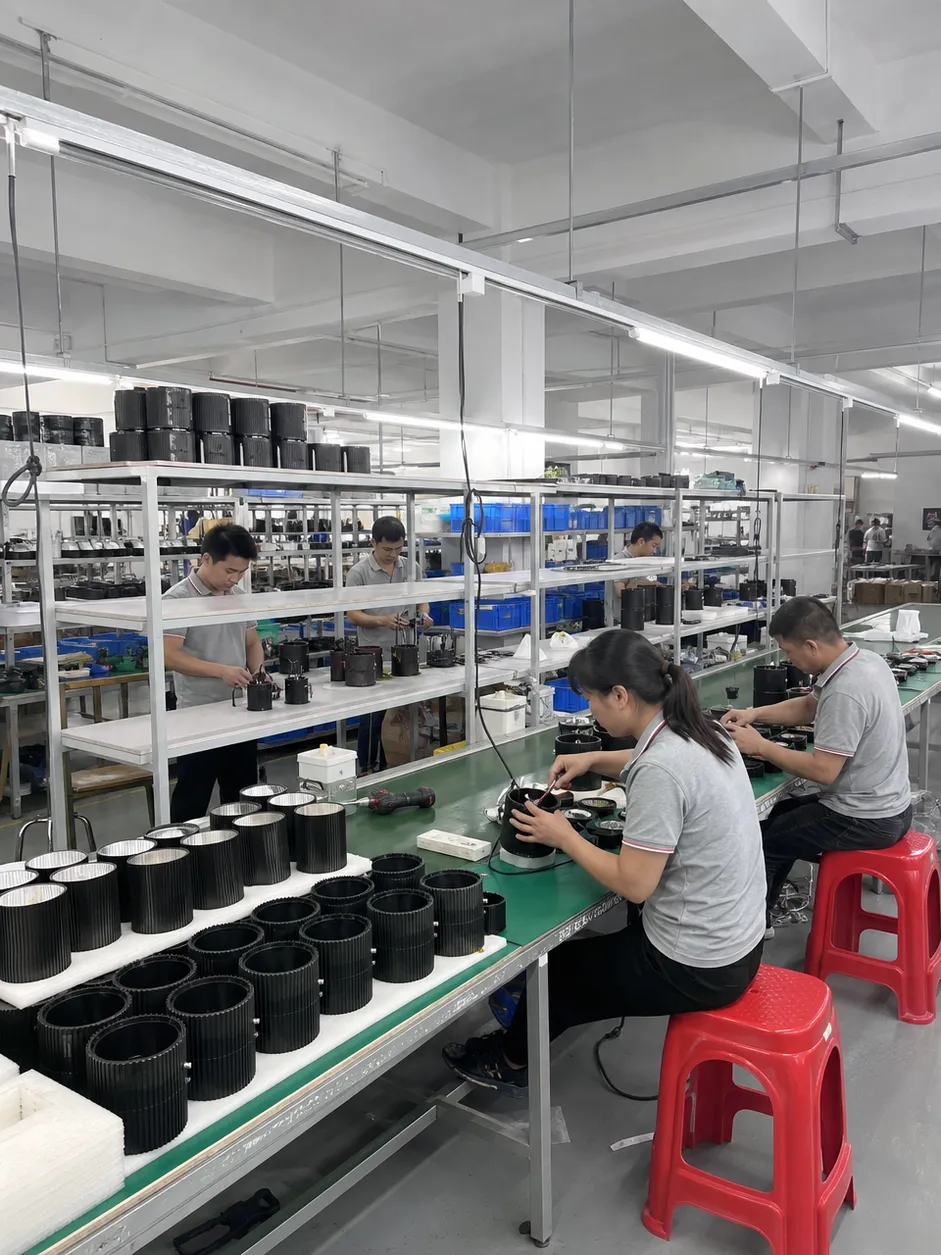
OEM vs ODM: Two Paths to a Product That's Yours
Most buyers come to us with one of two situations, and the path we take depends on which one fits.
OEM — You Bring the Design
OEM is for buyers who already have a design — technical drawings, a reference sample, or a detailed spec sheet. You own the design; we manufacture to it.
Our engineers review your drawings for production feasibility, flag any geometry that would complicate casting or finishing, and quote accordingly. The product ships under your brand, to your spec, with your packaging. We don't sell it to anyone else.
We sign NDAs before drawings change hands — that's standard practice here, not something you need to ask for.
What you bring:
- Technical drawings or CAD files
- Reference sample or detailed spec sheet
- Brand packaging requirements
ODM — We Develop the Design
ODM is for buyers who want a finished product without the design investment. You select from our existing designs — or describe a direction, a reference aesthetic, a target price point — and we develop the production-ready version.
Our structural engineers work from your brief, our optical lab validates the photometric performance, and you end up with a product that's differentiated from what your competitors are buying off a catalog.
The design belongs to you once the tooling is paid; we don't license it to other buyers.
What you bring:
- A brief and a budget
- Reference aesthetic or direction
- Target price point
The Practical Difference
OEM requires you to bring drawings. ODM requires you to bring a brief and a budget. Both paths end at the same place — a luminaire with your brand on it, built to the compliance requirements of your target market.
What We Can Actually Customize — and Where the Limits Are
Vague "full customization" claims don't help you scope a project. Here's what we can and can't do across each dimension.
Dimensions and Form Factor
We can modify overall dimensions, arm count, drop length, canopy size, and mounting configuration on most fixture types. Pendant lighting, chandeliers, wall sconces, ceiling fixtures, spotlights, and track systems are all within scope.
The constraint is tooling: if your dimension change requires a new die-cast mold, that's a tooling cost and a 15–20 day tooling cycle before production starts. If your change can be achieved through CNC machining of an existing casting, we can often skip new tooling entirely.
We'll tell you which path applies when we review your drawings.
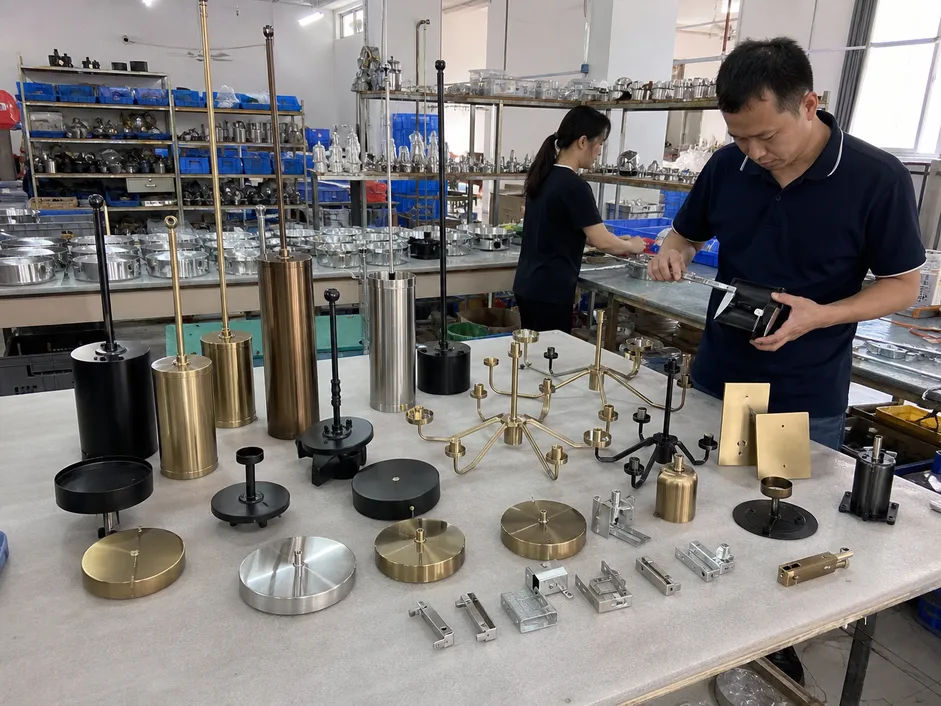
Materials and Construction
Housing Materials
Standard housing materials are aluminum alloy and zinc alloy — both die-cast in-house. We can work with customer-specified alloy grades if your project has particular weight or corrosion requirements.
Structural Components
Structural steel components for larger chandeliers are fabricated in-house.
Shade Materials
Shade materials include glass (clear, frosted, colored, textured), metal, and fabric. Glass shades are sourced from our Guzhen supply chain, where we have established relationships with several glass fabricators who can produce custom shapes and colors on reasonable MOQs.
Surface Finishes
The finishing line handles electroplating, powder coating, and PVD. We run salt spray testing on finish samples before committing a batch to production, which matters if you're supplying coastal markets or humid climates.
Standard Finishes (Dialed In)
- Brushed Gold
- Matte Black
- Chrome
- Antique Brass
- Brushed Nickel
- White Powder Coat
Custom Powder Coat
Custom RAL colors are available on powder coat runs of 200 units or more. Below that, the line changeover cost doesn't make commercial sense for either side.
Custom PVD Colors
Rose gold, gunmetal, titanium — available but require a minimum run discussion.
Electrical and Driver Configuration
LED driver selection is specified per SKU, not standardized across the range. We configure for your destination market's requirements. If your buyers are specifying fixtures for smart home or hospitality control systems, tell us the dimming protocol upfront — retrofitting driver specs after tooling is committed adds cost and time.
Voltage Configuration
- 110V/120V — North America
- 220–240V — Europe & Australia
- 220V — Middle East
Dimming Protocols
- TRIAC
- 0-10V
- DALI
Certification Targets
Configured per destination market compliance — CE, UL, SAA and others.
Packaging and Labeling
Full custom packaging is standard for OEM orders: your brand name, logo, product codes, barcode format, and language requirements on carton and inner packaging. We engineer the packaging per SKU for the destination market — fragile decorative fixtures ship in individual foam-lined cartons with outer carton reinforcement rated for ocean freight.
For large-volume programs, we optimize carton dimensions for 40HQ container loading efficiency. A 5–8% improvement in units per container is real money on a 2,000-unit order — we run the numbers as part of the packaging design.
What We Don't Do
Transparency about scope limits saves both sides time during quoting:
- Outdoor-rated IP65+ fixtures — not a standard capability. Our range is interior commercial and decorative.
- Specialized optical components — Fresnel lenses, precision beam optics for museum-grade applications are outside of standard LED optics scope.
- Small-batch custom runs below MOQ thresholds — the economics of custom tooling and line setup require a minimum volume to be viable for both sides.
The Collaboration Process: From Brief to Container
Buyers who haven't worked with a Chinese OEM factory before often don't know what to expect at each stage. Here's how a typical project runs.
Requirements Discussion
1–3 daysSend us your brief: fixture type, target market, volume estimate, certification requirements, and any reference images or drawings.
We'll come back with questions — usually about driver configuration, finish preferences, and packaging requirements — and a preliminary feasibility assessment.
If your project requires new tooling, we'll flag that upfront with an estimated tooling cost and timeline.
No commitment at this stage; we're just making sure we understand what you need before we quote.
Quotation & Design
3–7 daysOEM projects: Detailed quote covering unit price, tooling cost (if applicable), MOQ, lead time, and certification scope.
ODM projects: Our engineers develop a design proposal — typically 2D drawings and a 3D render — for your review before we quote.
We iterate on the design until you're satisfied before any tooling is committed.
The quote includes a breakdown of what's included in the unit price (driver, shade, hardware, packaging) so there are no surprises when the invoice arrives.
Sample Production
7–10 working daysOnce design and quote are approved, we produce a physical prototype. The 7–10 working day turnaround covers:
- CNC-machined prototype housings
- Provisional surface finishing
- Driver integration
- Photometric testing in our optical lab
You receive a functional sample — not a mock-up — with a photometric report showing lumen output, beam angle, and color temperature against the approved spec.
Most projects reach approval within two sample rounds.
Mass Production
25–40 daysStandard catalog items: 25–35 days from order confirmation.
Custom OEM with new tooling: Add 15–20 days for the tooling cycle — plan for 40–55 days total if new molds are required.
We communicate production milestones proactively: you'll know when tooling is complete, when production starts, and when QC inspection is scheduled.
If a production issue is going to affect your ship date, you hear about it before the container is supposed to load.
QC & Shipment
Final stage100% aging test: Powered burn-in to catch LED driver failures and wiring faults before they reach your customer's installation.
Photometric verification: Sample basis from each production batch.
Pre-shipment inspection: Packaging integrity, labeling accuracy, and carton count.
We accommodate third-party inspection (SGS, BV, or your nominated inspector) — just coordinate the inspection booking with your order timeline.
Prototyping Capability: 7–10 Days from Drawing to Sample
The 7–10 working day prototype turnaround is worth explaining, because it's not typical for a factory of our size.
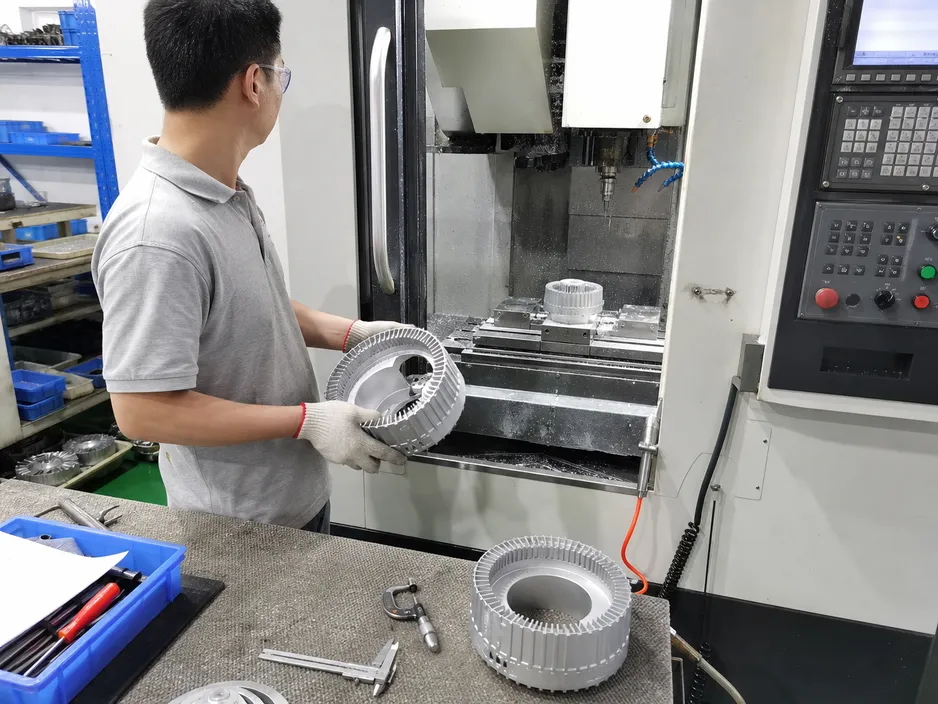
Most decorative lighting factories in Guzhen outsource prototype machining to local CNC shops, which adds coordination time and introduces a dependency on the shop's queue. We run CNC machining in-house on the same equipment used for production. When a prototype order comes in, it goes directly to our machining floor — no external queue, no coordination lag.
The same engineers who designed the fixture are on the floor when the prototype is being cut, which means fit issues get caught and corrected in hours, not days.
Why In-House CNC Matters
No External Queue
Prototype goes directly to our machining floor
Same Engineers
Designers on the floor during cutting — fit issues fixed in hours
Optical Lab On-Site
Photometric testing takes half a day, not a week
IES Files from Prototype
Accurate photometric data before production order
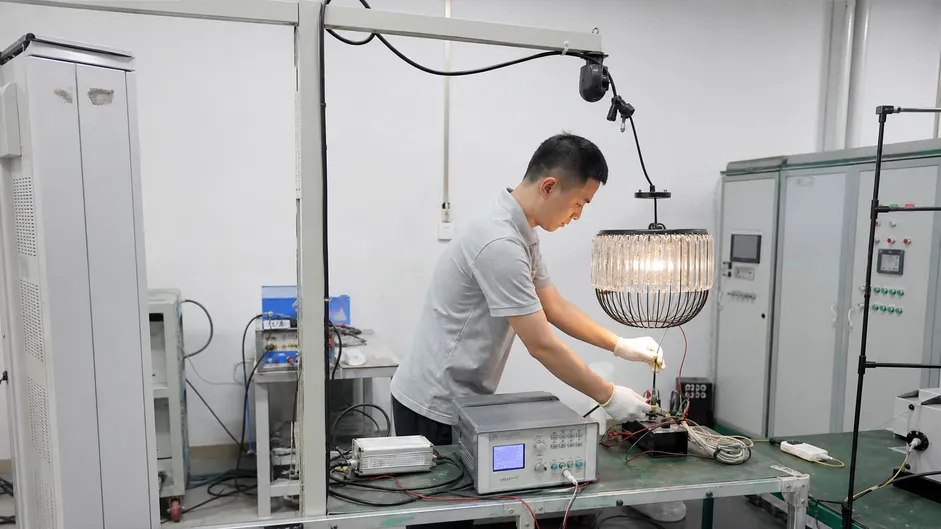
Optical Lab Validation
Photometric testing on a prototype takes half a day — lumen output, beam angle, color temperature, and CRI are measured against the approved spec before the sample ships.
For buyers who need IES files for project submissions, we generate them from our own measurements on the prototype. Your lighting designer or specifier has accurate photometric data before the production order is placed, not after.
"We've had buyers tell us this alone saved them a project revision cycle — the IES file from the prototype matched production within 3%, which is within the tolerance their specifier required."
ODM Early-Stage Validation
Getting photometrics right before committing to tooling
For ODM projects where the design is still being developed, the optical lab also runs early-stage validation on the LED module and optic combination before we commit to a housing design.
Getting the photometric performance right at the component selection stage is cheaper than redesigning the housing after a prototype fails. This front-loaded validation approach means the first physical prototype is far more likely to meet spec — reducing sample rounds and compressing your overall project timeline.
Functional Sample
Not a mock-up — fully assembled and powered
Photometric Report
Lumen output, beam angle, CCT, CRI
IES File
For specifier submissions — ±3% production match
Surface Finish
Provisional finishing on prototype housing
Certification Coverage Across Your Target Markets
Custom lighting is only as useful as its ability to clear customs and pass your buyer's compliance review. We hold and maintain certifications for the four major export markets we serve.
For OEM projects, we build certification requirements into the product development process from the start — driver selection, wiring configuration, and component specifications are all chosen with the target market's compliance requirements in mind. Retrofitting a product for a different market's certification after production is expensive and slow; we avoid it by asking about your target market in Stage 1.
If your project requires a certification we don't currently hold for a specific product type, we'll tell you upfront. We don't promise certifications we can't deliver.
Certification documents are available upon request — if your import team needs test reports or Declaration of Conformity documents for a specific SKU, we maintain these per product and can provide them as part of the order documentation.
Certifications Held
| Market | Certification | Coverage |
|---|---|---|
| Europe | CE (LVD + EMC) | Full decorative and commercial range |
| North America | UL | Pendant, chandelier, wall sconce, ceiling fixture types |
| Australia / NZ | SAA | Full decorative and commercial range |
| General export | SGS | Product safety and quality verification |
| Quality management | ISO 9001:2015 | Factory-wide quality management system |
MOQ, Lead Times, and What Affects Both
Standard Catalog Products
OEM — Existing Tooling
Your design, our existing molds or no new tooling required
OEM — New Tooling
MOQ set to amortize tooling cost to reasonable per-unit contribution
ODM — Design Development
MOQ and lead time depend on scope and tooling needs
Working Ranges, Not Guarantees
These are working ranges, not guarantees — actual MOQ and lead time are confirmed in the quotation based on your specific project. Every order is scoped individually, and the quotation you receive reflects the real production parameters for your configuration.
Factors That Extend Lead Time
- New tooling requirements
- Custom glass shades requiring external fabrication
- Multi-market certification requirements that need additional testing
- Peak season production scheduling (typically Q3–Q4)
Intellectual Property: What We Protect and How
OEM buyers are handing us their designs. That's a real risk, and we take it seriously.
Non-Disclosure Agreement
We sign a Non-Disclosure Agreement before any drawings, design files, or proprietary specifications change hands. The NDA covers design files, tooling, and production data — it's a standard commercial NDA, not a one-page form. If you have your own NDA template, we'll review it; if not, we use ours.
Tooling Ownership
Tooling ownership is explicit in the contract: tooling produced for your OEM project belongs to you. We store it in our facility for the duration of the commercial relationship, but we don't use it for other buyers' orders and we don't modify it without your written approval. If you decide to move production elsewhere, the tooling transfers with you.
Design File Security
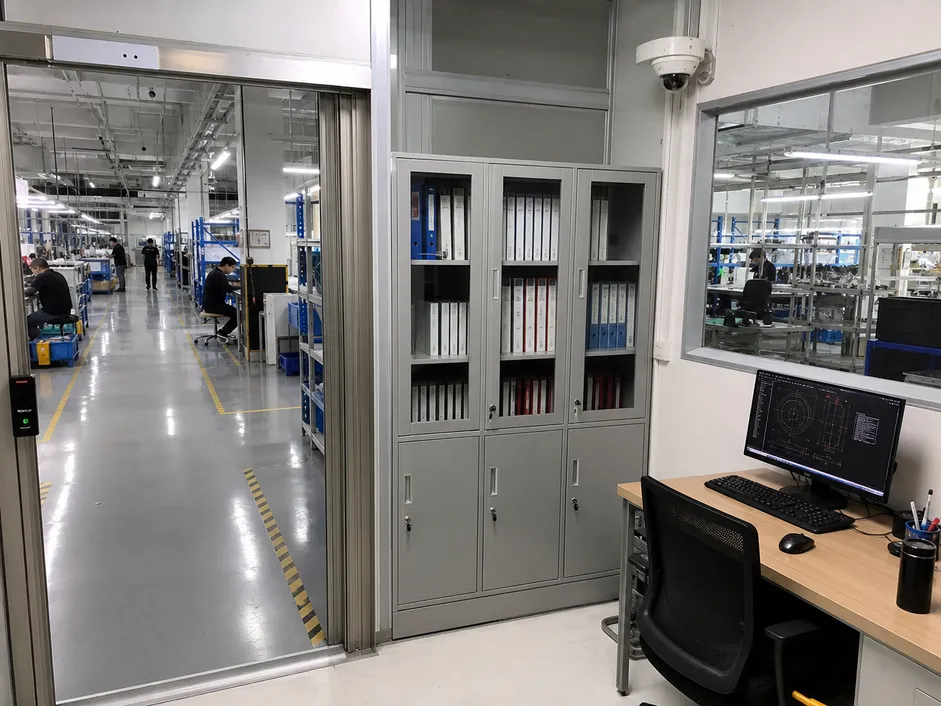
Design files are stored on access-controlled systems — your drawings don't circulate to the production floor in full; operators receive only the dimensions and specifications relevant to their station. We've been doing OEM work long enough to know that a buyer's confidence in IP protection is the foundation of a long-term relationship, and we structure our processes accordingly.
Our IP Commitments
- NDA signed before any design exchange
- Tooling belongs to you — contractually explicit
- No tooling reuse for other buyers' orders
- No modifications without written approval
- Tooling transfers with you if you move production
- Station-level access control — operators see only relevant specs
Market Segments Where Custom Lighting Generates Margin
The buyers who get the most out of our OEM and ODM capability are the ones who've identified a market segment where differentiated product commands a price premium over catalog imports.
Hospitality Supply
Hotels, restaurants, and serviced apartments specify lighting by project — the FF&E contractor or interior designer needs fixtures that match the design brief, not whatever's in stock. Custom OEM lighting lets you bid on these projects with a product that's specified to the brief, not adapted from a catalog.
Typical volumes: 200–2,000 units per property, with repeat orders as properties expand or renovate.
Branded Residential Distribution
Distributors building a private-label lighting line use ODM to differentiate their catalog from competitors sourcing the same factory-standard products. A branded line with consistent finish language, coordinated SKUs, and your own packaging commands better shelf positioning and protects your margin from direct price comparison.
Key advantage: Protection from direct price comparison with competitors sourcing identical factory-standard products.
Architectural & Commercial Fit-Out
Contractors and specification consultants sourcing for commercial office, retail, or mixed-use projects need fixtures that meet specific photometric requirements — beam angle, lumen output, color temperature — and carry the certifications required by the project's compliance review.
Why us: Our optical lab and certification portfolio make us a viable source for specification-grade commercial projects.
Export Distribution into Regulated Markets
If you're importing into North America, Europe, or Australia, the compliance infrastructure is already in place. CE, UL, and SAA certification on your custom product means your import team isn't waiting on certification work when you're ready to bring the container in.
Certifications ready: CE, UL, and SAA — no delays at port while waiting for compliance paperwork.
Frequently Asked Questions
What file formats do you need for OEM custom lighting projects?
What file formats do you need for OEM custom lighting projects?
We work from DWG, DXF, PDF technical drawings, and STEP/IGES 3D files. If you have a reference sample rather than drawings, we can reverse-engineer dimensions from the sample and produce drawings for your approval before production. For ODM projects where you're providing a design brief rather than technical files, reference images and a written spec (dimensions, finish, driver requirements, target market) are sufficient to start the design development process.
Can you produce a small trial order before we commit to full production?
Can you produce a small trial order before we commit to full production?
For standard catalog products, yes — our standard MOQ applies. For custom OEM orders requiring new tooling, a small trial order isn't economically viable because the tooling cost is fixed regardless of volume. In that case, the sample approval process (Stage 3) is the trial — you're evaluating a functional prototype before committing to the production order. Most buyers find that a thorough sample review gives them the confidence they need without a separate trial run.
What IP rating do I need for commercial interior lighting in hospitality applications?
What IP rating do I need for commercial interior lighting in hospitality applications?
For standard interior hospitality applications — hotel rooms, restaurant dining areas, lobby pendants — IP20 is the baseline requirement and covers the majority of decorative fixture types.
IP20 — Standard Interior
Hotel rooms, dining areas, lobby pendants
IP44 — Splash-Proof
Bathrooms and wet areas (minimum)
IP65+ — Water Exposure
Outdoor terraces, pool surrounds
Our standard decorative range is rated IP20. If your project includes bathroom or wet-area fixtures, tell us in Stage 1 — driver and wiring configuration changes for higher IP ratings need to be built into the design from the start.
How do LED drivers affect dimming compatibility, and what should I specify?
How do LED drivers affect dimming compatibility, and what should I specify?
The driver determines what dimming systems your fixture will work with:
TRIAC (Leading-Edge / Trailing-Edge)
Most common residential and light commercial dimming protocol — compatible with most standard wall dimmers.
0-10V Analog
Standard for commercial and hospitality applications where the lighting control system uses analog dimming signals.
DALI
Used in larger commercial and hospitality installations with addressable lighting control systems.
Important: If your buyers are specifying fixtures for a particular control system, get the dimming protocol from the specifier before you place the order — changing the driver after production means replacing the driver in every unit.
What happens if production samples don't match the approved spec?
What happens if production samples don't match the approved spec?
If a production batch drifts outside the approved photometric or dimensional tolerance, it doesn't ship. Our QC process runs photometric verification on a sample basis from each production batch — lumen output and color temperature are checked against the approved spec. Dimensional checks run at the in-process inspection stage.
If a non-conformance is found, we identify the root cause, correct it, and re-inspect before the batch is released. You'll hear about it before the container loads, not after it arrives.
Start Your Custom Lighting Project
Send us your brief — fixture type, target market, volume estimate, and any reference images or drawings. If you're not sure which path fits (OEM or ODM), describe what you're trying to build and we'll recommend the approach that makes sense for your timeline and budget.
Most new OEM relationships start with a single prototype run. We can have a functional sample in your hands within two weeks of drawing approval.
Direct Contact
Phone
+86 134 2021 9307Address
No. 14 Beisan Rd, Gusan Ind. Zone, Guzhen, Zhongshan, Guangdong, China
Wholesale only. Strict MOQ applies. Specific customization capabilities and lead times are confirmed in the project quotation.