
About ASCLighting
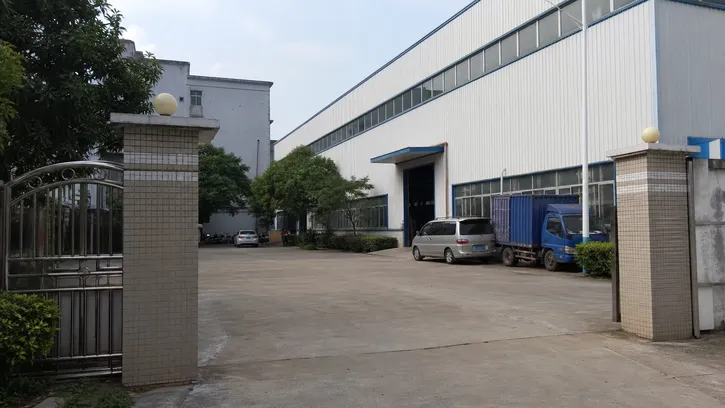
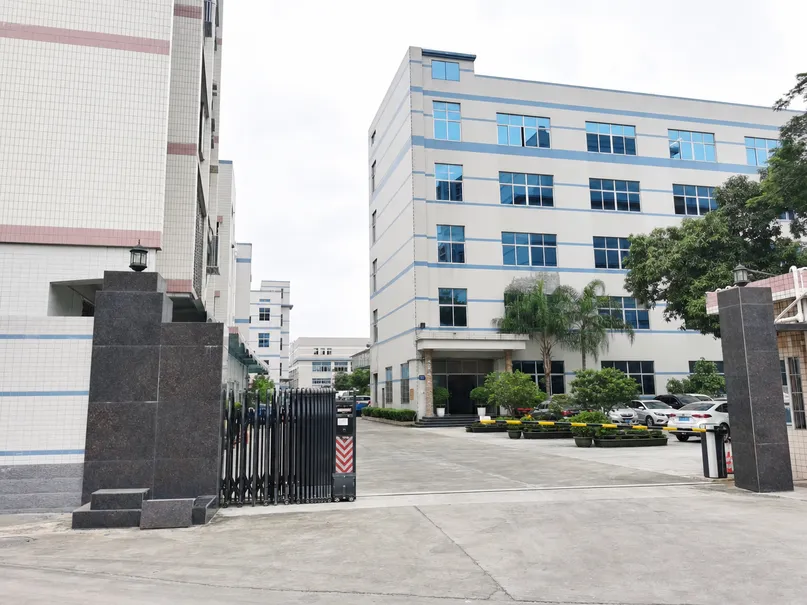
Zhongshan ASC Lighting Technology Co., Ltd. is a commercial and decorative lighting manufacturer based in Guzhen, Zhongshan, Guangdong. We've been running production here since 2008, and our business is straightforward: we manufacture custom and standard luminaires for importers, distributors, and project contractors who need a factory they can rely on across multiple orders, not just the first one.
Our product range covers pendant lighting, chandeliers, wall sconces, ceiling fixtures, spotlights, and track lighting — the full decorative and architectural spectrum. We work wholesale only, with strict MOQ requirements.
What We Make and Who We Supply
Our buyers are businesses building a product line or fulfilling project specs, not one-off purchasers. That focus shapes how we run the factory: batch consistency, documentation, and delivery reliability matter more here than they do at a sample-first operation.
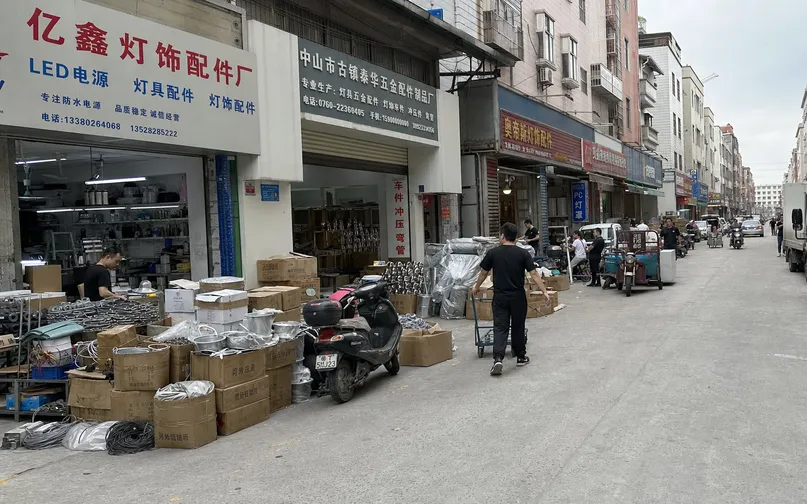
Guzhen is China's lighting manufacturing hub — the supply chain density here is something you can't replicate elsewhere. Raw materials, components, specialist subcontractors, and tooling shops are all within a short radius. That proximity compresses our lead times and gives us sourcing flexibility that factories in other regions simply don't have.
Full Decorative & Architectural Spectrum
Pendant Lighting
Decorative and architectural pendants for commercial and hospitality projects.
Chandeliers
Statement chandeliers for lobbies, ballrooms, and high-ceiling installations.
Wall Sconces
Ambient and accent wall lighting for corridors, rooms, and exterior facades.
Ceiling Fixtures
Flush-mount and semi-flush ceiling luminaires for general and task illumination.
Spotlights & Track Lighting
Directional and adjustable track systems for retail, gallery, and display environments.
Custom Decorative Lighting
Bespoke OEM/ODM luminaires engineered to your project specifications.
Who We Supply
Importers
Building branded product lines with consistent factory-direct supply.
Distributors
Stocking wholesale volumes with reliable batch-to-batch quality.
Project Contractors
Fulfilling project specs with documentation for customs clearance and compliance.
Eighteen Years of Building the Same Thing
We started in 2008 with a narrower focus — primarily decorative pendants and chandeliers for the Middle East and Southeast Asian markets. The early years were about learning what export buyers actually need versus what they say they need.
"Delivery dates matter more than catalog depth. Consistent finish quality across a 500-unit batch matters more than a perfect sample. Documentation for customs clearance matters more than a glossy brochure."
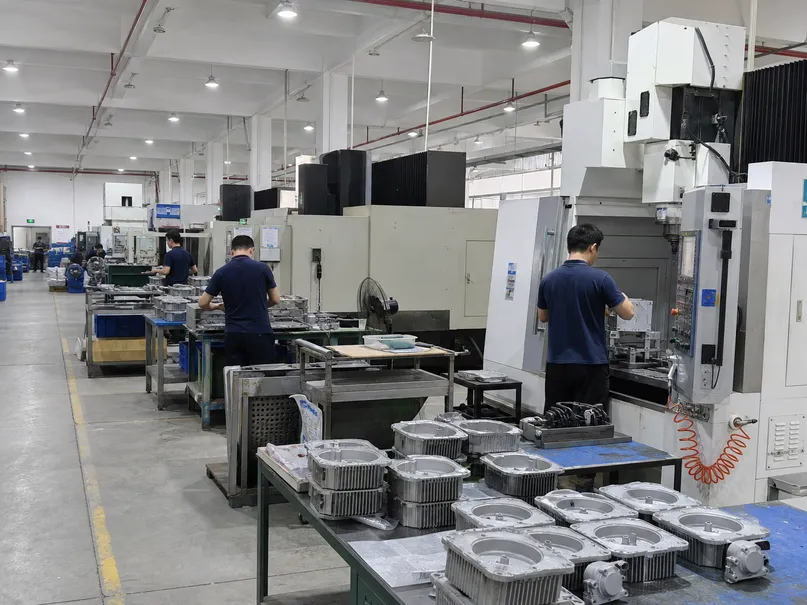
Those lessons drove the investments we made through the 2010s — expanding the die-casting and CNC machining capacity so we could control metal components in-house rather than depending on third-party suppliers, building out the surface finishing line to handle multiple finishes simultaneously, and formalizing the QC process around photometric verification — something a lot of decorative lighting factories still treat as optional.
Key Investments Through the 2010s
Die-Casting & CNC Machining
In-house metal component control — no dependency on third-party suppliers for critical parts.
Surface Finishing Line
Handles multiple finishes simultaneously — batch flexibility without cross-contamination.
Photometric Verification
Formalized QC around photometric testing — not optional, not an afterthought.
100% Aging Test — Non-Negotiable
We added the aging test protocol after a batch of LED drivers failed in the field for a Gulf distributor. That was an expensive lesson, and it's why 100% aging test is now non-negotiable before any container leaves.
Every luminaire undergoes full-duration burn-in testing to catch driver and component failures before shipment — not after installation.
Compliance Built In, Not Retrofitted
By the time we pushed into North American and European markets, the compliance infrastructure was already in place. UL and CE certification weren't retrofits — they were built into the product development process.
That's a meaningful difference when your buyer's import team is reviewing documentation. Certification isn't a checkbox we add at the end — it's embedded in how we design and test from day one.
UL Listed
North America
CE Certified
European Union
Middle East
Since 2008
SE Asia
Since 2008
The Factory: 12,000 m² of In-House Production
12,000
Square Meters
6
Production Lines
150
Production Staff
600,000
Luminaires / Year
The facility runs 12,000 square meters across six dedicated production lines, with 150 employees on the floor. Annual output capacity sits at 600,000 luminaires — enough to handle a 50,000-unit annual program without your orders competing for line time.
What matters more than the headline numbers is what we do in-house. Most decorative lighting factories in Guzhen are assembly operations — they buy die-cast housings, buy drivers, buy shades, and put them together. We run our own die-casting, CNC machining, and surface finishing under the same roof. That vertical integration means we control the three variables that cause the most quality problems in this category:
Three Variables We Control
- Dimensional consistency on metal components
- Finish uniformity across batches
- Driver-to-fixture compatibility
Die-Casting & CNC Machining
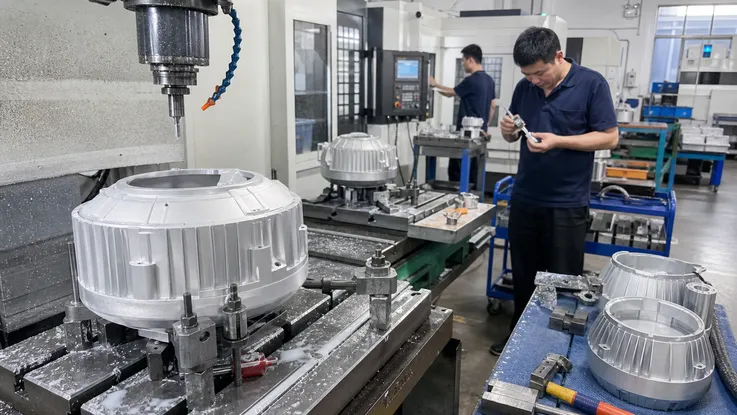
Aluminum and zinc alloy housings are cast and machined on-site. CNC tolerances hold to ±0.1mm on critical mounting dimensions, so your installation teams aren't dealing with fit issues on-site.
We run the same tooling across a production batch — no mid-run tooling swaps that introduce dimensional drift.
Surface Finishing
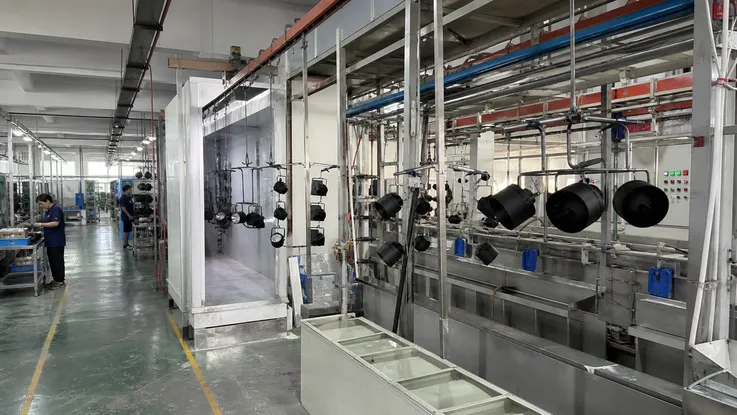
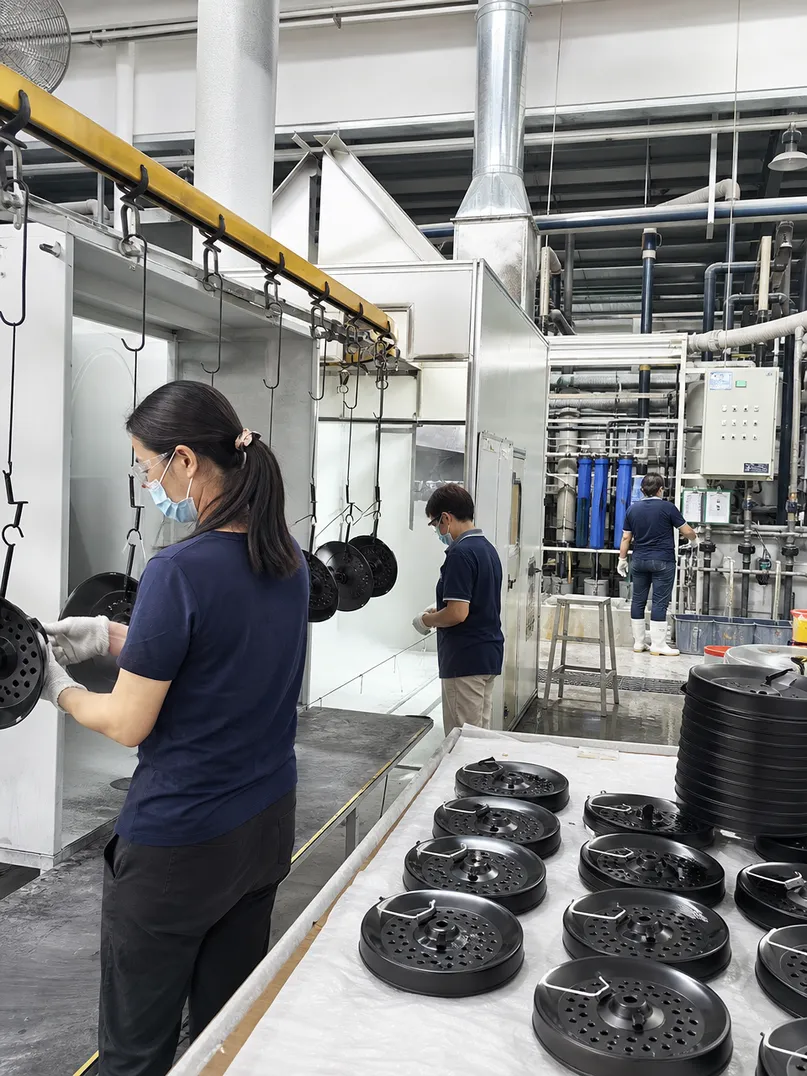
The finishing line handles electroplating, powder coating, and PVD in-house. Powder coat thickness runs 60–80μm with automated application — consistent across the batch, not just the first few units.
For buyers supplying coastal markets or humid climates, we run salt spray testing on finish samples before committing a batch to production.
Brushed gold and matte black are our two highest-volume finishes right now — if you're building a line around either, we have the process dialed in.
Assembly & Wiring
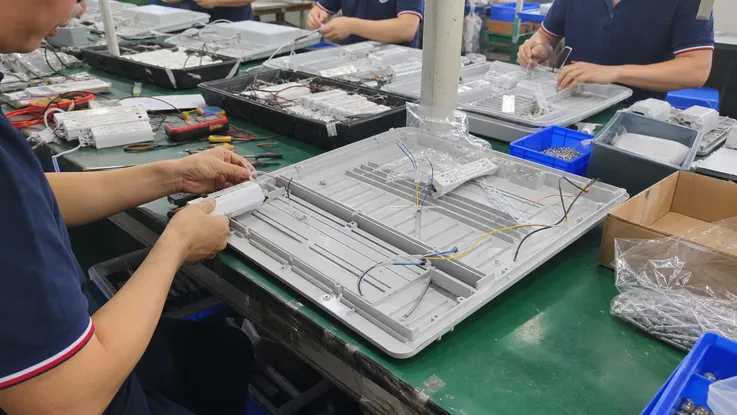
LED driver selection is matched to fixture type and target market voltage requirements. We don't use a single driver spec across all products — the driver is specified per SKU based on wattage, dimming compatibility, and the certification requirements of your destination market.
This matters when your buyer's electrician is on-site and the fixture needs to work with their existing dimmer infrastructure.
Optical Lab
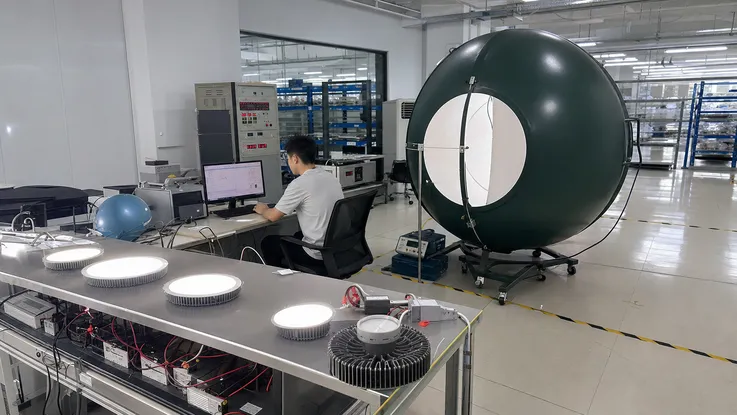
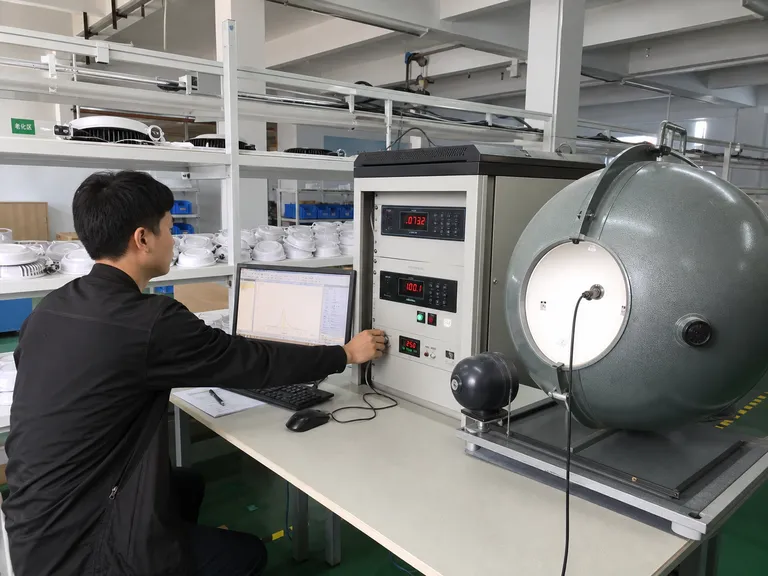
The in-house optical lab runs photometric testing on new designs and on production samples. Lumen output, beam angle, and color rendering are verified against spec before a design goes into production and spot-checked during runs.
For buyers who need IES files for project submissions, we generate them from our own measurements.
Quality Control: What Happens Before Your Container Loads
Certifications are the floor, not the ceiling. ISO 9001:2015 governs the process framework. CE, UL, SAA, and SGS cover the market-specific compliance requirements for Europe, North America, Australia, and general export. But the certificate doesn't tell you what happens on the line.
Four-Stage Inspection Process
Incoming Inspection
Raw materials and purchased components — aluminum alloy grade verification, driver batch testing, and glass or shade dimensional checks before anything enters production.
In-Process: Post-Machining
Dimensional verification after die-casting and CNC machining. Critical mounting dimensions checked against ±0.1mm tolerance spec.
In-Process: Post-Finishing
Where most defects in decorative lighting get caught — adhesion failures, color inconsistency, and surface contamination are visible at this stage and fixable before the fixture is assembled.
Outgoing: 100% Aging Test
Every luminaire runs powered for a minimum burn-in period before packing. LED driver failures, wiring faults, and early-life component failures show up here, not in your customer's installation.
Photometric Batch Verification
Photometric verification runs on a sample basis from each production batch — lumen output and color temperature are checked against the approved spec.
If a batch drifts outside tolerance, it doesn't ship.
Certifications Held
ISO 9001:2015
Process Framework
CE
European Market
UL
North American Market
SAA
Australian Market
SGS
General Export
Documentation Packages
For buyers who need specific documentation packages — test reports, Declaration of Conformity, material safety data — we maintain these per SKU and can provide them as part of the order documentation.
Environmental Practices and Compliance
The surface finishing operation is where most of the environmental load sits in a lighting factory. Our powder coating line uses low-VOC powder materials — no solvent-based liquid paint on the main finishing line. Wastewater from the electroplating process goes through an on-site treatment system before discharge, in compliance with Guangdong provincial standards. Aluminum and zinc alloy scrap from die-casting and machining is collected and returned to certified recyclers — we don't landfill metal waste.
Worker safety on the finishing floor follows standard PPE protocols for chemical handling, with ventilation systems on the plating and powder booths. We run annual safety audits internally and cooperate with customer-requested factory audits — if your compliance team needs to schedule a visit or review our environmental documentation, that's a standard part of how we work with buyers in regulated markets.
Low-VOC Powder Coating
No solvent-based liquid paint on the main finishing line
On-Site Water Treatment
Electroplating wastewater treated before discharge, Guangdong provincial compliant
Metal Scrap Recycling
Aluminum and zinc alloy scrap returned to certified recyclers — zero landfill for metal waste
Open to Factory Audits
Annual internal safety audits plus customer-requested compliance visits as standard
R&D and Engineering: 15 Engineers, One Optical Lab
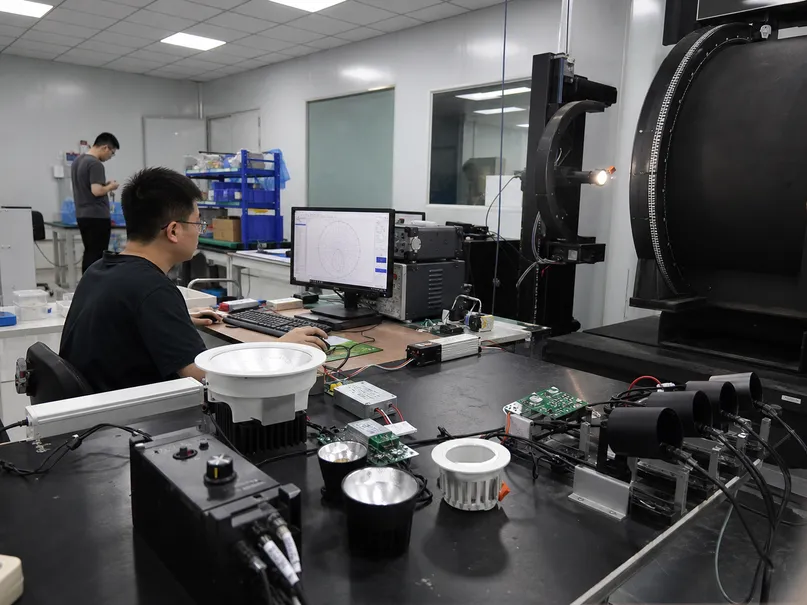
The R&D team runs 15 lighting engineers, which is a meaningful ratio for a 150-person factory. The team covers three areas: optical design, structural engineering, and driver/electronics integration. For OEM projects, the optical lab is where new designs get validated before tooling is committed — beam angle, lumen output, and thermal performance are tested on prototypes, not assumed from spec sheets.
Optical Design
Beam angle, lumen output, and thermal performance validated in the optical lab on physical prototypes before tooling commitment.
Structural Engineering
Production-ready housing design from reference images, dimensions, and target cost — identifying cost traps in decorative lighting geometry early.
Driver & Electronics Integration
Complete driver integration into functional prototypes — not mock-ups — ensuring electrical performance matches the mechanical design.
Rapid Prototyping: 7–10 Working Days
Rapid prototyping turnaround runs 7–10 working days from approved drawings to physical sample. That timeline covers CNC-machined prototype housings, provisional surface finishing, and driver integration — a functional sample, not a mock-up.
ODM Design Development
For ODM projects where you're bringing a design concept rather than finished drawings, our structural engineers work from reference images, dimensions, and target cost to develop the production-ready design.
Cost Traps We Flag Early
- Overly complex casting geometry that inflates tooling cost
- Non-standard driver cavities requiring custom enclosures
- Finishes that require multiple process steps, adding lead time and unit cost
We flag these early rather than quoting them in and surprising you later.
The People Running the Lines
The chief engineer has been in commercial and decorative lighting manufacturing for over 20 years — long enough to have worked through the transition from fluorescent to LED and to understand the driver compatibility issues that still cause problems in the field.
The QC manager came up through incoming inspection and has run the full four-stage process for over a decade; the 100% aging test protocol is largely his design.
On the optical side, the lead engineer holds a background in photometric measurement and has handled IES file generation for project submissions across North American and European markets.
These aren't recent hires — the core technical team has been stable for years, which matters when you're placing repeat orders and need consistent execution.
Chief Engineer
20+ years in commercial & decorative lighting. Deep expertise in LED driver compatibility and the fluorescent-to-LED transition.
QC Manager
10+ years running the full four-stage inspection process. Architect of the 100% aging test protocol.
Lead Optical Engineer
Background in photometric measurement. Handles IES file generation for project submissions across North American and European markets.
Shipping to North America, Europe, the Middle East, and Beyond
We ship to North America, Europe, the Middle East, Southeast Asia, and Australia — markets with different compliance requirements, different logistics realities, and different buyer expectations. That range isn't a marketing claim; it's reflected in the certification portfolio and in how we pack.
Export Packaging
Export packaging is engineered per SKU for the destination market. Fragile decorative fixtures — glass pendants, multi-arm chandeliers — ship in individual foam-lined cartons with outer carton reinforcement rated for the drop and compression forces of ocean freight.
We've learned which fixtures need additional internal bracing after seeing damage patterns from specific routes.
For large-volume orders, we optimize carton dimensions for 40HQ container loading efficiency — a 5–8% improvement in units per container is real money on a 2,000-unit order.
Lead Times & Communication
Lead time on standard catalog items runs 25–35 days from order confirmation.
Custom and OEM orders depend on tooling requirements — if new tooling is needed, add 15–20 days for the tooling cycle before production starts.
We communicate lead time milestones proactively; if a production issue is going to affect your ship date, you hear about it before the container is supposed to load, not after.
North America
Europe
Middle East
Southeast Asia
Australia
25–35 Days
Standard Catalog Items
+15–20 Days
New Tooling (if required)
5–8%
Container Loading Efficiency Gain
Core Strengths at a Glance
Full In-House Production
From casting to assembly — die-casting, CNC machining, surface finishing, and assembly under one roof, so dimensional consistency and finish quality don't depend on third-party suppliers meeting your spec.
15-Engineer R&D Team with Optical Lab
Photometric validation on new designs before tooling, IES file generation for project submissions, and 7–10 day prototype turnaround for OEM development.
Multi-Market Certification Coverage
CE, UL, SAA, and SGS held and maintained, so your compliance team isn't waiting on certification work when you're ready to import.
100% Aging Test Before Shipment
Every luminaire burns in before packing; driver failures and wiring faults show up here, not in your customer's installation.
600,000-Luminaire Annual Capacity
Across 6 production lines — your program runs on its own line allocation, not queued behind other customers' orders.
Guzhen Supply Chain Access
Located in China's lighting manufacturing hub, with component sourcing, specialist subcontractors, and tooling shops within the local supply chain, compressing lead times and enabling rapid prototyping.
Contact ASCLighting
Ready to discuss a sourcing requirement or OEM project? Send us your specs — fixture type, target market, volume, and any certification requirements — and we'll come back with a detailed quote and, where relevant, a recommendation on configuration based on what's working for our existing buyers in your region.
Wholesale only. Strict MOQ applies.
Direct Contact Details
Phone
+86 134 2021 9307Address
No. 14 Beisan Rd, Gusan Ind. Zone,
Guzhen, Zhongshan, Guangdong, China