

Modern Pendant Lighting
Clean geometry, consistent finish, certified for your market — modern pendant lighting manufactured at scale.
Aluminum and steel construction, 60–80μm automated powder coat, integrated LED or socket configurations. CE, UL, and SAA certified. OEM/ODM with 7–10 day prototype turnaround.
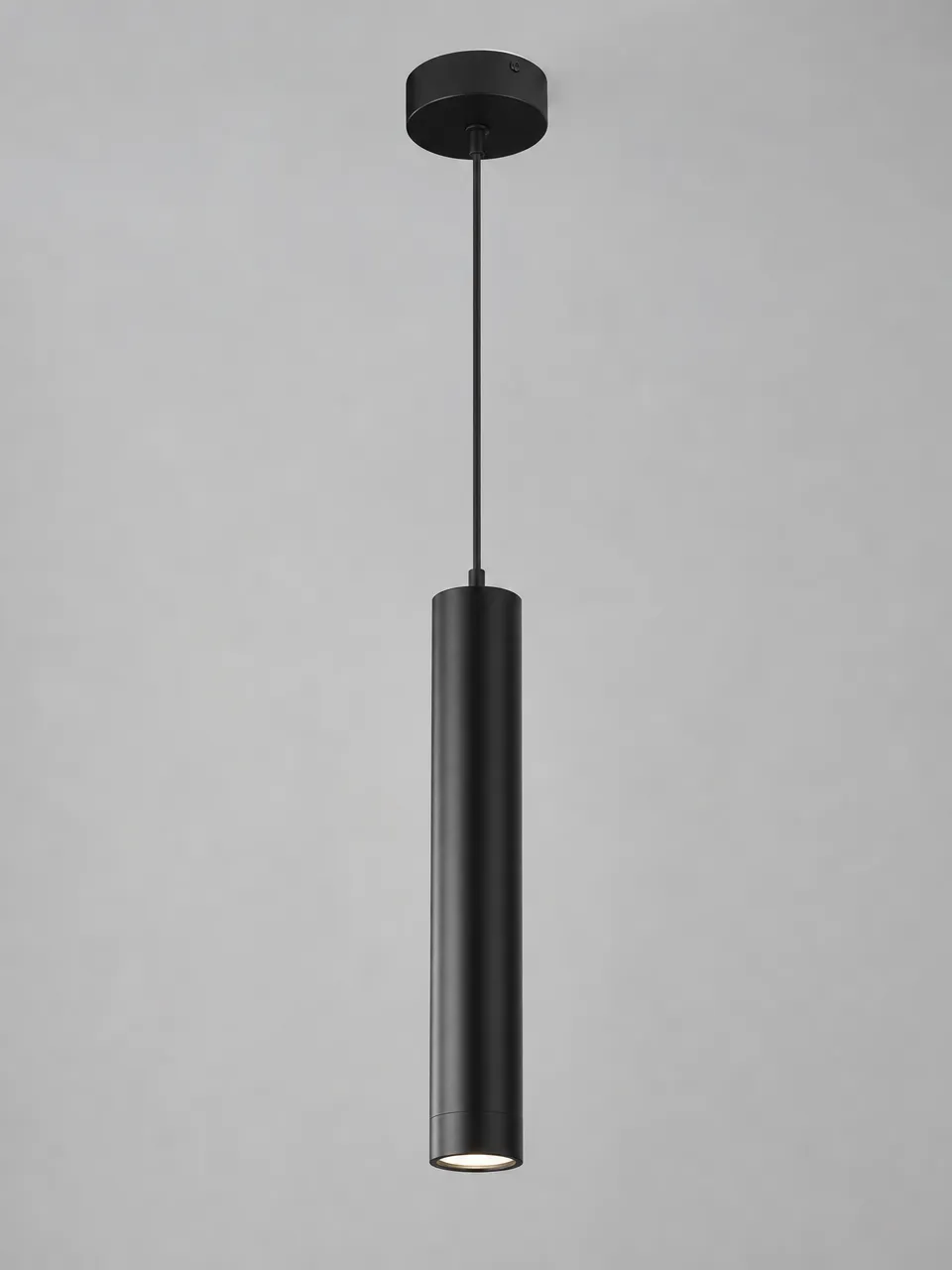
What Modern Pendant Lighting Is — and What Separates Ours
Modern pendant lighting is the volume segment of the pendant category. Clean lines, minimal ornamentation, geometric housings in aluminum or steel — the aesthetic that moves consistently across residential developers, hospitality fit-outs, and mid-to-high-end retail. It's not a niche. It's the core of most distributors' pendant catalogs, and it's where we've built the deepest production depth.
The design language is intentionally restrained: cylindrical or geometric housings, concealed wiring, canopy hardware that disappears into the ceiling, finishes that read as intentional rather than decorative. That restraint is harder to manufacture consistently than it looks. When there's no ornamental detail to distract the eye, every surface imperfection, every finish color drift, every dimensional inconsistency in the canopy hardware is visible. The tolerance requirements on a minimalist pendant are tighter than on a heavily decorated fixture — the simplicity is unforgiving.
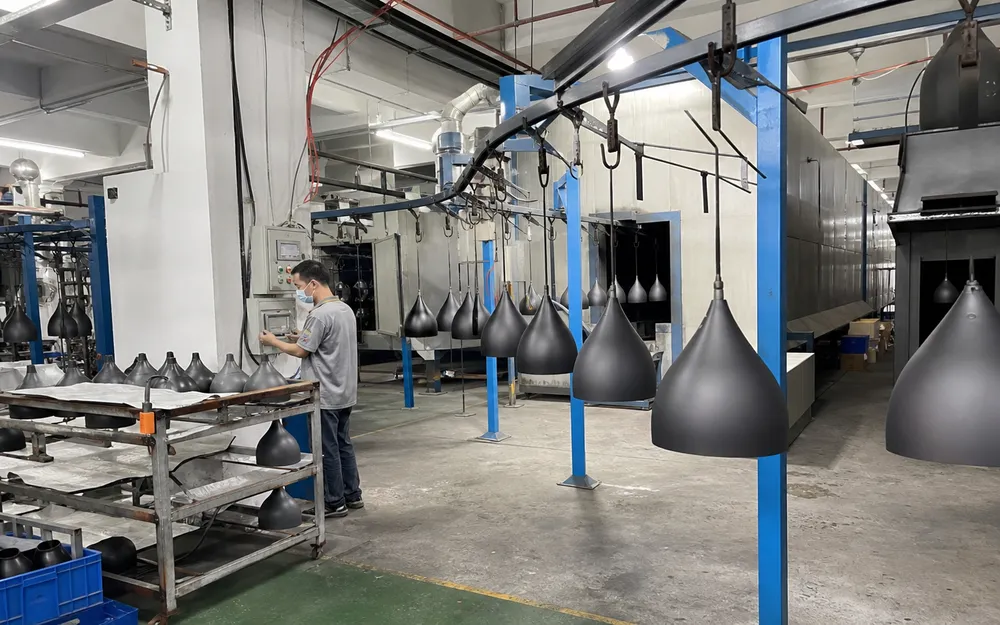
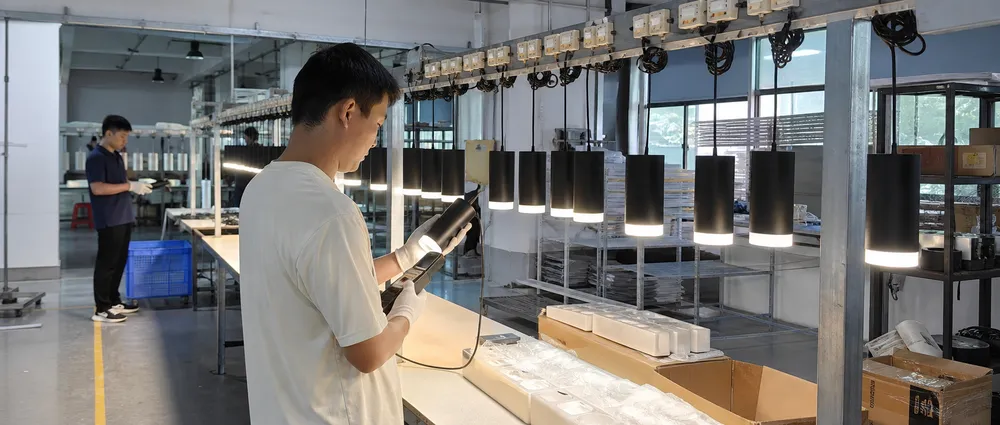
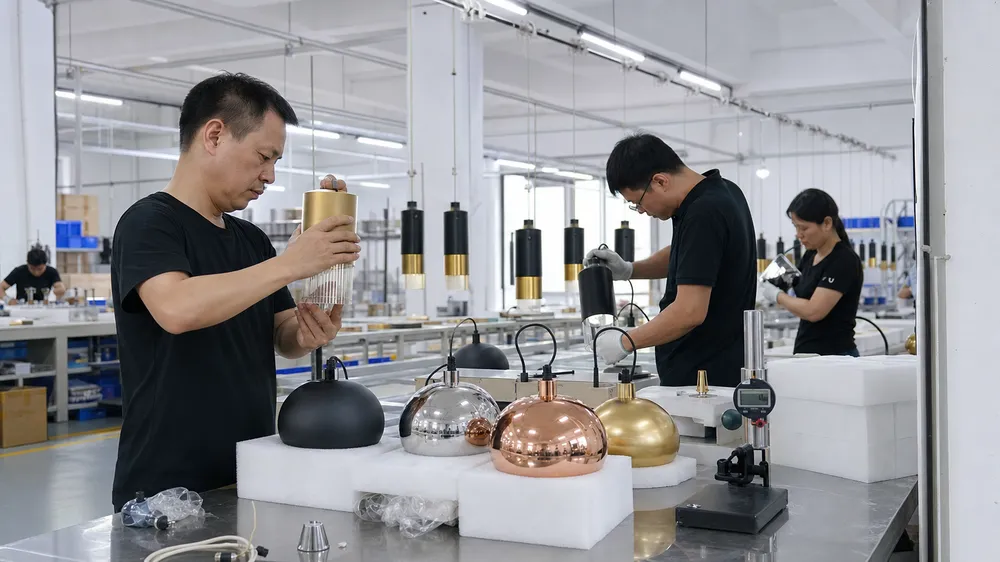
We've been making this category since 2008. The production infrastructure we've built — in-house die-casting, CNC machining to ±0.1mm, automated powder coat at 60–80μm — was built specifically because the quality variables that matter in modern pendant lighting can't be managed through assembly-only operations. When you're sourcing this product for a 200-unit residential development or a 50-room hotel fit-out, the fixture that arrives on unit 200 needs to match unit 1. That's a manufacturing problem, not a design problem.
Manufacturing Depth That Matters
-
In-house die-casting
Full control over housing geometry and alloy consistency
-
CNC machining to ±0.1mm
Dimensional consistency across production runs
-
Automated powder coat at 60–80μm
Unit 200 matches unit 1 — no color drift across batches
-
Manufacturing since 2008
16+ years refining this specific product category
Technical Specifications
Exact parameters for our modern pendant lighting range. Individual SKU data sheets are available on request.
| Parameter | Specification |
|---|---|
| Housing Material | Aluminum alloy (ADC12), steel; zinc alloy hardware components |
| Shade / Diffuser | Metal (aluminum, steel), acrylic diffuser, open-bottom configurations |
| Standard Finishes | Matte black, brushed gold, brushed nickel, white, satin brass |
| Custom Finishes | Any RAL powder coat color; custom PVD tones on OEM orders (minimum run applies) |
| Light Source Options | Integrated LED (built-in driver); E26/E27 socket; GU10 socket |
| Wattage | 8W – 40W (integrated LED); socket types support up to 100W equivalent |
| Color Temperature | 2700K, 3000K, 4000K standard; custom CCT on OEM orders |
| CRI | ≥80 standard; ≥90 available on specified SKUs |
| Dimming | TRIAC standard; 0-10V and DALI available (driver-dependent, specified per SKU) |
| Voltage | 100–240V universal; 120V and 230V dedicated versions available |
| Suspension Drop | 0.5m – 3m standard; custom lengths available |
| Canopy Diameter | 100mm – 200mm standard; custom sizes on OEM orders |
| IP Rating | IP20 standard; IP44 available on selected designs |
| Certifications | CE, UL, SAA, SGS; RoHS compliant |
| MOQ | Strict MOQ applies; contact for specific minimums by SKU |
Specifications shown are industry-standard values for this product type. Actual specifications may vary by SKU. Contact us for detailed product data sheets and exact parameters.
Why Finish Consistency Is the Commercial Variable That Matters Most
The category page covers our production infrastructure in detail — see the full pendant lighting overview. Here's what's specific to modern pendant lighting and why it affects your sourcing decision.
Modern pendant designs live or die on finish quality. A brushed gold cylinder pendant with color drift across a 100-unit batch is a returns problem. A matte black geometric fixture with adhesion failure at the weld seam is a warranty claim. These aren't hypothetical — they're the two most common quality failures we see when buyers switch to us from other sources.
Our surface finishing line runs powder coat at 60–80μm with automated application. The automation matters: manual spray application produces thickness variation of ±20μm or more across a batch, which translates to visible color inconsistency on metallic finishes. Our automated line holds ±5μm across a production run.
For matte black — our highest-volume finish in this category — that consistency means your 200-unit hotel order arrives with uniform color throughout, not a gradient from the first pallet to the last.
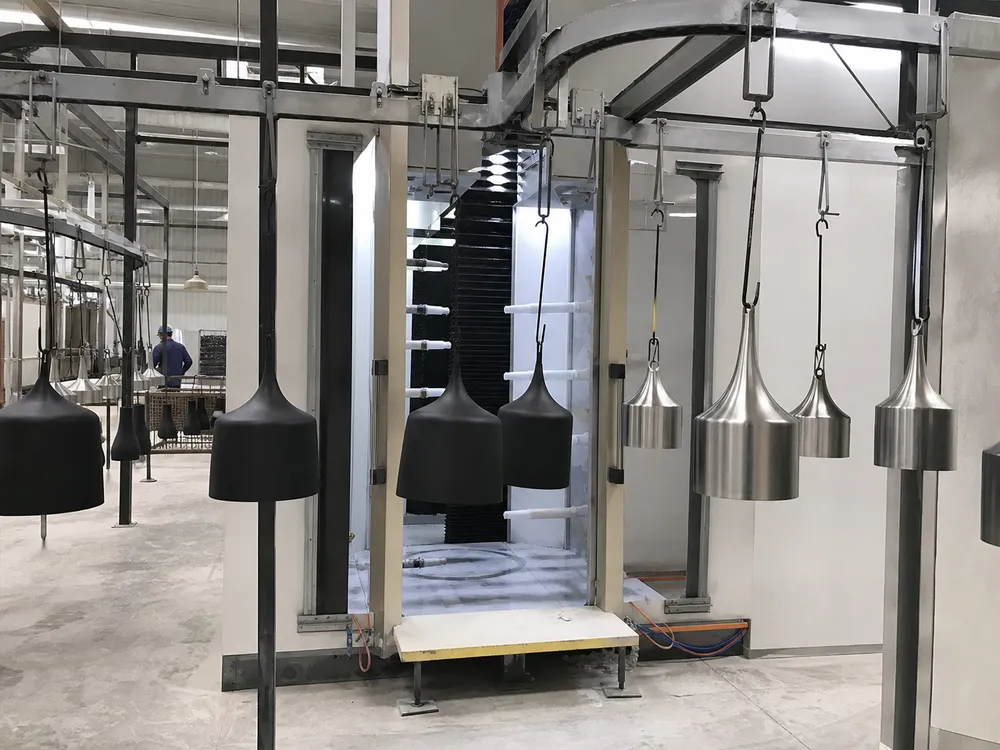
Powder Coat (Matte Black)
- 60–80μm automated application
- ±5μm thickness tolerance across batch
- 500-hour salt spray verified
- Highest-volume finish in category
PVD (Metallic Finishes)
- Molecular-level bond — no peel, no bubble
- Color consistency ΔE < 1.5 across run
- Brushed gold, satin brass, brushed nickel
- RMA rate dropped to near zero post-switch
Salt Spray Verification
- Pre-production sample testing on every batch
- 500-hour salt spray pass verified, not assumed
- Critical for coastal markets: FL, Gulf, SE Asia
- Prevents corrosion warranty claims downstream
Manual vs. Automated Application: Why It Matters Commercially
| Parameter | Manual Spray | Our Automated Line |
|---|---|---|
| Thickness variation | ±20μm or more | ±5μm |
| Visible color consistency | Inconsistent on metallics | Uniform across full run |
| Batch-to-batch match | Gradient risk (first vs. last pallet) | Consistent pallet-to-pallet |
| Commercial impact | Returns, RMAs, project delays | Near-zero finish-related RMAs |
Why we switched to PVD for brushed gold: We moved from electroplated brass to PVD on our brushed gold line after seeing color drift complaints from a North American distributor. The PVD process costs more per unit, but the RMA rate dropped to near zero. Most buyers in that segment have stayed on PVD since.
Market Segments Where Modern Pendant Lighting Generates Repeatable Volume
Modern pendant lighting isn't a single market — it's several distinct segments with different volume patterns, margin profiles, and specification requirements. Here's where the commercial opportunity sits:
Residential Developer Supply
Mid-to-high-end developments · North America, Europe, Middle East
Mid-to-high-end residential developers specify modern pendant lighting for kitchen islands, dining areas, and entrance spaces across multiple units. A 50-unit apartment development might specify 3–5 pendant fixtures per unit — that's 150–250 units from a single project, with the same spec repeated across the entire development.
Batch consistency is the critical variable: every fixture needs to match. Developers in this segment reorder when they start the next phase of a project, making it a predictable, repeatable revenue stream for distributors who get the spec right the first time.
Hospitality Fit-Out Supply
Hotels & serviced apartments · 3-to-5-star global
Hotels and serviced apartments specify modern pendant lighting in volume — a single mid-scale hotel project can run 100–500 units across guest rooms, corridors, and common areas. The modern aesthetic is the dominant specification in 3-to-5-star hospitality fit-outs globally right now, and it's been consistent for several years.
This segment has been our fastest-growing export market for modern pendant designs over the past three years — worth building into your catalog if you're supplying fit-out contractors. Buyers in this segment need CE or UL certification, consistent finish quality across large batches, and documentation packages for project sign-off.
Lighting Distributor Catalog Programs
Anchor segment for pendant catalogs
Distributors building a pendant catalog need modern pendant lighting as the anchor segment — it's the style that moves across the widest range of end markets. The commercial logic is straightforward: a distributor who stocks a well-specified modern pendant range in 3–4 finishes and 2–3 sizes covers the majority of residential and light commercial inquiries without needing to carry a deep SKU count.
Our production capacity — 600,000 luminaires per year across 6 lines — means your reorder doesn't queue behind other customers' programs.
Commercial Interior Fit-Out
Offices, co-working, boutique retail, restaurants
Offices, co-working spaces, boutique retail, and restaurant fit-outs specify modern pendant lighting for task and ambient lighting in open-plan environments. This segment typically requires 0-10V or DALI dimming compatibility for integration with building management systems, and UL or CE certification for the destination market.
Order volumes per project run 20–200 units, with repeat business from contractors who work across multiple fit-out projects annually.
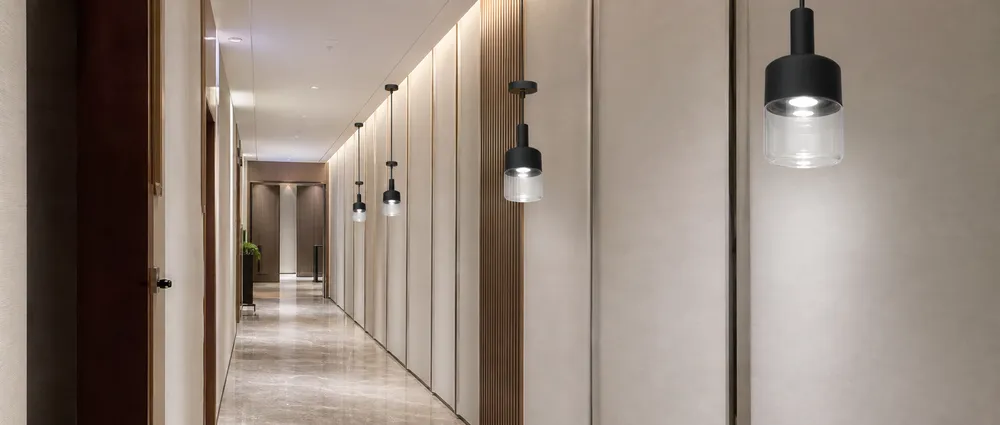
Customization: What You Can Specify, What Has Limits
Modern pendant lighting is one of the more customizable segments in our range — the geometric forms translate well to custom sizing, and the finish options are broad. Here's what's available and where the practical limits are.
Housing Dimensions
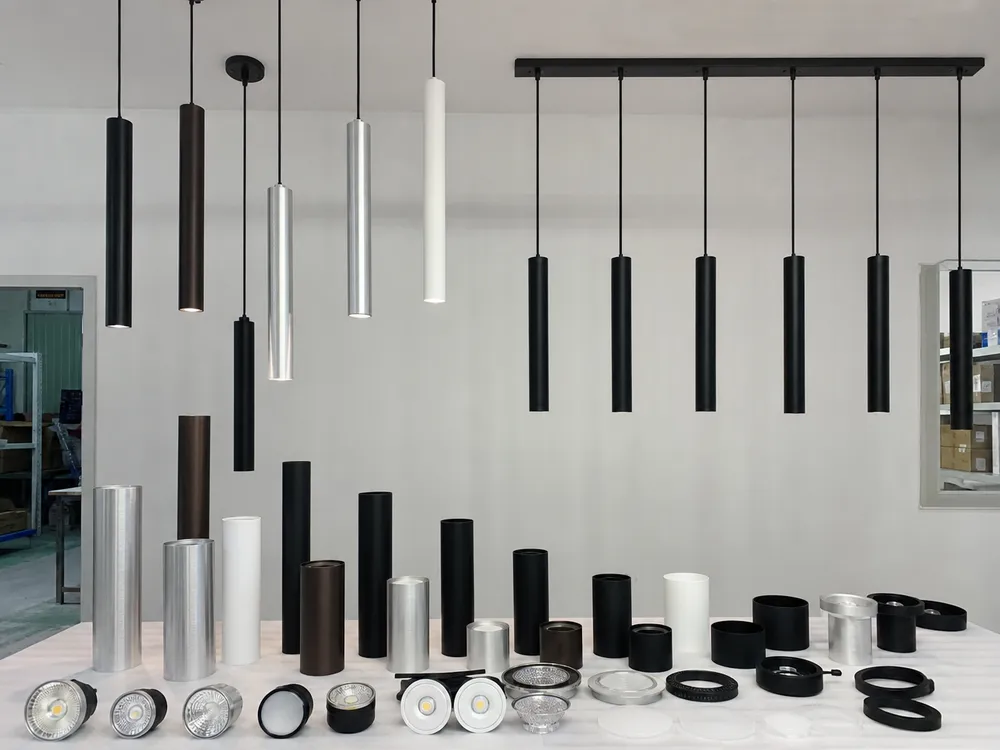
Standard catalog sizes run from 80mm diameter cylinders to 400mm diameter disc and cone forms. Custom sizing is available on OEM orders — specify your target diameter, height, and canopy dimensions, and we'll assess tooling requirements.
Lead time impact: New tooling adds 15–20 days to the lead time and a tooling cost that amortizes across the production run.
Finish Customization
Any RAL powder coat color is available on runs above our minimum threshold. Below that threshold, the powder line changeover cost doesn't make commercial sense for either side — we're direct about this rather than quoting it in and surprising you later.
PVD custom tones: Require a physical sample or Pantone reference for color matching. Minimum run requirements are higher than powder coat due to the PVD setup process.
Light Source Configuration
Integrated LED, E26/E27 socket, and GU10 socket configurations are all available. For integrated LED designs, we specify the driver per SKU based on your target market's dimming standard and voltage.
North American Residential
Default: TRIAC-compatible drivers
Commercial & Hospitality
Default: 0-10V (unless specified otherwise)
Suspension Length
Standard drops run 0.5m to 3m. Custom lengths are available — specify the finished drop from ceiling to bottom of fixture.
Multi-pendant installations: For kitchen island rows and dining table configurations, we can match suspension lengths across a set to ±5mm.
Private Label and OEM
Full private label capability — your brand name, packaging, and documentation. OEM orders with custom designs follow our 7–10 working day prototype turnaround from approved drawings to physical sample.
Learn more about our OEM/ODM servicesHow We Prevent the Failure Modes Specific to This Product
Modern pendant lighting has a specific set of failure modes that experienced buyers have encountered. The category page covers the general pendant lighting failure modes. Here's what's particular to modern pendant designs.
Weld Seam Finish Adhesion Failure
The Problem
The most common defect in metal pendant housings. Weld seams create surface irregularities that trap contamination and prevent powder coat adhesion if not properly prepared.
Our Prevention
We grind and chemically treat every weld seam before the housing enters the finishing line. It adds a step, but adhesion failure at a weld seam on a matte black cylinder pendant is visible from across the room — it's not a defect you can hide.
Canopy Hardware Dimensional Drift
The Problem
Modern pendant designs use minimal canopy hardware — a clean disc or rose that sits flush against the ceiling. When the canopy plate dimensions drift from spec, the gap between the canopy and ceiling is visible.
Our Prevention
Our CNC machining holds ±0.1mm on canopy plate dimensions across a production batch, with no mid-run tooling swaps. The 500th unit off the line fits the same as the first.
Driver Thermal Failure in Enclosed Housings
The Problem
Modern pendant designs often use compact, enclosed housings where the driver sits in a confined space. Thermal management in these configurations is tighter than in open-shade designs.
Our Prevention
We size the driver cavity and heat sink based on thermal modeling for each fixture design, and we verify thermal performance during prototyping. The 100% aging test catches thermal-related driver failures before the fixture leaves the factory — every luminaire runs powered for a minimum burn-in period before packing.
Color Temperature Inconsistency Across a Batch
The Problem
For integrated LED designs, color temperature variation across a batch is a visible problem in multi-fixture installations.
Our Prevention
We specify LED modules from established manufacturers with binning tolerances of ±100K from the target CCT, and we verify color temperature on a sample basis from each production batch. If a batch drifts outside tolerance, it doesn't ship.
Certifications and Market Compliance
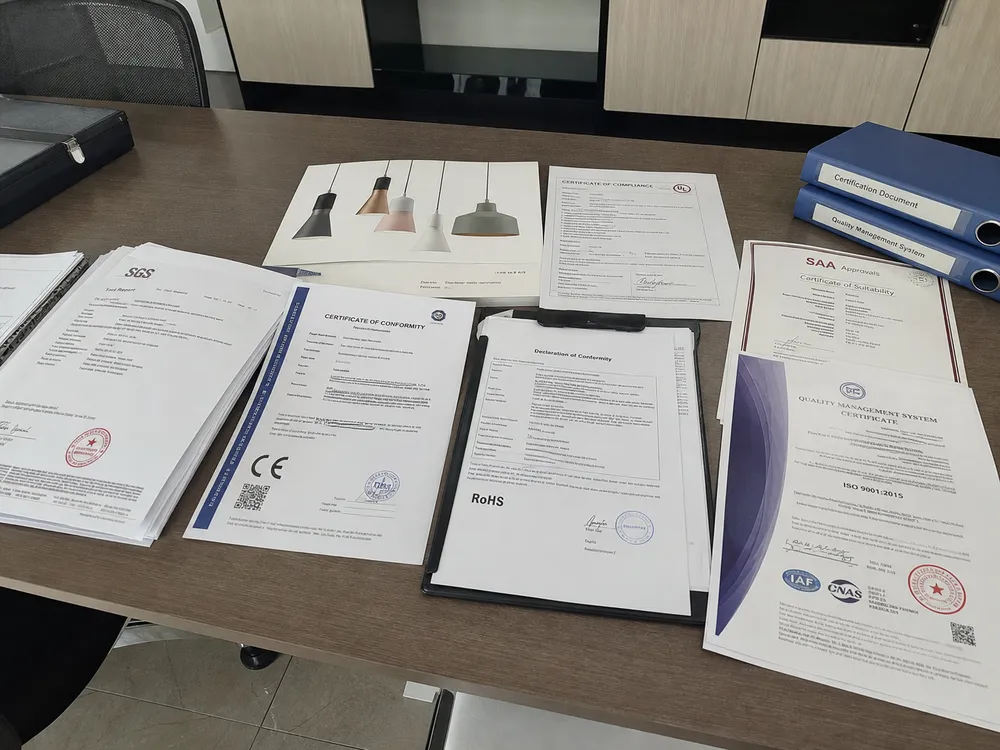
Modern pendant lighting from our facility carries CE, UL, SAA, and SGS certification — covering European, North American, and Australian market requirements. ISO 9001:2015 governs the quality management system. RoHS compliance is standard across the range.
For buyers importing into specific markets, we maintain test reports and Declaration of Conformity documentation per SKU. If your import team needs a specific documentation package for customs clearance or project sign-off, we provide it as part of the order documentation — not as a separate request after the container has loaded.
CE
European market compliance — covers electrical safety and EMC directives
UL
North American market — fixture and driver certified per SKU combination
SAA
Australian market approval — electrical safety standards compliance
SGS
Third-party testing and inspection — material and performance verification
A Note on UL Certification Specifically
UL certification for pendant lighting covers both the fixture and the driver. We don't use a single driver across all products — the driver is specified per SKU based on wattage and dimming compatibility, and UL certification is maintained per driver-fixture combination.
When you're importing UL-listed pendant lighting into North America, the certification needs to cover the specific driver installed in the fixture, not just the housing. We can provide the UL file number and test report for the specific SKU you're ordering.
Driver Specification
Per SKU based on wattage and dimming compatibility
Certification Scope
Covers specific driver-fixture combination, not housing alone
Documentation
UL file number and test report provided per ordered SKU
ISO 9001:2015
Quality management system governing all production processes
RoHS Compliant
Standard across the entire modern pendant lighting range
Selecting Between Modern Pendant Lighting and Sibling Products
Modern pendant lighting is the right choice when clean geometry and broad market applicability are the priority. Here's how it positions against the closest alternatives in our pendant range.
Modern vs. Glass Pendant Lighting
Glass pendants carry higher retail margins — the material cost is visible to the end buyer and supports premium pricing. Modern metal pendants have lower unit cost, higher container loading efficiency, and broader market applicability.
Decision logic: If your target market is mid-to-high-end residential or hospitality, glass pendants are worth adding to the catalog alongside modern metal designs. If you're building a volume catalog for a price-sensitive market, modern metal pendants are the anchor.
Modern vs. Industrial Pendant Lighting
Industrial pendants share the metal construction but use exposed hardware, cage configurations, and raw or matte finishes that read as deliberately rough. Modern pendants use concealed hardware and refined finishes that read as intentional minimalism.
Decision logic: The markets overlap in restaurant and bar fit-outs, but modern pendants have broader residential applicability. If your buyers are specifying for both residential and commercial projects, modern pendant designs cover more of the brief.
Modern vs. Cylinder Pendant Lighting
Cylinder pendants are a subset of the modern pendant category — the cylindrical form factor is the most versatile and highest-volume design within modern pendant lighting.
Decision logic: If you're building a focused catalog entry rather than a broad modern pendant range, cylinder pendants are the logical starting point.
Modern vs. Gold Pendant Lighting
Gold pendant lighting is a finish-defined category — the same geometric forms as modern pendant lighting, but in brushed gold, antique brass, and champagne gold finishes.
Decision logic: If your target market has strong demand for warm metallic finishes (Middle East, luxury residential globally), gold pendant lighting is a distinct catalog segment. Modern pendant lighting in matte black and brushed nickel covers the cooler-tone segment.
Quick Positioning Summary
Volume anchor: Modern metal pendants for price-sensitive markets
Premium margin: Glass pendants alongside modern metal
Focused entry: Cylinder pendants as starting point
Warm finishes: Gold pendants for Middle East and luxury
Frequently Asked Questions
What is the MOQ for modern pendant lighting, and how does it change for custom finishes?
Standard catalog items have lower MOQ requirements than custom finish or OEM orders. For custom powder coat colors, the minimum run is set by the powder line changeover cost — below a certain volume, it doesn't make commercial sense for either side. For PVD custom tones, the minimum is higher due to the setup process. Contact us with your target SKU, finish, and volume, and we'll confirm the exact MOQ and whether it's achievable for your program.
What dimming standard should I specify for modern pendant lighting going into North American residential projects?
TRIAC dimming is the standard for North American residential and works with the majority of existing dimmer infrastructure (Lutron, Leviton, and most universal dimmers). For commercial and hospitality projects with centralized lighting control, specify 0-10V. For high-end commercial projects with building management system integration, specify DALI. We specify the driver per SKU based on your target market — tell us the application and destination market when you request a quote, and we'll configure the driver correctly. A driver mismatch at installation is an avoidable problem if it's specified correctly at the order stage.
How do I verify that the finish color will be consistent across a 200-unit order?
Request a production sample before committing to the full order. We ship production samples — not pre-production mock-ups — so the sample reflects the actual automated powder coat or PVD process. For color-critical orders, we can provide a color reference chip from the production batch before the full run ships. If the batch drifts outside the approved color tolerance, we flag it before packing, not after the container loads.
What is the lead time for modern pendant lighting, and how does OEM affect it?
Standard catalog items: 25–35 days from order confirmation.
OEM orders with existing tooling: same lead time.
OEM orders requiring new tooling: add 15–20 days for the tooling cycle before production starts.
Prototype turnaround for new OEM designs: 7–10 working days from approved drawings to physical sample.
We communicate lead time milestones proactively — if a production issue is going to affect your ship date, you hear about it before the container is supposed to load.
What IP rating do modern pendant lights need for restaurant and hospitality applications?
For standard dry interior environments — dining rooms, hotel guest rooms, corridors, offices — IP20 is sufficient and is our standard rating. For kitchen pendant lighting above cooking areas, or any application with steam or moisture exposure, specify IP44 minimum. We offer IP44 on selected modern pendant designs; confirm the IP requirement when requesting a quote so we can specify the correct design.
Common mistake: Specifying IP20 fixtures for open kitchen environments in restaurants — the steam exposure causes premature finish degradation and driver failure. IP44 is the right spec for that application.
Can modern pendant lighting be shipped ready for Amazon FBA or direct-to-consumer fulfillment?
Yes. For buyers operating e-commerce channels, we can configure packaging for FBA compliance — FNSKU labeling, poly-bag requirements, and carton dimension/weight limits for Amazon's receiving standards. Each fixture ships in an individual carton with foam-lined interior; the packaging is designed to survive the drop and compression forces of both ocean freight and last-mile delivery.
For white-label or blind drop-shipping programs, we can configure documentation and packaging to your brand spec. Confirm the fulfillment channel when you request a quote so we can configure the packaging correctly.
Get a Quote for Modern Pendant Lighting
Most buyers in this segment start with a 2–5 unit sample order to verify finish quality and fit with their existing catalog before committing to volume. We can ship samples within the standard lead time for the specific SKU.
If you're evaluating modern pendant lighting for a project spec, a new catalog segment, or an OEM program, send us the details below and we'll come back with a detailed quote and, where relevant, a recommendation on configuration based on what's working for our existing buyers in your region.
Include in your inquiry:
- The design or SKU you're interested in (or a reference image if you're starting from a concept)
- Your target market and certification requirements
- Your target volume and price point
- Finish, light source type, and dimming requirements
Contact Us Directly
[email protected]
Phone / WhatsApp
+86 134 2021 9307
Factory Address
No. 14 Beisan Rd, Gusan Ind. Zone, Guzhen, Zhongshan, Guangdong, China
Wholesale only. Strict MOQ applies.