

Wall Washer Lighting
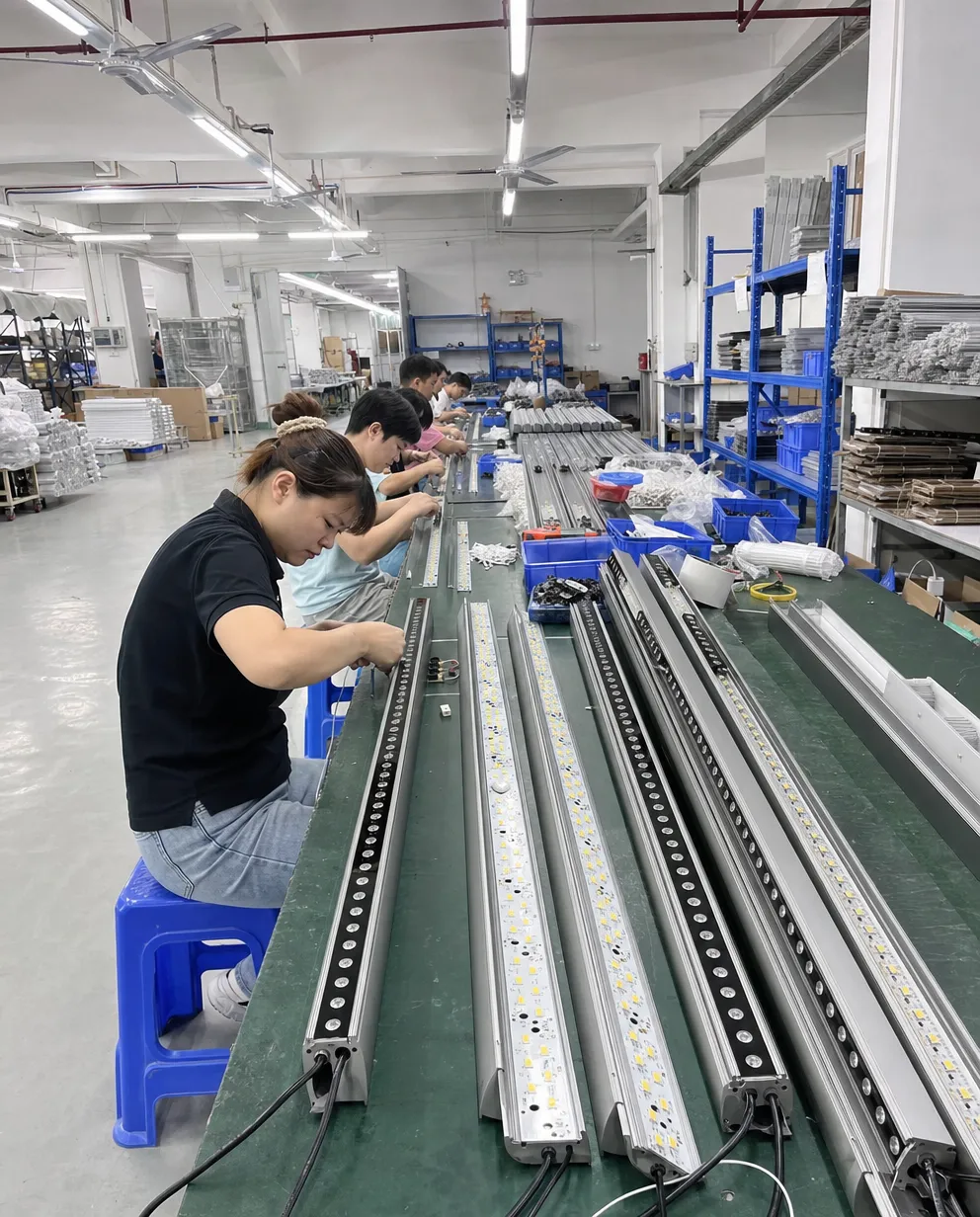
Asymmetric optics for even surface illumination from ceiling mount — no hot spots, no falloff edges. Linear formats in 300mm, 600mm, and 900mm.
Die-cast aluminum housing, in-house photometric verification, CE/UL/SAA certified. OEM/ODM with 7–10 day prototype turnaround.
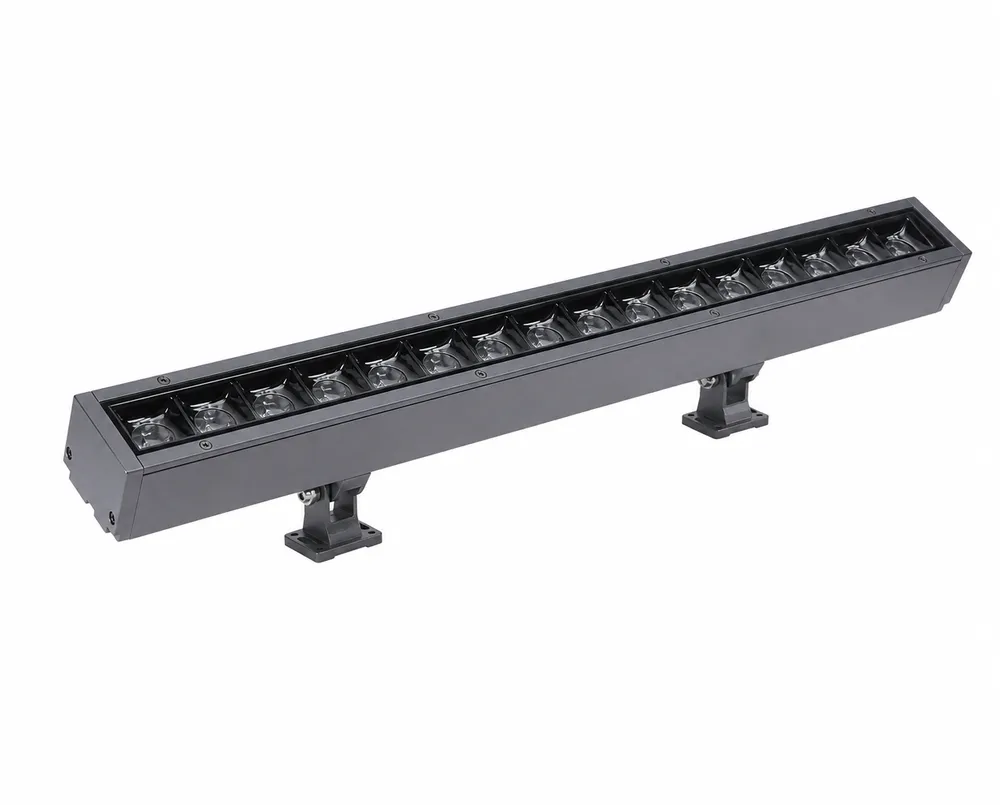
What Makes Wall Washer Lighting Different from a Spotlight Aimed at a Wall
This distinction matters commercially because buyers who don't understand it end up with the wrong product — and the warranty claim lands on you.
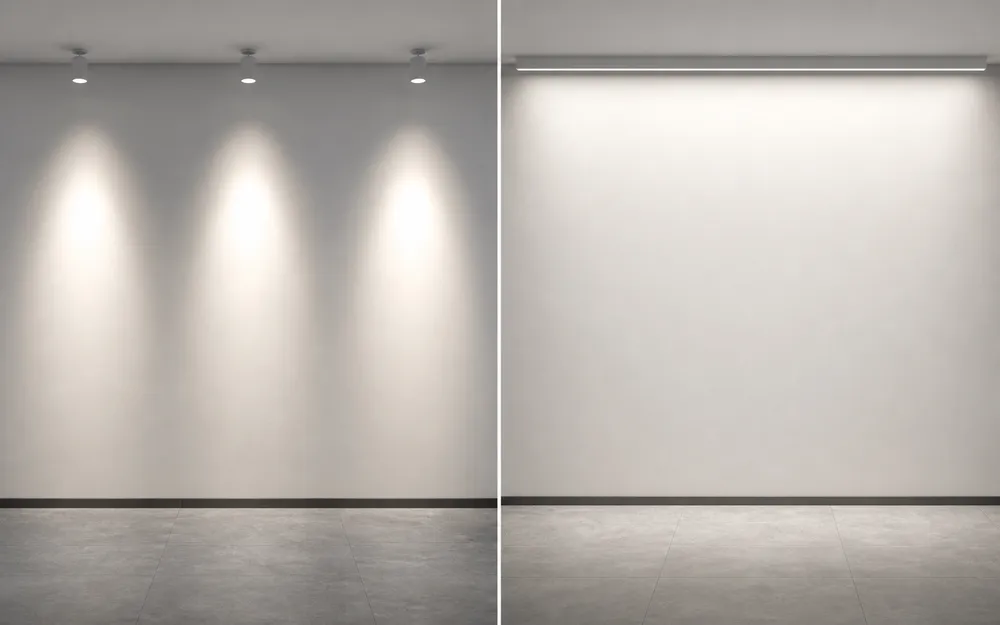
A standard spotlight aimed at a wall produces a circular pool of light with a bright center and rapid falloff toward the edges. Aim three of them at a feature wall and you get three overlapping circles with hot spots at each center and dark bands between them. That's not a wall wash — that's accent lighting pointed the wrong direction.
Wall washer lighting uses an asymmetric reflector or lens system specifically designed to throw light across a vertical surface from a ceiling-mounted position. The optical geometry redirects the beam so that light intensity is distributed evenly from the top of the wall to the bottom, and from one fixture to the next along a run. The result is a smooth, even luminous surface — the wall glows rather than being spotted.
Linear vs. Compact Formats
We manufacture both linear wall washers (300mm, 600mm, 900mm formats) and compact single-point wall washers. The linear format is the architectural standard for feature walls, textured stone, and large-format artwork. The compact format suits tighter installations — a single artwork panel, a niche, or a column face — where a 300mm linear unit would overshoot the target surface.
Linear Wall Washer
300mm / 600mm / 900mm. Architectural standard for feature walls, textured stone, large-format artwork. Primary SKU for hospitality projects.
Compact Wall Washer
Single-point, compact housing. Suits single artwork panels, niches, column faces — detail applications where a linear unit would overshoot.
Buyer note: Most buyers in the hospitality segment start with the 600mm linear as their primary SKU and add the compact for the detail applications. That combination covers about 80% of the wall washing scenarios we see in hotel and restaurant projects.
Technical Specifications
Exact values for this product line. Specifications are industry-standard for architectural wall washer lighting — contact us for detailed product data sheets and confirmation of exact parameters for your specific configuration.
| Parameter | Linear Wall Washer | Compact Wall Washer |
|---|---|---|
| Format | 300mm / 600mm / 900mm | Single-point, compact housing |
| Wattage | 10W / 20W / 30W | 7W – 15W |
| Beam Distribution | Asymmetric, wall-wash optic | Asymmetric, wall-wash optic |
| Horizontal Spread | 60°–90° (along wall length) | 40°–60° |
| Vertical Throw | Optimized for 2.5–4m ceiling height | Optimized for 2.5–3.5m ceiling height |
| Color Temperature | 2700K / 3000K / 4000K | 2700K / 3000K / 4000K |
| CRI | 90+ standard | 90+ standard |
| Input Voltage | 100–240V AC (universal) | 100–240V AC (universal) |
| Driver Type | Constant current, dimmable | Constant current, dimmable |
| Dimming | TRIAC, 0-10V; DALI 2.0 available | TRIAC, 0-10V |
| Housing Material | Die-cast aluminum | Die-cast aluminum |
| Surface Finishes | Matte white, matte black, brushed gold, brushed nickel, custom RAL | Matte white, matte black, brushed gold, brushed nickel, custom RAL |
| IP Rating | IP20 standard / IP44 available | IP20 standard / IP44 available |
| Certifications | CE, UL, SAA, SGS | CE, UL, SAA, SGS |
| Lifespan (LED) | L70 ≥ 50,000 hours | L70 ≥ 50,000 hours |
| Mounting | Recessed ceiling / surface mount | Recessed ceiling / surface mount |
Specifications shown are industry-standard values for this product type. Actual specifications may vary by configuration. Contact us for detailed product data sheets.
The Asymmetric Optic: What We Actually Build and Why It Matters for Your Orders
The optical performance of a wall washer is entirely determined by the reflector or lens geometry. Get this wrong and you have a spotlight with a wide beam — not a wall washer. We've seen both in the market, and the difference shows up immediately when the fixture is installed.
Our wall washer optic uses an asymmetric reflector profile that we design and verify in-house. The reflector geometry is calculated to produce a specific intensity distribution curve: high intensity at the near-wall edge of the beam, tapering gradually toward the far edge, with the horizontal spread calibrated to the fixture spacing and ceiling height.
For the 600mm linear format at a standard 3m ceiling height with 600mm fixture spacing, the result is a wall surface illuminated to within ±15% uniformity from top to bottom and from fixture to fixture along the run. That uniformity number is what a lighting designer is checking when they evaluate a wall washer specification.
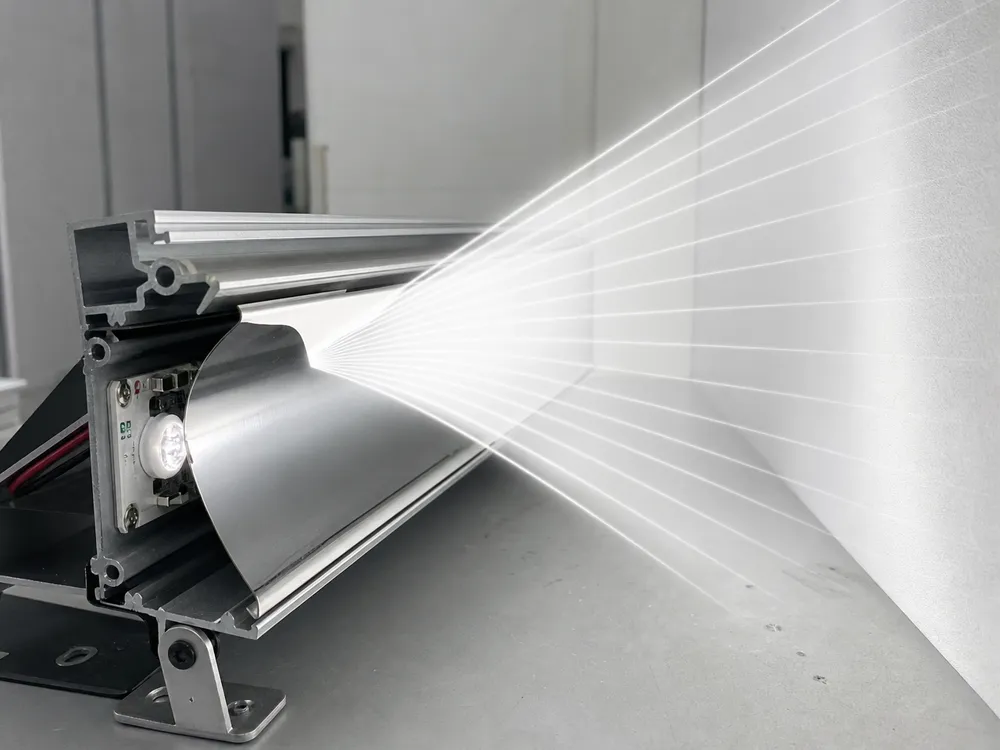
Optical Lab Verification
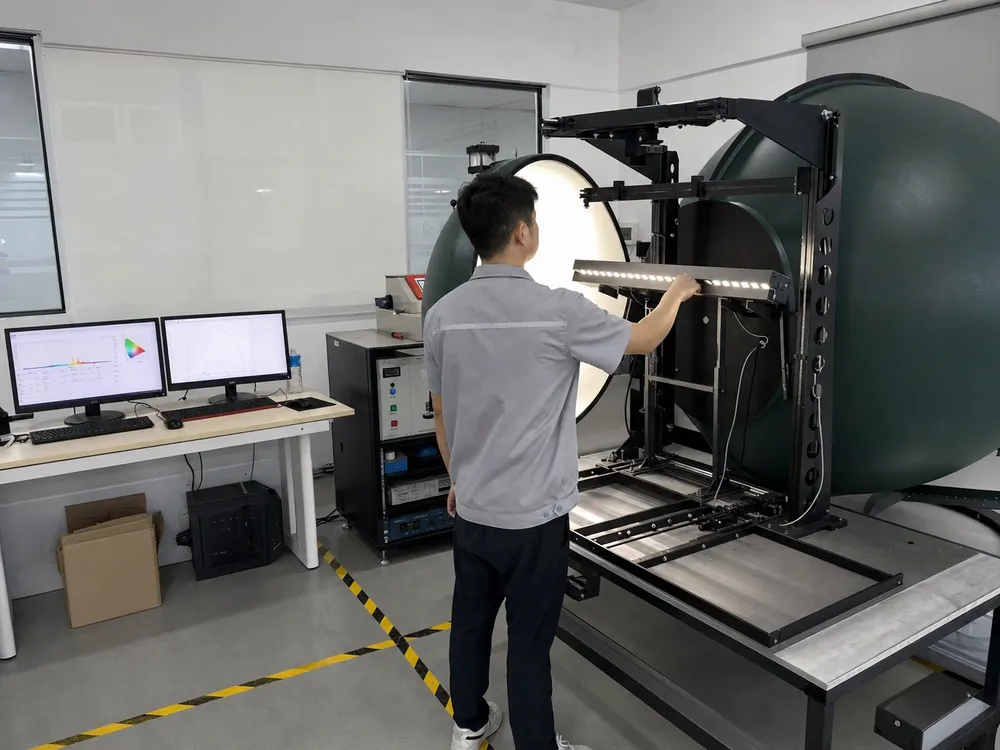
We verify this in our optical lab before any design goes into production. The photometric test generates the intensity distribution curve, the uniformity ratio, and the lumen output — and we generate an IES file from the actual measurement, not from a nominal spec.
For buyers supplying projects where the lighting designer needs to run a photometric simulation before approving the specification, the IES file is what makes that possible.
IES Files from Production Measurements
We've had buyers tell us that being able to provide IES files from actual production measurements — not manufacturer's nominal data — was the specific reason their lighting designer approved the spec over a competitor's product.
Photometric data generated from real production units, not theoretical calculations.
Machining Tolerance: ±0.1mm on LED Position
The reflector is housed in a die-cast aluminum body machined to ±0.1mm tolerance on the LED mounting position. That tolerance is what keeps the beam angle consistent across a production batch.
If the LED source position shifts 0.5mm relative to the reflector focal point, the intensity distribution changes — the uniformity ratio drops and the hot-spot-and-falloff pattern starts to appear. We control this at the machining stage, not by hoping the assembly is consistent.
±0.1mm
LED mounting position tolerance on die-cast aluminum body
0.5mm
Shift threshold where uniformity degrades visibly
Market Segments Where Wall Washer Lighting Generates Repeat Orders
Wall washing is a specification-driven purchase — it goes into projects where a lighting designer or architect has called it out by name. That means the buyer who can supply it with the right documentation and the right optical performance captures the project, and projects in these segments repeat.
Hospitality — Hotels & High-End Restaurants
Feature walls in hotel lobbies, textured stone in restaurant dining rooms, backlit bar facades — these are the highest-volume wall washing applications in the hospitality segment.
A 200-room hotel might specify wall washers in the lobby, corridors, restaurant, and bar, with quantities running 50–150 units per project.
Specification Requirements:
- Finish consistency — every fixture in the lobby must match
- Dimming compatibility — TRIAC or DALI for scene control
- Documentation for project compliance submission
Buyers supplying hospitality fit-out contractors who work on multiple hotel projects per year have a repeatable, high-value pipeline for this product.
Luxury Residential & Villa Projects
High-specification residential projects use wall washers on feature walls, artwork, and architectural details — stone cladding, textured plaster, timber paneling.
The buying pattern runs through interior designers and lighting consultants who specify by fixture type and finish, then hand procurement to a contractor or distributor. Order quantities per project are smaller (10–40 units typically), but the margin is higher and the designer relationship drives repeat business across multiple projects.
Key Specification:
CRI 90+ is the standard specification in this segment — color rendering on natural materials like stone and timber is visible, and designers notice when it's wrong.
Commercial Office & Co-Working — Branded Environments
Corporate headquarters, flagship offices, and co-working spaces with strong brand identities use wall washers on feature walls and branded surfaces. The specification here is often driven by a brand standards document — the lighting designer has specified the fixture type, and the contractor needs to source it.
This segment has grown for us over the last few years as companies invest in office environments that communicate brand identity.
The branded office segment orders in the 20–80 unit range per project and tends to repeat as companies expand or renovate. Worth paying attention to if you're building a product line for the commercial fit-out market.
Retail — Fashion, Jewelry & Luxury Goods
High-end retail uses wall washers to illuminate merchandise walls and brand imagery. The specification driver here is CRI — a jewelry retailer needs 90+ CRI minimum on the merchandise wall, and the premium for it is real.
Retail fit-out contractors who work with luxury brands are a high-value distribution channel for this product.
Gallery, Museum & Cultural Institutions
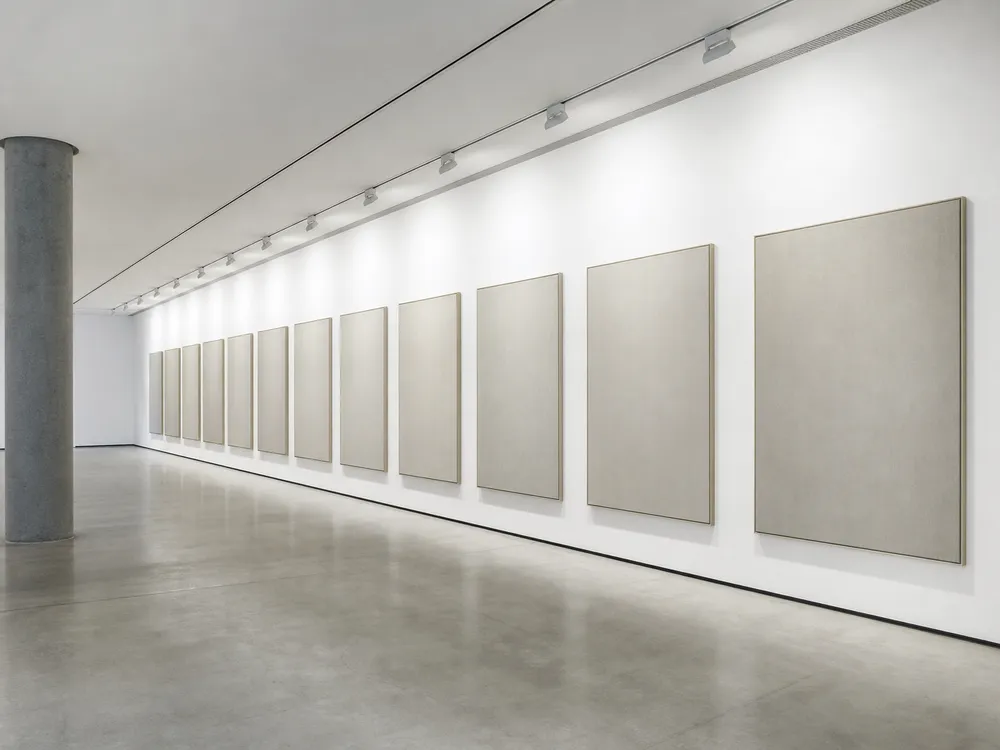
Wall washers for gallery spaces need tight uniformity control and, for light-sensitive works, UV-filtering options. This is a smaller volume segment but a high-specification one — the lighting designer knows exactly what they need and the documentation requirements are strict.
If you're supplying this segment, the IES files and photometric test reports we generate are part of what you're selling.
Customization: What We Can Engineer to Your Specification
Wall washer lighting is a product where customization requests are common — the fixture has to fit the ceiling construction, match the project's finish palette, and meet the target market's certification requirements. Here's what we can do and where the practical limits are.
Linear Length
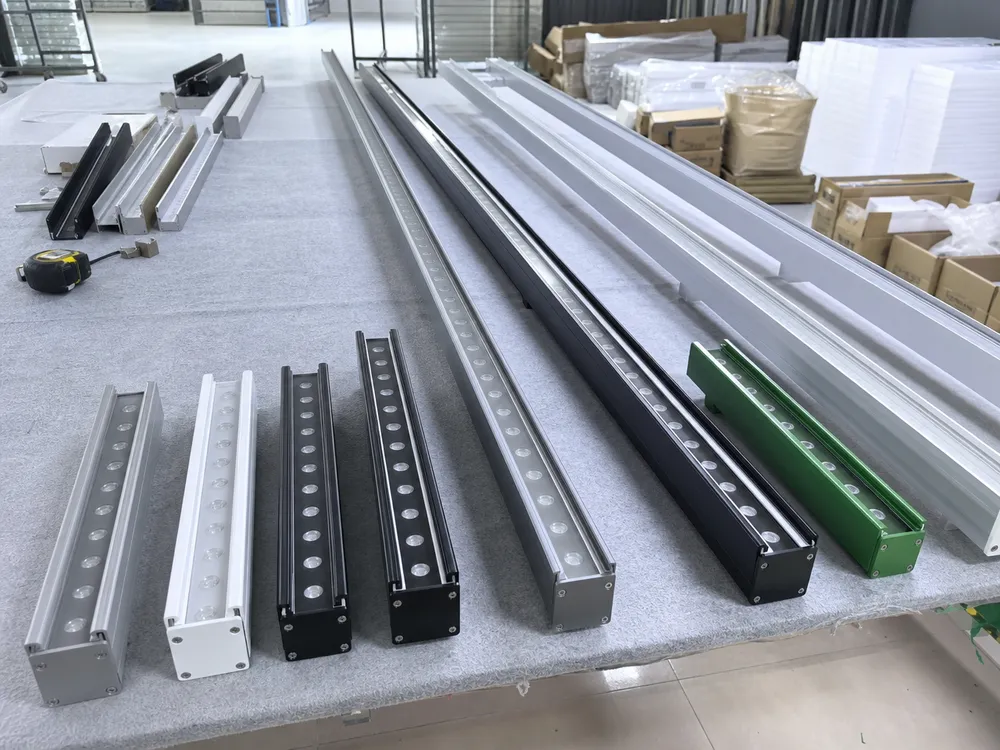
Standard formats are 300mm, 600mm, and 900mm. Custom lengths are available on runs over 200 units — the tooling cost for a non-standard extrusion profile is the constraint below that quantity.
If your project requires a specific length (say, 450mm to fit a ceiling module), flag it in your inquiry and we'll confirm the MOQ and tooling lead time.
Beam Distribution
The standard asymmetric optic is optimized for 2.5–4m ceiling height. For installations with higher ceilings — 5m or above, which comes up in hotel atriums and large retail spaces — we can adjust the reflector geometry to maintain wall uniformity at the greater throw distance.
This requires a new optical design and prototype verification, so it adds to the development timeline, but it's a standard engineering exercise for us.
Surface Finish
Standard palette covers matte white, matte black, brushed gold, and brushed nickel. Custom RAL colors are available on runs over 100 units — the powder line changeover cost below that quantity doesn't make sense for either side.
PVD finishes (brushed gold, brushed nickel, and custom metallic tones) are run in-house, which matters for color consistency on large hospitality orders.
Dimming Protocol
TRIAC and 0-10V are standard. DALI 2.0 is available on the linear format — relevant for hospitality and commercial projects with scene control systems.
Specify the dimming protocol when you inquire; the driver selection is made at the production stage and can't be changed after the order is placed.
Certification Scope
CE, UL, and SAA are held and maintained. If your target market requires a certification combination we don't currently hold for a specific configuration, we can discuss the testing scope and timeline.
For most standard configurations, the existing certifications cover the major export markets.
Private Label & Packaging
Custom carton branding, private label documentation, and blind drop-shipping are available.
Minimum quantities apply and vary by customization scope.
Quick Reference: MOQ Thresholds
Custom RAL colors
100+ units — powder line changeover cost threshold
Custom extrusion lengths
200+ units — tooling cost for non-standard profile
Custom optic design (high-ceiling)
New reflector geometry + prototype verification — adds development timeline
DALI 2.0 dimming
Available on linear format — specify at inquiry stage (cannot change post-order)
How We Control Finish Consistency Across Large Orders
Finish consistency is the failure mode that generates the most complaints on large wall washer orders — and it's worth explaining how we prevent it, because the mechanism isn't obvious.
The Problem
A 150-unit order for a hotel lobby where the matte black fixtures in the first delivery don't match the second delivery. The color difference is visible under the wall washing light, which is the worst possible context for a finish mismatch.
The contractor calls the distributor, the distributor calls the factory, and the resolution involves either a return or a touch-up — neither of which is cheap.
The Root Cause
The root cause is almost always in the surface finishing process. Powder coat color is sensitive to powder batch variation, oven temperature, and application thickness.
PVD color is sensitive to bath chemistry, deposition time, and substrate surface preparation. When these parameters drift between production runs, the color drifts with them.
Our Control Mechanism
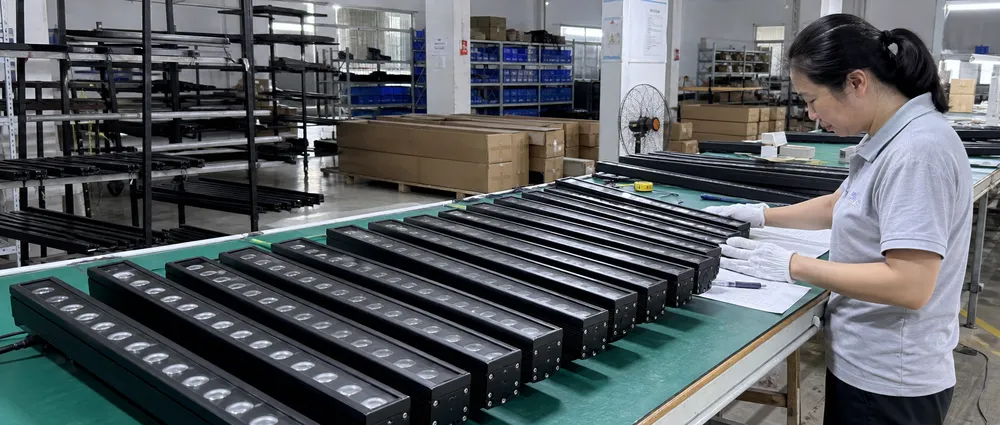
We run color verification on finishing samples before committing each production batch. For orders over 50 units, we pull a finishing sample from the start of the run and compare it against the approved color standard under standardized lighting conditions.
If it's outside tolerance, we adjust the process parameters before running the full batch.
For PVD finishes — brushed gold and brushed nickel are the most common on wall washer orders — we run the process in-house rather than outsourcing to a plating shop, which gives us direct control over the bath chemistry and deposition parameters.
We added the pre-batch color verification step after a brushed gold mismatch on a 200-unit hotel order early in our export history. The cost of that resolution was significant enough that the verification step has been standard practice ever since.
Sample Pull
Finishing sample from start of run
Color Compare
Against approved standard under standardized lighting
Tolerance Check
Pass/fail against color tolerance band
Adjust if Needed
Process parameters corrected before full batch
Full Run
Production batch committed only after verification
Certifications and Documentation for Your Target Market
CE, UL, and SAA certification covers the electrical safety and EMC compliance requirements for European, North American, and Australian markets. These are held and maintained — not one-time certifications that lapsed after the initial audit.
For wall washer lighting specifically, the documentation that matters most to buyers supplying project markets is the photometric package: IES files, photometric test reports, and uniformity data. Lighting designers running photometric simulations for project submissions need IES files that reflect the actual production fixture.
We generate these from our in-house optical lab measurements — the IES file is based on the measured intensity distribution of the production fixture, not a nominal spec.
Market-Specific Energy Efficiency Compliance
For buyers supplying markets with specific energy efficiency requirements — California Title 24, EU ErP Directive, Australian MEPS — we can confirm compliance status for specific configurations. Flag your target market's requirements when you inquire and we'll confirm which configurations are pre-qualified.
Certifications Held
Documentation Available Per SKU
Packaging and Container Loading for Wall Washer Orders
Linear wall washer fixtures are more vulnerable in transit than compact spotlights — the elongated housing profile and the recessed optic cavity are the two points where damage concentrates. We've engineered the packaging around these specific failure modes.
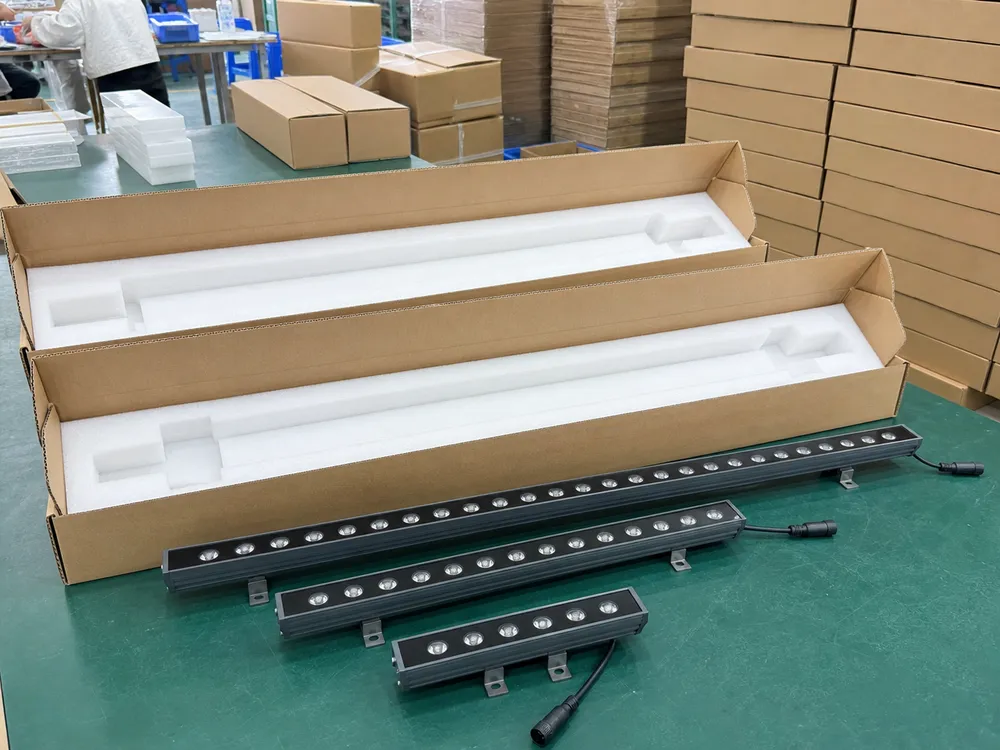
Each linear fixture ships in an individual inner carton with a die-cut foam insert that supports the housing at both ends and protects the optic cavity from compression. The foam profile is specific to each linear format — the 300mm, 600mm, and 900mm fixtures each have their own insert geometry, not a generic foam block. Outer cartons are double-wall corrugated, with carton dimensions optimized for 40HQ container loading.
Container Loading Reference (40HQ)
We provide exact CBM per carton and container loading calculations with the quotation — your logistics team can plan the container before the order is placed rather than discovering the loading efficiency after the fact.
Die-Cut Foam Inserts
Format-specific geometry for 300mm, 600mm, and 900mm fixtures — not generic foam blocks.
Double-Wall Corrugated
Outer cartons engineered for stacking strength and optimized for 40HQ container dimensions.
Dual-Point Support
Housing supported at both ends; optic cavity protected from compression during transit.
Pre-Quote CBM Data
Exact cubic meter per carton and container loading calculations provided with every quotation.
Retail-Ready Inner Packaging
For buyers supplying e-commerce channels or distributors who forward-ship to end customers, we can configure retail-ready inner packaging with product photography, specification cards, and installation instructions. This is a standard service for buyers building a branded product line.
Sibling Products in the Spotlight & Track Range
Wall washer lighting is one of seven product lines in our spotlight and track range. If your sourcing requirement extends beyond wall washing, the related lines below are designed to integrate seamlessly with wall washer orders.
Gallery Spotlights
Tight-beam 8°–24° spotlights with CRI 95+ and UV-filtering options, for art, museum, and luxury retail display.
If your project includes both wall washing and artwork accent lighting, these two lines are designed to work together.
Adjustable Spotlights
Gimbal-mounted accent spotlights for retail display and hospitality accent lighting where the target changes over time.
Track Lighting
If your buyer's project uses a track infrastructure, wall washer heads are available in track-mount configuration alongside the standard recessed and surface-mount options.
LED Spotlights
5W–35W accent and task spotlights, CRI 90+, for general accent lighting applications alongside wall washing in the same project.
Consolidate Sourcing, Simplify Logistics
Consolidating wall washer and spotlight sourcing with one factory simplifies documentation, finish matching, and logistics. A hotel project that specifies wall washers in the lobby and spotlights in the restaurant can source both from the same order, with matched finishes verified against the same color standard.
Frequently Asked Questions
What ceiling height is wall washer lighting designed for, and what happens if my project has higher ceilings?
The standard asymmetric optic on our linear wall washers is optimized for 2.5–4m ceiling height — the most common range in hospitality, retail, and residential applications. At this height range, the 600mm linear unit at 600mm fixture spacing produces wall uniformity within ±15% from top to bottom.
For ceiling heights above 4m — hotel atriums, large retail spaces, cultural institutions — the standard optic produces a narrower illuminated band on the wall because the throw distance changes the geometry. We can adjust the reflector profile for higher ceiling applications; this requires a prototype verification cycle but is a standard engineering exercise.
Flag your ceiling height when you inquire and we'll confirm whether the standard optic applies or whether a custom optical design is needed.
Linear wall washer vs. compact wall washer: which configuration should I specify?
The linear format (300mm, 600mm, 900mm) is the standard for continuous wall washing — feature walls, textured stone runs, large-format artwork, and corridor walls where you need even illumination across a long surface.
The compact format suits discrete applications: a single artwork panel, a niche, a column face, or any situation where the illuminated surface width is less than about 600mm.
Practical Selection Rule
- If the surface you're washing is wider than 1.2m, use linear units spaced at 600mm intervals.
- If it's narrower than 1.2m, the compact unit gives you better control without the overspill of a linear fixture.
Most hospitality projects use both — linear for the main feature walls, compact for the detail applications.
What uniformity ratio should I specify for a wall washer, and how do you verify it?
For architectural wall washing in hospitality and commercial applications, a uniformity ratio of 1:3 (minimum to maximum illuminance on the wall surface) is the standard specification — meaning the darkest point on the wall is no less than one-third the brightness of the brightest point.
High-end gallery and museum applications typically specify 1:2 or better.
We verify uniformity in our optical lab using photometric measurement of the actual production fixture, and we generate an IES file from the measurement. If you need to run a photometric simulation for a project submission, the IES file is what your lighting designer needs. We can provide the uniformity data for specific fixture configurations on request.
What dimming protocol do I need for a hospitality wall washer installation?
For hospitality projects with scene control systems — hotel lobbies, restaurant dining rooms, bar areas — DALI 2.0 is the standard specification if the project uses a building management system or a dedicated lighting control system. DALI allows individual fixture addressability and scene programming, which is what hospitality operators need to set different lighting scenes for different times of day.
If the project uses a simpler dimmer switch rather than a control system, TRIAC dimming is sufficient and more cost-effective.
The driver selection is made at the production stage, so specify the dimming protocol when you place the order. If you're unsure which protocol your buyer's project requires, send us the control system specification and we'll confirm the right driver.
BMS or dedicated lighting control system. Individual addressability, scene programming, time-of-day scheduling.
Simple dimmer switch installations. Cost-effective for projects without a central control system.
What is the MOQ for wall washer lighting, and can I mix linear formats in one order?
MOQ for standard catalog configurations varies by format and finish. Standard catalog items carry lower MOQs than custom configurations. Mixing linear formats (300mm, 600mm, 900mm) within a single order is possible — we can combine formats in one container.
Custom lengths, custom finishes outside the standard palette, and custom optical designs carry higher MOQs due to tooling and process setup costs.
Next step: Send us your SKU list and target quantities and we'll confirm the MOQ structure for your specific configuration.
Do your wall washers comply with energy efficiency regulations in North America and Europe?
CE certification covers EU electrical safety and EMC requirements. For energy efficiency specifically — EU ErP Directive, California Title 24, or Australian MEPS — compliance depends on the specific wattage and efficacy of the configuration.
Most of our standard configurations meet these requirements, but the specific compliance status varies by SKU.
Action: Flag your target market's energy efficiency requirements when you inquire and we'll confirm which configurations are pre-qualified and provide the relevant documentation.
Start a Sourcing Conversation
Wall washer lighting is a specification-driven product — the right configuration depends on ceiling height, surface dimensions, finish requirements, and the dimming protocol your buyer's project specifies. The most useful next step is a direct conversation about your specific requirement.
Send us your project details — ceiling height, wall dimensions, target finish, dimming protocol, target market, and volume — and we'll come back with a configuration recommendation, a detailed quote, and the photometric data your lighting designer needs to approve the specification.
No. 14 Beisan Rd, Gusan Ind. Zone, Guzhen, Zhongshan, Guangdong, China
Wholesale only. Strict MOQ applies.
© 2026 ASCLighting. All rights reserved.