

Wooden Wall Lighting Built for Buyers
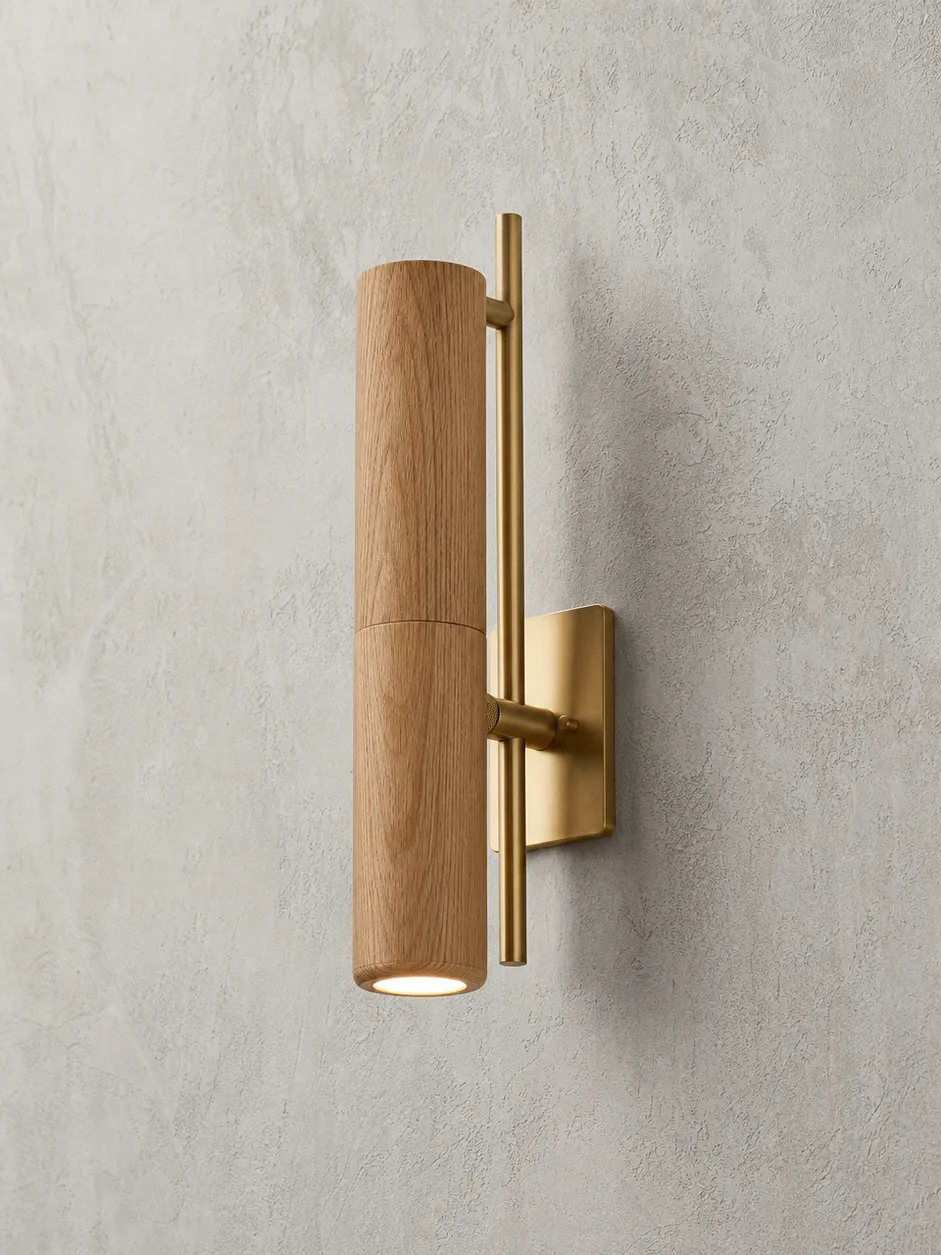
Natural wood wall lighting built for buyers whose markets demand organic material texture — hardwood-and-metal sconces manufactured to consistent dimensions, batch after batch.
Kiln-dried oak, walnut, and ash machined in-house, paired with die-cast metal hardware and integrated LED sources. CE, UL, and SAA certified for North American, European, and Australian market entry.
18+
Years Mfg.
In-House
Wood Machining
CE UL SAA
Certified
200+
MOQ Units
What Makes Wooden Wall Lighting a Different Manufacturing Problem
Wooden wall lighting sits at the intersection of two material categories that behave very differently in production — and that's where most quality problems originate. Metal components are predictable: cast them, machine them, finish them, and they hold their dimensions. Wood is not predictable. It moves with humidity, it responds to temperature, and if you don't control moisture content from the moment the material arrives, you'll see warping, cracking, and finish adhesion failures in the field — sometimes months after the fixture shipped.
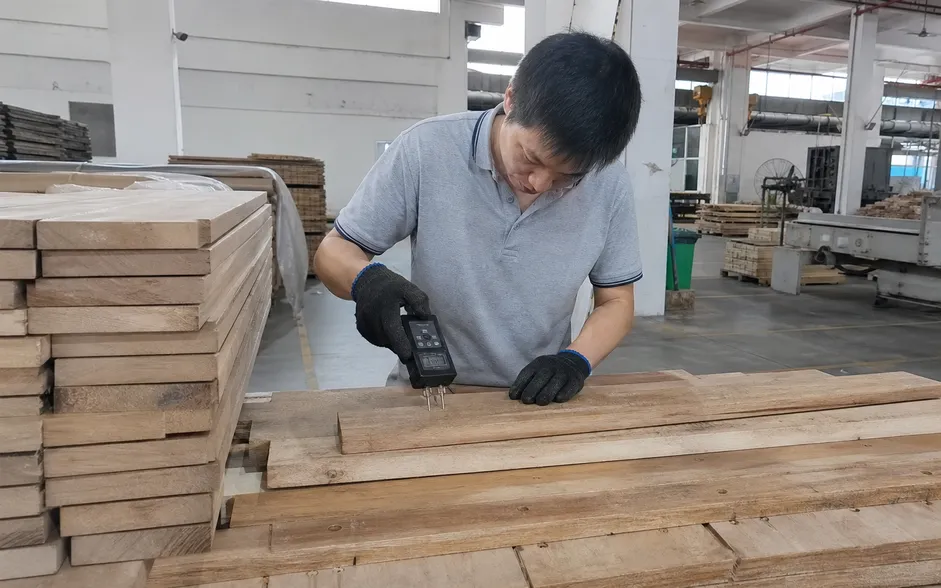
We've been manufacturing wood-element lighting long enough to know that the wood handling protocol matters more than the wood species selection. Our incoming material spec requires kiln-dried hardwood at 8–12% moisture content, verified on arrival with a pin-type moisture meter before the material enters the production floor.
We tightened this to a documented incoming inspection step after a batch of walnut components developed hairline surface cracks in transit to a European buyer — the material had been stored in a humid warehouse before it reached us, and the moisture content was running at 16%. That batch never shipped, but it was an expensive lesson about where the risk sits. Material that doesn't meet the moisture spec goes back to the supplier, not into production.
The Commercial Implication
Wood-element fixtures that crack or warp in the field generate warranty claims and damage your relationship with your downstream customers. Our moisture control protocol is the upstream step that prevents that outcome. It's not visible in a catalog photo, but it's the difference between a product line that runs cleanly and one that generates a steady stream of RMAs.
Material Arrival
Kiln-dried hardwood received and logged. Supplier documentation checked against purchase order specs.
Moisture Verification
Pin-type moisture meter reading at 8–12% MC required. Documented inspection step — no exceptions.
Accept or Reject
Material above 12% MC goes back to the supplier. No rework, no conditioning on-site — it doesn't enter production.
Production Floor
Approved material enters CNC machining. Controlled environment maintains stable humidity throughout processing.
Product Specifications
These are the standard parameters for our wooden wall lighting range. Exact values vary by SKU — contact us for the specific data sheet on any configuration.
Wood & Material
Electrical & LED
Dimensions & Compliance
Specifications shown are standard values for this product line. Actual specifications may vary by SKU. Contact us for detailed product data sheets and confirmation of exact parameters.
Request Spec SheetWood Species and Finish: What Moves in Which Markets
Species selection and finish treatment are the two decisions that most directly affect how your wooden wall lighting sells into different market segments. We've shipped this product line to buyers in Europe, North America, the Middle East, and Southeast Asia, and the preferences vary enough that it's worth understanding before you spec your order.
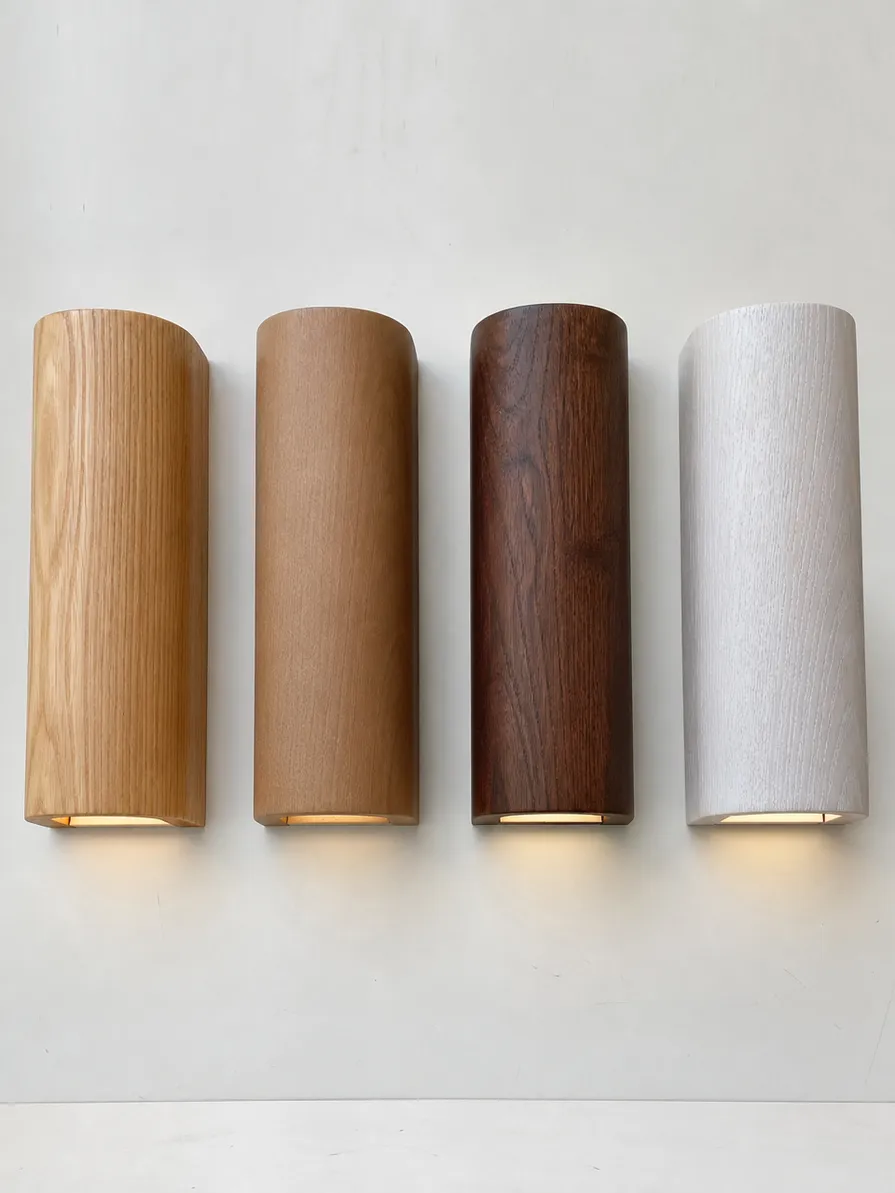
Oak
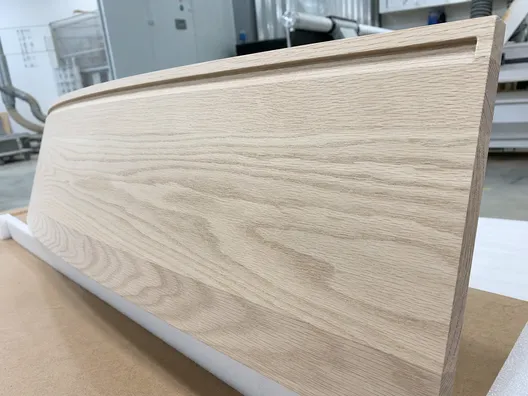
Highest VolumeThe highest-volume species we run. The grain is consistent and machines cleanly, which means dimensional tolerances are easier to hold than with more open-grained species. Oak takes stain evenly, so if your market wants a darker tone, the result is predictable across a batch.
Best for: Scandinavian-influenced markets — Northern Europe, parts of North America. Natural-finish oak is the dominant preference. The light, warm tone reads as contemporary and pairs well with matte black or brushed gold metal hardware.
Walnut
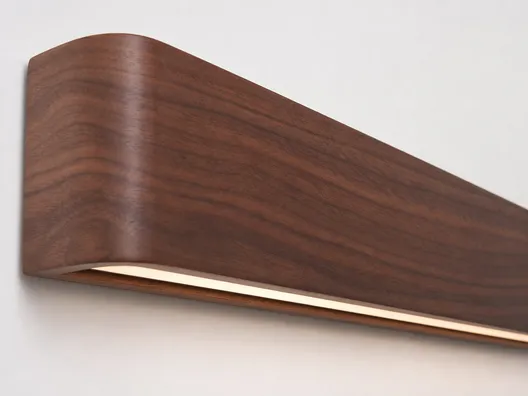
Premium OptionThe natural color is rich and the grain figure is more distinctive than oak, which gives the fixture a higher perceived value at retail. Walnut commands a price premium in most markets, and buyers who stock it typically position it at the top of their wall lighting range.
Trade-off: More expensive as raw material and the grain variation means more sorting at the machining stage — we select for consistent grain direction on visible faces to avoid a batch where some units look dramatically different from others.
This is one of the areas where buying from a factory that does its own wood machining matters — a factory sourcing pre-cut wood components from a third party has no control over grain selection.
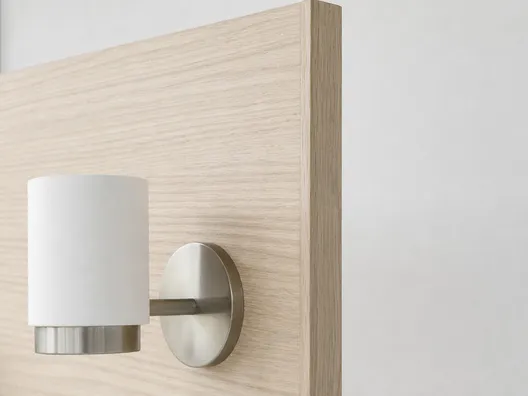
Ash
Mid-RangeSits between oak and walnut in both price and visual character. The grain is tight and the natural color is pale, which makes it a good base for whitewash and light stain finishes.
Best for: Buyers targeting the Japandi aesthetic — the combination of pale wood and minimal metal hardware is the look that segment is buying.
Finish Treatment: Aesthetics and Durability
Wood finish treatment affects both aesthetics and durability. The choice depends on your end application and how the fixture will be handled in service.
Natural Oil Finish
Preserves the wood's tactile quality and is the most authentic-feeling option. Requires the end user to understand that the wood will develop a patina over time.
Matte Lacquer
Seals the surface and is more resistant to handling marks and humidity variation — better for hospitality applications where the fixture will be touched and cleaned regularly.
Dark Stain & Whitewash
Aesthetic choices that expand the style range without changing the underlying species. Useful for matching specific interior palettes or broadening SKU variety.
Market Segments Where Wooden Wall Lighting Generates Repeat Orders
The organic materials trend in interior design has been running for several years now, and it's not a single market — it shows up differently across segments, with different volume patterns and margin profiles.
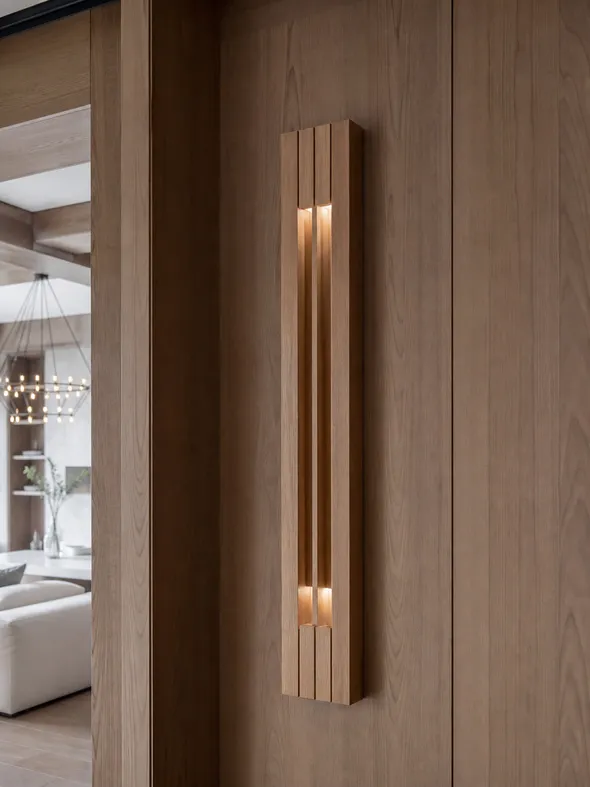
Boutique Hospitality
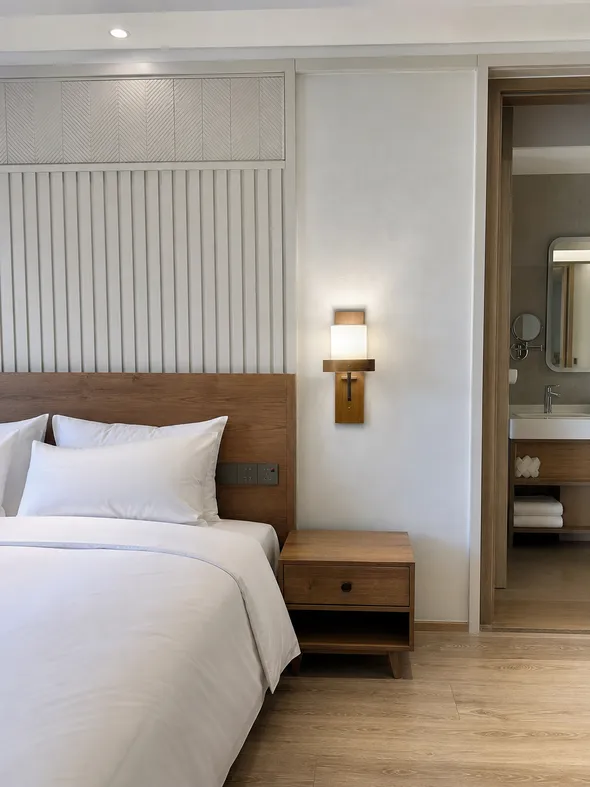
Largest single-project volumesThis is the segment where we see the largest single-project volumes for wooden wall lighting. Boutique hotels, eco-resorts, and design-led serviced apartments specify wood-element fixtures as part of a deliberate material palette — the brief typically calls for natural materials throughout, and the wall lighting is part of that specification.
A 60-room boutique property might specify 3–4 wood sconces per room plus public area fixtures, putting a single project in the 200–300 unit range.
What matters to this buyer: Visual consistency across the batch — they're installing the same fixture in 60 rooms and any visible variation between units is a problem. Our grain selection process and documented color temperature tolerance of ±100K are the specs that matter for this buyer.
Residential Distribution — Scandinavian-Influenced Markets
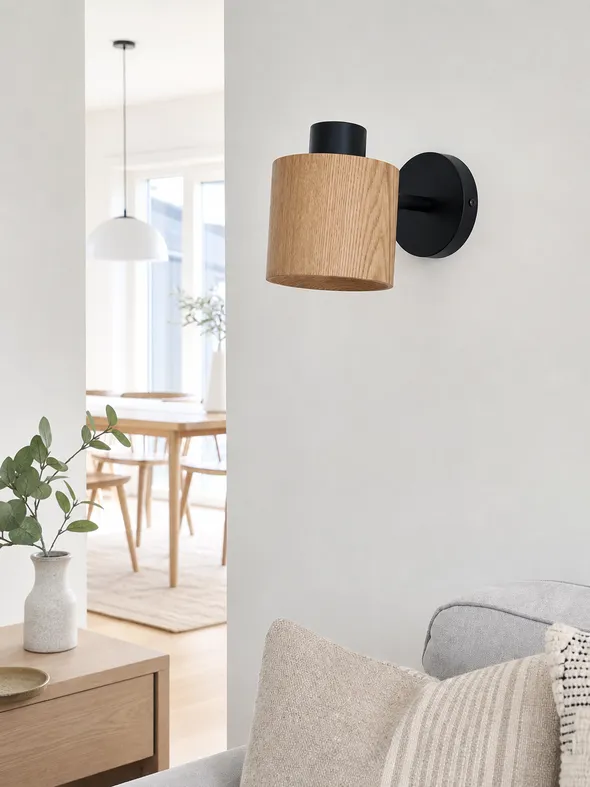
Highest-volume ongoing segmentDistributors in Northern Europe, Canada, and parts of the US Pacific Northwest carry wooden wall lighting as a core catalog item, not a seasonal addition. The demand is consistent and the reorder pattern is predictable — buyers in this segment typically place 2–3 orders per year once they've validated the product with their customers.
Top configuration: Natural oak with matte black hardware is the configuration that moves fastest in this segment. We can advise on the specific finish combinations that are performing for our existing buyers in your region.
High-End Residential & Villa Projects
Custom dimensions & OEM workInterior designers and project contractors specifying for luxury residential builds — a segment where custom dimensions and species selection are common requirements. These buyers often want a fixture adapted to their project's specific material palette: a custom wood species, a specific stain color matched to the project's millwork, or a modified fixture dimension to suit a particular wall configuration.
Key capability: Our 7–10 working day prototype turnaround is what makes this segment accessible — a designer can get a physical sample in hand before committing to a production run.
E-Commerce & Catalog Retail
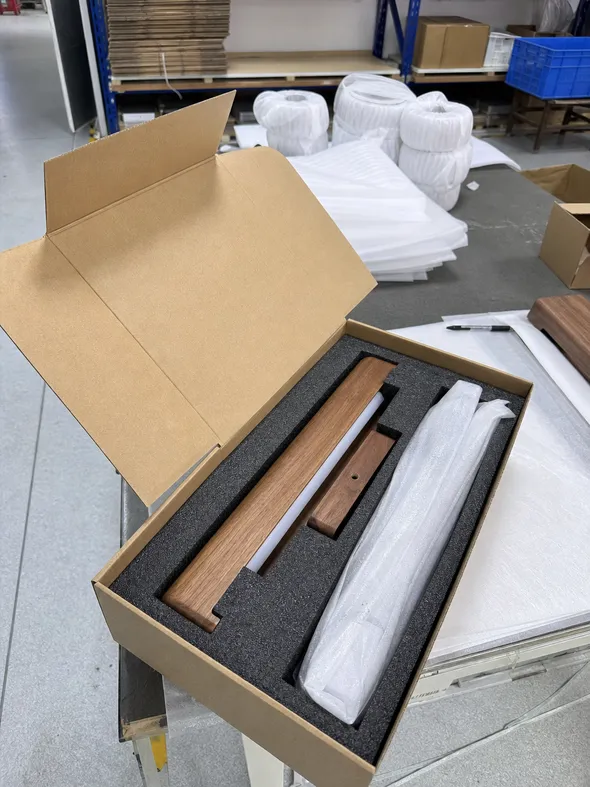
Packaging & SKU consistency criticalImporters supplying Amazon, Wayfair, or their own online stores — a segment where packaging durability and SKU consistency matter as much as the fixture itself. Wood-element fixtures are more vulnerable to transit damage than all-metal sconces because the wood component can crack if the packaging doesn't isolate it from impact.
We engineer the inner carton for each SKU with foam inserts cut to the wood component profile, and we've tracked damage rates by route to refine the spec.
Growth note: This segment has grown significantly for us in the last two years — worth paying attention to if you're building a product line for online retail.
How We Machine Wood Components In-House
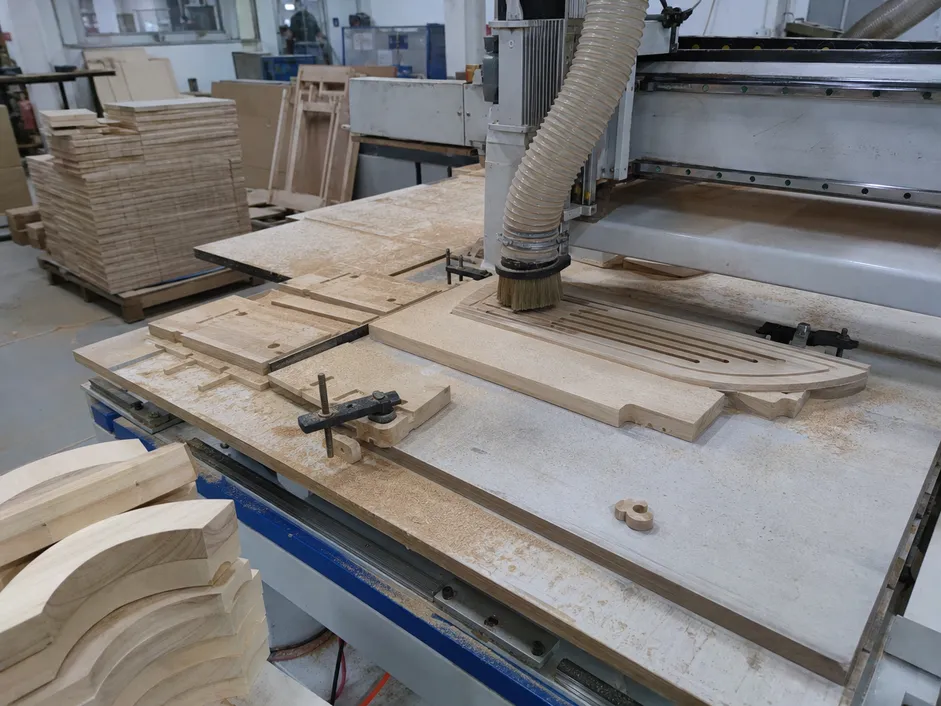
Most decorative lighting factories in Guzhen source pre-cut wood components from specialist wood suppliers and assemble them onto metal hardware. We machine our own wood components on-site, and the difference shows up in dimensional consistency and finish quality.
The machining process starts with kiln-dried blanks cut to rough dimensions, then run through CNC routing to final profile. CNC tolerances on wood components hold to ±0.3mm — tighter than hand-routing but accounting for the natural variation in wood density that affects cutting behavior.
The critical dimension is the joint between the wood component and the metal hardware: if that interface isn't machined to consistent dimensions, the assembly will show gaps or require force-fitting, both of which are visible defects on a finished fixture. We machine the metal hardware interface on the same CNC run as the wood profile, so the two components are dimensionally matched before assembly.
Surface Preparation and Finishing Process
Surface preparation before finishing is where most wood finish failures originate. We sand to 180-grit before applying any finish treatment, which removes machining marks and opens the grain for even finish penetration.
Oil-Finished Components
Two coats applied with a light sand between coats — the second coat is what gives the surface its depth. This two-pass process builds the tactile warmth and visual richness that distinguishes oil-finished wood from single-coat treatments.
Lacquered Components
A sealer coat is applied before the topcoat to prevent the wood from absorbing the lacquer unevenly, which would show as blotchy color variation across the surface. The sealer step adds time to the production process, but it's the step that prevents the finish inconsistency complaints we used to see before we added it.

Post-Finish Dimensional Verification
After finishing, wood components go through a dimensional check before assembly — we're verifying that the finishing process hasn't introduced any warping or dimensional change. Wood can move slightly during the finishing process if the finish is applied unevenly or if the component is exposed to humidity variation in the finishing area.
Controlled Finishing Environment
We control the finishing environment to 45–55% relative humidity, which is the range where wood is dimensionally stable during processing.
Customization Options and OEM Parameters
Wooden wall lighting is one of the product lines where OEM requests are most common, because the material combination — specific wood species, specific stain color, specific metal finish — is often part of a buyer's brand identity or a project's material specification.
Standard Customization Options
Available on runs of 200 units and above
| Parameter | Options |
|---|---|
| Wood Species | Oak, walnut, ash standard; teak, beech, and other species on request with longer lead time for material sourcing |
| Wood Finish | Natural oil, matte lacquer, dark stain, whitewash, custom stain color matched to RAL or Pantone reference |
| Metal Finish | Matte black, brushed gold, antique brass, brushed nickel, custom PVD color |
| Color Temperature | 2700K, 3000K, 4000K |
| CRI | ≥80 standard; ≥90 on request |
| Dimming | TRIAC standard; DALI on request |
| Branding | Logo on backplate, custom packaging, private label carton |
Dimension Customization
Available on OEM runs with new tooling. If your project requires a specific fixture projection, backplate size, or wood component dimension that isn't in the standard range, we develop the tooling from your drawings. Tooling cost and lead time depend on the complexity of the geometry — we quote both before you commit.
Wood Species Sourcing
Oak, walnut, and ash are stocked materials with short lead times. Less common species require sourcing lead time of 2–4 weeks before production can start. If you're specifying a non-standard species, confirm availability before finalizing your project timeline.
MOQ Guidance
Standard catalog configurations have lower MOQs than custom finish or custom dimension orders. Contact us with your target configuration and volume — we'll confirm the MOQ and whether your volume qualifies for the standard catalog price or requires a custom quote.
Building a Private Label Wooden Wall Lighting Line?
Custom species, custom finish, custom branding, custom packaging — we handle the full package from design to branded carton. Send your brief and we'll come back with a configuration recommendation and quote.
Certifications and Compliance for Your Target Market
CE
European Conformity
UL
North America
SAA
Australia & NZ
SGS
Testing & Inspection

ISO 9001:2015 Production Process
ISO 9001:2015 governs the production process. Certifications are maintained per SKU with test reports and Declarations of Conformity available as part of the order documentation package.
For wood-element fixtures specifically, there are two compliance dimensions beyond electrical safety that buyers in regulated markets need to address: material safety and formaldehyde content.
Material Safety
Wood finishes used in fixtures destined for European markets need to comply with REACH regulations on restricted substances. Our standard oil and lacquer finishes are REACH-compliant, and we maintain material safety data sheets for each finish product.
For EU importers: We can provide the relevant REACH documentation as part of the shipment package, including material safety data sheets for each finish product used on your order.
Formaldehyde Content
Wood composite materials used in some fixture designs are subject to formaldehyde emission limits in several markets:
- North America: California's CARB Phase 2 standard
- Europe: E1/E0 emission standards
Standard range: Our solid hardwood components don't use formaldehyde-based adhesives, so this isn't a compliance issue for the standard range. If your OEM design incorporates MDF or plywood components, confirm the formaldehyde standard for your target market before finalizing the material specification.
Full Documentation Package Available Per SKU
Test reports, Declaration of Conformity, REACH compliance statement, and material safety data — maintained per SKU and included in shipment documentation. If your import team has a specific checklist, send it before production starts.
Packaging for Wood-Element Fixtures: Protecting Your Margin in Transit
Why Wood Packaging Matters More
Wood components add a transit damage risk that all-metal fixtures don't have. A metal backplate that takes an impact in transit might dent; a wood component that takes the same impact can crack or split, and a cracked wood component is a write-off — it can't be repaired and reshipped. The packaging spec for wooden wall lighting is more involved than for standard metal sconces, and it's worth understanding before you calculate your landed cost.
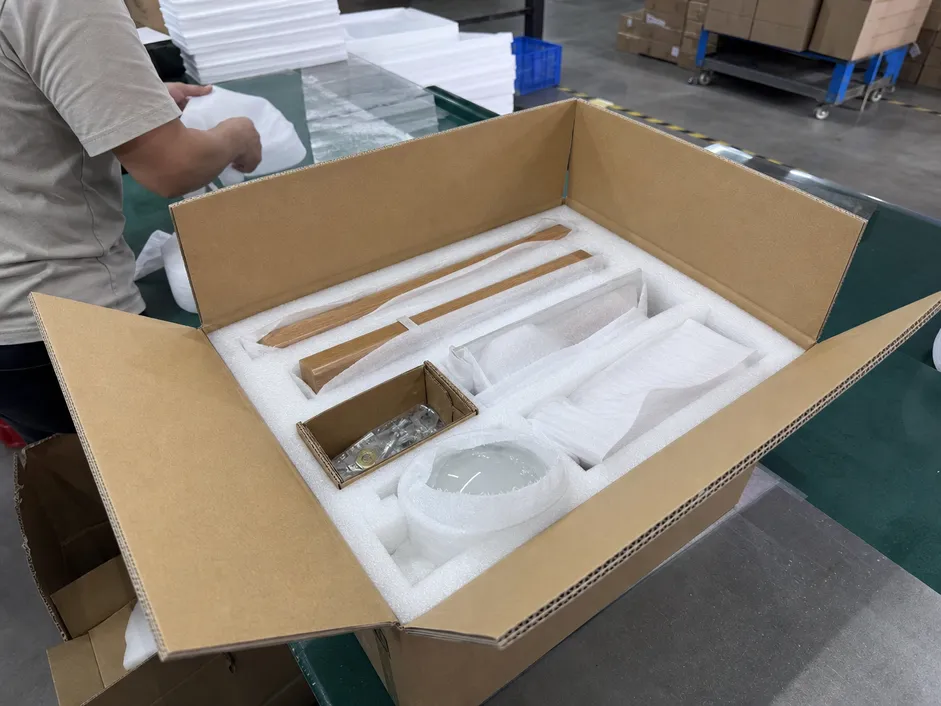
Multi-Layer Protection System
Individual EPE Foam Wrap
Each wood component individually wrapped in EPE foam, then seated in a foam insert cut to the exact profile of the wood piece.
Separated Metal Hardware
Metal hardware ships separately within the same inner carton, isolated from the wood component to prevent contact marks on the finished wood surface.
Double-Walled Inner Carton
Inner carton is double-walled corrugated, and the outer carton is rated for the compression forces of ocean freight stacking.
Glass Element Protection
For fixtures with glass diffusers, the glass element gets a secondary foam wrap and a fragile-goods label on the outer carton.
Route-Specific Packaging Intelligence
We've tracked damage rates by shipping route and by fixture configuration. The Pacific routes to North America and the Europe routes via Suez have different handling profiles, and the packaging spec reflects what we've learned about where breakage happens on each route.
If you're shipping to a market we haven't supplied before, we'll ask about the logistics chain — air freight, ocean LCL, and full container load all have different handling realities, and the packaging spec should match.
Container Loading Optimization
For large-volume orders, we optimize outer carton dimensions for 40HQ container loading.
Volume planning note: Wooden wall lighting fixtures tend to be bulkier than equivalent all-metal sconces because of the packaging requirements, so container loading efficiency is worth calculating before you finalize your order volume.
Selecting Between Wooden Wall Lighting and Sibling Products
Wooden wall lighting has a specific positioning within the wall lighting range — it's the right choice when natural material texture is a functional requirement of the specification, not just an aesthetic preference. Here's how it compares to the adjacent options.
vs. Modern Wall Lighting
Modern Wall Lighting is all-metal construction with clean geometric forms — the right choice when the brief calls for a contemporary, minimal aesthetic without organic material texture.
Choose wooden: If your buyers are specifying for a Scandinavian or biophilic interior where wood grain is part of the material palette.
Choose modern: If the brief is purely geometric and material texture isn't specified — simpler to source and has lower MOQs.
vs. Interior Wall Lighting
Interior Wall Lighting covers the broadest style range in the category — it's the right starting point for a general residential catalog.
Choose wooden: When targeting a market segment with a clear organic materials preference — the more focused choice.
Choose interior: If you're building a catalog that needs to cover multiple aesthetic directions — gives you more SKU flexibility.
vs. Wall Sconce Lighting
Wall Sconce Lighting covers the full range of decorative wall-mounted fixtures in metal construction.
Choose wooden: Wood commands a premium in markets where natural materials are valued — higher perceived value at retail.
Choose metal sconces: If your buyers are price-sensitive and the material isn't specified — lower-risk option with more careful handling requirements avoided and lower MOQs for custom configurations.
Not sure which configuration fits your market?
Send us your target retail price point and the segment you're selling into — we'll recommend the configuration that protects your margin.
Frequently Asked Questions
What is the MOQ for wooden wall lighting?
Standard catalog configurations have lower MOQs than custom species or custom finish orders. Contact us with your target SKU and volume — we'll confirm the MOQ and whether your volume qualifies for the standard catalog price or requires a custom quote.
Custom wood species, custom stain colors, and custom dimensions require higher MOQs to justify the material sourcing and tooling investment.
How do you prevent wood components from cracking or warping after delivery?
The primary control is moisture content management. We specify kiln-dried hardwood at 8–12% moisture content and verify on incoming inspection with a pin-type moisture meter. Material outside this range doesn't enter production.
After machining, wood components are finished in a humidity-controlled environment (45–55% RH) to prevent dimensional movement during the finishing process. The sealed finish — oil or lacquer — limits post-production moisture uptake, which is the main cause of warping in the field.
For buyers supplying markets with extreme humidity variation (Southeast Asia, coastal regions), we recommend lacquer finish over oil finish for better moisture resistance.
What wood species are available, and how do lead times differ?
Oak, walnut, and ash are stocked materials with standard lead times. Teak, beech, and other species are available on OEM request with 2–4 weeks additional sourcing lead time before production starts.
Species selection affects both price and visual character:
- Oak — most cost-effective and the most consistent to machine
- Walnut — commands a premium but has higher perceived value at retail
- Ash — the best base for whitewash and pale stain finishes
Are the wood finishes REACH-compliant for European market entry?
Yes. Our standard oil and lacquer finishes are REACH-compliant, and we maintain material safety data sheets for each finish product. For EU buyers, we include the relevant compliance documentation in the shipment package.
If your import team has a specific documentation checklist, send it before production starts and we'll confirm what we can provide.
Can wooden wall lighting be customized with our brand's specific stain color?
Yes, on runs of 200 units and above. We match stain colors to RAL or Pantone references.
The process involves producing a stain sample on the target wood species for your approval before committing to production — wood absorbs stain differently depending on grain density, so the same RAL reference can look different on oak versus walnut.
We send the stain sample with the pre-production prototype so you can approve both the color and the fixture configuration together.
What certifications does wooden wall lighting carry?
CE, UL, SAA, and SGS certifications are held across the range. ISO 9001:2015 governs the production process. Test reports and Declarations of Conformity are available per SKU.
For wood-specific compliance — REACH for EU, CARB Phase 2 for California — our solid hardwood construction avoids the formaldehyde adhesive issue that affects MDF and plywood components. Material safety documentation is available on request.
Source Wooden Wall Lighting Direct from the Factory
We manufacture wooden wall lighting for importers, distributors, and project contractors who need consistent quality across batches — not just a good sample.
Production Details That Protect Your Margin
Kiln-dried hardwood, in-house CNC machining, and a documented moisture control protocol are the production details that protect your margin in the field.
-
Kiln-dried hardwood sourced for dimensional stability
-
In-house CNC machining for repeatable precision
-
Documented moisture control protocol across production
-
Consistent quality across batches, not just a good sample
Send Us Your Specs
We'll come back with a configuration recommendation and quote, and where relevant, a note on what's moving for our existing buyers in your region.
Get in Touch
Wholesale only. Strict MOQ applies.
Address
No. 14 Beisan Rd, Gusan Ind. Zone, Guzhen, Zhongshan, Guangdong, China