
The fixture that works perfectly in a private villa will fail a hotel compliance review. Not because it looks wrong — it might look identical — but because the spec underneath is built for a different operating reality. Hotel projects get caught on this distinction more often than any other sourcing mistake we see, and the cost of discovering it after production starts is significant.
Here's the short version: hotel-grade fixtures carry higher IP ratings, commercial-grade drivers, DALI or 0-10V dimming compatibility, harder surface finishes, and market-specific certifications that residential-grade products don't require. The upfront price difference is real. The downstream cost of getting it wrong is larger.
This comparison covers the spec dimensions that actually drive procurement decisions — not a surface-level overview, but the parameters that determine whether your fixtures pass compliance review, survive a five-year maintenance cycle, and arrive in consistent finish across a 500-room order.

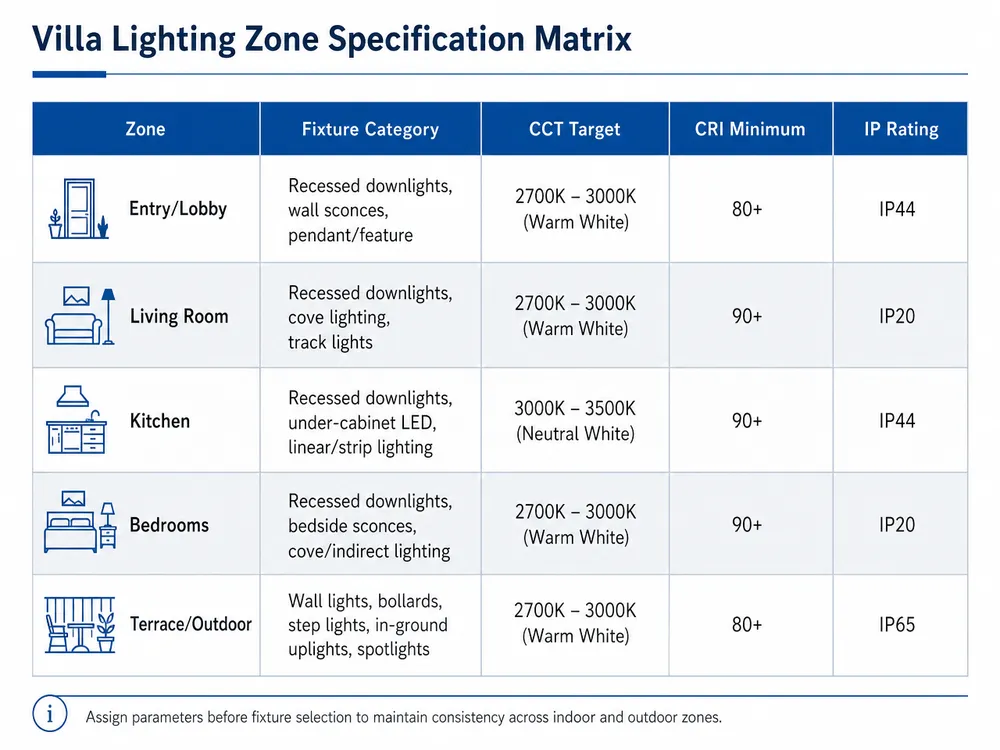
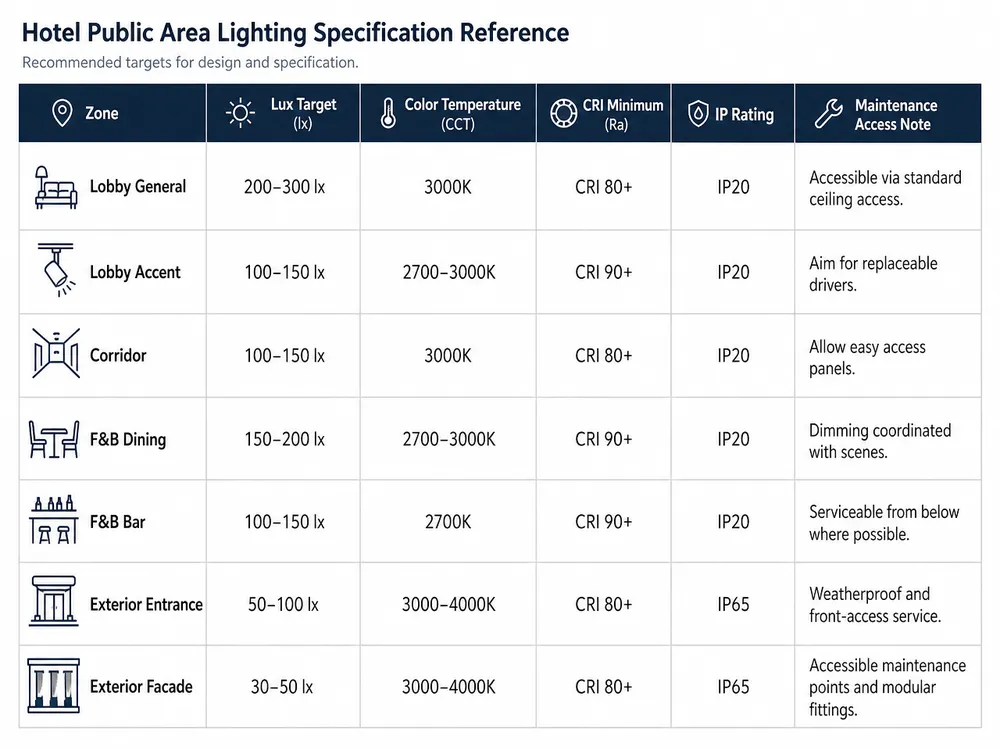
The Spec Table: Where Hotel and Residential Diverge
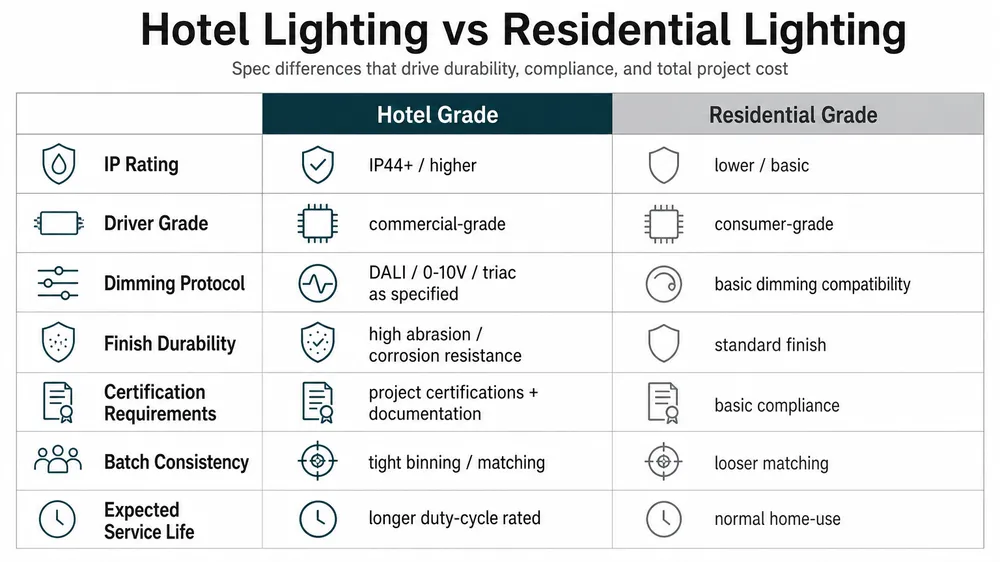
The differences aren't subtle. Across every parameter that matters to a project contractor or FF&E procurement team, hotel-grade fixtures carry specifications that residential products don't need to meet — because the operating environment, maintenance model, and compliance framework are fundamentally different.
| Parameter | Hotel Grade | Residential Grade |
|---|---|---|
| IP Rating | IP44 minimum (bathrooms IP65) | IP20 standard; IP44 optional |
| Driver Grade | Commercial-grade, 50,000+ hr rated | Consumer-grade, 25,000–35,000 hr rated |
| Dimming Protocol | DALI, 0-10V, or Casambi compatible | Trailing-edge TRIAC only |
| Finish Durability | 500+ hr salt spray; PVD or hard anodize | 200–300 hr salt spray; standard powder coat |
| Certifications | UL (NA), CE (EU), SAA (AU) — market-specific | CE or UL; rarely both; SAA uncommon |
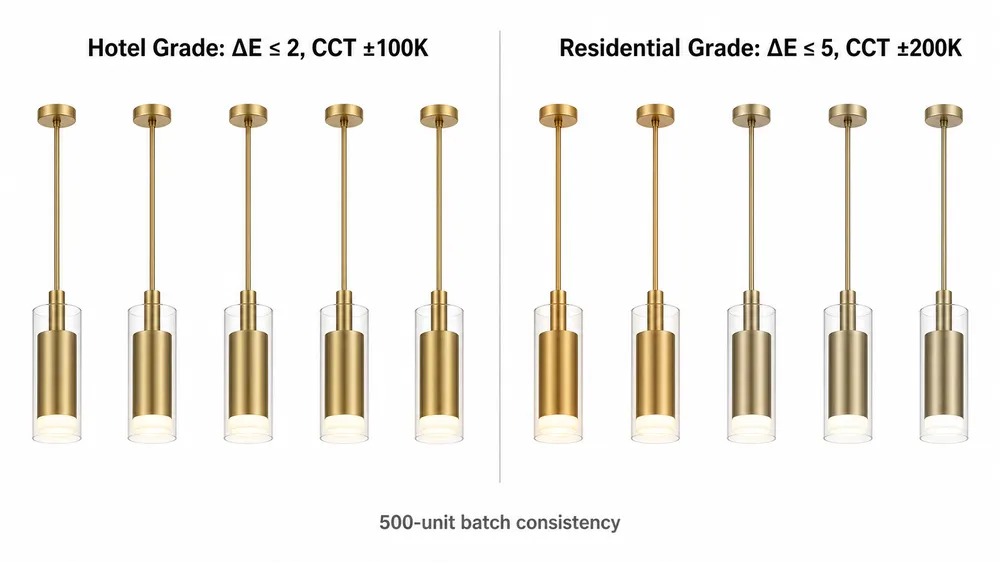
| Batch Consistency | ΔE ≤ 2 color tolerance across full order | ΔE ≤ 4–5 acceptable |
| CRI | 90+ standard; 95+ for F&B and spa zones | 80–85 typical |
| CCT Tolerance | ±100K across batch | ±200K acceptable |
| Expected Service Life | 5–7 years before maintenance cycle | 3–5 years typical |
| IES File Availability | Required for project submission | Rarely provided |
The driver spec and dimming protocol rows are where most sourcing mistakes happen. A residential-grade driver rated at 30,000 hours in a hotel room running 12–16 hours daily reaches end-of-life in under seven years — and hotel maintenance teams don't replace individual drivers, they replace fixtures. That's a full FF&E replacement cost, not a component swap.
Why Residential-Grade Fixtures Fail Hotel Compliance Review
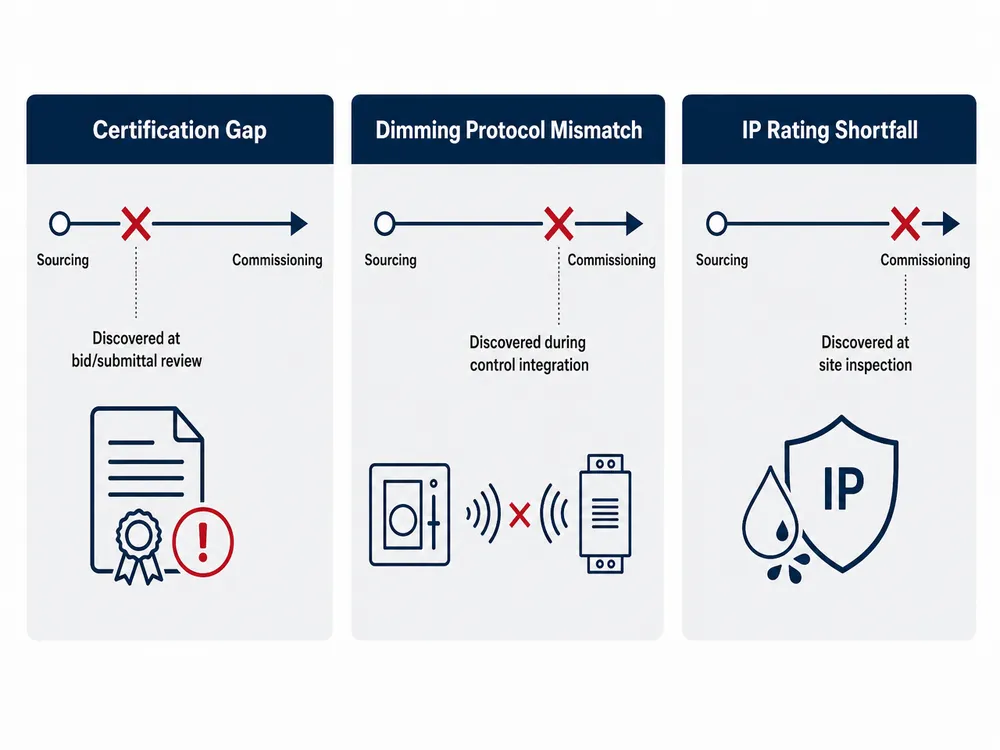
The compliance failure isn't always obvious at the sample stage. A residential pendant can look identical to a hotel-grade version, pass a visual inspection, and still fail the project's electrical review for three reasons: certification scope, dimming compatibility, and IP rating for wet zones.
Certification scope is the most common failure point. Hotel projects in North America require UL-listed fixtures. Projects in Europe require CE with the full technical file — not just the mark. Australian hotel projects require SAA. A residential-grade fixture sourced for cost might carry CE but not UL, or UL but not SAA. When the project spans multiple markets — a hotel group rolling out properties across the US, UK, and Australia — a single-certification fixture fails two of the three markets. The rework cost isn't just the fixture replacement; it's the delay to the project handover, the re-inspection fees, and the contractor's time.
Dimming compatibility is the second failure mode. Hotel room management systems — from Lutron to KNX to Crestron — use DALI or 0-10V protocols. Residential dimmers use TRIAC. A residential-grade driver with TRIAC-only dimming will flicker, buzz, or fail to dim at all when connected to a hotel BMS. We've seen this discovered during commissioning, which means the fixtures are already installed. Pulling and replacing at that stage costs three to five times what the spec upgrade would have cost at the sourcing stage.
IP rating in wet zones is the third. Hotel bathrooms, pool surrounds, and spa areas require IP44 minimum — IP65 for direct water exposure zones. Residential-grade fixtures in these zones fail the building inspection. (In some markets, the insurance liability for a non-compliant wet-zone fixture is the contractor's, not the hotel's — worth knowing before you spec it.)
The Hidden Cost: Driver Grade and Maintenance Frequency Over Five Years
The upfront price difference between a commercial-grade and residential-grade driver is typically 15–25% of the driver cost — a meaningful but manageable delta at the fixture level. The five-year maintenance cost difference is not manageable.
A hotel room runs its lighting 12–16 hours per day. At 14 hours average, that's roughly 5,100 hours per year. A residential-grade driver rated at 30,000 hours reaches its L70 point (the industry threshold for driver replacement) in under six years. A commercial-grade driver rated at 50,000 hours reaches the same point in under ten years. In a 300-room hotel, the difference between a six-year and ten-year replacement cycle is approximately 300 fixture replacements — at full fixture cost, not driver cost, because hotel maintenance teams don't carry driver inventory.
The math on a mid-range decorative pendant: if the fixture costs $85 landed and the hotel has 300 rooms with two pendants each, a six-year replacement cycle costs $51,000 in fixtures alone, plus labor. Push that cycle to ten years and the cost drops to zero within the typical FF&E depreciation window. The driver upgrade that enables the longer cycle costs roughly $8–12 per fixture at the sourcing stage.
We run 100% aging tests on every luminaire before shipment — every driver in every fixture burns in before the container loads. That catches early-life failures before they reach the installation. But the aging test doesn't change the driver's rated lifespan; it just ensures you're not shipping a defective unit. The rated lifespan is determined by the driver grade you specify at the sourcing stage.
Batch Consistency: The Hotel-Specific Requirement Residential Sourcing Ignores
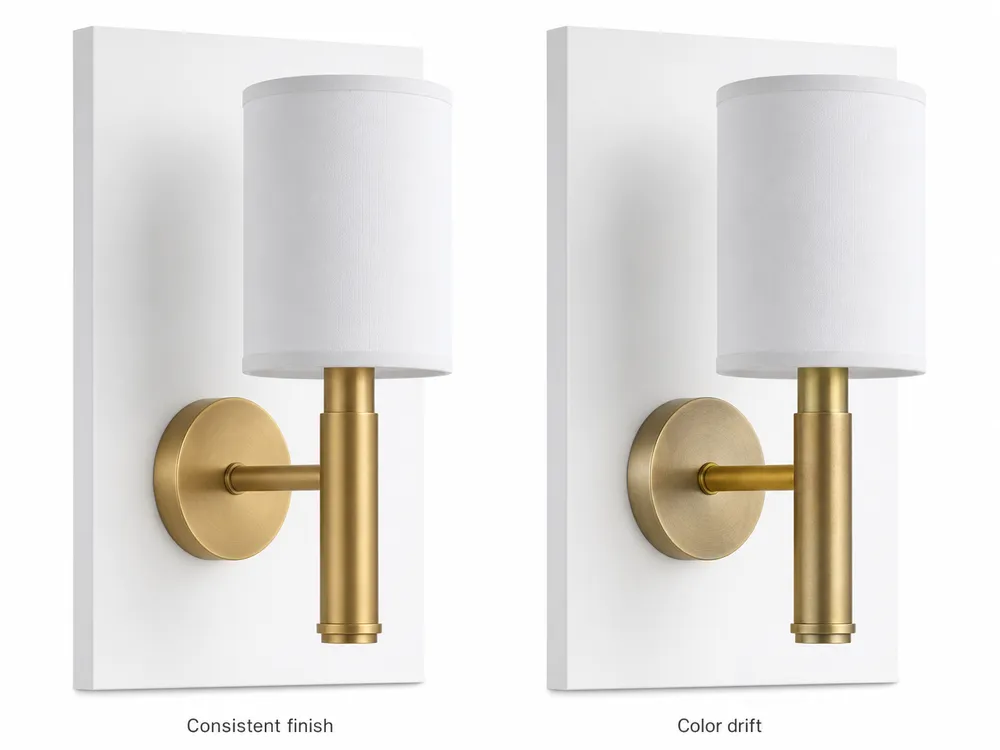
A residential buyer ordering 20 pendants can tolerate a ΔE of 4–5 between units — the fixtures are in different rooms, different lighting conditions, and the variation isn't visible. A hotel buyer ordering 500 pendants for 250 identical guest rooms cannot. When two pendants hang in the same room and one reads warm gold while the other reads cool champagne, the guest notices. The hotel notices. The contractor gets the call.
Batch consistency in hotel lighting has two dimensions: finish color and CCT (correlated color temperature). Both require tighter tolerances than residential sourcing typically demands.
Finish consistency across a 500-unit batch requires in-house surface finishing with automated application and batch-controlled process parameters. Factories that outsource finishing — or run manual spray lines — can't hold ΔE ≤ 2 across a full hotel order. We run our own electroplating, powder coating, and PVD lines in-house, with automated powder application at 60–80μm consistent thickness. For hotel orders, we run finish samples from the beginning, middle, and end of the production batch and compare them before the batch ships. (This sounds obvious, but a lot of factories only check the first-off sample and assume the rest of the batch matches.)
CCT consistency requires driver and LED source matching within the same production batch. We specify LED sources from the same bin code across a hotel order — not just the same model, the same bin. A ±100K CCT tolerance across a 500-room order is achievable when you control the LED sourcing. It's not achievable when you're buying LED modules from spot market suppliers who ship whatever bin is available.
For buyers sourcing hotel projects, the question to ask your factory isn't "what's your CCT tolerance?" — it's "how do you control bin consistency across a 500-unit order?" The answer tells you whether they've actually done hotel work before.
Certification Coverage by Market: What Hotel Projects Actually Require
The certification landscape for hotel projects is more demanding than residential, and it varies by destination market. Getting this wrong at the sourcing stage means either re-certifying fixtures (expensive and slow) or replacing them (more expensive and slower).
North America: UL listing is required for hotel fixtures in the US and Canada. This isn't a preference — it's a code requirement in most jurisdictions, and hotel projects go through electrical inspection. A CE-only fixture fails the inspection. UL certification requires testing to UL 1598 (luminaires) or the relevant product standard, plus ongoing factory surveillance audits. We hold UL and maintain it through annual audits — the certificate is current, not a legacy mark from a previous product generation.
Europe: CE marking is required, but the mark alone isn't sufficient for a hotel project submission. The technical file behind the CE mark — test reports, Declaration of Conformity, Bill of Materials — is what the project's M&E consultant reviews. A CE mark without a complete technical file is a compliance risk. We maintain the full technical file per SKU and provide it as part of the order documentation package.
Australia: SAA (Standards Australia) certification is required for hotel projects. This is the certification that most Chinese factories don't hold — it's a smaller market than North America or Europe, and the certification cost isn't justified for factories that don't actively supply Australian projects. We hold SAA because we supply hotel and hospitality projects in Australia regularly. For buyers sourcing a hotel group with Australian properties, this matters: you're not waiting on certification work before you can import.
The practical implication: a factory that holds UL, CE, and SAA can supply a hotel group's global rollout from a single source. A factory that holds only CE cannot supply the North American or Australian properties without either re-certifying or sourcing from a second factory. The supply chain complexity of managing two factories for the same fixture spec — different lead times, different QC standards, different documentation — is a real project risk.
Application Scenarios: Which Spec Wins in Each Context
Scenario 1: 300-room branded hotel, North American market, full FF&E package
Hotel grade wins, no contest. UL listing is non-negotiable. DALI dimming is required for the BMS integration. The 5-year maintenance window the hotel's facilities team is planning around requires commercial-grade drivers. Batch consistency across 300 identical rooms requires in-house finishing with tight tolerance control. Specifying residential grade here doesn't save money — it creates a compliance failure at inspection and a maintenance cost problem at year four.
Scenario 2: Boutique hotel, 40 rooms, European market, design-led FF&E
Hotel grade still wins on certification and driver spec, but the batch consistency requirement is more manageable at 40 rooms. CE with full technical file is required. DALI compatibility depends on whether the property is using a BMS — smaller boutique properties sometimes use standard dimming, which opens the door to trailing-edge compatible drivers. The finish tolerance requirement is still tighter than residential because the rooms are identical, but a 40-unit batch is easier to control than a 500-unit batch. (We'd still run the same bin-code LED sourcing protocol — the cost difference is negligible and the risk of a visible CCT mismatch in a boutique property is higher, not lower, because guests are paying for the design experience.)
Scenario 3: Serviced apartment complex, 120 units, mixed residential and hospitality use
This is the grey zone. Serviced apartments often use residential-grade fixtures because the procurement team is thinking "residential" — but the operating model is hospitality. Units run 12+ hours daily, maintenance is centralized, and the building goes through commercial electrical inspection. The right call depends on the inspection jurisdiction and the operator's maintenance model. If the building is inspected to commercial code, hotel-grade certification is required. If the operator is planning a 5-year FF&E refresh cycle, commercial-grade drivers are the right spec. We've supplied both configurations for this segment — the decision usually comes down to what the M&E consultant specifies on the drawings.
What to Include in Your RFQ for Hotel-Grade Fixtures
The difference between a useful RFQ and one that generates a generic quote is the spec data you include upfront. For hotel-grade fixtures, the minimum information that drives an accurate quote:
Fixture type and room category: Pendant, wall sconce, ceiling fixture, or spotlight — and which room type (guest room, lobby, F&B, spa, bathroom). Room type determines IP rating requirement and CRI specification.
Target market and certification requirement: North America (UL), Europe (CE with technical file), Australia (SAA), or multi-market. If the project spans markets, specify all of them — a single-certification quote won't cover your full project.
Dimming protocol: DALI, 0-10V, Casambi, or TRIAC. If you don't know the BMS specification yet, say so — we can quote with DALI as the default and adjust when the BMS spec is confirmed.
Order volume and batch structure: Total units and how they're distributed across room types. This determines whether we need to run a single production batch or multiple batches, which affects the batch consistency protocol.
Finish specification: Color, texture, and any durability requirement (coastal environment, high-humidity zone). If you have a finish reference — a RAL code, a physical sample, or a reference fixture — include it. Finish matching across a hotel order is easier when we have a physical reference rather than a color name.
For Hotel Lighting projects specifically, IES files for photometric documentation are available from our in-house optical lab — include that requirement in your RFQ if your project submission requires it.
Total Project Cost: The Five-Year View
The fixture price is the number that appears on the purchase order. The total project cost is the number that appears on the facilities manager's budget five years later.
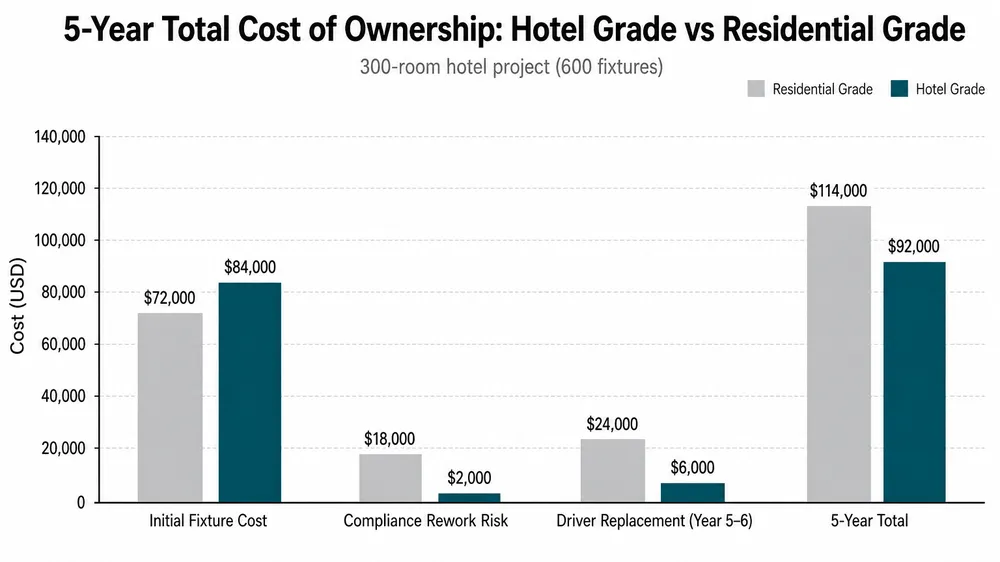
For a 300-room hotel with two decorative pendants per room (600 fixtures total):
| Cost Component | Residential Grade | Hotel Grade | Difference |
|---|---|---|---|
| Fixture unit cost (landed) | $65 | $85 | +$20/unit |
| Total fixture cost | $39,000 | $51,000 | +$12,000 |
| Compliance rework risk | High (certification gaps, dimming failure) | Low | — |
| Driver replacement at year 5–6 | ~$39,000 (full fixture replacement) | $0 (within rated life) | -$39,000 |
| Maintenance labor (2 cycles) | ~$8,000 | $0 | -$8,000 |
| 5-year total cost | ~$86,000 | ~$51,000 | -$35,000 |
The numbers above are illustrative — actual costs depend on fixture spec, labor rates, and market. But the direction is consistent: the upfront premium for hotel-grade fixtures is recovered within the first maintenance cycle, and the compliance rework risk is eliminated entirely.
The buyers who push back hardest on hotel-grade pricing are usually the ones who haven't been through a post-handover driver failure on a large property. The ones who have been through it don't ask about the price difference.
Sourcing Validation: What to Verify Before You Commit
The spec on a data sheet and the spec in the shipped fixture are not always the same thing. For hotel-grade fixtures, the verification steps that matter:
Driver grade verification: Request the driver manufacturer and model number, not just the rated hours. A 50,000-hour claim from an unknown driver brand is not the same as a 50,000-hour claim from a Meanwell, Inventronics, or Tridonic driver. We specify driver brand and model per SKU — if a factory can't tell you the driver brand, the grade claim is unverifiable.
Certification currency: Ask for the current certificate, not a copy of a certificate. UL certificates have a file number that can be verified on UL's public database. CE certificates should be accompanied by the Declaration of Conformity and test report date. An expired or superseded certificate is not compliant.
Batch consistency protocol: Ask how the factory controls finish consistency across a 500-unit order. The answer should include process controls (automated application, batch parameters), not just inspection (we check samples). Inspection catches variation after it happens; process control prevents it.
IES file availability: For hotel projects requiring photometric documentation, ask whether IES files are generated from in-house measurements or from the LED module manufacturer's data. In-house measurements reflect the actual fixture performance — module manufacturer data reflects the LED source in isolation, not the fixture's optical system.
We generate IES files from our own optical lab measurements for every fixture we supply to hotel projects. The photometric data reflects the actual fixture, not the LED module spec sheet. For project submissions where the lighting designer needs to model the fixture in DIALux or AGi32, that distinction matters.
For buyers working across Lighting Applications for Premium Projects, the certification and documentation requirements vary by project type — hotel, restaurant, villa, and retail each carry different compliance thresholds. Understanding where your project sits on that spectrum before you source determines whether your fixtures pass review or get pulled.
If you're ready to spec hotel-grade fixtures for a current project, Request Quote with your fixture type, room category, target market, certification requirement, and order volume — we'll return a grade recommendation and quote based on your actual project spec.