
Most hotel lighting specification guides stop at installation day. They give you lux targets, color temperature recommendations, and a fixture schedule — and then the project closes out. What they don't cover is what happens six months after handover when the maintenance team starts logging complaints: a corridor pendant that won't dim properly, a bathroom downlight with a failed driver that requires ceiling access to replace, a lobby chandelier where half the units have drifted to a noticeably different finish tone.
Those problems don't start at handover. They start at specification. The fixture selection decisions you make before the order is placed determine whether the maintenance team inherits a manageable system or a recurring problem. This guide covers both sides: the technical specification criteria for each space type, and the manufacturer-side requirements that most spec documents never mention.
Why Post-Handover Failures Trace Back to Specification Decisions
The failure pattern we see most often in hospitality projects isn't a manufacturing defect. It's a specification mismatch that was invisible at installation and becomes a problem at the 6–18 month mark.
Driver failures are the most common. An LED driver specified without a burn-in test will pass installation inspection — the fixture lights up, the dimming works, everything looks fine. The early-life failure rate on LED drivers follows a bathtub curve: failures cluster in the first few hundred hours of operation. If those hours happen in the hotel room rather than at the factory, the maintenance team is the one dealing with it. We run 100% aging test on every luminaire before it ships, so driver failures surface on our floor, not in the guest room. That's not a quality claim — it's a process decision that shifts where the failure cost lands.
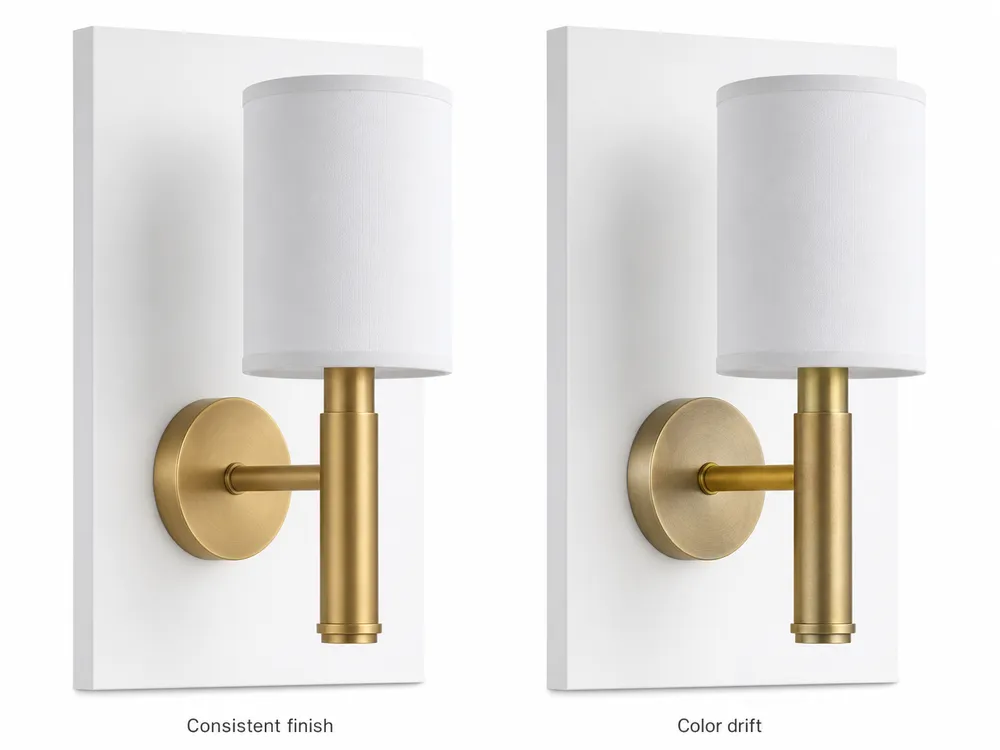
Finish drift is the second pattern. A hotel orders 300 units of the same pendant for a corridor run. The first 150 ship from one production batch, the second 150 from a batch three months later. If the manufacturer doesn't control powder coat thickness and color consistency across batches, the corridor looks fine at handover and starts showing visible tone variation within a year as the finishes age at different rates. (We've seen this on projects where the original supplier was replaced mid-order — the color match looked acceptable on a single sample but diverged under the corridor's consistent lighting conditions.)
Dimensional tolerance is the third. A 500-room hotel project means 500 ceiling cutouts, 500 canopy fits, 500 bracket alignments. If the fixture housing tolerances drift ±0.5mm or more across a production run, installation teams start shimming and forcing fits. That's rework cost on-site, and it's avoidable if the manufacturer holds CNC tolerances to ±0.1mm on critical mounting dimensions.
None of these failures are dramatic. They accumulate quietly and show up as maintenance tickets, warranty disputes, and replacement orders that eat into the project margin.
Guest Room Lighting Specification: Zones, Targets, and Dimming
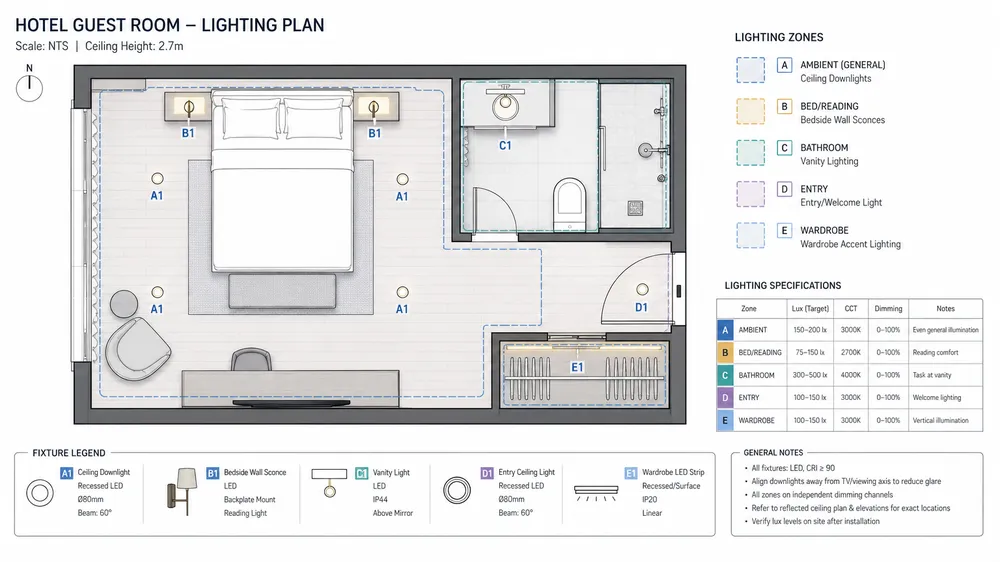
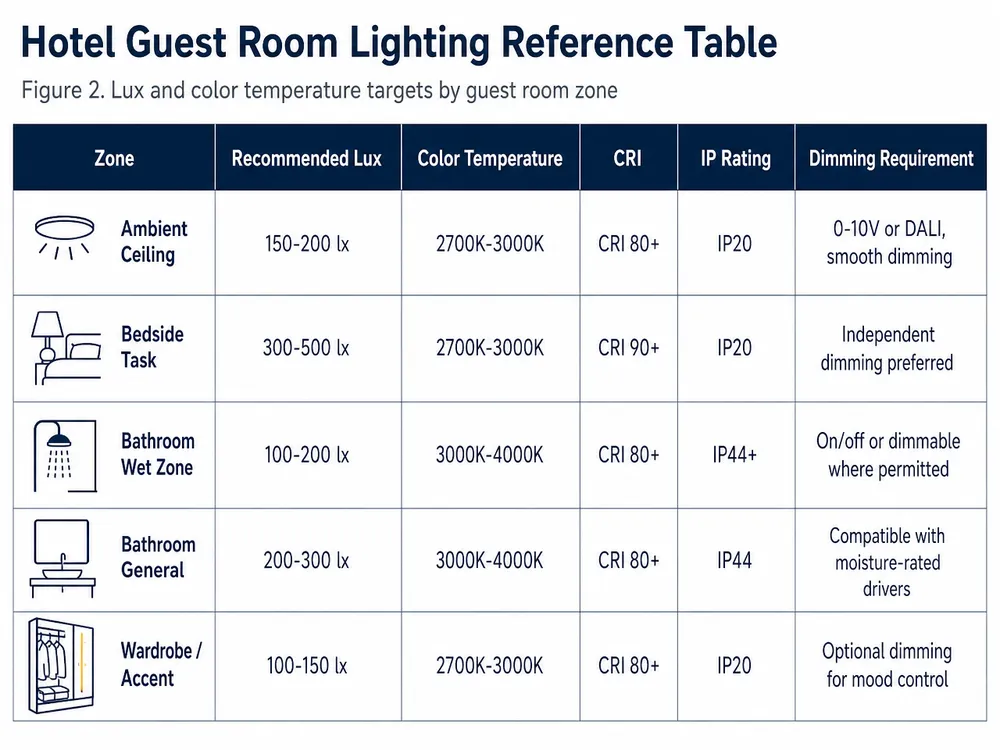
A hotel guest room has four distinct lighting zones, each with different requirements. Specifying them as a single fixture schedule is where most problems start.
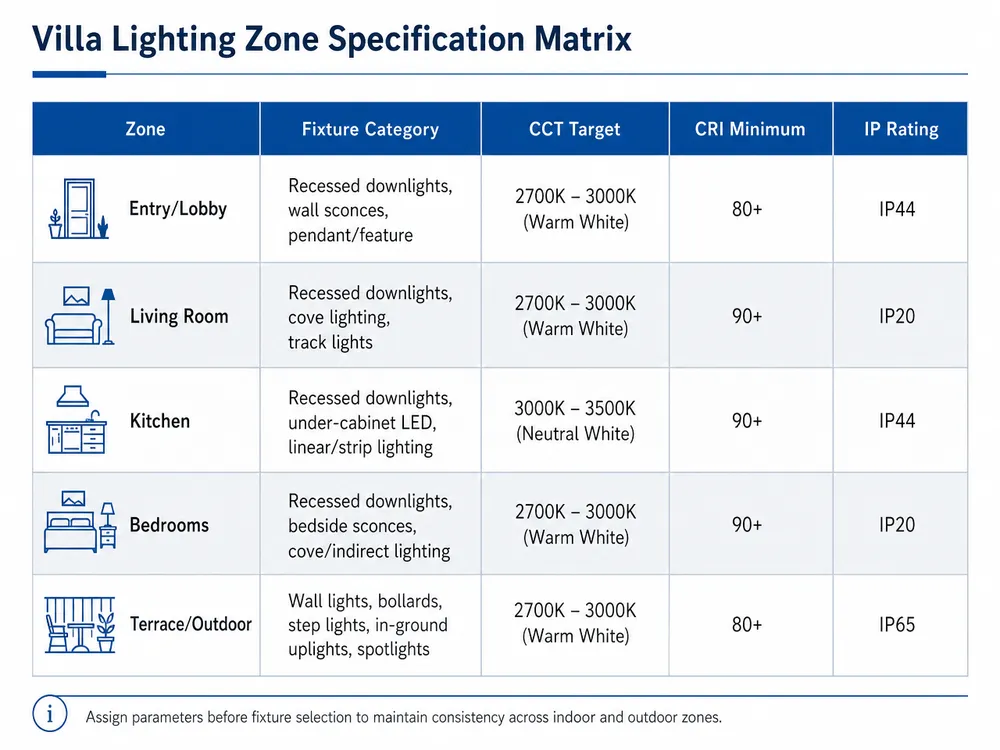
Ambient ceiling is the general illumination layer. For a standard guest room, 150–200 lux at floor level is the working target for a comfortable ambient level — bright enough for general use, low enough to feel residential rather than clinical. Color temperature in the 2700K–3000K range is standard for hospitality; 2700K reads warmer and works better in rooms with warm-toned finishes, 3000K is slightly crisper and suits contemporary interiors. CRI 90+ is worth specifying for any hotel above the mid-market tier — the difference in how fabrics, skin tones, and room finishes render under CRI 80 vs CRI 90 is visible to guests even if they can't name it.
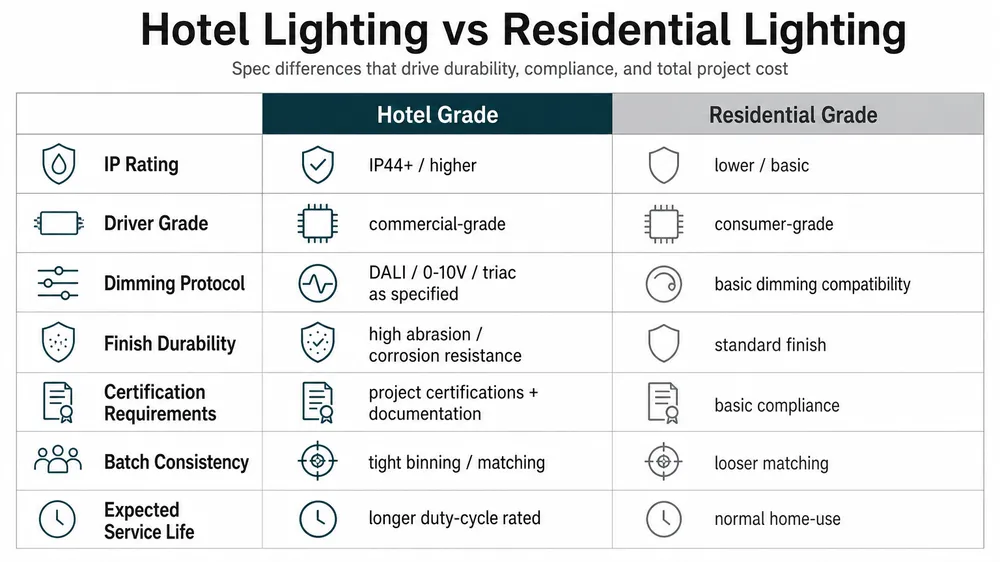
Bedside task lighting needs to be independently switchable and dimmable. The common failure here is specifying a wall sconce with a driver that isn't compatible with the hotel's dimmer infrastructure. Before finalizing the fixture spec, confirm the dimmer protocol in use — TRIAC, 0-10V, DALI, or Casambi — and specify drivers accordingly. A fixture that dims smoothly on a TRIAC dimmer may buzz or flicker on a 0-10V system. This is a driver selection issue, not a fixture quality issue, but it shows up as a fixture complaint.
Bathroom lighting has two non-negotiable requirements: IP rating and driver access. The wet zone directly above a shower or bath requires IP65 minimum; the wider bathroom zone (outside the wet zone but still subject to steam and humidity) requires IP44 minimum. These aren't conservative recommendations — they're the minimum thresholds for compliance in most markets. A downlight specified at IP20 in a bathroom zone will pass installation inspection and fail within 18 months as moisture ingress degrades the driver.
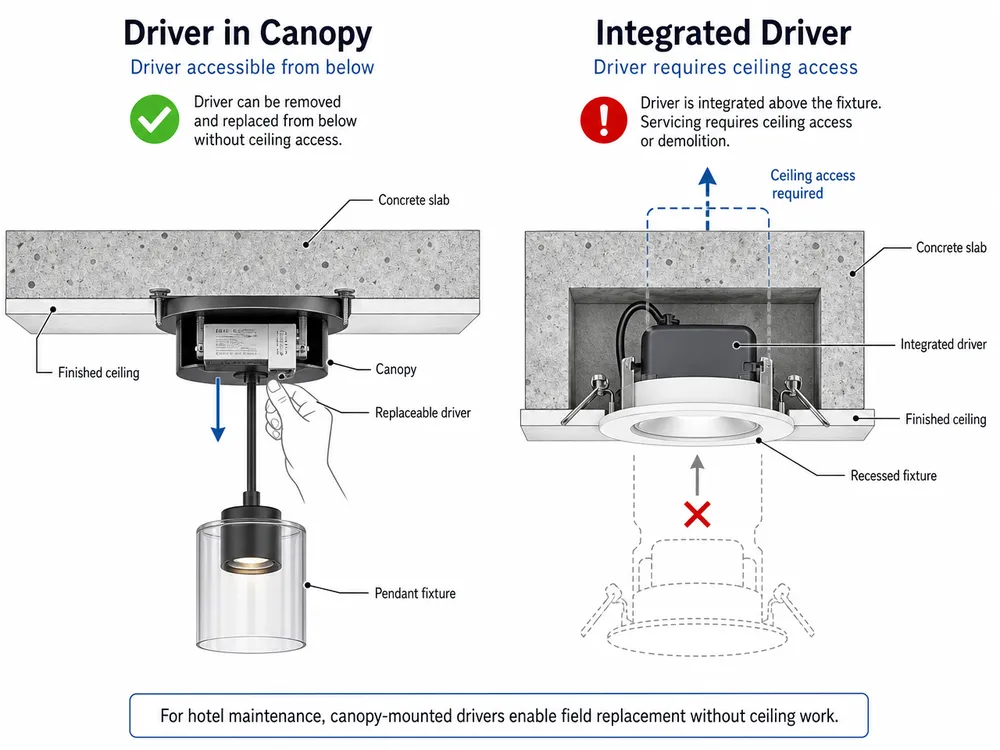
Driver access in bathrooms is the maintenance problem nobody specifies for. If the driver is integrated into the fixture housing and the fixture is recessed into a concrete ceiling with no access panel, replacing a failed driver means cutting into the ceiling. Specify fixtures with either externally accessible drivers or driver-in-canopy designs where the driver can be reached without ceiling access. (This sounds obvious, but we regularly see project specs that don't address it — and the maintenance team finds out the hard way.)
Wardrobe and accent lighting is typically lower-priority but worth noting: LED strip or small spotlights in wardrobe zones should be specified at 3000K or warmer to avoid the cold-white effect that makes clothing look washed out. Lumen output here is secondary to color quality.
Public Area Specification: Lobby, Corridor, F&B, and Exterior
Public areas have different failure modes than guest rooms, mostly because the operating hours are longer and the maintenance access is harder.
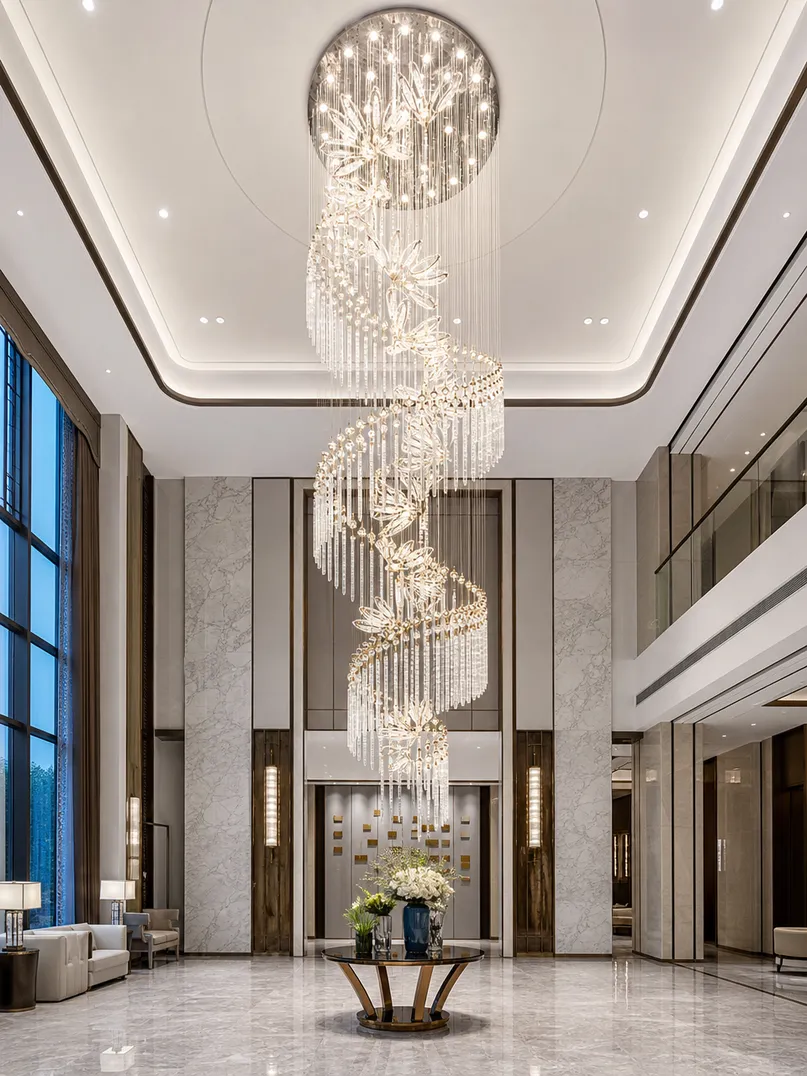
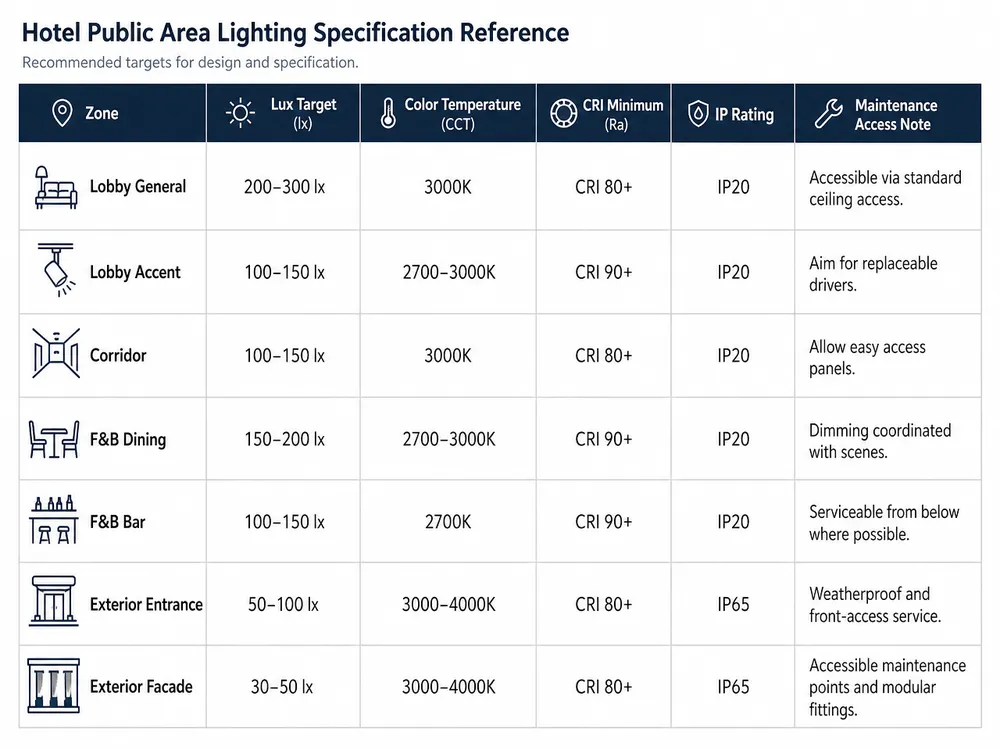
Lobby is the highest-visibility space and typically the most complex to specify. Lux targets for hotel lobbies range from 200–300 lux for general circulation, with accent lighting at 500–750 lux on feature walls, artwork, or reception desks. The fixture selection challenge in lobbies is scale: a chandelier or pendant cluster that looks proportionate in a render may be difficult to re-lamp or service in a 6-meter ceiling without scaffolding. Specify fixtures with accessible lamp or driver replacement — either a lowering system for large pendants or a design where the driver is in the canopy rather than the fixture body.
Color temperature consistency across a lobby installation matters more than in any other space. If you're specifying 20 pendants for a lobby atrium, all 20 need to come from the same production batch with verified color temperature tolerance. A ±150K drift across a batch is invisible on a single fixture and obvious when 20 are lit simultaneously. Require batch consistency documentation from your manufacturer — not just a spec sheet, but confirmation that the order will ship from a single production run.
Corridors are a maintenance frequency problem. Corridor lighting runs 24 hours a day in most hotels, which means a fixture rated for 50,000 hours at 8 hours/day is actually running through its rated life in 17 years at continuous operation — but in practice, driver quality variation means failures cluster much earlier. Specify L70 lumen maintenance data (the point at which output drops to 70% of initial) and require it from measured data, not manufacturer claims. For corridor pendants or wall sconces, driver replaceability without ceiling access is the same requirement as bathrooms.
Lux targets for hotel corridors: 100–150 lux at floor level is the standard working range. Below 100 lux starts to feel dim and raises safety concerns; above 200 lux in a corridor reads as institutional rather than hospitality.
F&B spaces (restaurants, bars, breakfast rooms) have the most demanding color rendering requirements of any hotel space. CRI 95+ is worth specifying for fine dining; CRI 90 is the minimum for any F&B space where food presentation matters. Color temperature in F&B typically runs 2700K–3000K for dining, with the lower end (2700K) preferred for evening dining environments. Dimming is non-negotiable in F&B — the space needs to transition from breakfast service at 300 lux to dinner service at 80–100 lux. Confirm dimming range: some LED drivers dim to 10% minimum, others to 1%. For a dinner service environment, 10% minimum may still be too bright.
Exterior and entrance lighting requires IP65 minimum for all fixtures in exposed positions. For coastal hotel projects — beach resorts, waterfront properties — finish durability becomes a specification criterion, not just an aesthetic one. Salt air accelerates corrosion on powder-coated and plated finishes. Specify powder coat thickness (60–80μm is the working standard for coastal applications) and require salt spray test results from the manufacturer. A finish that passes 500-hour salt spray testing will hold in a coastal environment; a standard decorative finish rated for 200 hours will show corrosion within two seasons.

Batch Consistency: The Specification Criterion Most Guides Skip
A 200-room hotel project typically means 200–500 units of the same fixture across guest rooms, corridors, or public areas. At that scale, batch consistency stops being a quality preference and becomes a project risk.
The two variables that drift most in large decorative lighting orders are finish tone and lumen output. Finish tone drift happens when a manufacturer runs your order across multiple production batches — different powder coat batches, different plating chemistry cycles, or different surface preparation runs. Each batch may be within the manufacturer's internal tolerance, but the cumulative drift across 500 units can be visible when the fixtures are installed side by side under consistent lighting.
Lumen output drift is less visible at installation but shows up over time. If the LED modules in your order come from two different component batches with slightly different binning, the fixtures will age at different rates. A corridor that looks uniform at handover may show visible brightness variation at the 2-year mark.
What to require from your manufacturer:
- Single-batch production confirmation: For orders over 100 units of the same SKU, require written confirmation that the order will be produced in a single run, not split across multiple batches.
- Color consistency documentation: Require finish samples from the production batch, not just the approved sample. For powder coat finishes, require thickness measurement records (60–80μm is the standard range; variation outside this range indicates process inconsistency).
- LED binning documentation: Require confirmation that all LED modules in the order come from the same binning batch. MacAdam ellipse Step 3 or tighter is the standard for hospitality applications — Step 5 is acceptable for utility spaces but visible in high-quality environments.
We run our die-casting and CNC machining in-house with tolerances held to ±0.1mm on critical mounting dimensions, so dimensional consistency across a 500-unit batch isn't dependent on a third-party supplier's process control. The finish line runs automated powder application at 60–80μm — consistent across the batch, not just the first units off the line. For large hotel orders, we can provide batch production records as part of the shipment documentation.
Driver Replaceability and IP Ratings: What to Require Before the Container Ships
Driver replaceability is the single most overlooked specification criterion in hospitality lighting. It determines whether a failed fixture is a 10-minute maintenance task or a ceiling demolition job.
The specification question is simple: can the driver be replaced without removing the fixture from the ceiling? For recessed downlights, this means a driver that's accessible through the fixture aperture or mounted in an accessible junction box. For surface-mounted or pendant fixtures, this means a driver in the canopy or a driver compartment with a removable cover. For any fixture going into a concrete ceiling without an accessible ceiling void, driver-in-canopy is the only practical design.
IP rating requirements by zone:
| Zone | Minimum IP Rating | Notes |
|---|---|---|
| Guest room bathroom — wet zone (above shower/bath) | IP65 | Mandatory in most markets |
| Guest room bathroom — general | IP44 | Steam and humidity exposure |
| Guest room general | IP20 | Standard interior |
| Corridor | IP20 | Standard interior |
| Lobby | IP20 | Standard interior |
| Exterior — covered entrance | IP44 | Indirect weather exposure |
| Exterior — exposed | IP65 | Direct weather exposure |
| Pool area | IP65 | Humidity and splash |
For coastal and tropical hotel projects, treat the IP44 zones as IP54 minimum. The additional ingress protection is worth the marginal cost difference when the alternative is premature driver failure from humidity.
Certification requirements vary by destination market. For North American hotel projects, UL listing is required for fixtures in occupied spaces — CE marking is not a substitute. For European projects, CE marking with the relevant EN standards is required. For Australian projects, SAA certification. For hotel groups operating across multiple markets, confirm that your manufacturer holds the relevant certifications in-house rather than relying on third-party certification retrofits — the documentation trail matters when your import team is reviewing compliance.
We hold CE, UL, and SAA certifications in-house, built into the product development process rather than added after the fact. For project submissions that require Declaration of Conformity, test reports, or IES files, we maintain these per SKU and include them in the order documentation package.
Common Specification Mistakes and How to Avoid Them
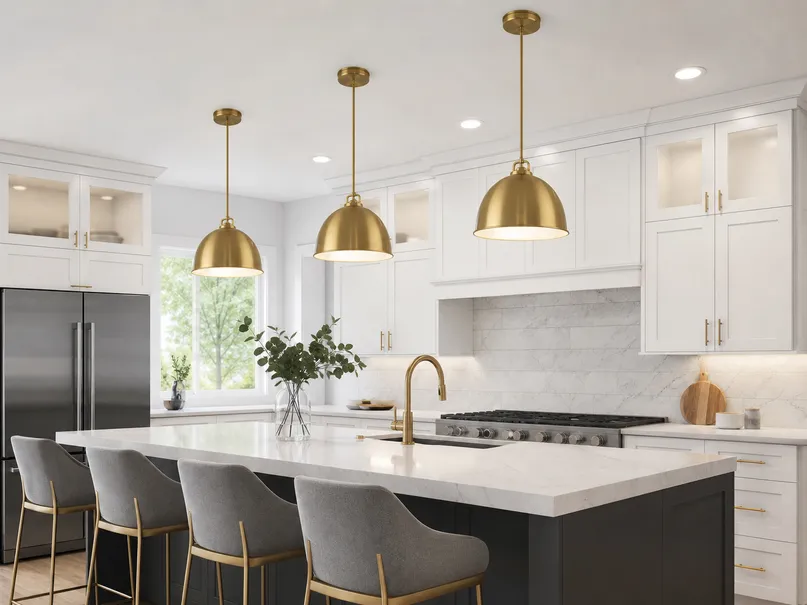
Finish selection without climate consideration. A brushed gold finish specified for a beach resort in a humid coastal environment will corrode within 18 months if the manufacturer hasn't run salt spray testing on that finish. Before finalizing finish selection for any coastal or tropical project, ask for salt spray test results. 500-hour salt spray is the minimum threshold for coastal applications; 1000-hour is worth specifying for exposed exterior fixtures.
Driver mismatch with dimmer infrastructure. This is the most common cause of post-handover dimming complaints. The fixture dims, but it buzzes, flickers at low levels, or has a limited dimming range. The fix at specification stage is straightforward: confirm the dimmer protocol (TRIAC, 0-10V, DALI, Casambi, or other) and specify drivers that are tested and confirmed compatible. The fix after installation is expensive — either replace the drivers or replace the dimmers.
Missing IES files for project submissions. Many hotel projects require photometric data for lighting design software submissions — the architect or lighting designer needs IES files to model the actual fixture performance, not generic approximations. If your manufacturer can't provide IES files generated from measured data, you're either submitting with approximations (which creates compliance risk) or paying a third party to measure the fixtures after they arrive. Our optical lab generates IES files from measured photometric data on production samples — usable directly in AGi32, DIALux, or Relux submissions.
Specifying by catalog without confirming certification. A fixture that looks right in a catalog may not hold the certification required for your destination market. CE marking doesn't satisfy UL requirements. A fixture certified for the European market needs separate UL testing for North American projects. Confirm certification coverage before the order is placed, not when the container arrives at customs.
Over-specifying lumen output in guest rooms. A 1000-lumen downlight in a 30m² guest room will hit 300+ lux at floor level — bright enough to feel like an office. Guest rooms need layered lighting at lower lumen outputs per fixture, not a single high-output source. The specification error here is treating lumen output as a quality proxy; higher lumens in a guest room context is often a worse outcome.
What to Require from a Hospitality Lighting Manufacturer
The fixture spec covers what you're buying. The manufacturer evaluation covers whether you'll actually receive it — consistently, across the full order quantity, with the documentation your project needs.
A practical checklist for evaluating a hospitality lighting manufacturer for a hotel project:
Production capability
- [ ] In-house die-casting and CNC machining, or assembly-only operation? (Assembly-only means dimensional consistency depends on third-party suppliers.)
- [ ] Powder coat line with automated application and thickness measurement? (Manual application produces thickness variation across a batch.)
- [ ] Can they confirm single-batch production for orders over 100 units of the same SKU?
Quality control
- [ ] 100% aging test before shipment? (Spot-check aging is not equivalent — early-life driver failures require 100% testing to catch.)
- [ ] Photometric verification on production samples, not just prototypes?
- [ ] LED binning documentation available per order?
Documentation
- [ ] IES files generated from measured data, not manufacturer approximations?
- [ ] Declaration of Conformity and test reports available per SKU?
- [ ] Batch production records available for large orders?
Certification
- [ ] CE, UL, and SAA held in-house, not retrofitted?
- [ ] Certification coverage confirmed for your destination market before order placement?
Finish durability
- [ ] Salt spray test results available for finishes specified for coastal or humid-climate projects?
- [ ] Powder coat thickness specification (60–80μm) confirmed and documented?
The manufacturers who can answer yes to all of these are a smaller group than the catalog suggests. Most decorative lighting factories in Guzhen are assembly operations — they buy components, assemble, and ship. The documentation and process control requirements above require in-house production capability and a QC infrastructure that most assembly operations don't have.
Documentation Requirements for Project Submissions
Hotel projects — particularly those involving international hotel brands, government-funded hospitality developments, or projects in regulated markets — typically require a documentation package that goes beyond a product spec sheet.
The standard documentation set for a hospitality lighting project submission:
Technical documentation
- IES photometric files (generated from measured data, not approximations)
- Lumen output and color temperature test reports
- CRI measurement data
- Beam angle verification
Compliance documentation
- Declaration of Conformity (CE for European projects, or equivalent)
- UL listing documentation (North American projects)
- SAA certification (Australian projects)
- IP rating test reports for bathroom and exterior fixtures
Production documentation
- Batch production records for large orders
- LED binning documentation
- Finish specification records (powder coat thickness, salt spray test results)
If your manufacturer can't provide this package, you're either assembling it yourself from third-party testing (expensive and slow) or submitting without it (a compliance risk). For hotel lighting specification projects where brand standards or local regulations require full documentation, confirm the manufacturer's documentation capability before the order is placed.
We maintain this documentation per SKU and include it in the shipment package as standard for project orders. For buyers who need specific test reports or certifications not already on file, we can arrange third-party testing through SGS — the lead time adds to the project schedule, so it's worth flagging early.
Putting the Specification Together
The practical sequence for a hotel lighting specification that holds up after handover:
1. Zone the spaces first. Guest room ambient, task, bathroom, and accent are separate specifications. Lobby, corridor, F&B, and exterior each have different lux targets, color temperature requirements, IP ratings, and maintenance access considerations. A single fixture schedule that doesn't distinguish between zones will produce a specification that's wrong for at least some of them.
2. Confirm dimmer infrastructure before finalizing drivers. The dimmer protocol in the hotel's electrical specification determines which driver types are compatible. Get this confirmed before the fixture order is placed, not after.
3. Specify IP ratings by zone, not by fixture type. A downlight that's IP20-rated is fine for a guest room ceiling and wrong for a bathroom. The fixture type doesn't determine the IP requirement — the zone does.
4. Require batch consistency documentation for orders over 100 units. Single-batch production confirmation, LED binning documentation, and finish thickness records are the three documents that protect you from the finish drift and lumen variation problems described above.
5. Confirm certification coverage for your destination market. CE, UL, and SAA are not interchangeable. Confirm which certification applies to your project market and verify the manufacturer holds it in-house before the order is placed.
6. Require IES files before the project submission deadline. IES files generated from measured data take time — the manufacturer needs to run photometric testing on a production sample. Build this into the project schedule, not as an afterthought.
7. Specify driver replaceability for bathroom and high-ceiling fixtures. For any fixture going into a location where ceiling access is difficult or impossible, driver-in-canopy or accessible driver compartment is a specification requirement, not a preference.
For lighting applications across premium hospitality and commercial projects, the specification decisions above are the difference between a project that closes cleanly and one that generates maintenance calls for the next three years.
If you're working on a hotel project and need confirmation of certification coverage, batch consistency capability, or IES file availability for specific fixture types, send your fixture list to Request Quote — room types, quantities, target market, and any certification requirements — and we'll come back with a detailed quote and documentation confirmation.