
The question comes up constantly in project specs and distributor line reviews: pendants or recessed cans over the island? Most of the content out there answers it with aesthetics — "pendants add warmth," "recessed looks clean." That framing is useless if you're sourcing 200 units for a hospitality rollout or building a kitchen lighting SKU mix for a regional distributor.
The real decision turns on three things: how much usable task light actually reaches the counter, how much ceiling height you're working with, and how much customization flexibility you need when the project spec changes. On those three dimensions, the two fixture types behave very differently — and the right answer depends on which of those constraints is binding for your application.
Quick verdict: For island task lighting in standard residential and hospitality kitchens with 8–10 ft ceilings, pendant fixtures deliver better lux at counter level with more sourcing flexibility for custom specs. Recessed downlights win in open-plan commercial kitchens with high ceilings, where pendant cord management becomes a liability and uniform ambient coverage matters more than focused task illumination.

The Photometric Reality: What Actually Reaches the Counter
This is where the comparison starts, not with aesthetics. The question is how many lux land on a 36-inch-wide island work surface, and what determines that number for each fixture type.
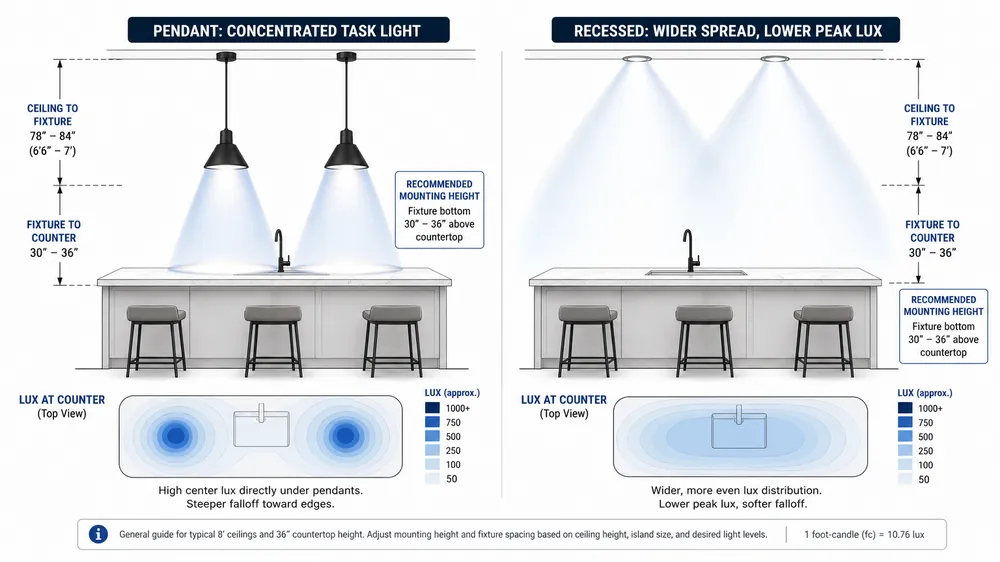
For pendant fixtures, the key variables are mounting height above the counter, lumen output, and beam angle. A pendant hung 30–36 inches above the counter surface — the standard residential spec — with a 15W LED source producing 1,200–1,500 lumens through a 60° beam angle will deliver roughly 300–500 lux at the center of the work surface directly below. That's well within the 300–500 lux range recommended for kitchen task lighting. The proximity is doing most of the work: the inverse square law means that halving the distance from source to surface roughly quadruples the illuminance. Pendants exploit this by getting the light source close to the work plane.
Recessed downlights work against that same physics. Installed in a standard 9 ft ceiling, a recessed fixture sits approximately 60–66 inches above the counter surface — roughly double the mounting height of a pendant. A 15W recessed downlight with 1,200 lumens and a 40° beam angle will deliver somewhere in the 150–250 lux range at counter center, depending on the exact ceiling height and fixture spacing. That's below the task lighting threshold for food preparation. To compensate, you either add more fixtures (typically 3–4 recessed cans over a 36-inch island versus 2 pendants) or specify higher-output sources — both of which increase cost and complexity.
The beam angle difference compounds this. Pendant shades with directional optics can focus output into a 30–60° cone aimed directly at the work surface. Most recessed downlights ship with 40–60° beam angles, but the ceiling-height penalty means that cone has spread significantly by the time it reaches the counter. The effective illuminated area is larger, but the lux density at any given point is lower.
(We run photometric testing on all pendant designs in our optical lab before production. The lux-at-counter numbers above are consistent with what we see on our own 15W pendant SKUs — the exact values shift with shade geometry and reflector design, but the directional advantage over recessed holds across configurations.)
Ceiling Height: The Threshold That Changes the Calculation
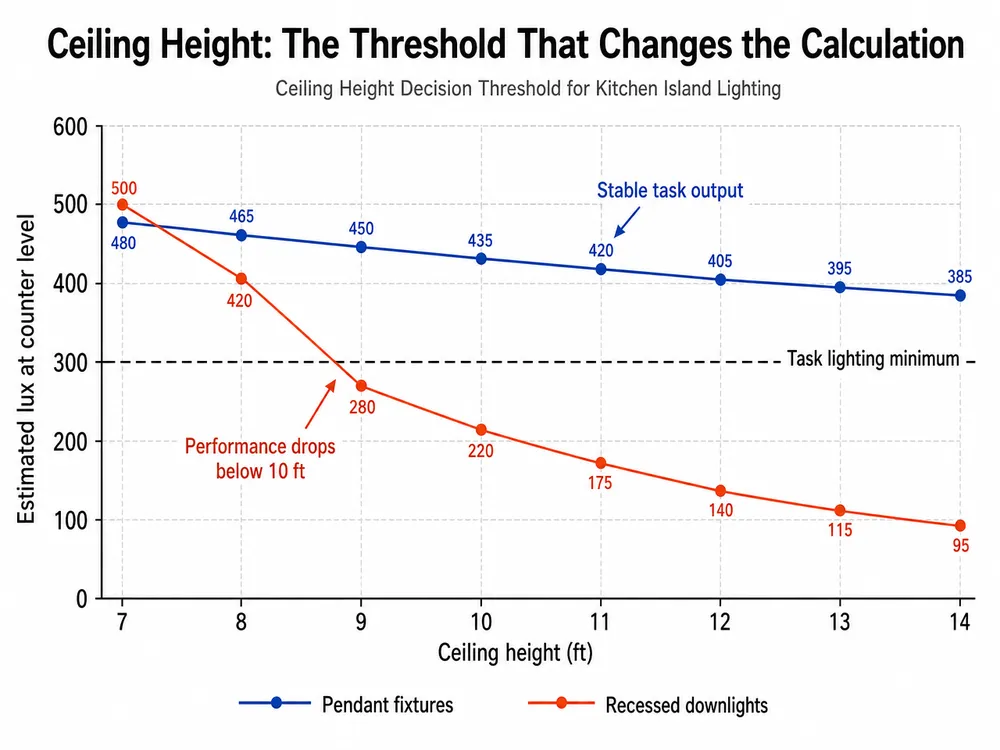
Ceiling height is the single variable that most often gets ignored in fixture selection, and it's the one that most directly determines whether recessed lighting can function as primary task illumination over an island.
The threshold we use internally: at ceiling heights below 9 ft, recessed downlights should not be specified as the primary task light source over a kitchen island. The physics don't support it. At 8 ft ceiling height, a recessed fixture sits 54–60 inches above the counter — the lux delivery drops further, and the beam spread at counter level is wide enough that you're providing ambient fill rather than task illumination. You'd need 4–5 fixtures over a standard island to approach adequate task lighting levels, and at that point you're dealing with glare, heat load, and a ceiling that looks like a grid.
Pendant fixtures don't have this constraint in the same way. The mounting height is controlled by cord or stem length, not by ceiling height. A 10 ft ceiling with a 48-inch pendant cord still puts the fixture 30–36 inches above the counter. The ceiling height affects the visual proportion of the installation, but not the photometric performance. This is why pendants dominate in residential and boutique hospitality applications where ceiling heights run 8–10 ft — they're the only fixture type that reliably delivers task-level illumination in that range without over-specifying the source wattage.
The calculus flips above 12 ft. At that height, pendant cord management becomes a real issue — long cords are harder to install cleanly, more vulnerable to air movement, and create a visual weight that can overwhelm the space. High-ceiling commercial kitchens and open-plan restaurant environments are where recessed or track-mounted downlights make more sense, often supplemented by under-cabinet lighting for the actual task zones.
Head-to-Head Specification Matrix
| Dimension | Pendant Fixtures | Recessed Downlights |
|---|---|---|
| Effective ceiling height range | 8–12 ft (optimal) | 10 ft+ for task lighting |
| Lux at counter (9 ft ceiling, 15W) | 300–500 lux | 150–250 lux |
| Beam angle (typical) | 30–60° (directional) | 40–60° (wide spread) |
| Fixtures needed over 36" island | 2–3 | 3–5 |
| Customization depth | High (housing, shade, finish, cord) | Low (trim ring, finish) |
| IES file availability | Available from manufacturer | Standard from most suppliers |
| Installation complexity | Medium (cord/stem, canopy) | Low (can, trim, driver) |
| Driver replacement access | Accessible at fixture | Requires ceiling access |
| Finish/SKU match across project | Full custom match possible | Limited to standard finishes |
| Certification coverage (ASC) | CE, UL, SAA | N/A (ASC pendant focus) |
| MOQ for custom spec | 50–200 units (housing-dependent) | Commodity — no custom |
The table above is a starting point. The dimensions that actually drive the sourcing decision depend on your project type — and that's where the scenarios below matter more than the matrix.
The Hidden Cost in Recessed Specifications
The spec sheet comparison makes recessed look cheaper. Lower per-unit cost, simpler installation, no cord management. The hidden cost shows up downstream.
The first place it shows up is in fixture count. If you're specifying recessed as primary task lighting over a kitchen island in a standard-ceiling residential or hospitality project, you need more fixtures to hit the same lux target. Three to five recessed cans versus two pendants — that's a 50–150% increase in fixture count, wiring runs, and installation labor. The per-unit cost advantage evaporates quickly.
The second place is in driver access. Recessed downlights embed the driver in the ceiling cavity. When a driver fails — and in hospitality environments with continuous operation, driver failures happen — replacement requires ceiling access, which means disruption to the space. Pendant fixtures hang the driver in the fixture body or canopy, accessible without touching the ceiling. For a hotel kitchen or restaurant that can't close for maintenance, that difference is real money.
The third place is in project specification lock-in. Recessed cans are commodity products. The finish options are limited, the trim ring geometry is standardized, and there's no meaningful customization available at the housing level. If your project spec calls for a specific brushed brass finish that matches the cabinet hardware, or a shade geometry that fits a particular design language, recessed can't deliver it. You're choosing from what's in the catalog. Pendant fixtures — at least from a manufacturer with in-house die-casting — can be specified to match the project exactly.
(We've had buyers come to us after committing to a recessed spec for a hospitality project, then discovering mid-project that the finish they needed wasn't available in the recessed format. The retrofit cost — re-specifying, re-ordering, re-installing — was significantly higher than the original pendant premium would have been.)
Application Scenarios: Which Fixture Wins Where
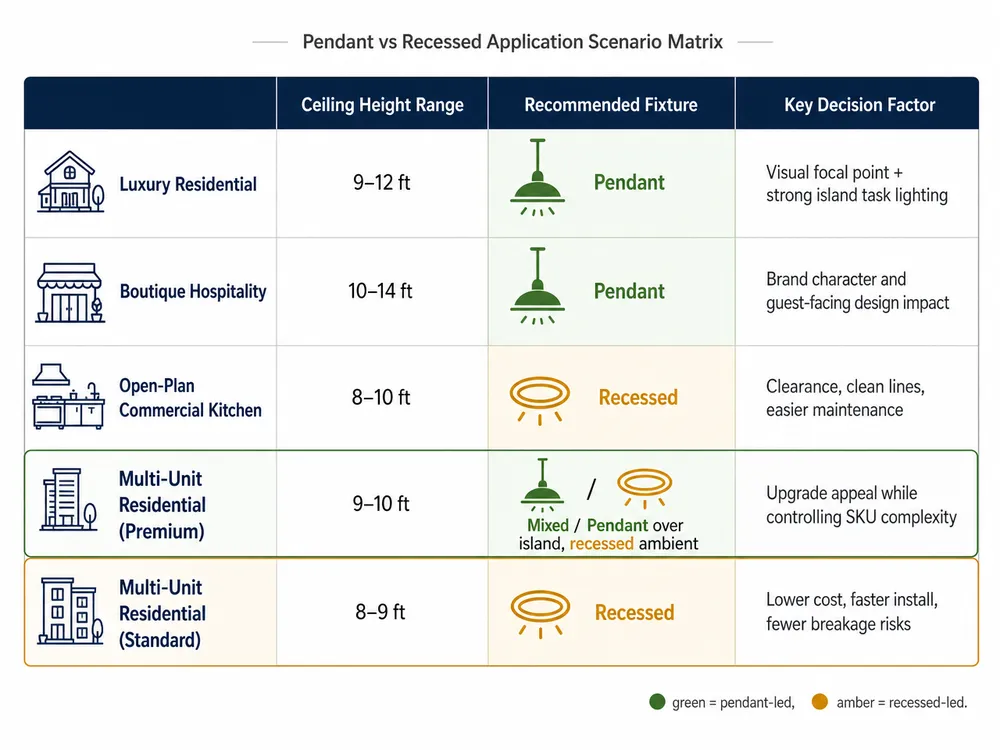
Luxury Residential and Villa Projects
Winner: Pendant fixtures.
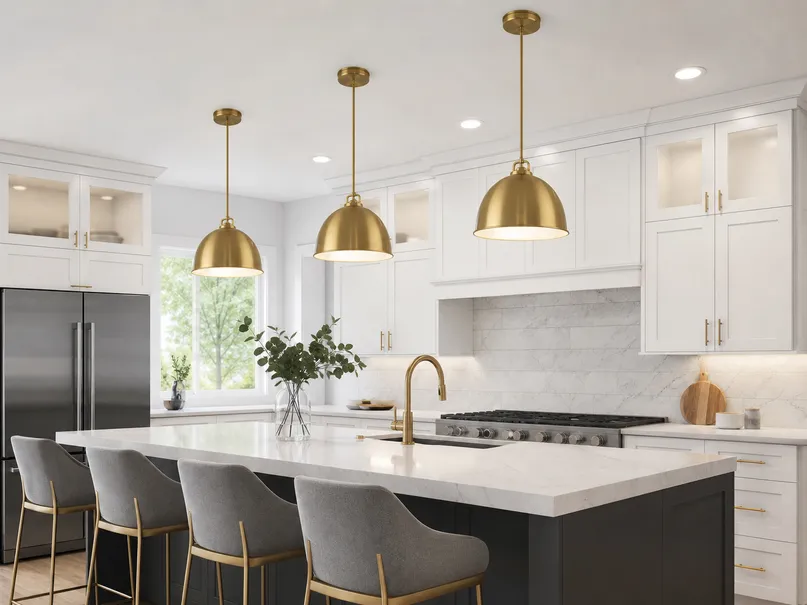
Standard ceiling heights of 9–10 ft, custom finish requirements, and design-forward specifications make this the natural pendant territory. Two or three pendants over a 36–48 inch island deliver task-level illumination, provide a visual anchor for the space, and can be specified in finishes that match the broader interior scheme. For buyers supplying luxury residential developers or high-end kitchen renovation contractors, pendant SKUs with custom finish options are the higher-margin, lower-substitution product. Recessed cans in this segment are a commodity race to the bottom.
Boutique Hospitality: Hotel Suites, Restaurant Private Dining, Serviced Apartments
Winner: Pendant fixtures, with driver reliability as the deciding factor.
Hospitality buyers have a different cost model than residential. Field failures are expensive — not just the replacement cost, but the service disruption and the brand impact. The 100% aging test before shipment matters here: every pendant driver burns in before the container loads, so early-life failures show up at the factory, not in a hotel suite at 11 PM. For buyers sourcing for hospitality rollouts, that reliability guarantee is worth more than the per-unit cost difference versus a commodity recessed fixture.
Certification coverage also matters in this segment. A pendant SKU with CE, UL, and SAA certification can be sourced for a hotel group's properties across North America, Europe, and Australia without re-certification work. That's a meaningful supply chain simplification for a buyer managing multi-market procurement.
Open-Plan Commercial Kitchens and Restaurant Back-of-House
Winner: Recessed downlights or track-mounted fixtures.
High ceilings (12 ft+), industrial aesthetic, and the need for uniform ambient coverage rather than decorative task lighting make this the recessed use case. Pendant cord management at commercial ceiling heights is a liability — cleaning, maintenance, and the physical environment of a working kitchen all argue against hanging fixtures. Recessed or track-mounted downlights with high-output sources and wide beam angles provide the uniform illumination these spaces need. This is not ASC's primary product territory, and we'd say so directly to a buyer asking us to spec this application.
Multi-Unit Residential Developments
Winner: Pendant fixtures for premium units; recessed for standard units.
The split depends on the unit tier. Premium units in a multi-unit development — where the developer is differentiating on finish quality and design — benefit from pendant fixtures that can be specified consistently across the project. Standard units where cost-per-door is the primary constraint are better served by recessed, where the commodity pricing and simple installation reduce the per-unit cost. For buyers supplying multi-unit developers, carrying both SKU types and understanding which tier each applies to is the right approach. The pendant line is where the margin is; the recessed line is where the volume is.
Sourcing Trade-offs: Pendant Customization Depth vs Recessed Standardization
This is the dimension that matters most for buyers building a product line or specifying for a project portfolio — and it's the one that consumer-facing content never covers.
Recessed downlights are a commodity category. The housing geometry is standardized around common rough-in sizes (4-inch, 6-inch). Finish options are limited to what the manufacturer catalogs. There's no meaningful customization available at the housing or optical level. If you're a distributor building a kitchen lighting line, recessed cans are easy to source from multiple suppliers, easy to compare on price, and easy to substitute. The downside is that they're also easy for your competitors to source and substitute. There's no differentiation available in the product itself.
Pendant fixtures are the opposite. The housing geometry, shade design, finish, cord length, canopy style, and light source configuration are all variables that can be specified. A manufacturer with in-house die-casting — which is what we run here — can produce a custom housing geometry from approved drawings in 7–10 working days for prototyping, and commit to consistent production across a 200-unit batch. That customization depth is what allows a distributor to build a pendant SKU that their competitors can't easily replicate, because the tooling and the spec are proprietary to their line.
The IES file question is worth addressing directly, because it comes up in commercial and hospitality project submittals. When a lighting designer or architect submits a fixture specification for a commercial project, they typically need an IES file — a photometric data file that describes the fixture's light distribution — to run lighting calculations and satisfy the submittal requirements. For recessed downlights, IES files are widely available from commodity suppliers. For custom pendant designs, the IES file has to come from the manufacturer's own photometric testing. We generate IES files from our optical lab for pendant designs we produce — this is what enables our buyers to submit custom pendant specifications for commercial and hospitality projects rather than being forced to substitute a catalog fixture.
(The IES file requirement catches buyers off guard more often than it should. If you're sourcing pendants for a hospitality project and your client's lighting designer needs a submittal package, ask your supplier upfront whether they can provide IES files from their own measurements. A supplier who can't generate their own IES data is relying on generic estimates, which won't pass a rigorous submittal review.)
Spec Decision Matrix: Matching Fixture Type to Project Parameters
Use this matrix to map your project parameters to the right fixture type before you write the RFQ.
| Project Parameter | Pendant | Recessed |
|---|---|---|
| Ceiling height | 8–12 ft | 10 ft+ |
| Island width | 24–60 in | 36 in+ |
| Project type | Residential, hospitality, boutique commercial | Open-plan commercial, standard multi-unit |
| Finish requirement | Custom or matched | Standard catalog |
| IES file required | Yes — specify manufacturer optical lab | Available from most suppliers |
| Driver access requirement | Easy (fixture body) | Ceiling access required |
| Certification market | Multi-market (CE/UL/SAA) | Single-market commodity |
| Customization need | High | None |
| Volume per SKU | 50–500 units | 100+ (commodity pricing) |
| Margin target | Higher (differentiated product) | Lower (commodity) |
The matrix points to pendant fixtures for the majority of residential and hospitality applications where ceiling height is standard and finish quality matters. Recessed wins in the narrow band of high-ceiling commercial applications where pendant cord management is a liability and uniform ambient coverage is the primary goal.
What to Verify When Sourcing Pendant Fixtures at Volume
The pendant category has more sourcing risk than recessed, because the customization depth means there are more variables that can go wrong between sample approval and production delivery.
Housing dimensional consistency: Die-cast housings need to hold consistent dimensions across a production batch. The canopy diameter, cord entry point, and shade mounting geometry all affect installation fit. Ask your supplier for their CNC tolerance spec on critical mounting dimensions — ±0.1mm is the standard for quality production; anything looser and your installation teams will encounter fit issues on-site. We hold ±0.1mm on critical dimensions across the batch, not just on the sample.
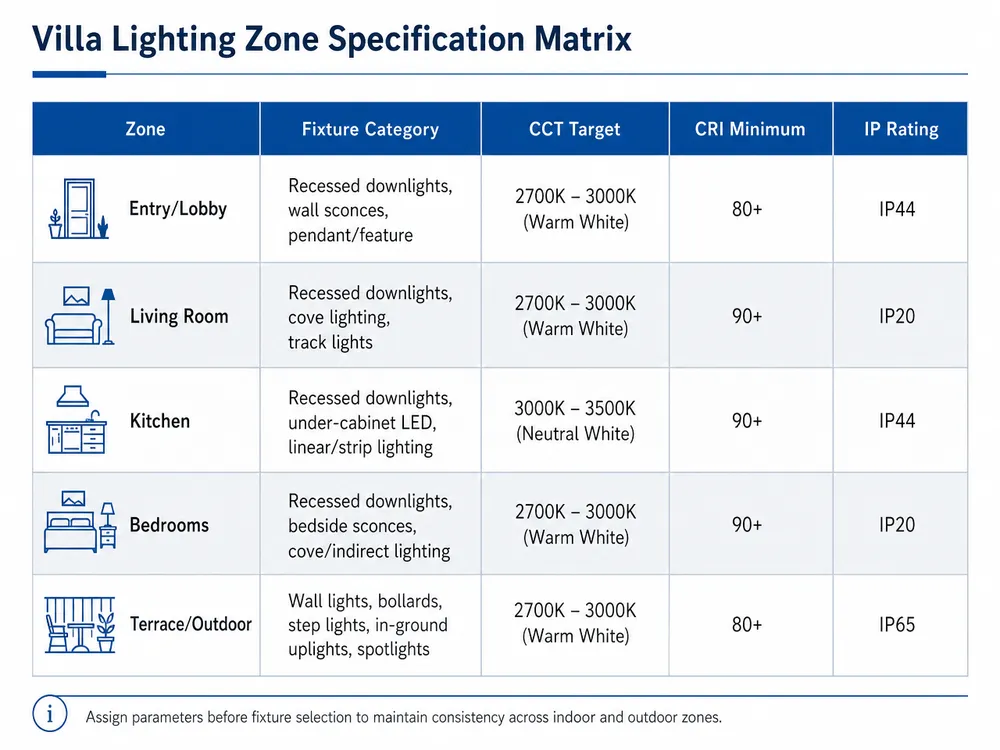
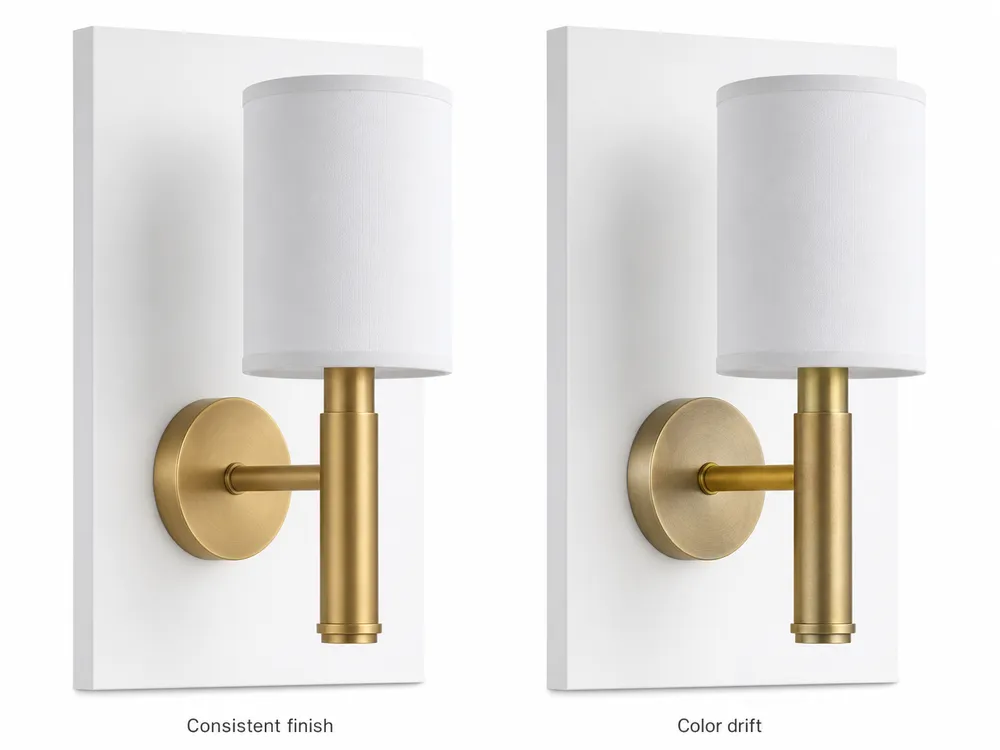
Finish batch consistency: Finish color and texture need to match across every unit in the order, not just match the approved sample. Powder coat thickness variation is the most common cause of color inconsistency — automated application at 60–80μm is the spec that prevents it. Ask for the application method and thickness spec, not just a color reference.
Driver specification and dimming compatibility: The driver spec needs to match the destination market's voltage requirements and the installation's dimming infrastructure. A pendant specified for a North American hospitality project needs a driver compatible with the dimmer switches already installed in the property — which may be TRIAC, 0-10V, or DALI depending on the property's control system. Confirm the driver spec before production, not after delivery.
Certification documentation: For multi-market sourcing, confirm that the certification covers the specific fixture configuration you're ordering, not just a generic product family. CE, UL, and SAA certifications are SKU-specific — a certified housing with a non-certified driver combination is not a certified fixture.
IES file delivery: If your project requires photometric submittals, confirm that the IES file will be generated from the actual production fixture configuration, not from a similar design. Optical performance varies with shade geometry and reflector design — the IES file needs to reflect the specific fixture you're ordering.
For a deeper look at how these specifications interact across a full kitchen lighting project, the Kitchen Lighting Specification Guide covers the full spec workflow from zone planning through fixture selection and documentation.
The Sourcing Decision in One Framework
The pendant vs recessed decision is not a style question. It's a specification question that determines your fixture count, your lux delivery, your customization options, and your downstream sourcing risk.
For standard residential and hospitality applications with 8–10 ft ceilings: pendant fixtures deliver better task illumination with fewer fixtures, offer meaningful customization depth for differentiated product lines, and carry the certification coverage needed for multi-market sourcing. The per-unit cost is higher; the total project cost — accounting for fixture count, installation labor, and driver access — is often comparable or lower.
For high-ceiling commercial applications where pendant cord management is a liability: recessed or track-mounted downlights are the right call. Don't force pendants into an application where the physics and the installation environment argue against them.
For buyers building a kitchen lighting line: the pendant category is where the margin and differentiation live. Recessed is a commodity line that fills out the catalog; pendant is the line that builds repeat business with buyers who need a supplier that can match their project specs across multiple orders.
The Kitchen Lighting category page covers the full fixture range we manufacture for kitchen applications, including pendant configurations, mounting options, and finish availability. For buyers working through a specific project spec, the How to Layer Kitchen Lighting for Island, Task, and Ambient Zones article covers the zone-by-zone specification logic that determines how pendant and recessed fixtures work together in a complete kitchen lighting plan.
If you're sourcing for a specific project or building a kitchen lighting line and need photometric data, IES files, or a custom pendant configuration, send your project parameters — island dimensions, ceiling height, target market, finish requirements, and annual volume — to our applications team. We'll return a matched fixture recommendation with photometric data and a detailed quote. See the Lighting Applications for Premium Projects section for the full range of application contexts we support.
Frequently Asked Questions
How many pendant lights do I need over a kitchen island?
For a 36-inch island, two pendants spaced 12–16 inches from each end of the island and centered on the work surface is the standard spec. For a 48–60 inch island, three pendants with equal spacing. The spacing rule is more important than the count: pendants should be centered over the work zones, not distributed evenly across the full island length. For project sourcing, plan fixture count based on island width in 12-inch increments — it simplifies the BOM and makes reorder quantities predictable.
What ceiling height is too low for recessed lighting over a kitchen island?
Below 9 ft, recessed downlights should not be specified as the primary task light source over an island. At 8 ft ceiling height, the fixture-to-counter distance is 54–60 inches, and the lux delivery at counter level from a standard 15W recessed downlight falls below the 300 lux task lighting threshold. You'd need 4–5 fixtures to compensate, which creates glare and heat load issues. Pendant fixtures are the correct specification for 8–9 ft ceilings.
What beam angle should I specify for kitchen island pendant lighting?
For task lighting over an island, 30–45° beam angle delivers the best lux concentration at counter level. Wider beam angles (60°+) provide more ambient fill but reduce the lux density at the work surface. If the pendant is the primary task light source, specify 30–45°. If the pendant is supplementing recessed ambient lighting, 60° is acceptable. For project submittals, confirm the beam angle from the manufacturer's IES file — catalog specs are often nominal values that don't reflect the actual optical output of the production fixture.
What is the difference between pendant lighting and recessed lighting for commercial kitchen projects?
For commercial kitchen project submittals, the key differences are IES file availability, certification requirements, and maintenance access. Pendant fixtures from a manufacturer with an in-house optical lab can provide IES files generated from actual photometric testing — required for lighting calculations in commercial submittals. Recessed downlights have IES files widely available from commodity suppliers. On maintenance: pendant drivers are accessible at the fixture body; recessed drivers require ceiling access, which is a real operational constraint in a working commercial kitchen. For certification, confirm that the fixture carries the certification required for your jurisdiction — CE for Europe, UL for North America, SAA for Australia.
What MOQ applies to custom pendant fixtures for kitchen island applications?
MOQ for custom pendant fixtures depends on whether new tooling is required. For existing housing geometries with custom finish or cord length specifications, MOQ typically runs 50–100 units per SKU. For new housing geometries requiring new die-casting tooling, MOQ runs 200+ units to amortize the tooling cost. Prototyping turnaround for new tooling is 7–10 working days from approved drawings to physical sample. For distributors building a kitchen lighting line, the practical approach is to start with existing housing geometries and custom finishes — lower MOQ, faster lead time, and the tooling investment is deferred until volume justifies it.