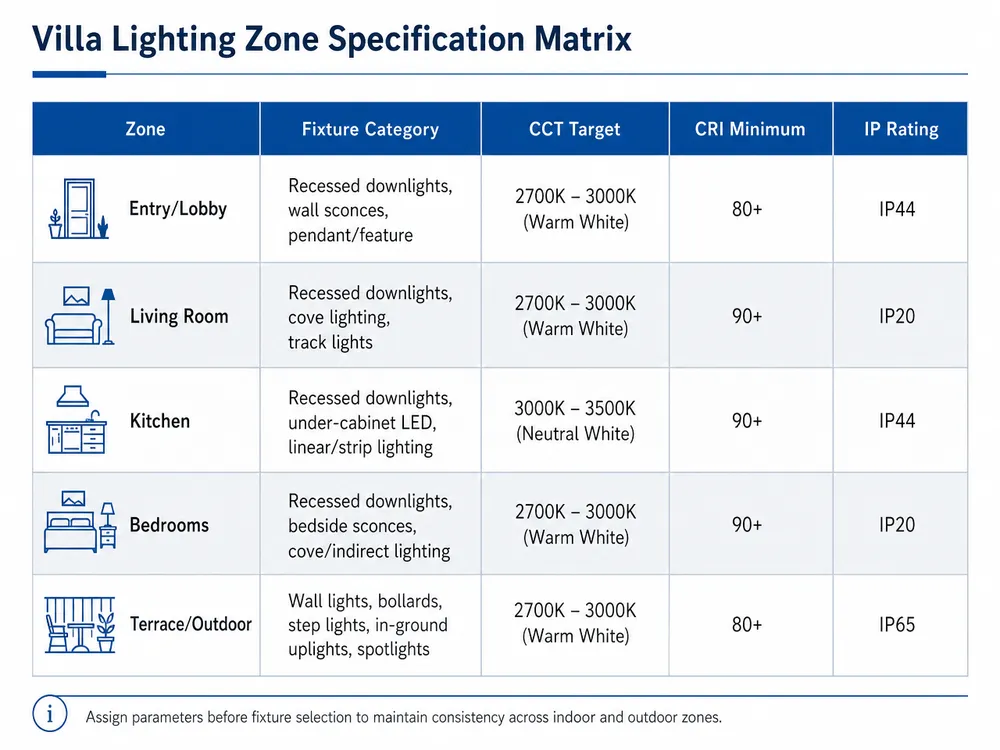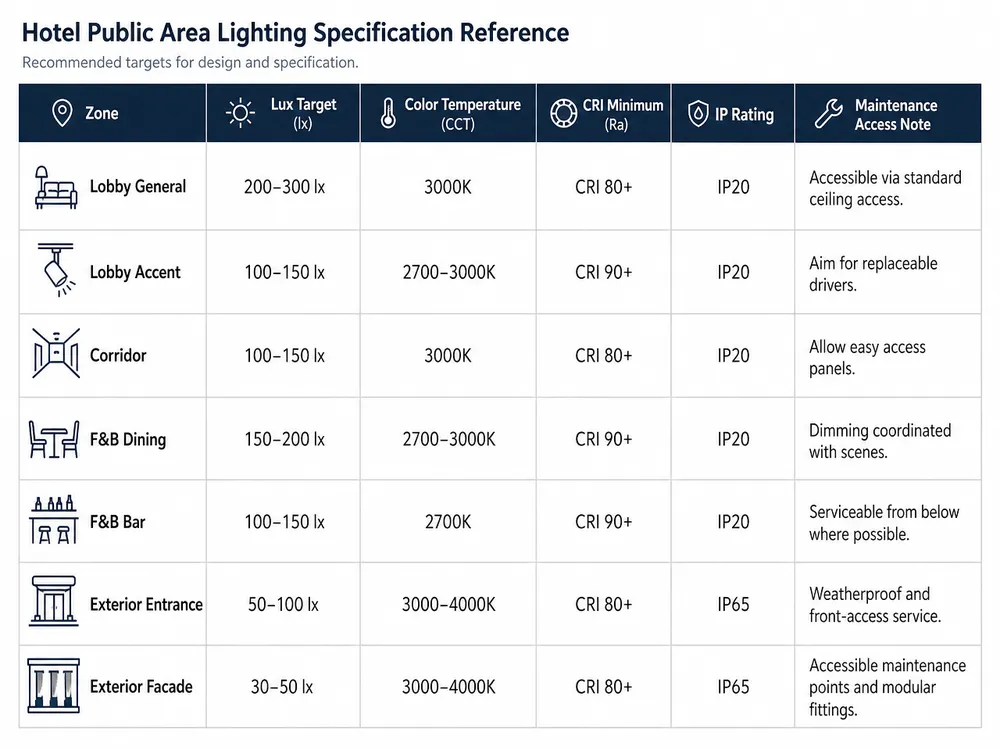

The UAE hospitality and residential fit-out market runs on a specific procurement logic: tight FF&E schedules, 5-star finish expectations, and compliance requirements that can stall a shipment at Jebel Ali if the documentation isn't right. Most buyers in this market end up sourcing through local distributors — not because it's the most cost-effective route, but because it's the most familiar one.
This review covers 10 manufacturers and supplier types actively serving UAE hotel and villa projects. The goal isn't a theatrical ranking — it's a sourcing framework that helps you understand what each supplier model actually delivers, where local distribution adds genuine value, and where factory-direct procurement improves your economics on repeat-volume orders.
We've shipped to the Gulf since our early years. The compliance requirements, the finish expectations, the documentation that UAE import teams actually ask for — we know this market from the production side. That perspective shapes how we've framed each entry below.
What UAE Hotel and Villa Projects Actually Demand from a Lighting Supplier
Before evaluating any supplier, it helps to be precise about what a UAE hospitality project requires — because the requirements are more specific than most generic supplier lists acknowledge.
ESMA and DEWA compliance: The Emirates Authority for Standardization and Metrology (ESMA) mandates energy efficiency standards for lighting products sold in the UAE. DEWA (Dubai Electricity and Water Authority) has its own requirements for electrical installations. CE certification is widely accepted as a baseline for import clearance, but buyers on government-linked projects or those supplying to developers with strict procurement policies should verify whether ESMA registration is required for their specific fixture categories. (In practice, most of our UAE buyers clear customs on CE documentation — but if your project has a government client or a developer with a strict compliance brief, ask the question early rather than at the port.)
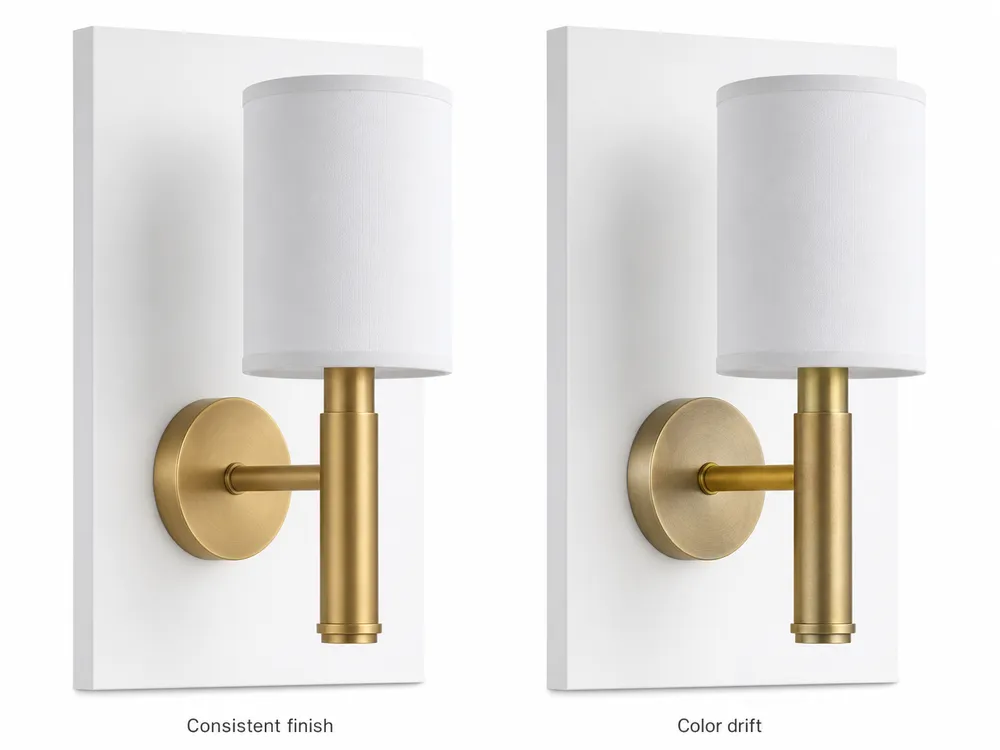
Finish consistency across multi-room batches: A 200-room hotel order isn't 200 individual purchases — it's one batch that needs to look identical across every room. Brushed gold that drifts between production runs, or matte black with inconsistent texture, creates visible problems during handover inspection. This is where the distinction between a factory with in-house surface finishing and an assembly operation sourcing pre-finished components becomes commercially significant.
OEM and custom capability: UAE 5-star projects frequently involve branded environments where standard catalog fixtures don't fit the interior design brief. The ability to modify a fixture's finish, dimensions, or shade material — and to prototype it within a timeline that fits the FF&E schedule — separates manufacturers from trading companies.
Documentation for import clearance: UAE customs requires a full documentation package: CE Declaration of Conformity, test reports, packing lists, and commercial invoices with correct HS codes. Suppliers who hold certifications through third-party agents rather than in-house often struggle to produce the specific test reports that UAE import teams request.
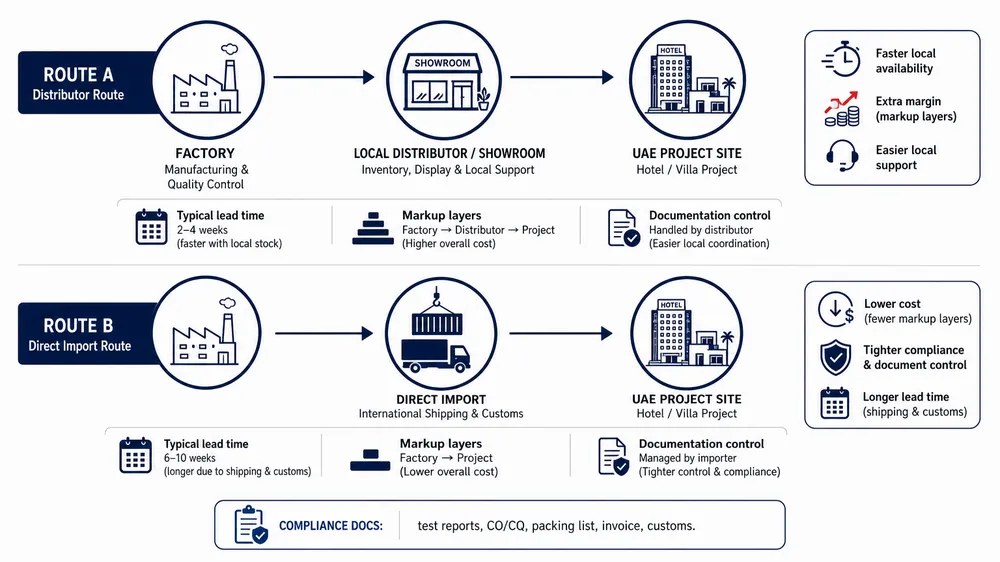
Lead time to Dubai port: Standard ocean freight from Guangdong to Jebel Ali runs 18–22 days. Add production lead time and you're looking at 45–55 days total for a factory-direct order. That's workable for planned procurement — it's not workable for emergency replacements. Local distributors earn their margin on urgency.
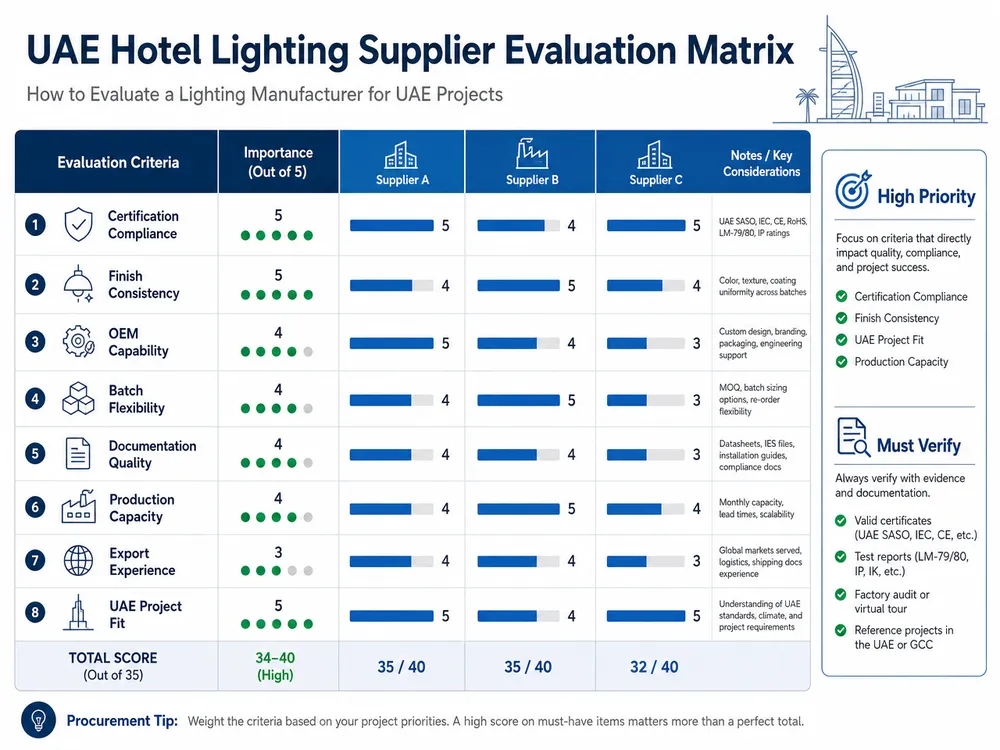
How to Evaluate a Lighting Manufacturer for UAE Projects
The evaluation criteria that matter for UAE hospitality sourcing are different from what you'd apply to a commodity purchase. Here's the framework we'd use:
| Criterion | What to Verify | Why It Matters for UAE Projects |
|---|---|---|
| Certification type | CE held in-house vs. via agent | In-house certs come with full test reports; agent certs often don't |
| Surface finishing | In-house vs. outsourced | In-house = batch consistency; outsourced = finish drift risk |
| OEM capability | Prototype turnaround time | FF&E schedules don't wait for 30-day sample cycles |
| Batch size flexibility | MOQ and mid-project reorder policy | Hotels need replacement stock; rigid MOQs create problems |
| Documentation package | DoC, test reports, HS codes | UAE customs clearance requires complete documentation |
| Production capacity | Annual output, number of lines | Large hotel orders need dedicated line allocation |
| Export experience | Middle East references | Gulf logistics and compliance have specific requirements |
The 10 Manufacturers and Supplier Types in This Market
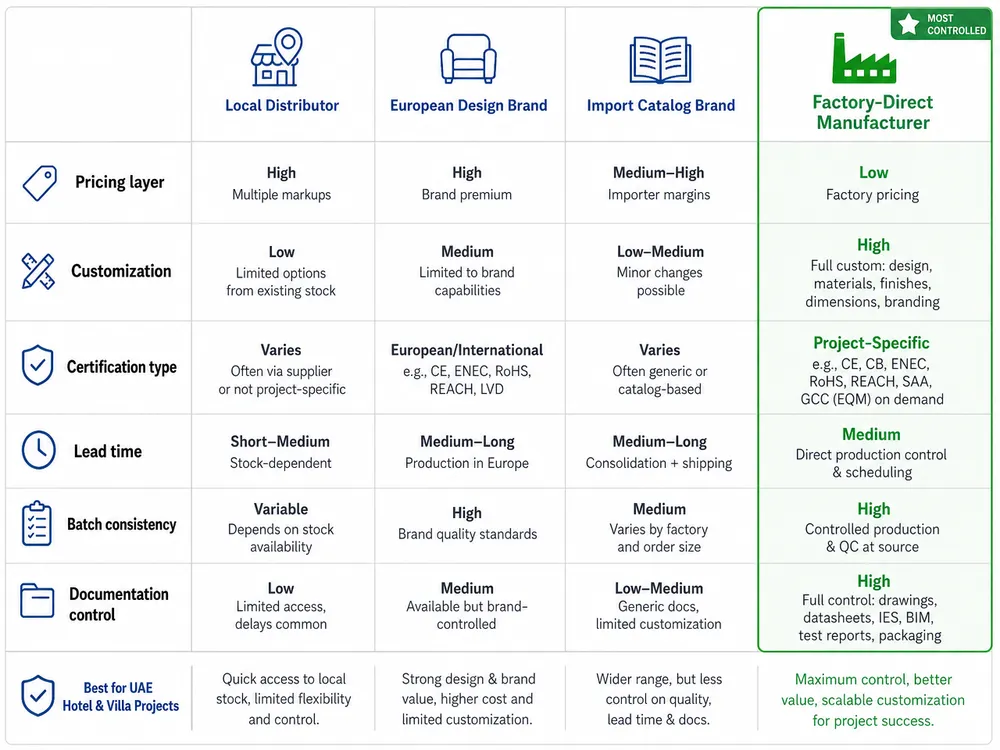
The UAE lighting supply landscape for hotel and villa projects breaks into four distinct supplier models. Understanding which model you're dealing with is more useful than any numbered ranking.
1. Philips Lighting (Signify) — Global OEM, Local Distribution Network
Website: www.signify.com
Signify (formerly Philips Lighting) operates through a regional distribution network in the UAE, with local partners handling stock and project sales. For commercial and hospitality applications, their portfolio covers architectural downlights, track systems, and connected lighting infrastructure. The brand carries strong recognition with UAE developers and consultants, which simplifies specification approval on projects where the client has brand preferences.
The trade-off: you're buying through a distributor, not the factory. Pricing reflects that layer, and customization for branded hotel environments isn't available through the standard channel. For large decorative fixture requirements — chandeliers, statement pendants, custom wall sconces — Signify's portfolio doesn't cover the decorative segment that most UAE 5-star projects require.
Best fit: Architectural and functional lighting where brand specification is required by the developer or consultant.
2. Osram — Technical Lighting, Regional Distributor Model
Website: www.osram.com
Osram's UAE presence operates similarly to Signify — regional distributors handling project sales and stock. Their strength is in technical and professional lighting: high-output downlights, track systems, and driver components. For hospitality projects with complex dimming requirements or high-specification technical zones (ballrooms, conference facilities), Osram's driver and control ecosystem is well-regarded.
Decorative fixture coverage is limited. Like Signify, the distributor model adds a margin layer that becomes significant on large-volume orders, and custom finish or OEM capability isn't available through the regional channel.
Best fit: Technical lighting zones in hospitality projects where dimming infrastructure and driver compatibility are the primary specification concerns.
3. Flos — European Design Brand, UAE Distributor
Website: www.flos.com
Flos operates in the UAE through authorized distributors and is specified on premium residential and boutique hospitality projects where the design brief calls for recognizable European design credentials. Their fixtures carry strong design identity and are frequently specified by international interior design firms working on UAE villa and boutique hotel projects.
The economics are straightforward: Flos fixtures carry European manufacturing costs plus distributor margin, which positions them at the top of the price range. For projects where the design specification is non-negotiable and the client is paying for the brand, that's the right call. For projects where the design brief can be met with a custom-manufactured alternative, the cost differential is substantial — particularly on multi-room hotel orders where the per-unit price multiplies across hundreds of fixtures.
Best fit: Boutique hospitality and high-end residential projects where European design brand specification is part of the project brief.
4. Artemide — Italian Design, Selective UAE Distribution
Website: www.artemide.com
Artemide's UAE distribution is selective — fewer stockists than Flos, with availability concentrated in Dubai's premium design showrooms. Their product range covers both architectural and decorative applications, and the brand is well-positioned for projects targeting a design-forward specification. Lead times on non-stocked items can extend significantly, which creates risk on projects with tight FF&E schedules.
Best fit: Design-led residential and boutique hospitality projects where Artemide's specific design language is part of the brief and lead time flexibility exists.
5. Eglo — Austrian Brand, Broad UAE Distribution
Website: www.eglo.com
Eglo operates a broader distribution footprint in the UAE than the premium European brands, with product available through multiple lighting showrooms and trade channels. Their range covers residential and light commercial applications at mid-market price points. For villa projects with standard specification requirements and no custom finish needs, Eglo's local availability and accessible pricing make them a practical option.
The ceiling on Eglo's suitability for 5-star hospitality is the product range itself — their catalog is designed for standard residential and light commercial use, not for the custom finish and specification requirements of premium hotel fit-outs.
Best fit: Mid-market villa projects and residential developments where standard catalog fixtures meet the specification and local availability is a priority.
6. Lutron Electronics — Lighting Control Systems, UAE Project Presence
Website: www.lutron.com
Lutron is a control systems specialist rather than a fixture manufacturer, but they're relevant to any UAE hotel lighting discussion because their dimming and control infrastructure is specified on a significant proportion of premium hospitality projects in the region. If your fixture procurement needs to integrate with a Lutron system, driver compatibility is a specification requirement — not an afterthought. We've had UAE buyers come to us specifically asking for fixtures pre-configured for Lutron compatibility, and it's a straightforward specification if you raise it at the sourcing stage.
Best fit: Any premium hospitality project where Lutron control systems are specified — relevant as a compatibility requirement for fixture sourcing, not as a fixture supplier itself.
7. Kichler Lighting — North American Brand, UAE Market Presence
Website: www.kichler.com
Kichler is a large North American decorative lighting manufacturer with a broad catalog covering residential and light commercial applications. Their product range includes chandeliers, pendants, and wall sconces that overlap with UAE villa project requirements. UAE availability is through import channels rather than local stock, which means lead times are longer than locally-stocked options.
For buyers already importing from North America or familiar with the brand from other markets, Kichler offers a wide decorative range with UL certification. The catalog depth is a genuine advantage for villa projects with varied fixture requirements across multiple room types.
Best fit: Villa projects where a wide decorative catalog is needed and the buyer has existing import infrastructure or North American market familiarity.
8. Feiss (Generation Brands) — Decorative Lighting, Import Channel
Website: www.generationbrands.com
Feiss, now part of Generation Brands, covers the decorative residential segment with a catalog that includes chandeliers, pendants, and bath fixtures. Like Kichler, UAE availability is through import rather than local stock. The brand is well-established in North American residential markets and carries UL certification across its range.
For UAE villa projects where the design brief calls for a traditional or transitional decorative aesthetic, Feiss's catalog covers that segment well. The import-only availability means planning lead times carefully.
Best fit: Residential villa projects with traditional or transitional design briefs and buyers comfortable with import procurement timelines.
9. Maxim Lighting — Decorative Manufacturer, Import Channel
Website: www.maximlighting.com
Maxim Lighting is a US-based decorative lighting manufacturer with a broad catalog spanning contemporary, transitional, and traditional styles. Their range covers chandeliers, pendants, wall sconces, and outdoor fixtures — relevant for UAE villa projects that need a consistent decorative language across interior and exterior zones. UL certification is standard across the range.
The import-only model applies here as well. For buyers sourcing a full villa fit-out from a single decorative catalog, Maxim's range depth is an advantage. For hotel-scale orders where batch consistency and custom finish capability matter, the standard catalog model has limitations.
Best fit: Villa fit-outs requiring a wide decorative catalog with consistent design language across multiple fixture types.
10. ASCLighting (Zhongshan ASC Lighting Technology Co., Ltd.) — Factory-Direct Manufacturer
Website: www.asclighting.com
This is where the sourcing logic shifts. The nine suppliers above are either brands sold through UAE distributors or import-channel catalog brands. ASCLighting is a factory — 12,000 m², six production lines, 600,000 luminaires per year, operating since 2008 out of Guzhen, Zhongshan. We manufacture; we don't distribute.
The distinction matters for UAE hotel and villa projects in specific, measurable ways. We'll cover them in the section below.

The Cost of the Distributor Layer on UAE Hotel-Scale Orders
Local distributors earn their place in the supply chain. For urgent small orders, emergency replacements, or projects where the client has specified a brand by name, the distributor model is the right answer. Speed and local inventory access have real value — we're not dismissing that.
The economics shift when you're looking at a 200-room hotel order or a 50-villa development. At that scale, the distributor margin — typically 30–50% above factory price on decorative fixtures — becomes a significant line item. On a 500-unit chandelier order at AED 800 per unit through a distributor, the margin layer alone can represent AED 80,000–200,000 that stays in the distribution channel rather than in your project budget or your margin.
Factory-direct procurement at that volume doesn't just save on unit price. It gives you direct control over the specification — finish, dimensions, driver configuration, packaging — without paying for catalog items that are close but not exactly right. For a 5-star hotel where the interior designer has specified a particular brushed bronze finish that doesn't exist in any distributor's catalog, the choice between "close enough from stock" and "exactly right from the factory" is a project quality decision, not just a cost decision.
The honest trade-off: factory-direct requires planning. A 25–35 day production lead time plus 18–22 days ocean freight means you need to be in the procurement process 55–60 days before your installation date. If your FF&E schedule has that runway, the economics favor factory-direct at volumes above roughly 100–150 units per fixture type. Below that threshold, or when urgency overrides cost, local distribution makes sense.
ASCLighting's Factory-Direct Profile for UAE Projects
We've been shipping to the Gulf since 2008. The Middle East was one of our first export markets, and the compliance and logistics requirements of UAE projects shaped how we built the factory's documentation and QC infrastructure.
Certifications held in-house: CE, UL, SAA, and SGS — all held and maintained by our own compliance team, not managed through a third-party certification agent. That distinction matters when your UAE import team asks for the actual test reports behind the CE mark. We can produce them because we ran the tests. (We've seen situations where buyers received CE-marked fixtures from trading companies that couldn't produce the underlying test documentation when UAE customs asked for it. That's a clearance problem that costs time and money to resolve.)
In-house surface finishing for batch consistency: The finishing line handles electroplating, powder coating, and PVD under the same roof as die-casting and assembly. Powder coat thickness runs 60–80μm with automated application across the full batch. For a 200-room hotel order, every fixture in the batch goes through the same finishing process on the same line — no variation from outsourced finishing suppliers. We run salt spray testing on finish samples before committing a batch to production, which matters for UAE coastal projects in Abu Dhabi and Ras Al Khaimah.
100% aging test before shipment: Every luminaire runs powered through a burn-in period before packing. LED driver failures and wiring faults show up in our facility, not during your hotel handover inspection. We added this protocol after a batch of LED drivers failed in the field for a Gulf distributor early in our export history — it was an expensive lesson, and it's been non-negotiable since. For a hotel project where a failed fixture during handover means a delay in room sign-off, that pre-shipment test is worth more than its cost.
OEM and custom capability: The R&D team runs 15 lighting engineers with an in-house optical lab. Prototype turnaround is 7–10 working days from approved drawings to physical sample — a functional sample with provisional surface finishing and driver integration, not a mock-up. For UAE interior designers working to tight FF&E schedules, that turnaround supports the design iteration cycle without blowing the project timeline. We've developed custom chandeliers, modified pendant dimensions, and matched proprietary finishes for branded hotel environments across the Gulf. If you're bringing a design concept rather than finished drawings, our structural engineers work from reference images and target cost to develop the production-ready design.
Documentation package for UAE import clearance: CE Declaration of Conformity, test reports, packing lists with correct HS codes, and material safety data are maintained per SKU and provided as standard with every order. We've cleared enough containers through Jebel Ali to know what UAE customs actually asks for, and we prepare the documentation accordingly.
Lead time to Dubai port: Production runs 25–35 days from order confirmation on standard items. Ocean freight from Guangdong to Jebel Ali adds 18–22 days. For OEM orders requiring new tooling, add 15–20 days for the tooling cycle. We communicate lead time milestones proactively — if a production issue is going to affect your ship date, you hear about it before the container is supposed to load.
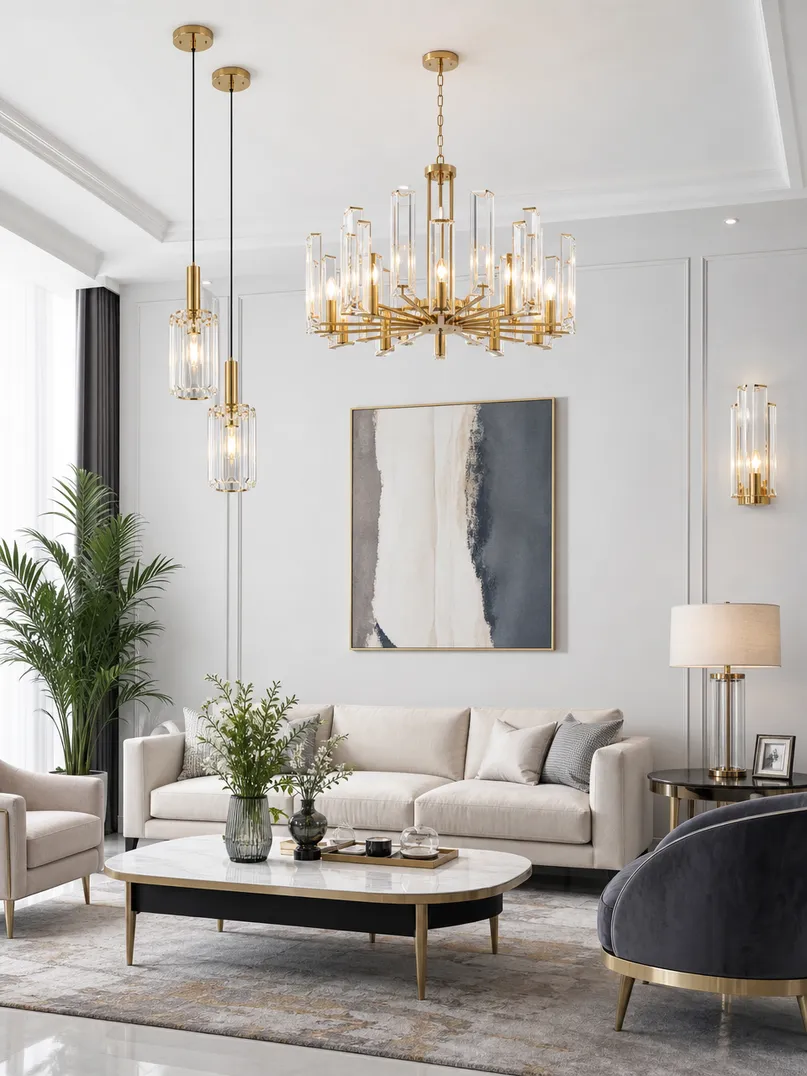
For hotel lighting for hospitality projects and villa lighting solutions, the factory-direct route through ASCLighting covers the full decorative and architectural spectrum: pendant lighting, chandeliers, wall sconces, ceiling fixtures, spotlights, and track lighting.
When Local Supply Is the Right Answer
A credible sourcing review has to be honest about this. There are scenarios where local distribution is the better choice, and forcing a factory-direct procurement into those scenarios creates problems.
Urgent small orders: If you need 20 replacement fixtures for a hotel room that's been damaged and needs to reopen in two weeks, a local distributor with stock is the only viable option. Factory-direct lead times don't compress to fit emergency timelines.
Projects with brand-specified fixtures: If the developer or consultant has specified Flos, Artemide, or another brand by name in the project documentation, that specification needs to be met or formally changed. A factory-direct alternative requires a specification substitution process that may not be feasible on the project timeline.
Small villa projects with standard requirements: For a single villa with standard decorative requirements and no custom finish needs, the MOQ and planning requirements of factory-direct procurement may not be justified. Local distributor stock at a modest premium is often the practical choice.
Compliance timing uncertainty: If you're not certain whether ESMA registration is required for your specific fixture categories on a particular project, resolving that question before committing to a factory-direct order is the right sequence. Local distributors who have already cleared their products through UAE compliance channels remove that uncertainty.
The factory-direct model earns its economics on repeat-volume procurement, planned project timelines, and orders where custom specification is required. Outside those conditions, local supply has genuine advantages.
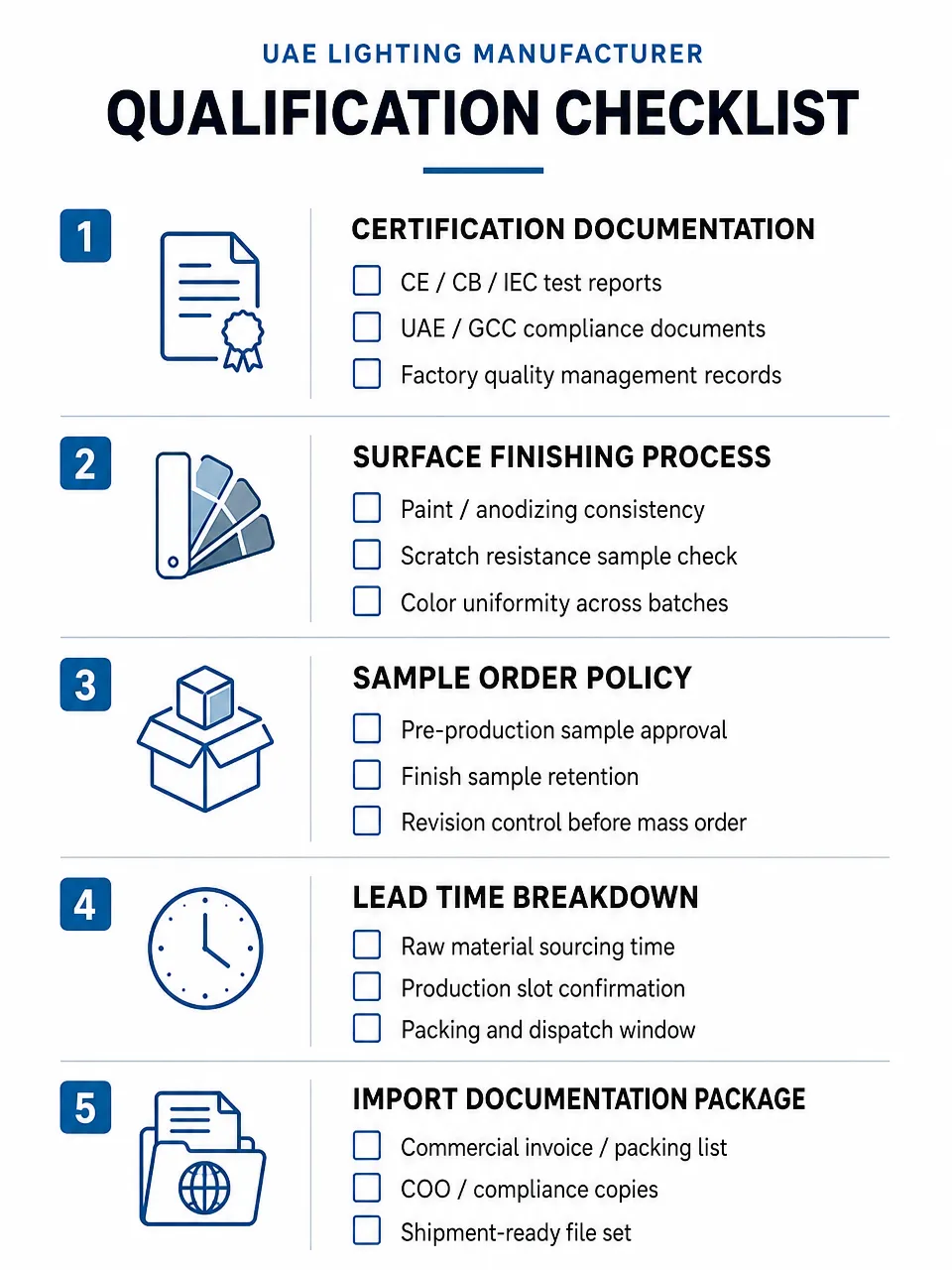
Qualifying a Lighting Manufacturer for a UAE Hotel Fit-Out: Red Flags and Verification Steps
The supplier landscape for UAE projects includes a significant number of trading companies presenting as manufacturers. The distinction matters because a trading company can't control batch consistency, can't produce the underlying test documentation behind a CE mark, and can't modify a specification without going back to their own supplier — adding time and uncertainty to your procurement cycle.
Red flags to watch for:
- CE certification without the ability to produce the underlying test reports on request
- No in-house surface finishing — all finishing outsourced to third-party suppliers
- Prototype turnaround quoted at 30+ days (suggests no in-house tooling or engineering)
- No photometric data or IES files available for project submissions
- Vague answers about production capacity and line allocation for your order
- No references for UAE or Gulf projects specifically
Verification steps before committing:
- Request the CE Declaration of Conformity and the underlying test report for the specific fixture type you're sourcing. A manufacturer with in-house certification can produce this within 24 hours. A trading company often can't.
- Ask for the factory's surface finishing process — specifically whether it's in-house or outsourced, and what thickness tolerance they hold on powder coat. A specific answer (e.g., 60–80μm automated application) indicates a real manufacturing operation. A vague answer indicates assembly.
- Request a sample order before committing to the full project volume. For a 200-room hotel order, a 5-unit sample that goes through your own inspection is worth the lead time investment.
- Ask for the production lead time broken down by stage: tooling (if applicable), production, QC, and packing. A factory that can give you a stage-by-stage breakdown is running a real production operation. One that quotes a single number without breakdown is likely a trading company.
- Confirm the documentation package: DoC, test reports, packing list format, and HS code assignment. UAE customs clearance requires all of these, and gaps in the documentation package create delays at Jebel Ali.
Sourcing Route Decision Guide for UAE Projects
The right sourcing route depends on your order profile, timeline, and specification requirements. Here's how to frame the decision:
Choose local distribution when:
- Order volume is below 50 units per fixture type
- Timeline is under 30 days to installation
- The specification calls for a named brand
- ESMA compliance status is uncertain and needs to be resolved quickly
Choose factory-direct import when:
- Order volume exceeds 100–150 units per fixture type
- The project timeline has 55–60 days of procurement runway
- Custom finish, dimensions, or OEM specification is required
- Batch consistency across multi-room orders is a project quality requirement
- You need full certification documentation for UAE import clearance
- The project is the first in a repeat procurement relationship (hotel chain rollout, villa development program)
For mixed projects — a hotel where the architectural lighting is specified by brand and the decorative fixtures are custom — a split sourcing strategy often makes sense. Brand-specified technical fixtures through local distribution; custom decorative fixtures factory-direct.
The lighting applications overview covers the full range of project types we supply, from hotel public areas to villa exterior zones.
FAQ: UAE Hotel and Villa Lighting Procurement
Does CE certification satisfy UAE customs requirements for decorative lighting?
CE certification is the most widely accepted compliance basis for lighting imports into the UAE and is sufficient for customs clearance in most commercial and residential applications. For projects with government clients or developers operating under specific procurement policies, ESMA registration may be required for certain product categories. The practical approach: confirm with your UAE import agent whether ESMA registration applies to your specific fixture types before the order is placed, not after the container arrives at Jebel Ali.
What's the minimum order quantity for a factory-direct hotel lighting order?
MOQ varies by fixture type and whether the order involves standard catalog items or custom specification. For standard catalog fixtures, MOQ typically starts at 50–100 units per SKU. For OEM or custom finish orders, the economics of tooling and finishing line setup generally require 100+ units per SKU to be viable. Below those thresholds, local distributor stock is usually the more practical route — the per-unit cost savings from factory-direct don't offset the fixed costs of a small custom run.
How do I ensure finish consistency across a 200-room hotel order?
Finish consistency on large hotel orders requires two things from your supplier: in-house surface finishing (not outsourced) and a single production run for the full batch. Outsourced finishing introduces variation because different batches go through different facilities with different process parameters. A single production run on an in-house finishing line, with automated application and thickness verification, is the only reliable way to ensure that room 201 looks identical to room 1. Ask your supplier directly: is your surface finishing in-house or outsourced? If they can't answer that question specifically, treat it as a red flag.
What documentation does a UAE hotel lighting import require?
Standard UAE customs clearance for lighting imports requires: CE Declaration of Conformity, underlying test reports (not just the certificate), commercial invoice with correct HS codes, packing list, and bill of lading. For projects with ESMA-registered products, the ESMA registration certificate is also required. Gaps in any of these documents can result in customs holds at Jebel Ali — which on a hotel project with a fixed handover date is a serious risk. Verify the documentation package with your supplier before the order is placed, not when the container is already at port.
Can a factory-direct supplier match a finish specified by a UAE interior designer?
Yes, with the right factory. Custom finish matching requires in-house surface finishing capability and a supplier willing to run a finish sample for approval before committing the full batch to production. The process typically involves: designer provides a physical reference sample or Pantone/RAL reference, factory produces a finish sample on the actual fixture substrate, designer approves or requests adjustment, then full batch production proceeds. Turnaround on finish samples runs 5–7 working days at our facility. The key constraint is MOQ — custom finish matching on runs below 50–100 units per SKU is generally not economical.